


 Top Rated Course

We may not have the course you’re looking for. If you enquire or give us a call on 01344203999 and speak to our training experts, we may still be able to help with your training requirements.
Lean Six Sigma on Resume: How to Highlight Your Certification
James Smith 31 August 2026Learn how to present Lean Six Sigma on your resume, from listing your certification and relevant experience to highlighting measurable achievements and career benefits that can strengthen your professional profile.

Training Outcomes Within Your Budget!
We ensure quality, budget-alignment, and timely delivery by our expert instructors.
Table of Contents
Key Takeaways
1) Lean Six Sigma can demonstrate structured process improvement and problem-solving capability.2) The way you present the certification on your resume matters as much as the qualification itself.3) Relevant projects, achievements and measurable results can make the certification more meaningful.4) Lean Six Sigma can support applications for quality, operations, process improvement and related roles.5) A well-presented certification can complement your existing experience and support career progression.
You may have completed a Lean Six Sigma Certification, but simply adding “Lean Six Sigma Certified” to your resume does not show an employer how that knowledge relates to your work.
The real value comes from connecting the certification with relevant experience, projects and measurable results. In this blog, we'll explore what Lean Six Sigma is, how to present it on your resume, the career benefits it can support and the common mistakes to avoid.
What is Lean Six Sigma?
Lean Six Sigma is a process improvement methodology that combines the principles of Lean and Six Sigma. Lean focuses on reducing waste and improving efficiency, while Six Sigma aims to minimise errors, defects and process variation. Together, they help organisations streamline operations, improve quality, reduce costs and deliver greater value to customers through a structured, data-driven approach.
When Should You Include Lean Six Sigma on Your Resume?
Lean Six Sigma is most useful on a resume when it is relevant to the role you are targeting and supported by genuine knowledge or experience.
Consider including it when:
1) The Job Mentions Process Improvement: Roles involving quality, operations, efficiency or continuous improvement may value Lean Six Sigma knowledge.
2) You Hold a Recognised Certification: Listing the full certification title and provider can give recruiters clearer information about your qualification.
3) You Have Applied the Methods: Projects involving process mapping, root-cause analysis, DMAIC or waste reduction can help demonstrate practical relevance.
4) You Can Show Measurable Outcomes: Evidence such as reduced cycle time, fewer defects or improved efficiency can make the qualification more meaningful.
5) It Supports Your Career Direction: Lean Six Sigma can be relevant when moving towards roles in quality, operations, process improvement, business analysis or related areas.
Interactive: Which Resume Profile is Stronger?Profile A:“Experienced professional with Lean Six Sigma certification.”Profile B:“Operations professional with Lean Six Sigma Green Belt certification and experience supporting process improvement initiatives.”Which one gives the employer more context?The stronger statement connects the certification with the candidate's professional background.
Common Lean Six Sigma Certification Levels
Lean Six Sigma certifications are often organised into Belt levels, but the names, requirements, experience expectations and progression routes vary between certification providers. Common levels include:
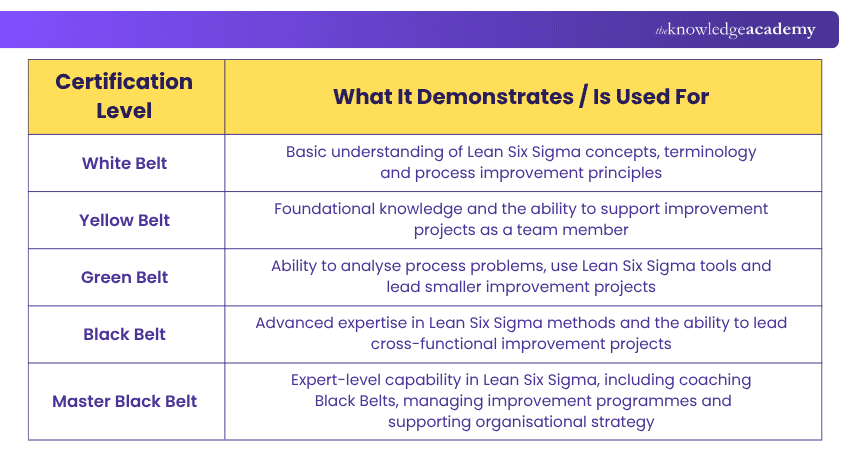
Important: Certification levels and requirements are not universal. Always check the specific certification body when listing a Lean Six Sigma qualification on your resume.
Take the next step in process improvement with the Lean Six Sigma Green Belt Training - Sign up today!
How to Add Lean Six Sigma to Your Resume?
Once you have the certification, the next step is presenting it in a way that shows its relevance rather than simply adding another qualification to your resume.
1) Mention Your Certification
You can include Lean Six Sigma in different sections depending on your experience and the role you are targeting.
a) Certifications: List the full certification name, certification provider and, where relevant, the year.
b) Professional Summary: Mention it when it directly supports your professional profile or the requirements of the position.
c) Skills: Include relevant Lean Six Sigma knowledge alongside other role-specific skills.
d) Relevant Experience: If you have applied Lean Six Sigma methods to a project or process, explain what you did and what changed.
Keep the certification entry clear and professional.
For Example:
Lean Six Sigma Green Belt | [Certifying Organisation] | 2026
If your certification has a credential number, expiry date or other information that the awarding organisation recommends displaying, include it where appropriate.
2) Showcase Lean Six Sigma Experience
Avoid relying only on statements such as:
Lean Six Sigma certified professional.
Instead, explain how you applied the knowledge.
For Example:
“Supported a process improvement initiative that identified workflow bottlenecks and reduced processing delays.”
If you led a specific project, describe your responsibility and the outcome:
“Applied Lean Six Sigma methods to analyse a customer service process and helped reduce average response time by 15%.”
Only include results that you can genuinely support.
3) Use Relevant Keywords
Use Lean Six Sigma terminology where it accurately reflects your knowledge or experience.
Relevant terms may include:
Process Improvement | DMAIC | Root Cause Analysis | Waste Reduction | Continuous Improvement | Data Analysis | Quality Management | Process Mapping
Do not fill your resume with technical terms simply to match keywords. Prioritise terms that are relevant to the job description and supported by your experience.
4) Highlight Measurable Results
Numbers can make an achievement easier for an employer to understand.
Instead of:
“Improved the team's process using Lean Six Sigma.”
Consider:
“Supported a process improvement initiative that reduced processing time by 15%.”
The strongest statements connect action, method, and result.
Which Statement Shows More Value?A. Lean Six Sigma Green Belt Certified.B. Used process improvement techniques to identify workflow bottlenecks and reduce processing time by 15%.Answer: BStatement B provides evidence of what the candidate did and the result achieved, rather than simply naming the qualification.
Top Career Benefits of Lean Six Sigma on Resume
The value of Lean Six Sigma extends beyond the certification itself. When supported by relevant experience, it can help communicate capabilities that employers may look for across several career paths.
1) Adds Process Improvement Expertise to Your Professional Profile
Lean Six Sigma can add a structured process improvement capability to your professional profile, particularly when combined with relevant experience.
It can help show that your background includes knowledge of areas such as quality improvement, process analysis, waste reduction and evidence-based problem-solving.
2) Demonstrates Problem-Solving Capability
Lean Six Sigma is associated with structured approaches to identifying problems, analysing causes and improving processes. Including relevant projects on your resume can therefore provide evidence of a methodical approach to workplace challenges.
3) Supports Process Improvement Roles
The certification can be particularly relevant when applying for roles focused on improving processes, quality or operational performance.
Depending on your experience and other qualifications, relevant roles may include:
a) Process Improvement Analyst
b) Continuous Improvement Specialist
c) Quality Analyst
d) Business Analyst
e) Operations Manager
f) Process Engineer
g) Project Manager
The certification itself does not automatically qualify you for these positions. Employers may also expect relevant experience, technical knowledge or other qualifications.
4) Shows Data-driven Decision-making
Six Sigma's emphasis on measurement and analysis can help demonstrate an evidence-based approach to decision-making. This can be useful for positions where professionals are expected to assess performance, identify trends and support improvement decisions.
5) Helps Demonstrate Continuous Professional Development
Completing a relevant Lean Six Sigma certification can show that you have invested in developing structured process-improvement knowledge beyond your existing experience.
When combined with practical examples, this can demonstrate an ongoing commitment to improving your professional capabilities rather than relying only on previous responsibilities.
Start your Lean Six Sigma journey with practical Lean Six Sigma Yellow Belt Training - Register now!
Mistakes to Avoid When Adding Lean Six Sigma to Your Resume
Even a relevant certification can lose impact if it is presented poorly. Avoid these common mistakes:
1) Listing the Certification Without Evidence
Do not rely only on the certification title if you have relevant experience or project examples that show how you applied the knowledge.
2) Making Unsupported Claims
Only include achievements and measurable results that you can genuinely explain and support.
3) Overloading the Resume With Lean Six Sigma Terminology
Use technical terms only where they are relevant to the role and supported by your actual knowledge or experience.
4) Treating Every Job Application the Same
Lean Six Sigma may be highly relevant to some roles and less important to others. Tailor the emphasis according to the job description and role requirements.
Lean Six Sigma Resume Checklist
Before submitting your application, use this checklist to make sure your Lean Six Sigma certification, experience and achievements are presented clearly and accurately:
1) Listed the correct Lean Six Sigma certification name
2) Included the certifying organisation
3) Added the certification date where appropriate
4) Placed the certification in a relevant section
5) Connected Lean Six Sigma to relevant experience
6) Included relevant process improvement keywords
7) Highlighted genuine achievements and results
8) Used measurable outcomes where possible
9) Avoided unsupported claims
10) Tailored the resume to the job description
Conclusion
Lean Six Sigma can add value to a resume when it is relevant, specific and supported by evidence. The certification alone tells an employer what you studied, while your projects, responsibilities and results show how you can apply that knowledge. Present the qualification in context and tailor it to the role you are targeting.
Advance your process improvement capabilities with Lean Six Sigma Black Belt Training - Join now!
Frequently Asked Questions
Where Should Lean Six Sigma Appear on a Resume?

Lean Six Sigma can appear in the Certifications, Professional Summary, Skills or Experience sections depending on your background and the role. Use the Certifications section for the formal qualification and relevant Experience sections to show where you applied Lean Six Sigma methods.
Should I Include Lean Six Sigma if I Have No Work Experience?
Yes. You can still list a genuine Lean Six Sigma certification even if you have limited professional experience. If you completed relevant academic, voluntary or practice-based projects, you can mention them separately to show how you applied process-improvement concepts. Clearly distinguish these examples from paid professional experience
Which Lean Six Sigma Certification is Best for a Resume?
There is no single certification level that is best for every candidate. The appropriate level depends on your experience, career objectives and the requirements of the roles you are targeting. You should also consider the recognition and requirements of the specific certification provider.

James Smith


Digital Marketing Manager and Trainer
James Smith is a digital marketing professional with over a decade of experience in SEO, content strategy, paid media and analytics. He has supported both SMEs and global brands in transforming their digital presence. James’s writing and training are rooted in results-driven tactics and the latest marketing trends.
View Detail

 If you wish to make any changes to your course, please


