


 Top Rated Course

We may not have the course you’re looking for. If you enquire or give us a call on +44 1344 203999 and speak to our training experts, we may still be able to help with your training requirements.
Highest Paying Tech Jobs and Their Salaries
The Knowledge Academy 02 September 2026The Highest Paying Tech Jobs offer rewarding career opportunities across AI, data, cloud computing, Cyber Security and software development.

Training Outcomes Within Your Budget!
We ensure quality, budget-alignment, and timely delivery by our expert instructors.
Table of Contents

Key Takeaways
1. High-paying technology careers span AI, data, Cloud Computing, Cyber Security, software development and product management.2. Salary potential varies according to factors such as experience, location, industry and specialisation.3. AI Engineer, Machine Learning (ML) Engineer and Data Scientist are strong options for people interested in intelligent systems and data.4. Cloud, DevOps and software architecture roles are suited to professionals interested in infrastructure, automation and system design.5. The right technology career should match not only your salary expectations but also your interests and long-term goals.
Picture two professionals. One is an AI Engineer, building intelligent systems that can learn, generate and automate. The other is a Cloud Architect, designing the infrastructure that keeps modern applications scalable, secure and available.
Different technologies require different skills and responsibilities, but both illustrate how specialised technical expertise can create valuable career opportunities.
From AI and data to Cloud Computing, Cyber Security and software development, many technology careers offer strong earning potential. In this blog, we'll explore some of the Highest Paying Tech Jobs, what these professionals do, the skills they need and the factors that influence salaries.
Top 15 Highest Paying Tech Jobs
There is no single technology job that pays the most in every company or location. However, specialist and senior roles in software, AI, data, cloud and Cyber Security can offer significant earning potential. Before exploring each career option, here is a quick overview:
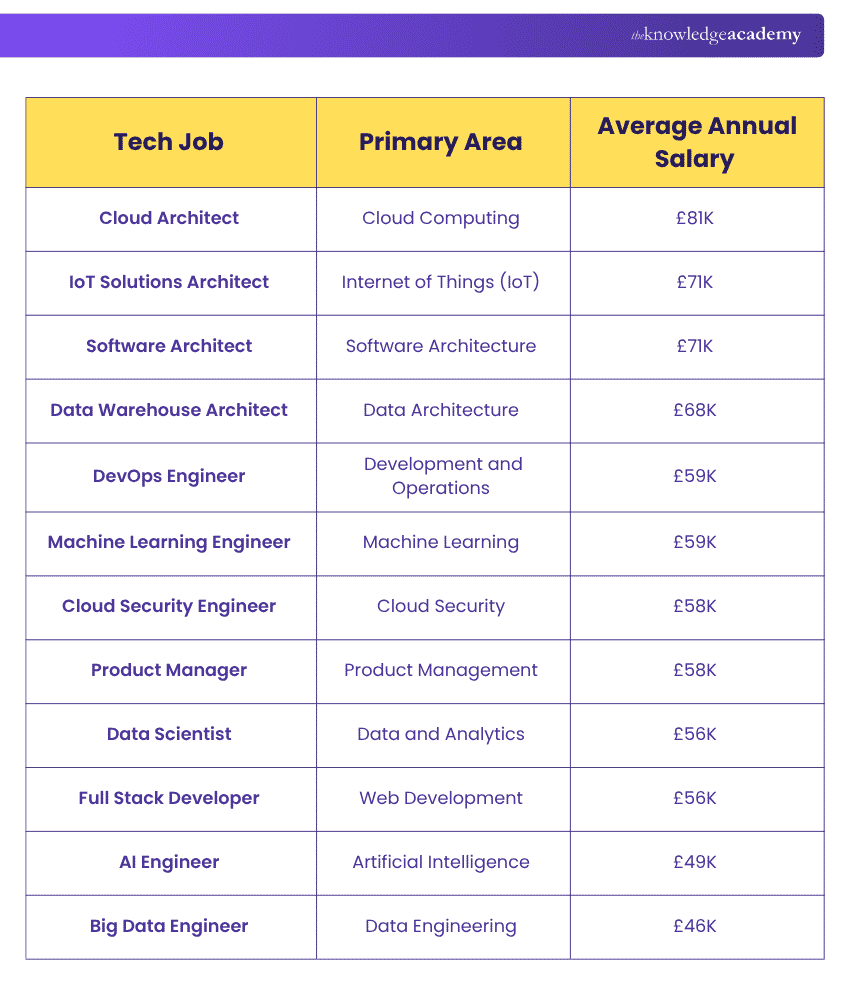
Source: Glassdoor
Don't choose a tech career based on salary alone. Consider what you enjoy doing, the skills required, opportunities for progression and whether the day-to-day responsibilities match your strengths.
Also, the salary figures in this blog are UK averages and should be used as a general market reference rather than guaranteed earnings. Salaries can vary according to experience, location, employer and specialisation. Now let's explore these jobs in detail:
1) Cloud Architect
A Cloud Architect designs and oversees an organisation's cloud computing environment. A Cloud Architect in the UK can earn an average annual salary of £81K. This career may appeal to you if you enjoy designing large-scale systems rather than concentrating on a single application.
Roles and Responsibilities:
A Cloud Architect may:
a) Develop cloud architecture
b) Plan cloud migrations
c) Design scalable infrastructure
d) Integrate networks, applications and data
e) Support cloud security
f) Evaluate cloud services and technologies
Key Skills:
a) AWS, Azure or Google Cloud
b) Networking
c) Cloud security
d) Linux
e) Automation
f) Infrastructure architecture
g) Programming or scripting

2) IoT Solutions Architect
An Internet of Things Solutions Architect designs systems that connect devices, networks, applications and cloud services. Such a professional can command an average annual salary of £71K in the UK. This role combines hardware, software, connectivity and architecture, making it particularly suitable for people who enjoy working across different areas of technology.
Roles and Responsibilities:
They may:
a) Design IoT architectures
b) Integrate connected devices
c) Plan networking requirements
d) Support IoT security
e) Connect devices with cloud platforms
f) Evaluate hardware and software requirements
Key Skills:
a) Networking
b) Cloud computing
c) IoT protocols
d) Embedded systems
e) Data management
f) Cyber Security
g) Systems architecture
Discover how IoT systems can turn everyday devices into smart solutions with our Internet of Things IoT Systems and Applications Training – Sign up now!
3) Software Architect
A Software Architect makes high-level decisions about how software systems should be designed and structured. A Software Architect in the UK can earn an average annual salary of £71K.
Roles and Responsibilities:
Software Architects may:
a) Define software architecture
b) Select suitable technologies
c) Establish technical standards
d) Review system designs
e) Guide development teams
f) Balance scalability, performance and maintainability
Key Skills:
a) Software design
b) Programming
c) APIs
d) Cloud architecture
e) Databases
f) System integration
g) Technical leadership
4) Data Warehouse Architect
A Data Warehouse Architect designs systems that bring together organisational data for reporting, analytics and decision-making. A Data Warehouse Architect can earn £68K as yearly average salary in the UK. This role can be particularly suitable for professionals interested in data architecture rather than just statistical analysis.
Roles and Responsibilities:
a) Design data warehouse architecture
b) Develop data models
c) Integrate different data sources
d) Define data storage structures
e) Improve data accessibility
f) Support analytics and reporting
Key Skills:
a) SQL
b) Data modelling
c) ETL/ELT concepts
d) Data warehousing
e) Database technologies
f) Cloud data platforms
5) DevOps Engineer
A DevOps Engineer helps development and IT operations teams work together efficiently. The role focuses heavily on automation, software delivery, infrastructure and system reliability. A DevOps Engineer in the UK can earn an average annual salary of £59K. This career could suit you if you enjoy automation, infrastructure and improving how software is built and deployed.
Roles and Responsibilities:
DevOps Engineers may:
a) Build and maintain CI/CD pipelines
b) Automate deployment processes
c) Manage cloud infrastructure
d) Monitor applications and systems
e) Work with development and operations teams
f) Improve software delivery processes
Key Skills:
a) Linux
b) Cloud computing
c) Git
d) CI/CD
e) Containers and Kubernetes
f) Infrastructure automation
g) Scripting
Pro Tip
Build transferable skills. Programming, Cloud Computing, Git, data literacy, Cyber Security awareness and problem-solving appear across many technology careers. Strong fundamentals can make it easier to move between specialisations as your career develops.
6) Machine Learning Engineer
A Machine Learning (ML) Engineer specialises in designing, creating and deploying systems that learn from data. An ML Engineer in the UK can earn an average annual salary of £59K.
Roles and Responsibilities:
Typical responsibilities include:
a) Building Machine Learning models
b) Preparing and processing data
c) Training and evaluating algorithms
d) Deploying models into production
e) Monitoring model performance
f) Optimising Machine Learning systems
Key Skills:
a) Python
b) Machine Learning algorithms
c) TensorFlow
d) PyTorch
e) Deep Learning
f) Statistics
g) Data engineering fundamentals
Make sure a well-designed warehouse fuels your next big data report. Sign up for our Data Warehousing Training now!
7) Cloud Security Engineer
A Cloud Security Engineer helps protect an organisation's Cloud infrastructure, applications and data from security threats. The role combines Cloud Computing with Cyber Security and focuses on designing, implementing and maintaining security controls across Cloud environments. These professionals can command an average yearly salary of £58K in the UK.
Roles and Responsibilities:
a) Configure and maintain Cloud security controls
b) Manage Identity and Access Management (IAM)
c) Monitor Cloud environments for security threats
d) Identify and remediate Cloud vulnerabilities
e) Implement encryption and data protection measures
f) Support incident detection and response
g) Work with development, Cloud and security teams
Key Skills:
a) AWS, Azure or Google Cloud
b) Cloud security
c) Identity and Access Management (IAM)
d) Network security
e) Vulnerability management
f) Security monitoring
g) Infrastructure as Code (IaC)
h) Cyber Security fundamentals
Trainer Insight
Projects can demonstrate what skills alone cannot. Knowing a technology and applying it are different things. Build practical projects that showcase how you solve real problems.
8) Product Manager
A Product Manager guides the development and direction of a product by connecting customer needs, business priorities and technical teams. Product Management is a useful option for professionals who enjoy technology but are equally interested in customers, business strategy and decision-making. In the UK, a Product Manager can earn an average annual salary of £58K.
Roles and Responsibilities:
a) Understand customer requirements
b) Define product priorities
c) Develop product roadmaps
d) Coordinate with stakeholders
e) Analyse market and user data
f) Prioritise features
g) Measure product performance
Key Skills:
a) Product strategy
b) Communication
c) Data analysis
d) UX understanding
e) Market research
f) Problem-solving
g) Stakeholder management
Own the journey from ideation to product launches. Register for our Product Management Training now!
9) Data Scientist
A Data Scientist transforms complex datasets into useful insights that organisations can use to make better decisions. The role combines statistics, programming, data analysis and Machine Learning. In the UK, a Data Scientist can earn an average annual salary of £56K. This career may suit you if you enjoy working with numbers, solving analytical problems and discovering patterns in data.
Roles and Responsibilities:
A Data Scientist may:
a) Collect, clean and analyse data
b) Identify trends and patterns
c) Develop predictive models
d) Create data visualisations
e) Communicate findings to stakeholders
f) Apply Machine Learning techniques to business problems
Key Skills:
a) Python or R
b) SQL
c) Statistics and mathematics
d) Machine Learning
e) Data visualisation
f) Critical thinking
g) Communication
10) Full Stack Developer
A Full Stack Developer works across both the front-end and back-end of web applications. A Full Stack Developer can command an average annual salary of £56K in the UK.
Roles and Responsibilities:
They may:
a) Develop user interfaces
b) Build server-side functionality
c) Work with databases
d) Develop and integrate APIs
e) Test and debug applications
f) Maintain web applications
Key Skills:
a) HTML and CSS
b) JavaScript
c) Front-end frameworks
d) Back-end development
e) Databases
f) APIs
g) Git
11) Artificial Intelligence (AI) Engineer
An AI Engineer develops systems and applications that use Artificial Intelligence to perform tasks, make predictions or support decision-making. An AI Engineer in the UK can earn an average annual salary of £49K. This role is well suited to professionals interested in building intelligent systems and applying AI to real-world problems.
Roles and Responsibilities:
AI Engineers may:
a) Design AI-powered applications
b) Develop and integrate AI models
c) Work with Natural Language Processing (NLP)
d) Build intelligent automation solutions
e) Test and optimise AI systems
f) Collaborate with Data Scientists and Software Engineers
Key Skills:
a) Python
b) Machine Learning
c) Deep Learning
d) NLP
e) Data structures
f) AI frameworks
g) Mathematics and statistics
12) Big Data Engineer
A Big Data Engineer designs and maintains systems for processing and managing large or complex datasets. The role often focuses on scalable data pipelines, distributed processing and infrastructure that makes data available for analytics and Machine Learning. A Big Data Engineer in the UK can command an average annual salary of £46K.
Roles and Responsibilities:
a) Build data pipelines
b) Integrate data from different sources
c) Maintain large-scale data systems
d) Improve data quality and availability
e) Support analytics and Machine Learning teams
Key Skills:
a) Apache Spark
b) Hadoop
c) Kafka
d) SQL
e) NoSQL
f) Data warehousing
g) Programming
Trainer Insight
Look Beyond the Job Title. The same Tech Job can look very different across organisations. Compare responsibilities, required technologies, seniority and industry.
13) Mobile Application Developer
Mobile Application Developers design, build, test and maintain applications for smartphones and other mobile devices. A Mobile Application Developer in the UK can command an average annual salary of £42K. Developers may specialise in iOS, Android or cross-platform development, depending on their chosen technologies.
Roles and Responsibilities:
a) Develop mobile applications
b) Test and debug code
c) Integrate APIs
d) Maintain existing applications
e) Improve performance and usability
f) Collaborate with designers and development teams
Key Skills:
a) Swift
b) Kotlin
c) Java
d) Mobile UI/UX
e) APIs
f) Git
g) Testing and debugging
14) Information Security Analyst
An Information Security Analyst helps protect an organisation's systems, networks and information from security threats. These professionals can earn £41k as average annual salary in the UK.
Roles and Responsibilities:
They may:
a) Monitor systems for suspicious activity
b) Investigate security incidents
c) Assess vulnerabilities
d) Implement security controls
e) Maintain security policies
f) Prepare security reports
g) Support risk management activities
Key Skills:
a) Cyber Security fundamentals
b) Network security
c) Risk management
d) Vulnerability assessment
e) Security monitoring
f) Incident response
15) AR/VR Developer
An Augmented Reality (AR) or Virtual Reality (VR) Developer creates interactive digital experiences that combine software development with 3D environments. An AR/VR Developer can earn an annual average salary of £39K in the UK. AR/VR development can appeal to professionals interested in the intersection of software, design and immersive technology.
Roles and Responsibilities:
a) Build AR and VR applications
b) Develop interactive environments
c) Integrate 3D assets
d) Test immersive experiences
e) Optimise application performance
Key Skills:
a) C#
b) C++
c) Unity or similar development platforms
d) 3D development
e) UI/UX
f) Game development concepts
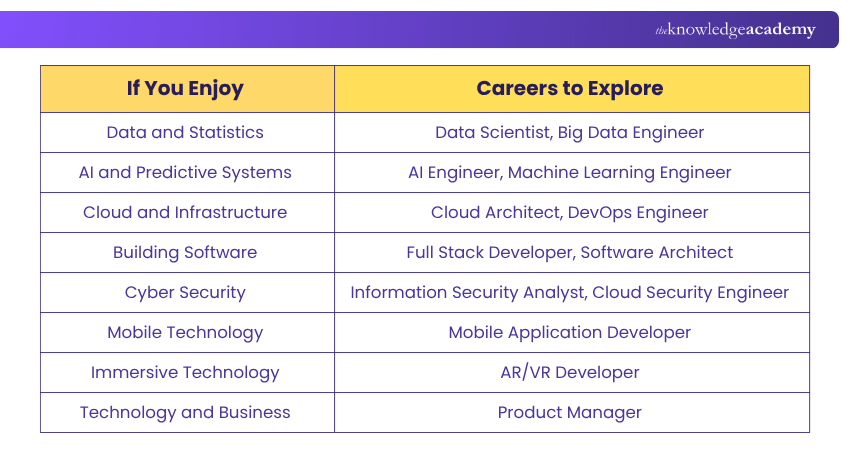
Here's a quick career match to help you out:
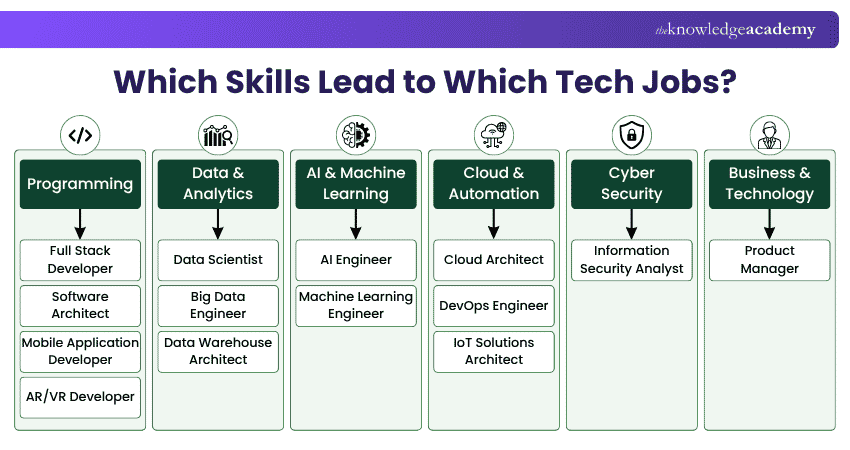
Which Skills Lead to Which Tech Jobs?
Different technology careers build on overlapping skill areas. The visual below shows how interests in programming, data, AI, cloud, Cyber Security and business can connect with the careers discussed above. Here's a quick look into the skills and the tech jobs they are ideal for:
What Factors Affect Salaries in Tech Jobs?
Two professionals with the same job title can earn very different salaries. This is because compensation depends on much more than the role itself.
a) Experience: Professionals with several years of relevant experience can generally take on more complex responsibilities and command higher salaries.
b) Location: Technology salaries vary considerably between countries, cities and regions. Areas with strong technology sectors or higher living costs may offer different compensation levels.
c) Technical Skills: Specialised skills can influence earning potential. Expertise in areas such as AI, cloud computing, Cyber Security, data engineering and software architecture may strengthen a professional's position in the job market.
d) Industry: The same technical role can have different responsibilities and salary levels depending on whether you work in finance, healthcare, retail, technology or another industry.
e) Seniority and Responsibilities: A job title does not always reveal the full scope of a role. Managing complex systems, leading teams or making strategic technical decisions can influence compensation.
f) Company Size: Start-ups, established technology businesses and multinational organisations can offer very different salary and benefits packages.
Conclusion
The Highest Paying Tech Jobs span areas such as AI, data, Cloud Computing, Cyber Security and software architecture. However, salaries change with experience, location, specialisation and market demand. Use salary data as one factor when comparing careers, alongside your interests, strengths and long-term goals. Focus on building practical skills that remain valuable as technology evolves.
Turn great concepts into greater digital experiences with our App & Web Development Training. Sign up now!
Frequently Asked Questions
Which High-paying Tech Jobs Require Less Coding?

Some technology careers involve less day-to-day programming than software development. Product Management, selected architecture, governance, risk and technology consulting roles may place greater emphasis on strategy, analysis, communication and coordination. Technical understanding can still be important depending on the position.
Do You Need a Degree to Get a High-paying Tech Job?
Not every technology career follows the same educational route. Employers may consider a combination of formal education, certifications, portfolios, practical projects and professional experience depending on the position.
Which Tech Careers Combine Technical and Business Skills?
Product Management, Cloud Architecture and Software Architecture can combine technical understanding with business requirements, stakeholder communication and strategic decision-making.
Can You Switch from One Tech Career to Another?
Yes. Many technology careers share transferable skills. For example, experience in programming, databases, cloud computing, security or data analysis can support movement into related roles when combined with the necessary specialist skills.

The Knowledge Academy


Global Training Provider
The Knowledge Academy is a world-leading provider of professional training courses, offering globally recognised qualifications across a wide range of subjects. With expert trainers, up-to-date course material, and flexible learning options, we aim to empower professionals and organisations to achieve their goals through continuous learning.


 If you wish to make any changes to your course, please


