


 Top Rated Course

We may not have the course you’re looking for. If you enquire or give us a call on 01344203999 and speak to our training experts, we may still be able to help with your training requirements.
Dynamics 365 Jobs: Top Roles and Skills You Need
The Knowledge Academy 02 September 2026Discover where a career in Dynamics 365 can take you, from popular job roles to the essential skills required for professional growth.

Training Outcomes Within Your Budget!
We ensure quality, budget-alignment, and timely delivery by our expert instructors.
Table of Contents
Related Courses
- Microsoft 365 Administrator Training MS102
- Microsoft 365 Fundamentals MS900
- Microsoft Dynamics 365 Supply Chain Management - Functional Consultant MB330
- Microsoft Dynamics 365 Business Central Functional Consultant MB800
- Retired: Configuring and Operating a Hybrid Cloud with Microsoft Azure Stack Hub AZ600

Key Takeaways
1. Dynamics 365 offers career opportunities across consulting, development, administration, analysis, and solution architecture.2. Each Dynamics 365 role requires a different mix of technical, functional, and business skills.3. Developers and technical consultants focus more on customisation, integration, and technical solutions.4. Functional consultants and business analysts connect business requirements with suitable Dynamics 365 capabilities.5. Project Managers, architects, testers, and adoption specialists support successful implementation from different perspectives.
Good with business processes? There’s a Dynamics 365 role for that.
Enjoy coding and building solutions? There’s a path for you too.
And if designing complete business systems interests you, another set of opportunities awaits.
Dynamics 365 Jobs cover a wide range of roles, each requiring a different mix of technical knowledge, business understanding, and problem-solving skills. So, if you’re wondering where you could fit into this growing ecosystem, you’re in the right place.
Ready to explore your options? Read on and discover where your strengths could take you within Dynamics 365.
What is Microsoft Dynamics 365?
Microsoft Dynamics 365 is a suite of cloud-based business applications that combines Customer Relationship Management (CRM) and Enterprise Resource Planning (ERP) capabilities. It helps organisations manage areas such as sales, customer service, finance, supply chain operations, marketing, and project management through connected applications.

Top Microsoft Dynamics 365 Jobs
Dynamics 365 projects require professionals with different responsibilities throughout implementation, operation, and continuous improvement. The following roles represent some of the main career directions you can explore:
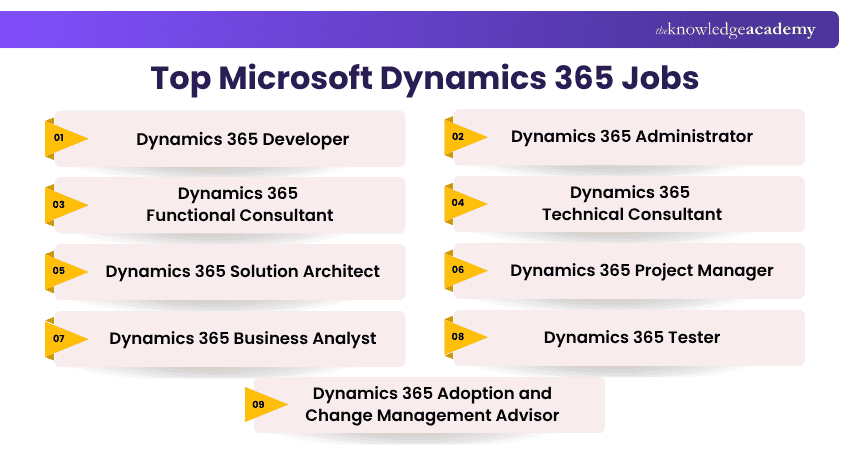
1) Dynamics 365 Developer
Dynamics 365 Developers build, customise, and extend solutions to meet specific business and technical requirements. Their work can include coding custom functionality, developing plugins or extensions, creating integrations through APIs, and building automation that supports specific business requirements.
They usually work closely with Functional Consultants and Solution Architects to turn technical requirements into working solutions. Strong programming, API, debugging, and application development skills are particularly valuable in this role.
2) Dynamics 365 Administrator
Dynamics 365 Administrators support the ongoing management of Dynamics 365 environments within an organisation. Their responsibilities can include user access, security settings, environment administration, configuration, monitoring, and general system support.
Administrators also help maintain reliable day-to-day platform usage and respond when users encounter access or configuration problems. Attention to detail, troubleshooting skills, and knowledge of security controls are particularly important.
3) Dynamics 365 Functional Consultant
Dynamics 365 Functional Consultants understand business requirements and map them to appropriate Dynamics 365 capabilities. They may configure applications, analyse processes, support data migration, conduct testing, and assist during implementation.
The role combines platform knowledge with a strong understanding of how different business functions operate. Strong communication is equally important because Functional Consultants regularly work with users, business stakeholders, developers, and project teams.
Optimise business processes and deliver value through Microsoft Dynamics 365 Business Central Functional Consultant MB800 Training – Register today!
4) Dynamics 365 Technical Consultant
Dynamics 365 Technical Consultants typically focus on the technical aspects of implementing and customising Dynamics 365 solutions. Depending on the organisation and project, their responsibilities may include integrations, data migration, technical configuration, environment setup, security, and troubleshooting.
They often act as the link between functional requirements and the underlying technical solution, working with Developers, Functional Consultants, and Solution Architects to ensure the proposed approach can be implemented effectively.
Trainer’s Insight:
Don’t choose a Dynamics 365 role based on the job title alone. Look at the day-to-day responsibilities. Someone who enjoys understanding business processes may be better suited to a Functional Consultant role, while someone who prefers coding and technical problem-solving may find the Developer path more suitable.
5) Dynamics 365 Solution Architect
A Dynamics 365 Solution Architect provides high-level direction for the overall design of a Dynamics 365 solution. They consider business requirements, system integration, technical architecture, security, scalability, and long-term platform requirements.
Solution Architects also coordinate important technical decisions across different parts of an implementation. Microsoft describes Solution Architects as responsible for the successful design, implementation, deployment, and adoption of an overall solution.
This is generally a more experienced role requiring broad technical knowledge alongside strong business and stakeholder understanding.
6) Dynamics 365 Project Manager
Dynamics 365 Project Managers coordinate implementation activities and help keep projects aligned with agreed objectives. Their responsibilities can include planning, timelines, resources, risks, stakeholders, budgets, dependencies, and project reporting.
They typically work across technical and business teams, focusing on project coordination and delivery rather than hands-on system configuration. Strong organisation, communication, leadership, and risk management skills are particularly valuable for this career path.
7) Dynamics 365 Business Analyst
Dynamics 365 Business Analysts examine organisational requirements and help define what a Dynamics 365 solution should achieve. They can gather requirements, analyse processes, identify gaps, document needs, and support communication between business and technical teams.
Their work helps ensure implementation decisions reflect genuine operational requirements rather than assumptions. Strong analytical, process mapping, questioning, documentation, and stakeholder management abilities are valuable in this role.
8) Dynamics 365 Tester
Dynamics 365 Testers help verify whether configured or developed solutions operate as expected before wider deployment. Testing may cover business processes, system integrations, customisations, updates, data flows, and other important functionality.
They identify problems, document defects, verify corrections, and help implementation teams assess whether requirements have been satisfied. Analytical thinking, attention to detail, process understanding, and structured testing skills are particularly valuable.
Career Tip:
Treat your first Dynamics 365 role as a starting point rather than a fixed destination. Experience gained in consulting, development, administration, or analysis can help you understand the wider platform and prepare for more specialised or senior responsibilities later.
9) Dynamics 365 Adoption and Change Management Advisor
Technology alone cannot make an implementation successful if employees struggle to adopt new ways of working. Adoption and Change Management Advisors focus on preparing and supporting people through the changes introduced by Dynamics 365.
Their work may involve communication, stakeholder engagement, adoption planning, training coordination, and user readiness activities. Microsoft includes Adoption and Change Management Advisors among the core roles that can support Dynamics 365 implementation projects.
This path can particularly suit professionals with strong communication, organisational change, training, and stakeholder engagement skills.
Advance your development expertise with Microsoft Power Platform Developer PL400 Training and create scalable solutions.
What Skills do You Need for Dynamics 365 Jobs?
Dynamics 365 roles require different levels of technical and business expertise. However, several transferable skills can support professionals across multiple career paths. The following skills can help you prepare for different Microsoft Dynamics 365 roles:
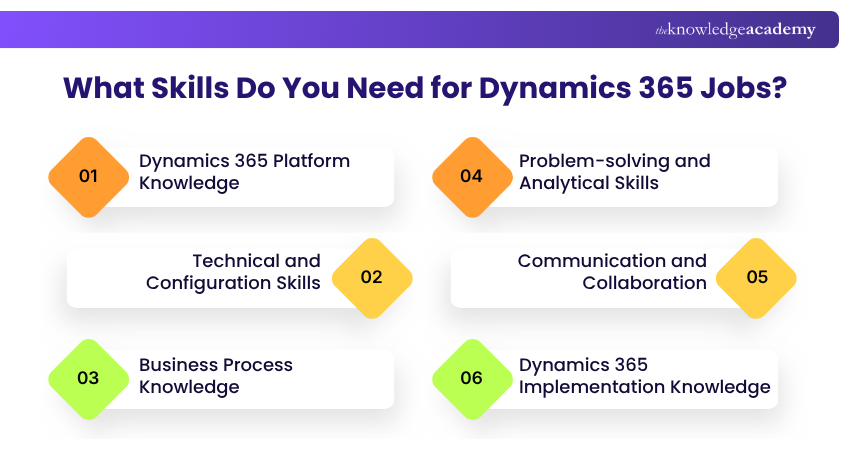
1) Dynamics 365 Platform Knowledge
Understanding Dynamics 365 applications and how they support different business processes provides an important foundation. Professionals should focus on the applications and capabilities most relevant to their intended role rather than trying to learn every product equally.
2) Technical and Configuration Skills
Technical abilities can include configuration, integrations, automation, security, data management, development, and troubleshooting. The required depth varies by role, with Developers and Technical Consultants typically requiring deeper knowledge of development, integrations, and technical architecture, while Functional Consultants tend to focus heavily on configuration and business processes.
3) Business Process Knowledge
Understanding processes across areas such as sales, customer service, finance, operations, and supply chain management can help professionals connect business requirements with appropriate Dynamics 365 capabilities.
4) Problem-solving and Analytical Skills
Dynamics 365 professionals regularly deal with system issues, process gaps, changing requirements, and implementation challenges. Analytical thinking helps them identify causes, assess possible approaches, and determine suitable solutions.
5) Communication and Collaboration
Dynamics 365 projects bring together technical teams, business users, consultants, Project Managers, and senior stakeholders. Clear communication, active listening, and effective collaboration help teams understand requirements and coordinate implementation activities.
6) Dynamics 365 Implementation Knowledge
Understanding how a Dynamics 365 implementation progresses from planning and configuration through testing, deployment, and ongoing support can benefit professionals across different roles, even when project management is not their primary responsibility.
Which Dynamics 365 Job Could Suit You?
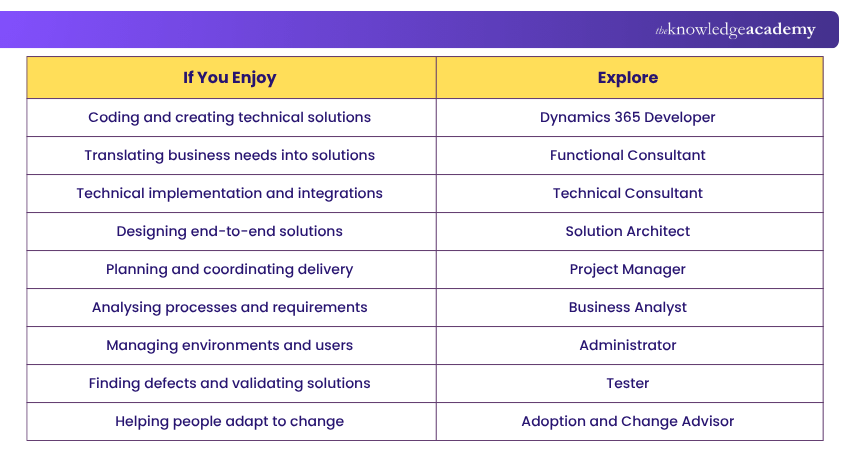
The right career path depends on the type of work you enjoy and the strengths you want to develop. Consider how your interests match the responsibilities of different Dynamics 365 roles:
Conclusion
Dynamics 365 Jobs can take many directions, depending on whether your strengths lie in technology, business processes, project delivery, or working with people. The key is to identify the area that interests you and build practical knowledge around it.
As you gain experience, you can deepen your expertise, explore specialised areas, and take on greater responsibilities. Start with the path that fits your strengths, keep developing your capabilities, and let your Dynamics 365 career grow from there.
Build Power Platform knowledge with Microsoft Power Platform Fundamentals PL900 Training and support smarter solutions.
Frequently Asked Questions
Do I Need a Microsoft Certification to Get a Dynamics 365 Job?

Not every Dynamics 365 Job requires certification, as employers may also consider practical experience, platform knowledge, technical ability, and business expertise. Certification expectations vary depending on the employer, project, and specific role.
Which Industries Hire Dynamics 365 Professionals?
Dynamics 365 professionals can work across industries that use CRM, ERP, finance, sales, customer service, or operational management systems, including manufacturing, retail, professional services, finance, healthcare, public services, and technology.
Can Dynamics 365 Jobs be Contract or Remote Roles?
Yes. Dynamics 365 professionals may work in permanent, contract, consultancy, remote, hybrid, or project-based positions. The working arrangement generally depends on the organisation and project requirements rather than the Dynamics 365 role itself.

The Knowledge Academy


Global Training Provider
The Knowledge Academy is a world-leading provider of professional training courses, offering globally recognised qualifications across a wide range of subjects. With expert trainers, up-to-date course material, and flexible learning options, we aim to empower professionals and organisations to achieve their goals through continuous learning.


 If you wish to make any changes to your course, please


