


 Top Rated Course

We may not have the course you’re looking for. If you enquire or give us a call on + 1-866 272 8822 and speak to our training experts, we may still be able to help with your training requirements.
Compliance Officer Roles and Responsibilities: Explained
Hailey Davis 07 September 2026Compliance Officer Roles and Responsibilities involve managing risks, ensuring legal adherence, developing policies, training staff, and monitoring processes. They help organisations reduce compliance risks that could lead to regulatory penalties.
Home
 Resources
IT Security & Data Protection
Compliance Officer Roles and Responsibilities: Explained
Resources
IT Security & Data Protection
Compliance Officer Roles and Responsibilities: Explained
Resources
IT Security & Data Protection
Compliance Officer Roles and Responsibilities: Explained

Training Outcomes Within Your Budget!
We ensure quality, budget-alignment, and timely delivery by our expert instructors.
Table of Contents
Key Takeaways
1. Compliance Officers help organisations understand and manage the requirements that apply to their activities.2. Their responsibilities can include risk assessment, policy development, monitoring, training, investigation, reporting and corrective action support.3. Effective Compliance Officers need analytical thinking, communication, attention to detail and sound ethical judgement.4. The exact scope of the role varies according to the organisation, industry, jurisdiction and regulatory environment.5. Technology and data are increasingly supporting compliance monitoring, risk identification and reporting.
When a new regulation comes into effect, suddenly several teams may need answers:
a) Which processes are affected?
b) What needs to change?
c) Are existing controls enough?
d) Who makes sure potential compliance gaps are identified before they become bigger problems?
This is where the Compliance Officer Roles and Responsibilities become important.
Rather than simply checking whether the rules are being followed, Compliance Officers can help organisations interpret requirements, assess compliance risks, develop policies, monitor processes and advise decision-makers. Their work connects regulatory expectations with everyday business activities.
Who is a Compliance Officer?
A Compliance Officer is a professional who helps an organisation understand and follow applicable legal, regulatory and internal requirements. Their role can involve monitoring compliance, interpreting requirements, identifying risks and supporting appropriate controls. They may also act as in-house compliance specialists, staying updated on relevant regulatory changes and helping teams understand what is expected of them.

Key Roles and Responsibilities of a Compliance Officer
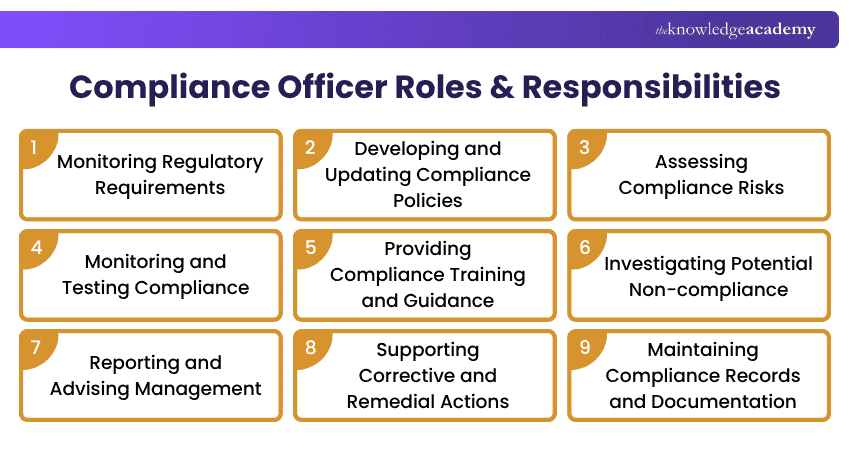
The responsibilities of a Compliance Officer extend across different parts of an organisation. Rather than focusing only on detecting non-compliance, the role can involve helping the organisation understand requirements, manage risks and strengthen its compliance arrangements. Here are some of the key responsibilities:
1) Monitoring Regulatory Requirements
Compliance Officers need to stay informed about applicable laws, regulations and other requirements that may affect their organisation. When relevant requirements change, they can assess how those changes affect existing policies, controls and business processes. They may also communicate necessary changes to relevant teams and management.
2) Developing and Updating Compliance Policies
Compliance Officers can help develop policies and procedures that translate compliance requirements into practical organisational expectations. These documents may explain responsibilities, expected behaviours, controls and processes employees should follow. Policies should also be reviewed when requirements, risks or business activities change.
3) Assessing Compliance Risks
Compliance risk assessment involves identifying where an organisation may be exposed to non-compliance and evaluating the likelihood and potential impact of those risks. Compliance Officers can use these assessments to help prioritise monitoring, controls and other compliance activities.
Trainer Insight
A Compliance Officer should not be viewed as the person who "does compliance" for the entire organisation. Business teams remain responsible for operating within applicable requirements, while compliance helps interpret requirements, assess risks, monitor adherence and escalate concerns.
4) Monitoring and Testing Compliance
Policies alone do not show that requirements are being followed. Compliance Officers may therefore monitor activities and test relevant controls to identify potential gaps or weaknesses.
Depending on the organisation, this can involve reviewing records, analysing compliance information, conducting monitoring activities or coordinating assessments. Findings can then be used to identify areas requiring further investigation or improvement.
5) Providing Compliance Training and Guidance
Employees need to understand how compliance requirements affect their work. Compliance Officers can support this by developing or coordinating training and providing guidance on policies, procedures and relevant regulatory expectations.
Effective training should make requirements understandable and applicable to employees' actual responsibilities rather than simply presenting rules in isolation.
6) Investigating Potential Non-compliance
When a potential compliance issue is identified, Compliance Officers may support or conduct an investigation, depending on the organisation and nature of the concern. This can involve gathering relevant information, understanding what happened, assessing potential impacts and identifying contributing or root causes.
Serious matters may also need to be escalated through appropriate internal governance or reporting channels.
Empower your organisation's success with our Corporate Governance Training – Sign up now!
7) Reporting and Advising Management
Compliance Officers can provide management with information about significant compliance risks, monitoring results, incidents and emerging requirements. They may also advise decision-makers on the compliance implications of proposed business activities or changes.
Good reporting should help management understand not only what happened, but also why it matters and what action may be required.
8) Supporting Corrective and Remedial Actions
Identifying a compliance issue is only part of the process. Organisations also need to address the underlying problem. Compliance Officers may recommend or support corrective measures, monitor their implementation and assess whether actions taken have addressed identified weaknesses.
The objective is not simply to close an issue, but to reduce the likelihood of the same or similar problems recurring.
9) Maintaining Compliance Records and Documentation
Clear documentation can help demonstrate how compliance risks, monitoring activities, incidents, decisions and corrective actions have been managed. Compliance Officers may maintain or oversee records related to policies, assessments, training, monitoring, investigations and reporting. Record-keeping requirements can vary depending on the organisation and applicable regulatory obligations.
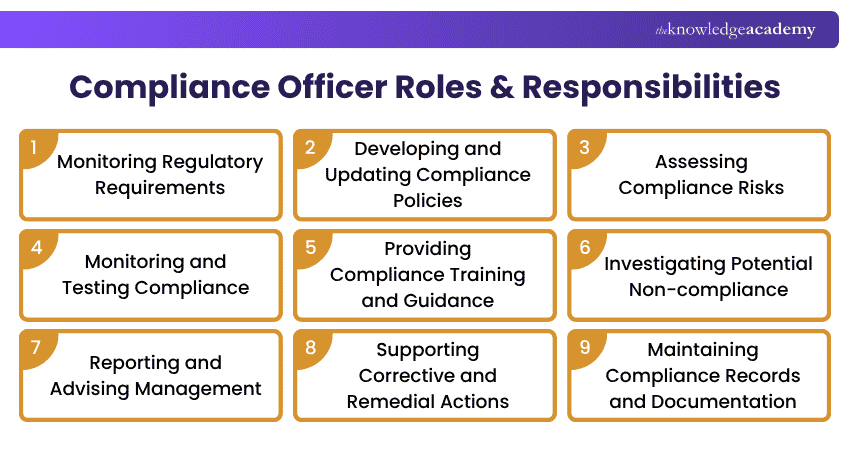
When a compliance issue is identified, the following path may be taken:
How to Become a Compliance Officer?
There is no single universal route to becoming a Compliance Officer. Requirements vary depending on the organisation, industry, jurisdiction and seniority of the position. However, the following areas can help build a relevant career foundation:
1) Build a Relevant Educational Foundation
Employers may look for educational backgrounds relevant to the role or industry. Areas such as law, business, finance, accounting, risk management or related disciplines can provide useful foundations. However, specific educational requirements vary between positions.
2) Gain Relevant Experience
Experience in areas such as compliance, risk management, audit, legal services, governance, financial crime prevention or regulatory affairs can help develop practical knowledge. Some professionals also move into compliance from operational or specialist roles within regulated industries.
3) Develop Core Compliance Skills
Build skills in areas such as:
a) Risk assessment
b) Regulatory interpretation
c) Policy development
d) Monitoring
e) Investigation
f) Reporting
g) Communication
h) Data analysis
Practical experience applying these capabilities can be particularly valuable.
4) Build Industry-specific Knowledge
Compliance requirements differ across sectors. Professionals should understand the regulatory environment relevant to the industry in which they intend to work.
5) Continue Professional Development
Compliance requirements and risks change over time. Continuing education, professional training and relevant certifications can help professionals maintain and expand their knowledge.
Pro Tip
Build expertise around the sector you want to enter. Compliance requirements can differ considerably across financial services, healthcare, data protection and other regulated industries, so relevant sector knowledge can be particularly valuable.
How the Compliance Officer Role is Evolving
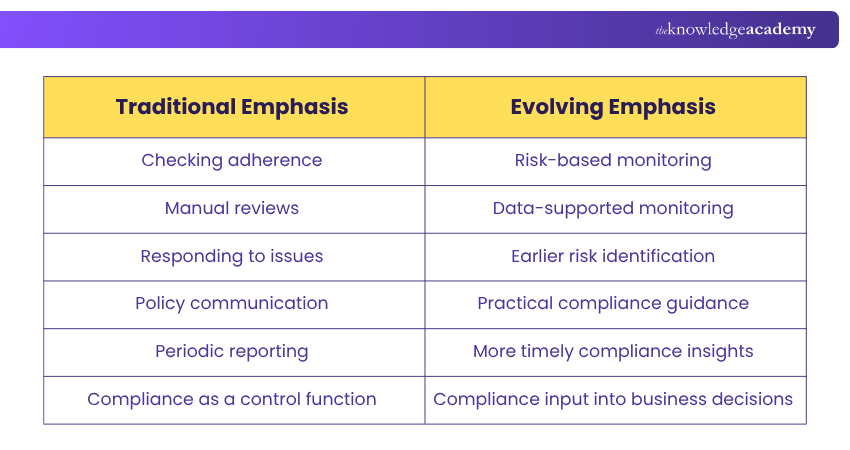
Compliance work continues to change as organisations operate across more complex regulatory and technological environments. Technology can allow Compliance Officers to work with larger volumes of information more efficiently. The role is also becoming increasingly connected with areas such as data protection, Cyber Security, financial crime risk, third-party risk and organisational governance.
Rather than responding only after a problem occurs, they can help organisations consider compliance risks when designing products, changing processes or making strategic decisions. Here's how much has changed:
Skills and Qualities of an Effective Compliance Officer
The role of a Compliance Officer requires a unique blend of skills and qualities that help them uphold ethical standards and ensure legal adherence within an organisation. Here are some of the most essential skills of a Compliance Officer:
1) Analytical and Critical Thinking
The ability to analyse intricate regulatory frameworks and assess potential Compliance gaps is paramount. Effective Compliance Officers exhibit sharp analytical skills, enabling them to identify areas of vulnerability and proactively devise strategies to address them. Critical thinking empowers them to craft comprehensive solutions that anticipate potential challenges.
2) Strong Communication Skills
Communication is key for Compliance Officers, who must translate complex regulations into clear directives for employees at all levels. Effective communication fosters understanding, ensuring Compliance policies are disseminated effectively and embraced by the workforce.
3) Attention to Detail
The role demands a meticulous eye for detail. Effective Compliance Officers scrutinise policies, procedures, and operations to identify even the most minute deviations from Compliance standards. This attention to detail is instrumental in preventing oversights that could lead to non-compliance.
4) Ethical Integrity
Compliance professionals may deal with sensitive information, potential misconduct and decisions that affect employees or the organisation. Integrity and sound judgement are therefore essential when handling concerns objectively and maintaining appropriate confidentiality.
EXTRA INSIGHT
The global Enterprise Governance, Risk and Compliance (eGRC) market is projected to reach £150 billion by 2033, according to Grand View Research.
5) Regulatory Awareness
Compliance Officers need an appropriate understanding of the laws, regulations, standards, policies and other requirements relevant to their organisation. Because requirements can change, maintaining this knowledge is an ongoing part of the profession.
6) Problem-solving Skills
Compliance Officers may need to help determine how an organisation can address a requirement or compliance gap without unnecessarily disrupting legitimate business activities. Problem-solving helps them evaluate options and recommend proportionate responses.
How Much Does a Compliance Officer Earn?
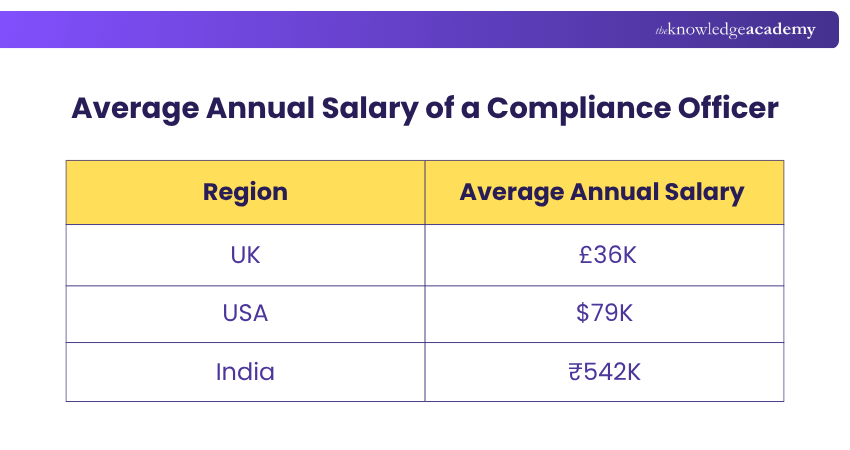
Compliance Officer salaries can vary according to experience, location, industry and level of responsibility. Compliance roles exist at different levels, from junior and entry-level positions to senior Compliance Managers and Chief Compliance Officers.
Here's a breakdown of the average salary earned by a Compliance Officer across three major regions:
Source: Indeed
Conclusion
As automation, AI‑driven insights, and global regulatory shifts reshape the landscape, the future of compliance will hinge on anticipating risks before they emerge. In this rapidly advancing environment, elevating Compliance Officer Roles and Responsibilities becomes essential to building resilient organisations capable of thriving amid continuous transformation.
Learn to navigate rules, reduce risks, and build a culture of integrity. Sign up for our Compliance Training now!
Frequently Asked Questions
What is the Difference Between a Compliance Officer and a Compliance Manager?

A Compliance Officer often carries out activities such as monitoring requirements, assessing risks, reviewing controls and supporting investigations. A Compliance Manager generally has broader responsibility for coordinating compliance activities, supervising teams and reporting on compliance performance. Exact responsibilities vary by organisation.
Is a Compliance Officer a Senior-level Role?
It can be, but compliance roles exist at different levels. Organisations may employ Compliance Analysts, Compliance Officers, Compliance Managers, Heads of Compliance or Chief Compliance Officers depending on their size, structure and regulatory environment.
What are the Seven Elements of an Effective Compliance and Ethics Program?
Under the U.S. Federal Sentencing Guidelines, an effective compliance and ethics program includes areas such as standards and procedures, appropriate oversight, effective training and communication, monitoring and reporting mechanisms, consistent enforcement, and appropriate responses to identified misconduct.
What are the Key Types of Compliance Policies?
Compliance policies vary by organisation, industry and regulatory requirements. Common examples can include:
a) Code of conduct
b) Data protection and privacy
c) Anti-bribery and corruption
d) Conflicts of interest
e) Whistleblowing and reporting
f) Financial crime or Anti-Money Laundering policies, where applicable
g) Workplace or safety policies, where relevant

Hailey Davis


Compliance Officer
Hailey Davis is an ISO compliance expert with over 10 years of experience in audit, quality management systems (QMS), and regulatory compliance. She has worked with various industries, including manufacturing, healthcare, and technology, ensuring organisations achieve and maintain ISO certifications. Hailey’s content provides practical, actionable insights on navigating compliance challenges and improving business processes.
View Detail

 If you wish to make any changes to your course, please


