


We may not have the course you’re looking for. If you enquire or give us a call on + 1-866 272 8822 and speak to our training experts, we may still be able to help with your training requirements.
Agile Roles and Responsibilities: A Complete Guide
ByThe Knowledge AcademyLast updated on: 18 November 2026
Explore Agile roles and responsibilities, from Product Owners and Scrum Masters to Developers and supporting specialists.

The Gist
1. Scrum defines three accountabilities: Product Owner, Scrum Master and Developers.2. Agile teams collaborate to deliver valuable outcomes and respond to changing requirements.3. Product Designers, Testers, Architects and domain experts contribute specialist skills within teams or through external support.4. Clear responsibilities, self-management and continuous improvement support successful Agile delivery.
More than mere titles, Agile roles and responsibilities are the engines of innovation and collaboration for any modern organisation. That's the strength of Agile teams: they are fluid, adaptable and purpose-driven. From the visionary Product Owner to the supportive Scrum Master, each role contributes to the team's progress.
This blog dives into the key roles and team structures that make Agile thrive, revealing how responsibilities are shared and adapted to meet evolving goals. So read on, learn about the key Agile roles and responsibilities and attune your project management approach to lasting success!
Key Agile Roles and Responsibilities
Agile teams bring together people with different skills to deliver value through collaboration and continuous improvement. While responsibilities vary across Agile approaches, Scrum provides a clear example of how accountability works.
In Scrum, three accountabilities guide product value, team effectiveness and delivery. Let's explore them:
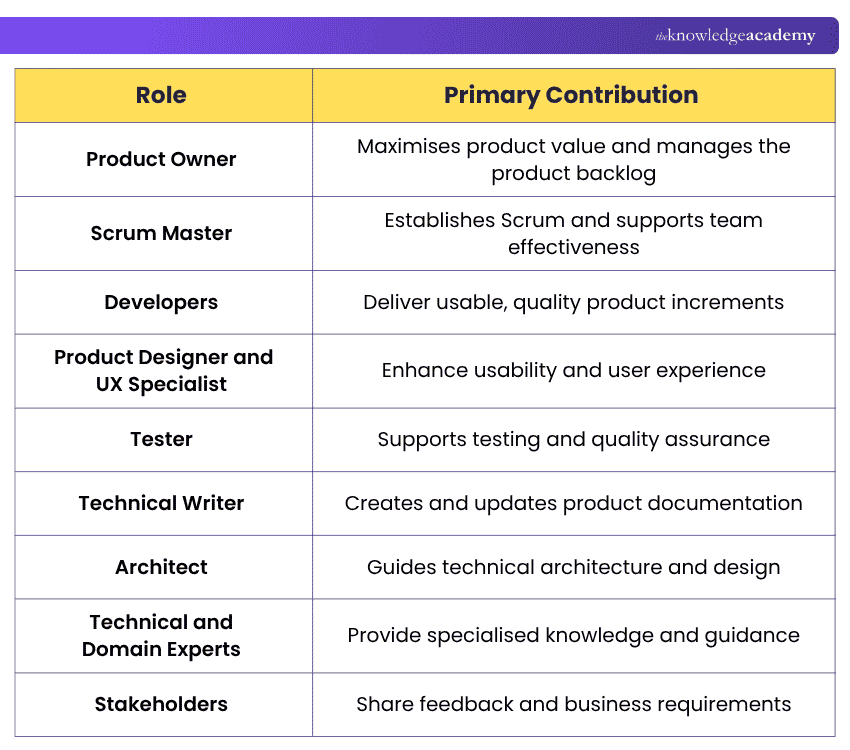
1) Product Owner
The Product Owner is accountable for maximising the value of the product resulting from the Scrum team's work. They help establish a clear product direction and ensure that the team understands what matters most.
Responsibilities:
a) Define the Product Goal: Establish and clearly communicate the product's long-term objective.
b) Manage the Product Backlog: Ensure product backlog items are created, communicated and ordered effectively.
c) Prioritise Product Value: Focus on work that delivers meaningful benefits to customers and stakeholders.
d) Communicate Requirements: Help the team understand product needs, expectations and priorities.
e) Engage Stakeholders: Gather feedback and consider business and customer requirements when making product decisions.
The Product Owner may delegate some backlog management activities, but remains accountable for their effectiveness.

2) Scrum Master
The Scrum Master is accountable for establishing Scrum as defined in the Scrum Guide and improving the Scrum team's effectiveness. Rather than acting as a traditional team leader who assigns tasks, the Scrum Master helps team members understand Scrum principles, improve collaboration and address obstacles affecting progress.
Responsibilities:
a) Support Scrum Practices: Help team members and stakeholders understand Scrum principles and practices.
b) Facilitate Scrum Events: Ensure Scrum events take place and remain productive and focused and within their prescribed timeboxes.
c) Address Impediments: Help the team identify and remove obstacles that affect progress.
d) Coach Team Members: Support self-management, cross-functionality and effective collaboration.
e) Encourage Continuous Improvement: Help the Scrum Team evaluate its practices and identify ways to improve effectiveness.
The Scrum Master also supports the Product Owner and organisation in applying Scrum effectively.
Learn the art of Scrum and empower teams to thrive with the Scrum Master Certification Training – Join now!
3) Developers
In Scrum, Developers are the people committed to creating any aspect of a usable product increment during each sprint. The term Developers is not limited to programmers. Depending on the product, it may include professionals contributing design, testing, analysis, documentation or other skills required to deliver value.
Responsibilities:
a) Plan Sprint Activities: Create and maintain the sprint backlog to guide the team's work.
b) Develop Product Increments: Collaborate to create usable outcomes that support the sprint goal.
c) Maintain Quality: Ensure completed work meets the applicable Definition of Done.
d) Adapt Daily Plans: Review progress and adjust activities to remain aligned with the sprint goal.
e) Maintain Shared Accountability: Support one another and take professional responsibility for delivering quality work.
Developers collectively decide how to organise and complete their work rather than relying on a separate authority to assign every task.
Other Roles That Support Agile Teams
Beyond the core Scrum accountabilities, Agile teams may require additional expertise depending on the product, industry and project requirements. These specialists may contribute as Developers within a Scrum Team or provide external support, depending on the team's needs. Their involvement helps address specific technical, operational and business needs:
1) Stakeholders
Stakeholders are individuals or groups who have an interest in the product or are affected by its outcomes. They may include customers, users, business leaders and other organisational representatives. Stakeholders provide information and feedback that help teams understand requirements, evaluate progress and make informed product decisions.
Responsibilities:
a) Communicate Business Needs: Share expectations, objectives and relevant requirements.
b) Provide Product Feedback: Review outcomes and offer insights that support improvement.
c) Support Product Alignment: Help ensure the product addresses business and customer needs.
2) Product Designer and UX Specialist
Product Designers and UX Specialists focus on making products useful, accessible and easy to interact with. They research user needs, develop interface concepts and evaluate how effectively a product supports user goals.
Responsibilities:
a) Conduct User Research: Understand customer needs, behaviours and challenges.
b) Create Designs and Prototypes: Develop wireframes, user flows and interactive prototypes.
c) Evaluate Usability: Conduct usability testing and recommend improvements.
d) Collaborate With Developers: Help translate design requirements into practical product functionality.
Pro Tip
Include design and usability expertise during early planning and product discussions. Identifying user needs before development progresses can reduce avoidable rework and improve the final experience.
3) Tester
Testers contribute specialist knowledge in software testing and quality assurance. They help teams identify defects, evaluate requirements and verify that product functionality behaves as expected. In Agile environments, testing is not necessarily a separate final phase. It can take place throughout development, with Developers sharing responsibility for product quality.
Responsibilities:
a) Design Test Cases: Develop suitable test scenarios based on product requirements.
b) Identify and Report Defects: Record issues and communicate findings to the team.
c) Validate Functionality: Verify that features behave as expected and meet relevant acceptance criteria.
d) Support Quality Improvements: Contribute to testing practices, automation and defect prevention.
4) Technical Writer
Technical Writers create and maintain documentation that helps users, developers, and other stakeholders understand a product. Their contribution is particularly valuable for products requiring user guides, technical instructions, release notes or extensive support documentation.
Responsibilities:
a) Develop Documentation: Create user manuals, technical guides and instructions.
b) Maintain Content Accuracy: Update documentation when features or processes change.
c) Improve Clarity: Present complex technical information in an understandable format.
d) Collaborate With Specialists: Work with Developers and other experts to verify technical details.
5) Architect
Architects contribute expertise in technical design and system architecture. They help teams make decisions about the structure, integration, scalability and maintainability of products. In Agile environments, architectural decisions should support collaboration and evolving requirements rather than create unnecessary barriers between specialists.
Responsibilities:
a) Guide Technical Architecture: Support the design of reliable and maintainable systems.
b) Evaluate Technical Decisions: Assess architectural options, constraints and trade-offs.
c) Support Scalability and Performance: Identify technical requirements affecting long-term product effectiveness.
d) Collaborate With Developers: Help teams align implementation decisions with product and business needs.
Great teams don't just work together; they grow together. The Agile for Teams Training helps you improve collaboration – Sign up now!
6) Technical and Domain Experts
Technical and domain experts provide specialised knowledge that helps Agile teams understand complex business processes, technologies or industry requirements. Their contributions are particularly useful when developing products in areas such as healthcare, banking, cyber security or regulated industries.
Responsibilities:
a) Provide Specialist Knowledge: Explain technical concepts, operational processes and domain requirements.
b) Clarify Requirements: Help teams understand complex business rules and constraints.
c) Support Decision-making: Offer guidance when teams face specialised challenges.
d) Review Relevant Solutions: Evaluate whether proposed outcomes meet applicable domain or technical expectations.
Agile Team Responsibility Checklist
Use this checklist to establish clear responsibilities while supporting collaboration and flexibility:
□ Define Accountabilities: Clarify the Product Owner, Scrum Master and Developers accountabilities in Scrum.□ Identify Required Skills: Determine the design, development, testing and domain expertise needed.□ Clarify Decision-making: Define responsibility for product priorities, sprint planning and Scrum effectiveness.□ Encourage Collaboration: Promote knowledge sharing and shared goals.□ Maintain Self-management: Allow the Scrum team to organise and manage its work.□ Involve Stakeholders: Encourage feedback and discussions about product needs.□ Review Responsibilities: Adapt working arrangements as requirements and team needs evolve.

The Knowledge Academy develops accessible learning content across Project Management, IT, Cybersecurity, Data Science, Business Analysis, HR, Accounting and Finance, Leadership and Health and Safety. Its resources combine subject research with clear explanations to help professionals build practical knowledge across a wide range of disciplines.
View Detail

 If you wish to make any changes to your course, please


