




We may not have the course you’re looking for. If you enquire or give us a call on +33 805638382 and speak to our training experts, we may still be able to help with your training requirements.
Home
 Resources
Project Management
PRINCE2® Methodology Advantages and Disadvantages: A Comprehensive Guide
Resources
Project Management
PRINCE2® Methodology Advantages and Disadvantages: A Comprehensive Guide
Resources
Project Management
PRINCE2® Methodology Advantages and Disadvantages: A Comprehensive Guide
PRINCE2® Methodology Advantages and Disadvantages: A Comprehensive Guide
ByThe Knowledge AcademyLast updated on: 10 September 2026
PRINCE2 is a structured Project Management method designed to provide clear governance, defined responsibilities and controlled project delivery. This blog explores the advantages and disadvantages of PRINCE2 in detail.
Imagine a project where no one is quite sure who should approve a major decision. Progress reports vary between teams, risks are discovered too late and every problem is escalated to senior management. Would adding more structure solve the problem or simply create more work?
This is where PRINCE2 can make a difference. It provides a structured Project Management method while allowing that structure to be tailored to the project. However, like any approach, it has strengths and limitations. Understanding the Advantages and Disadvantages of PRINCE2 Methodology can help you decide whether it provides the right level of control for your project.
What is PRINCE2® Methodology?
PRINCE2 stands for Projects IN Controlled Environments. It is a structured Project Management method that provides principles, practices, processes, roles and responsibilities for managing projects from initiation through to closure.
Rather than prescribing exactly how every project activity should be performed, PRINCE2 provides a management framework that can be tailored to the project's circumstances. It focuses on areas such as business justification, responsibilities, planning, risk, quality, progress and controlled decision-making.
A central idea is that a project should continue to remain desirable, viable and achievable. PRINCE2 therefore places continued attention on the Business Case throughout the project rather than treating it as a one-time document.

Key Elements of PRINCE2
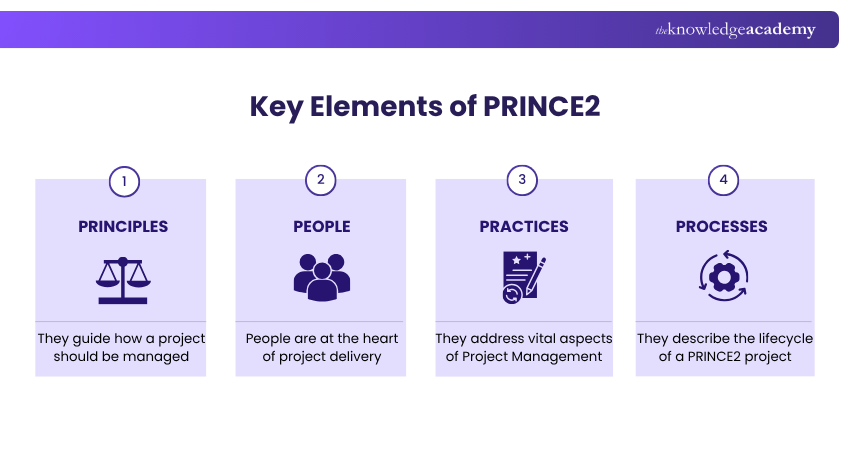
PRINCE2 brings its guidance together through four integrated elements:
1) Principles
The principles provide the foundation for applying PRINCE2. They guide how the method should be used and help ensure that a project is genuinely being managed using PRINCE2.
The seven principles cover areas such as continued business justification, learning from experience, defined responsibilities, management by stages, management by exception, focus on products and tailoring to suit the project.
2) People
People are central to successful projects. PRINCE2 7 explicitly recognises the people involved in the project and those affected by the changes it delivers.
This element encourages project teams to consider relationships, communication, leadership and how people respond to change.
Steer projects to success with confidence the PRINCE2 way. Sign up for our range of PRINCE2® Courses now!
3) Practices
Practices cover important aspects of Project Management that should be addressed throughout the project. The seven practices are:
a) Business Case
b) Organising
c) Plans
d) Quality
e) Risk
f) Issues
g) Progress
Together, they help teams consider whether the project remains justified, what needs to be delivered and how uncertainty, quality and progress should be managed.
4) Processes
Processes describe the progression of a PRINCE2 project from the activities before initiation through delivery and eventual closure. They help clarify what decisions and management activities are required at different points in the project lifecycle.
Trainer's Pro Tip
Don't assume every PRINCE2 management product needs maximum detail. Tailor documentation, controls and responsibilities according to the project's scale, risk, complexity and environment.
Advantages of PRINCE2® Methodology
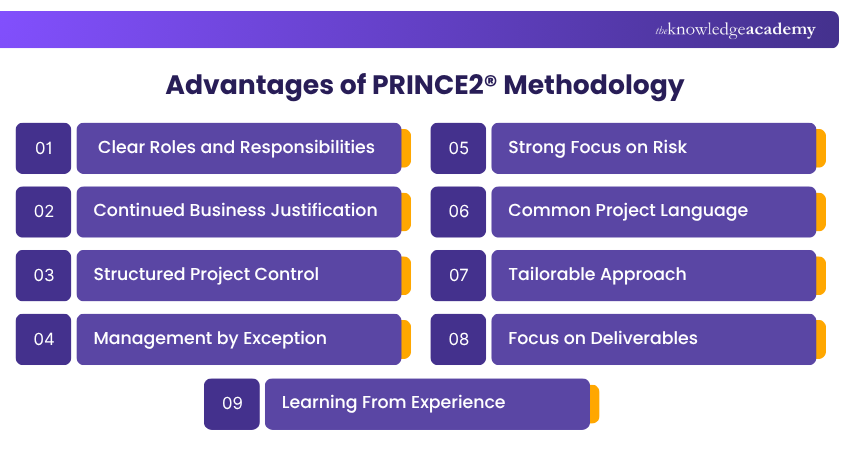
PRINCE2’s strengths can be better understood by looking at how PRINCE2 supports project governance and decision-making. Let’s dive in:
1) Clear Roles and Responsibilities
PRINCE2 establishes defined responsibilities within the project management team. This helps clarify who makes decisions, who manages day-to-day activities and who represents different project interests. Clear accountability can reduce confusion and make it easier to understand where decisions should be made or escalated.
2) Continued Business Justification
PRINCE2 requires projects to have continued business justification. Rather than assuming a project should continue simply because work has started, teams regularly consider whether it remains worthwhile, achievable and aligned with its objectives. This can help organisations avoid continuing projects whose justification has significantly changed.
3) Structured Project Control
PRINCE2 provides a defined management structure for initiating, directing, controlling and closing projects. Projects are managed in stages, giving decision-makers opportunities to review progress and determine whether continuing with the next stage remains appropriate.
4) Management by Exception
One of PRINCE2's distinctive principles is management by exception. Appropriate tolerances can be established for areas such as time, cost, quality, scope, benefits and risk. As long as work remains within agreed tolerances, management can continue at the appropriate level without unnecessary escalation. If a tolerance is forecast to be exceeded, the issue can be escalated to the appropriate management level.
Trainer's Pro Tip
Management by exception works best when tolerances and escalation routes are clear from the beginning. Teams should understand what they can decide independently and when an issue needs to move to the next management level.
5) Strong Focus on Risk
Risk is one of the PRINCE2 practices. The method encourages teams to identify, assess and control uncertainty throughout the project rather than considering risk only at the beginning. This can help teams understand threats and opportunities and decide how they should be addressed.
6) Common Project Language
A shared framework can give project participants common terminology for roles, management products, processes and decisions. This can improve consistency when different teams or stakeholders need to collaborate on the same project.
7) Tailorable Approach
PRINCE2 is intended to be tailored to suit the project. The appropriate level of governance, documentation and control can vary according to factors such as project size, complexity, risk, delivery method and organisational environment. This flexibility is particularly important because applying the same level of control to every project could create unnecessary overhead.
Master the methodologies that drive successful projects – Sign up for our PRINCE2® Practitioner Training now!
8) Focus on Deliverables
PRINCE2 emphasises defining products clearly before planning the activities required to create them. This product focus can help teams establish clearer expectations about what needs to be delivered and the quality criteria those deliverables should satisfy.
9) Learning From Experience
PRINCE2 encourages project teams to use lessons from previous experience and capture new lessons throughout the project. This can help teams avoid repeating known mistakes and improve how future stages or projects are managed.
Pro Tip
Tailor the method to the project, not the project to the method. Good PRINCE2 implementation preserves useful governance while removing unnecessary complexity.
Disadvantages of PRINCE2® Methodology
Despite its benefits, PRINCE2 comes with some challenges. Here are the key ones to watch out for:
1) Can Become Documentation-heavy
PRINCE2 uses management products to support planning, decision-making and control. If organisations create more documentation than their project actually requires, administration can begin to consume unnecessary time. The challenge is therefore not simply the existence of documentation, but determining the appropriate level of detail.
How to reduce it: Tailor management products to the project's needs and avoid producing information that does not support a useful decision or control.
2) Can Feel Complex at First
PRINCE2 introduces specific terminology, responsibilities, practices and processes. Teams unfamiliar with the method may initially need time to understand how these parts work together. This can create a learning curve, particularly when an organisation is introducing PRINCE2 for the first time.
How to reduce it: Provide appropriate guidance and introduce the method in a way that reflects the team's responsibilities.
3) Poor Tailoring Can Create Bureaucracy
PRINCE2 is designed to be tailored, but effective tailoring requires judgement. Applying every possible control, document or procedure at maximum detail can make a relatively straightforward project unnecessarily complicated.
How to reduce it: Match the level of governance and control to the project's size, risk, complexity and context.
4) Requires Clear Role Adoption
Defining roles is useful only when people understand and perform those responsibilities.
If responsibilities exist on paper but decisions continue to be made informally or by the wrong people, the expected governance benefits may not materialise.
How to reduce it: Clarify responsibilities and decision authority at the beginning of the project.
5) Structured Governance May Feel Heavy for Small Projects
A small, low-risk project may not require the same level of formal control as a complex programme of work. If PRINCE2 is applied without sufficient tailoring, its structure can feel disproportionate to the project's needs.
How to reduce it: Use lighter governance, reporting and documentation while preserving the principles that are relevant to the project.
Pro Tip
Don't remove PRINCE2 controls simply to make a project feel more agile. Instead, simplify how those controls are applied. Keep the governance that supports good decisions while reducing unnecessary documentation and reporting.
6) Effective Application Requires Understanding
Teams need to understand why PRINCE2 controls exist rather than simply following them mechanically. Without this understanding, organisations may create documents or hold reviews because “PRINCE2 requires them” without considering whether those activities actually help manage the project.
How to reduce it: Focus on the purpose behind the method and tailor its application accordingly.
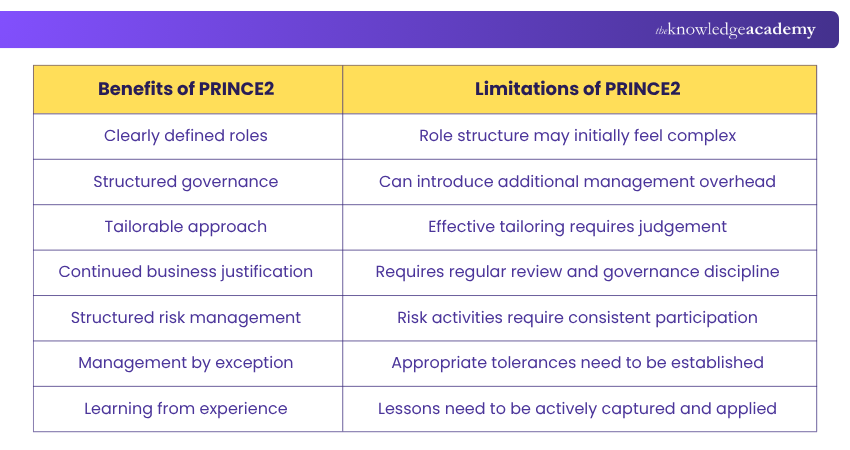
Here are the PRINCE2 Advantages and Disadvantages at a glance:
When Should You Use PRINCE2?
The existing blog describes PRINCE2 as being used in areas such as governance, construction, finance and IT. However, industry alone does not determine whether PRINCE2 is appropriate.
It can be particularly useful when a project requires:
1) Clear governance and decision-making authority
2) Defined roles and accountability
3) Continued business justification
4) Structured management stages
5) Formal risk and issue management
6) Multiple stakeholders or teams
7) Clear escalation routes
8) Consistent progress monitoring
So, the question you should ask is not just “Is this project large enough for PRINCE2?” but “What level of PRINCE2 governance does this project actually need?”
Reality Check: Is PRINCE2 Really Rigid?
PRINCE2 provides structure. It does not require every project to be managed identically.
A poorly tailored implementation may feel rigid because teams impose unnecessary controls or documentation. Appropriate tailoring allows the method to reflect the project's context while maintaining effective governance.
Trainer's Pro Tip
If PRINCE2 feels excessively bureaucratic, examine how it has been tailored before blaming the method itself. Applying more documentation and controls than the project needs can create the very overhead tailoring is intended to avoid
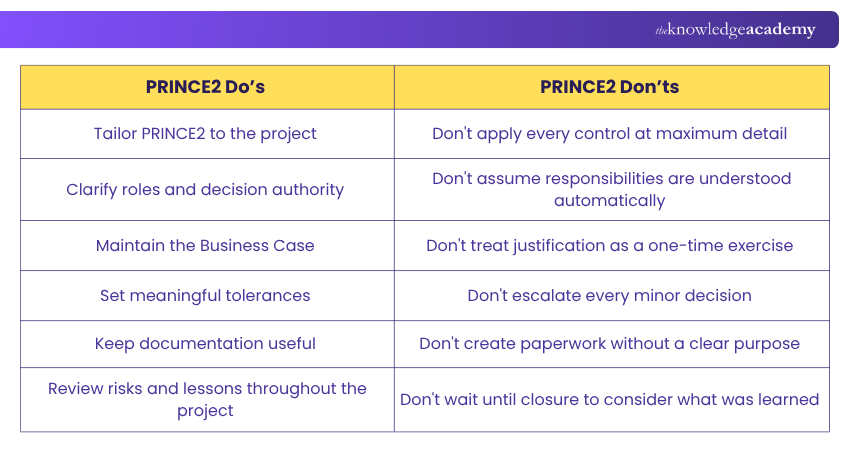
The following PRINCE2 do’s and don’ts must be kept in focus for better results:

The Knowledge Academy develops accessible learning content across Project Management, IT, Cybersecurity, Data Science, Business Analysis, HR, Accounting and Finance, Leadership and Health and Safety. Its resources combine subject research with clear explanations to help professionals build practical knowledge across a wide range of disciplines.
View Detail

 If you wish to make any changes to your course, please


