


 Top Rated Course

We may not have the course you’re looking for. If you enquire or give us a call on +44 1344 203 999 and speak to our training experts, we may still be able to help with your training requirements.
What is Agile: A Beginner’s Guide to Agile Development
The Knowledge Academy 13 July 2026Agile is an iterative Project Management approach that delivers value through short cycles, continuous feedback and rapid adaptation to changing business needs. It encourages collaboration, flexibility, and a culture of ongoing improvement. It helps teams respond efficiently to customer needs while delivering high-quality outcomes.

Training Outcomes Within Your Budget!
We ensure quality, budget-alignment, and timely delivery by our expert instructors.
Table of Contents

Projects rarely move in a straight line. As priorities change, customer needs evolve, and challenges appear, understanding What is Agile has become important. It offers a flexible and people-focused way of working that adapts as projects grow, where traditional approaches fall short.
Built around collaboration, continuous feedback, and improvement, Agile helps teams to respond quickly towards change. In this blog, you will learn about What is Agile, its history, types, principles, and more. Keep reading to explore how Agile supports better ways of working.
Table of Contents
1) What is Agile?
2) What is Agile Software Development?
3) Agile Principles
4) Types of Agile Methodologies
5) Advantages and Disadvantages of Agile
6) Agile Tools
7) What Roles are Involved in Agile?
8) What is a Backlog in Agile?
9) Conclusion
What is Agile?
Agile is a Project Management approach that focuses on flexibility, collaboration, and continuous improvement. It breaks work into small, manageable phases, known as sprints. This approach allows teams to plan, build, review, and improve their work in a structured way, making progress visible and measurable.
Through cross-functional teamwork and regular feedback, Agile is valuable for teams to respond quickly to change. Continuous review and improvements ensure that each sprint delivers real value, reduces risks, and keeps the project aligned with the customer needs and overall business goals.

1) Pre-2001: The Foundation
Before 2001, many software development projects followed traditional, plan-driven methods such as the Waterfall model. While these approaches provided structure, they often struggled to accommodate changing customer requirements and evolving business needs.
During the 1990s, several lightweight development methodologies, including Scrum, Extreme Programming (XP), Crystal, and Feature-Driven Development (FDD), emerged to promote greater flexibility, collaboration, and iterative development. These methodologies laid the foundation for the Agile approach.
2) 2001: Birth of Agile Manifesto
In February 2001, seventeen software developers gathered to overcome the challenges of traditional software development methods. Their collaboration resulted in the Agile Manifesto, which gave four core values and 12 guiding principles.
These values focused on individuals, collaboration, customer involvement, and responding to change. This marked the official beginning of Agile as a unified approach and established a shared vision for modern software development.
3) Post-2001: Widespread Adoption
Following the introduction of the Agile Manifesto, Agile gained widespread acceptance across the software industry before expanding into sectors such as finance, healthcare, manufacturing, education, and marketing.
Organisations adopted Agile frameworks such as Scrum, Kanban, Lean, and XP to improve collaboration, accelerate delivery, and respond effectively to changing customer needs. Today, Agile is widely recognised as a flexible Project Management approach used by organisations of all sizes to drive innovation and continuous improvement.
What is Agile Software Development?
Agile Software Development goes beyond specific frameworks like Scrum, Kanban, or Extreme Programming. It is rooted in the Agile Manifesto, which encourages teams to adapt their methods based on project needs rather than follow rigid processes. Instead of following a strict, linear plan, teams work in short, iterative cycles, called sprints, to design, develop, and test features.
This approach enables developers to adapt to new insights, changing user needs, and unexpected challenges. By prioritising communication, transparency, and working software, Agile Software Development ensures that the final product evolves naturally based on real-world feedback.
Agile Principles
Agile Project Management is based on 12 principles and four values, which are listed in the Agile Manifesto. The document was originally created by seventeen Software Development Practitioners who wanted to simplify the process by responding to heavy, rigid processes and domain-specific values. The twelve Agile principles are as follows:
a) Satisfying the customer through continuous delivery
b) Welcoming change at all stages of development
c) Frequently delivering working software
d) Business people and developers work together throughout the project
e) Building projects around motivated individuals
f) Having face-to-face conversations with the team members
g) Making working software as the primary measure of progress
h) Promoting sustainable development using Agile processes
i) Enhancing Agility using good design and technical excellence
j) Maximising the amount of work done
k) Having self-organising teams to develop the best architectures and designs
l) Reflecting regularly on how to become more efficient
Strengthen your ability to manage large-scale initiatives with our Agile Programme Management (AgilePgM®) Course – Register today!
Types of Agile Methodologies
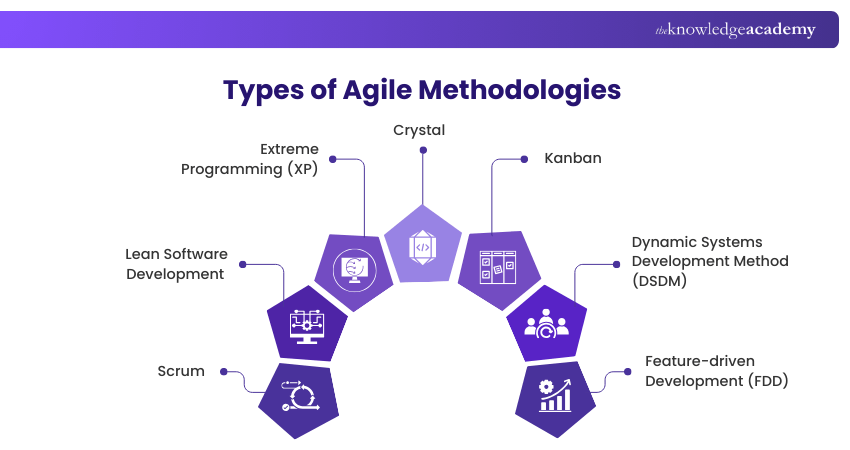
Agile isn’t limited to one specific process or framework. Instead, it includes a variety of methodologies, each offering a unique approach to delivering value quickly, improving collaboration, and adapting to change. Here are some of the most widely used Agile methodologies:
1) Scrum
Scrum is one of the famous Agile methodologies, known for its simplicity and structure. It organises work into short, time-boxed iterations called sprints, typically lasting two to four weeks. A Scrum team includes defined roles such as the Scrum Master, Product Owner, and Developers, all collaborating to deliver a potentially shippable product increment by the end of each sprint.
2) Lean Software Development
Inspired by Lean manufacturing principles, Lean Software Development aims to reduce waste, enhance learning, and optimise the flow of value. It encourages delivering small, incremental improvements and empowers teams to make decisions, thereby speeding up delivery and improving quality.
3) Extreme Programming (XP)
Extreme Programming focuses on enhancing software quality and responsiveness to changing requirements. It introduces practices such as pair programming, continuous integration, Test-Driven Development (TDD), and frequent releases. XP encourages close collaboration between developers and stakeholders to ensure the final product matches user needs.
4) Crystal
Crystal is a family of Agile methodologies that adapts based on the size and complexity of the team and project. It promotes frequent delivery, reflective improvement, and high user involvement. Crystal places greater emphasis on people, interaction, community, and skills over rigid processes, offering flexibility in its application.
5) Kanban
Kanban is a visual workflow management system that helps teams manage work efficiently. It uses a Kanban board to display tasks in different stages of the process, promoting transparency and encouraging continuous delivery. Teams focus on limiting work in progress to improve flow and reduce cycle time.
6) Dynamic Systems Development Method (DSDM)
DSDM is a full project delivery framework that focuses on delivering business value on time and within budget. It follows an iterative lifecycle and incorporates practices like active user involvement, integrated testing, and frequent delivery of working products. DSDM sets strict time and resource boundaries, ensuring projects remain focused and effective.
7) Feature-Driven Development (FDD)
Feature-Driven Development combines Agile methods with model-driven techniques. It emphasises building and delivering features with small, client-valued functions every few days. FDD promotes upfront design and detailed planning, making it suitable for larger projects that require clear structure and documentation.
Prove your Agile project expertise and stand out as an Agile Project Leader with the Certified Professional in Agile Project Management (CPAPM) Course – Join now!
Advantages and Disadvantages of Agile
While Agile offers impressive benefits like flexibility, faster delivery, and stronger collaboration, it also comes with challenges that teams must be prepared to manage. Exploring both sides helps ensure you make informed, practical decisions when adopting Agile. So, here are the advantages and disadvantages of understanding what Agile is:
1) Advantages of Agile
Here are the advantages of Agile:
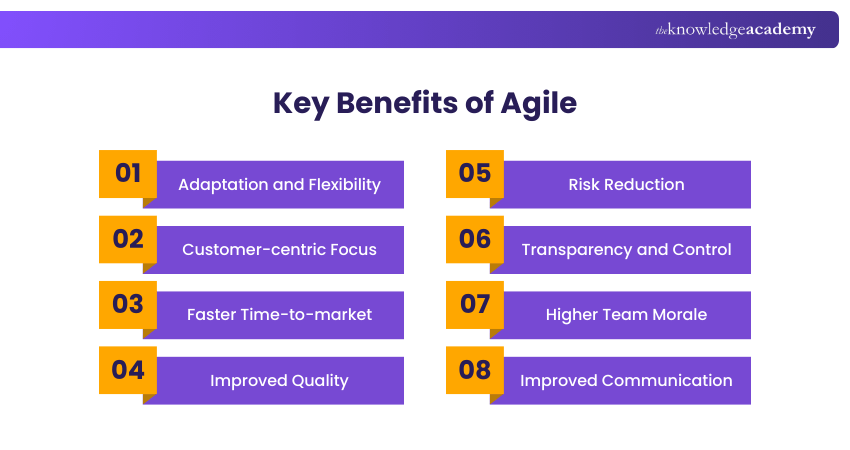
a) Adaptation and Flexibility: Agile easily integrates changing requirements, even during late stages of the development process. This helps organisations remain competitive.
b) Customer-centric Focus: Regular feedback and frequent delivery of working software ensure solutions meet real customer needs.
c) Faster Time-to-market: Iterative releases enable teams to launch usable products sooner and deliver value to customers sooner.
d) Improved Quality: Continuous testing and reviewing help to identify and fix issues proactively. This results in a higher-quality product.
e) Risk Reduction: Short sprints and regular inspections help to identify problems early. This helps organisations to avoid costly surprises.
f) Transparency and Control: Daily meetings like stand-ups and regular demonstrations provide clear visibility into progress made.
g) Higher Team Morale: Empowered, self-organising teams experience stronger ownership of their work. This results in better collaboration and motivation.
h) Improved Communication: Ongoing and direct interaction reduces misunderstandings and improves alignment of the work with business goals.
2) Disadvantages of Agile
Here are the disadvantages of Agile:
a) Unpredictability: Agile makes it difficult to fix timelines, budgets, and scope early as requirements evolve throughout the project lifecycle.
b) Risk of Scope Creep: Continuous changes and new inputs can expand the project beyond the original objectives. This can result in the delay of deadlines.
c) High Customer Involvement: Agile is reliant on regular stakeholder feedback. This can potentially slow down progress if customers are unavailable or unclear.
d) Limited Documentation: Agile focuses on working software, which often results in minimal documentation. This makes maintenance and knowledge transfer challenging.
e) Scaling Challenges: Agile can be difficult to manage in large teams or complex projects due to the demand for increased coordination and communication.
Agile Tools
Agile Software Development tools help teams plan, track, and manage iterative work more effectively. They support collaboration, backlog management, sprint planning, reporting, and visual workflows. Popular options include:
a) Jira
b) Trello
c) Monday.com
d) ClickUp
e) Wrike
f) Zoho Sprints
g) Notion
These tools make it effective to monitor progress, manage dependencies, streamline communication, and ensure transparency across the team.
Build a unified, high-performing Agile team with our Agile for Teams Training – Sign up soon!
What Roles are Involved in Agile?
Successful Agile projects rely on cross-functional teams where each role contributes to delivering value efficiently. While responsibilities may vary across Agile frameworks, the following roles are commonly involved in Agile teams:
1) Product Owner
The Product Owner represents the customer and is responsible for maximising product value. They define the product vision, prioritise the product backlog, clarify requirements, and ensure the team focuses on delivering features that meet business and customer needs.
2) Scrum Master
The Scrum Master serves as a facilitator and coach for the Agile team. They ensure Agile principles and Scrum practices are followed, remove obstacles that hinder progress, support collaboration, and help the team continuously improve its processes.
3) Development Team
The Development Team or Developers consists of professionals with the skills required to design, build, test, and deliver working product increments. Team members collaborate closely, self-organise their work, and share responsibility for achieving Sprint goals.
4) Stakeholders
Stakeholders include customers, business leaders, users, and other individuals with an interest in the project's outcome. They provide valuable feedback, help define business requirements, and ensure the product aligns with organisational objectives.
5) Agile Coach
An Agile Coach helps teams and organisations adopt Agile practices effectively. They provide guidance, mentor teams, promote Agile values, and support continuous improvement to enhance collaboration, productivity, and overall Agile maturity.
What is a Backlog in Agile?
An Agile backlog is a prioritised list of work items that need to be completed to deliver a product or project successfully. It typically includes user stories, features, bug fixes, enhancements, and technical tasks, all organised based on business value and priority.
The Product Owner is responsible for maintaining and refining the backlog by adding new requirements, updating priorities, and removing outdated items as project needs evolve. A well-managed backlog helps Agile teams stay focused, plan upcoming sprints effectively, and deliver the highest-value work first.
Conclusion
Agile is a Project Management tool as well as a mindset. It promotes flexibility, collaboration, and continuous improvement, enabling organisations to deliver value faster, improve quality, and align with customer needs. When adopted with the right set of skills and commitment, it empowers teams to adapt confidently, strengthen delivery outcomes, and build a sustainable approach to Project Management.
Learn Agile the practical way and become confident in Agile project delivery with Agile Training today!
Frequently Asked Questions
What is Agile vs Waterfall?

Agile and Waterfall are two Project Management approaches. Waterfall is rigid with distinct, non-overlapping phases, while Agile is dynamic, cyclical, and teamwork-focused. Each suits different project types.
Is Kanban Part of Agile?
Yes, Kanban is part of the Agile methodology. Although it does not stem from Agile, it complements it by supporting its instructions, such as flexibility, constant delivery, and interactivity. Kanban is prioritised on patterns of work, which is why it is preferred by Agile teams that want to start working as efficiently as possible.

The Knowledge Academy


Global Training Provider
The Knowledge Academy is a world-leading provider of professional training courses, offering globally recognised qualifications across a wide range of subjects. With expert trainers, up-to-date course material, and flexible learning options, we aim to empower professionals and organisations to achieve their goals through continuous learning.


 If you wish to make any changes to your course, please


