


 Top Rated Course

We may not have the course you’re looking for. If you enquire or give us a call on +44 1344 203 999 and speak to our training experts, we may still be able to help with your training requirements.
Asset Management vs Investment Banking: A Detailed Comparison
The Knowledge Academy 31 March 2026Learn the key differences in Asset Management vs Investment Banking, including roles, skills, salaries, work culture, and career opportunities in finance today. Asset Management focuses on long-term wealth creation, while Investment Banking deals with capital raising, mergers, and major financial transactions.

Training Outcomes Within Your Budget!
We ensure quality, budget-alignment, and timely delivery by our expert instructors.
Table of Contents

Asset Management and Investment Banking; these two powerhouse career paths stand at the heart of global finance. Both demand strategy, but the rules and rewards differ wildly. While one focuses on nurturing investments for long-term growth, the other thrives on high-stakes deal-making. Understanding the Asset Management vs Investment Banking differences helps aspiring professionals choose the right journey toward success.
In this blog, we’ll decode the core Asset Management vs Investment Banking distinctions, explore the career trajectories and help you discover which financial frontier aligns best with your ambitions and talents. So read on and boost your career!
Table of Contents
1) What is Asset Management?
2) What is Investment Banking?
3) Asset Management vs Investment Banking
4) Career Opportunities in Asset Management and Investment Banking
5) Pros and Cons of Careers in Asset Management and Investment Banking
6) Work Environment and Lifestyle
7) Can You Go From Investment Banking to Asset Management?
8) Is Asset Management Easier Than Investment Banking?
9) Conclusion
What is Asset Management?
Asset Management refers to the process of investing and managing money on behalf of clients. Its aim is to grow and protect its wealth over a certain period. Asset Managers develop plans for investment for complementing a client’s financial goals.
To achieve increase value of investments and minimise risk, Asset Managers decide which assets to buy, such as stocks, bonds or real estate. Their work requires extensive research, Market Trend Analysis, making financial reports and using economic indicators to make informed decisions.

What is Investment Banking?
Investment Banking handles large and complex financial transactions for corporate, governments, and institutions. It helps to raise capital, guide companies through mergers and acquisitions and help them go public through Initial Public Offerings (IPOs).
Under Investment Banking, new securities are underwritten to help companies raise money by selling stocks or bonds. They make valuations on risk, deals and make sure transactions run seamlessly. Often, they act as intermediaries between companies and investors for ensuring the right price and adopting the right market strategy.
Asset Management vs Investment Banking
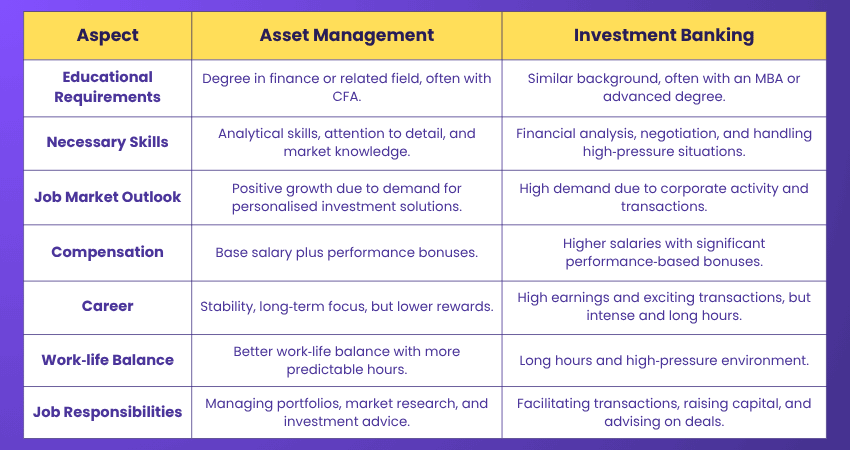
When comparing Asset Management vs Investment Banking, assess factors like education, skills, and job outlook. Understanding these will help you choose the best path for your career goals. Read on for a detailed comparison.
1) Educational Requirements
In Asset Management, a degree in finance, Economics, or a related field is typically required, often complemented by a professional qualification such as the Chartered Financial Analyst (CFA). Investment Banking usually demands a similar educational background, with additional emphasis on quantitative skills and often an MBA or other advanced degrees.
2) Necessary Skills
Asset Management professionals must possess strong Analytical Skills, keen attention to detail and a comprehensive understanding of market trends and investment strategies. Additionally, Investment Banking Skills are crucial for investment bankers, as they require robust financial analysis capabilities, negotiation skills and ability to handle high-pressure situations effectively.
3) Job Market Outlook
Both fields have strong career prospects. Asset Management is expanding as people seek customised support on their investments. Investment Banking remains a highly competitive field, driven by constant corporate deals and capital raising. While both offer several opportunities, Investment Banking delivers a slightly higher pay.
Unlock the future of finance! Sign up for our Cryptocurrency Trading Training today and master the skills to profit in the Digital Currency Market!
4) Compensation
Compensation in Asset Management generally includes a combination of base salary and performance-based bonuses, which can vary based on factors like experience and the Asset Manager Salary structure within the firm. In Investment Banking, salaries are often higher, with significant bonuses tied to successful deals and performance, reflecting the high-stress nature and long hours of the job.
5) Career Advantages and Disadvantages
Asset Management offers a career with potentially more stability and a focus on long-term investment strategies. However, it may involve less dramatic financial rewards compared to Investment Banking, which offers higher earning potential and the excitement of high-stakes transactions but can entail longer hours and a more intense work environment.
6) Work-life Balance
Asset Management typically provides a better work-life balance compared to Investment Banking. Investment bankers often face long hours and high-pressure environments, while Asset Managers may enjoy more predictable working hours.
7) Job Responsibilities and Environment
In Asset Management, professionals focus on managing and growing client portfolios, conducting market research, and providing investment advice. Investment bankers work on raising capital, facilitating mergers and acquisitions and advising on complex financial transactions. The environment in Asset Management is often more client-focused and steady, whereas Investment Banking is fast-paced and transaction-oriented.
Break into investment banking confidently by joining the Investment Banking Training today!
Career Opportunities in Asset Management and Investment Banking
Asset Management and Investment Banking both offer high-growth and well-paid career paths in finance. Let's look at the rewarding roles to help you choose the direction that suits your career goals below:
1) Career Opportunities in Asset Management
In Asset Management, professionals manage investment portfolios for individuals, institutions, or funds. These roles require strong analytical and quantitative skills, with a focus on long-term performance and asset allocation. Some of the key roles include:
1) Portfolio Manager
2) Investment Analyst
3) Equity Research Analyst
4) Fixed Income Analyst
5) Risk Manager
6) Hedge Fund Manager
7) Private Equity Analyst
2) Career Opportunities in Investment Banking
Generally, investment banking roles are fast-paced and deal-driven, involving capital raising, Mergers and Acquisitions (M&A), and financial advisory. Professionals work closely with corporate clients and must excel in financial modelling and client management. Some of the key roles include:
1) Analyst
2) Associate
3) Vice President (VP)
4) Director / Senior Vice President (SVP)
5) Managing Director (MD)
Fixed assets mastery begins with smart Accounting and sharper management. Learn more in our Fixed Assets Accounting and Management Course - Sign up now!
Pros and Cons of Careers in Asset Management and Investment Banking
Asset Management or Investment banking, each pathway offers meaningful advantages and notable challenges. Let's explore them:
1) Pros of Asset Management
1) It offers more predictable working hours and healthier work-life balance.
2) It delivers stable, long-term career growth focused on Portfolio Management.
3) It ensures strong client relationships and steady interaction with investors.
4) It offers the opportunity to help individuals and institutions achieve long-term financial goals.
2) Cons of Asset Management
1) It’s sensitive to market downturns, which can affect performance and job security.
2) Slower-paced environment may not suit those seeking adrenaline-filled work.
3) Client retention and fund performance heavily influence the career progression.
3) Pros of Investment Banking
1) This has high earning potential, especially at senior levels.
2) It handles work on major, market-shaping deals with significant impact.
3) It’s got fast-paced, competitive environment that rewards ambition and drive.
4) It ensures strong prestige and visibility in global finance.
4) Cons of Investment Banking
1) It involves long, demanding hours that strain work-life balance.
2) It includes high-pressure environment with tight deadlines.
3) Vulnerable to economic cycles; deal flow drops during downturns.
4) Intense competition and steep learning curve.
Work Environment and Lifestyle
Asset Management offers a more stable and predictable work environment, typically involving 40–60 working hours per week with fewer weekend demands. The focus is on research, portfolio management, and long-term performance, allowing professionals to take a strategic approach to investments. The culture is collaborative, with lower turnover, and values strong analytical skills and a deep interest in financial markets.
In contrast, Investment Banking is highly demanding and fast-paced, often requiring 70–90+ hours per week, including late nights and weekends. The work is transaction-driven, centred on mergers, acquisitions, and capital raising, with strict deadlines and high client expectations. The environment is competitive and high-pressure, requiring strong financial modelling skills, resilience, and attention to detail.
Learn how to build and manage profitable investments with the Investment And Portfolio Management Course – Sign up now!
Can You Go From Investment Banking to Asset Management?
Yes, you can transition from Investment Banking to Asset Management. Many bankers adopt this career path as their skills in financial analysis and modelling are highly sought after. This shift involves focusing on long-term investments, Portfolio Management and client needs. Also, earning CFA qualification can boost your transition opportunities.
Is Asset Management Easier Than Investment Banking?
Asset Management is generally considered easier than investment banking in terms of hours and intensity, but “easier” depends on what you find challenging. Asset Management is less demanding day-to-day, but it still requires deep technical skill and consistent performance. Investment banking is more time-consuming, making it harder for many professionals. But it also offers higher pay and more visibility.
Conclusion
The choice between Asset Management vs Investment Banking hinges on your career goals and preferences. Asset Management offers stability and a balanced lifestyle, while Investment Banking provides high earnings and a fast-paced environment. Understanding the differences between both careers can help you make an informed decision and pursue a path that aligns with your strengths and ambitions.
Learn pricing tactics and demand forecasting methods with our Revenue Management Training - Register today!
Frequently Asked Questions
How Many Types of Investment Banking are There?

Investment Banking primarily includes three types:
1) Mergers and Acquisitions (M&A), which involves advising on company transactions
2) Underwriting, where banks help companies issue new securities.
3) Sales and Trading, focusing on buying and selling financial instruments for clients.
What is the Best Practice for Asset Management?
The best practices in Asset Management include:
1) Diversification
2) Spreading investments across various asset classes to reduce risk
3) Regular performance reviews
4) Adjusting strategies based on market conditions
5) Clear goal setting
6) Aligning investment choices with clients' financial objectives
What are the Other Resources and Offers Provided by The Knowledge Academy?
The Knowledge Academy takes global learning to new heights, offering over 3,000+ online courses across 490+ locations in 190+ countries. This expansive reach ensures accessibility and convenience for learners worldwide.
Alongside our diverse Online Course Catalogue, encompassing 17 major categories, we go the extra mile by providing a plethora of free educational Online Resources like Blogs, eBooks, Interview Questions and Videos. Tailoring learning experiences further, professionals can unlock greater value through a wide range of special discounts, seasonal deals, and Exclusive Offers.
What is The Knowledge Pass, and How Does it Work?
The Knowledge Academy’s Knowledge Pass, a prepaid voucher, adds another layer of flexibility, allowing course bookings over a 12-month period. Join us on a journey where education knows no bounds.
What are the Related Courses and Blogs Provided by The Knowledge Academy?
The Knowledge Academy offers various Investment and Trading Training, including Investment Banking Training, Revenue Management Training, and Real Estate Risk Training. These courses cater to different skill levels, providing comprehensive insights into Foreign Portfolio Investment (FPI).
Our Business Skills Blogs cover a range of topics related to Investment Banking and Asset Management, offering valuable resources, best practices, and industry insights. Whether you are a beginner or looking to advance your Investment Banking and Asset Management Skills, The Knowledge Academy's diverse courses and informative blogs have got you covered.

The Knowledge Academy


Global Training Provider
The Knowledge Academy is a world-leading provider of professional training courses, offering globally recognised qualifications across a wide range of subjects. With expert trainers, up-to-date course material, and flexible learning options, we aim to empower professionals and organisations to achieve their goals through continuous learning.

Upcoming Business Skills Resources Batches & Dates
Date
 Investment Banking Training Course
Investment Banking Training Course
Fri 14th Aug 2026
Investment Banking Training Course
Fri 6th Nov 2026

 If you wish to make any changes to your course, please


