


 Top Rated Course

We may not have the course you’re looking for. If you enquire or give us a call on +44 1344 203 999 and speak to our training experts, we may still be able to help with your training requirements.
Capital Markets: What They are and How They Work
Olivia Taylor 24 February 2026Capital Markets are financial platforms where long-term stocks and bonds are traded, connecting investors with organisations seeking capital. They play a key role in economic growth by enabling businesses to fund expansion. These markets also offer investors opportunities to earn returns while managing risk over time.

Training Outcomes Within Your Budget!
We ensure quality, budget-alignment, and timely delivery by our expert instructors.
Table of Contents
Capital Markets are essential to the process of urban economic growth and financial stability. They serve as a bridge between the investors and the corporate and government entities that are looking for long-term financing. So, let's dive into the workings of these markets and their significance in the modern economy.
Table of Contents
1) What are Capital Markets?
2) How do Capital Markets Work?
3) Components of a Capital Market
4) Types of Capital Markets
5) Functions of a Capital Market
6) What are the Best-known Capital Markets?
7) Are Capital Markets the Same as Financial Markets?
8) What Markets Do Firms Use to Raise Capital?
9) Conclusion
What are Capital Markets?
Capital Markets are financial marketplaces where companies and governments raise capital or money to fund their growth, operations or public projects. This is carried by selling financial assets, such as company shares or debt instruments to investors seeking returns on their money. Some popular examples of Capital Markets include the stock market, the bond market and the commodity market.
In Capital Markets, mainly two groups are connected, known as buyers and sellers. Sellers refer to businesses and governments looking for funds to expand. Buyers are investors, such as banks, individuals or mutual funds looking to invest and earn profit. Through Capital Market, both sides find it easier to trade by creating an organized and trusted environment.

How do Capital Markets Work
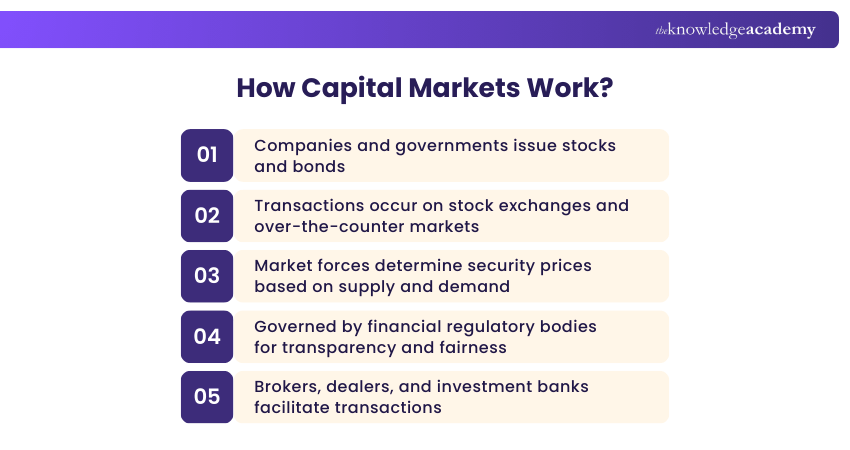
The Capital Markets are placed between the organisations that need long-term money and investors through the release of stocks and bonds. These securities are first sold in the primary market in order to gather the necessary funds.
After being sold, they are then exchanged in secondary markets where their prices are determined by the forces of demand and supply. This exchange acts as a source of liquidity and at the same time, promotes market transparency.
Upgrade your capital adequacy planning with our Asset and Liability Management Training – Register today!
Components of a Capital Market
The Capital Market is a complex and multifaceted system consisting of several key components that work together to facilitate the flow of capital and financial transactions. Understanding these components is essential to grasp how Capital Markets function:
a) Stock Markets: Capital Markets are areas in which the shares of publicly-traded companies are sold and purchased. Capital Markets Stock markets are an important element that contemplates the dealings of capital in the Capital Markets.
b) Bond Markets: The aspect is concerned with the trading of debt securities such as government and corporate bonds. It enables borrowers to obtain long-term funding at a fixed interest rate.
c) Primary Markets: This is where securities are issued, which have not been issued earlier, enabling organisations to raise new capital. This entails the first-time offering of stock (IPOs) and the issue of new bonds.
d) Secondary Markets: These are forms of Capital Markets that are used to trade in the already existing securities among Investors. This is done by most of the Investors who purchase and sell stocks, bonds, and other securities.
e) Investment Banks: These banks are also very important in Capital Markets, particularly underwriting the new securities, acquisition and mergers, and also in services that offer financial advice.
f) Regulatory Bodies: Regulatory bodies control the operations of the Capital Markets. It assists businesses in the sense that it maintains transparency, fairness, and the safety of Investors.
g) Market Indices: These are statistical indices that monitor the performance of a given group of stocks or bonds, providing an understanding of the general market trends and Investor sentiment.
h) Brokers and Dealers: They are middlemen in the Capital Markets, and they carry out transactions on behalf of Investors. The orders are implemented by brokers who act on behalf of the clients and the dealers trade on their behalf.
i) Derivative Markets: The markets are characterised by instruments like futures, options, and swaps, which are pegged on an underlying asset and offer Risk Management instruments and speculative options such as Short Selling.
j) Foreign Exchange Markets (Forex): Forex, though not a traditional component, is an intersection between Capital Markets; it affects international investment and capital flows as a result of consideration of currency exchange
Types of Capital Markets
Primary markets and secondary markets are the two major types of Capital Markets. Let's explore them in detail:
1) Primary Markets
Primary Markets play a crucial role in the financial world by serving as the venue for issuing and selling new securities. Here's an in-depth look at their functioning and importance:

a) New Security Issuance: In primary markets, companies, governments, or other entities issue new stocks, bonds, or other securities to the public for the first time. This is known as an Initial Public Offering (IPO) for stocks.
b) Capital Generation: The primary purpose of primary markets is to enable issuers to raise capital directly from Investors. This capital is often used for expansion, development projects, or other operational needs.
c) Pricing of Securities: In the primary market, the price of new securities is typically determined through various methods, such as book building or auctions, reflecting the market's demand and the issuer's valuation.
d) Investor Access: Primary markets provide opportunities for Investors to join in during the early stages of a security's life, often offering the potential for significant returns as the security enters secondary trading.
e) Underwriting Process: Often, investment banks play a key role as underwriters, helping to set the initial price for the security, managing the IPO process, and sometimes guaranteeing the sale of securities by purchasing them first.
f) Regulatory Compliance: Issuers in primary markets must adhere to stringent regulatory requirements, providing detailed information about their business, financial health, and risks associated with the securities offered.
g) Market Indicators: The performance and trends in the primary market can be indicators of the broader economic environment, Investor confidence, and the appetite for new investments.
h) Exclusivity and Accessibility: Initially, primary market offerings may be restricted to institutional Investors or high-net-worth individuals, but they often become more accessible to retail Investors.
i) Reduction in Intermediaries: Transactions in Primary Markets involve fewer intermediaries than Secondary Markets, as Investors buy securities directly from the issuer.
j) Economic Impact: By facilitating the direct transfer of funds from savers to those requiring capital, primary markets play a vital role in economic development and the efficient allocation of resources.
Do you want to harness the power of Letters of Credit? Sign up now for our Letters of Credit Training Course!
2) Secondary Markets
The Secondary Market is a key component of the financial ecosystem, providing a platform for the buying and selling of previously issued securities. This market plays a big role in the overall financial system:
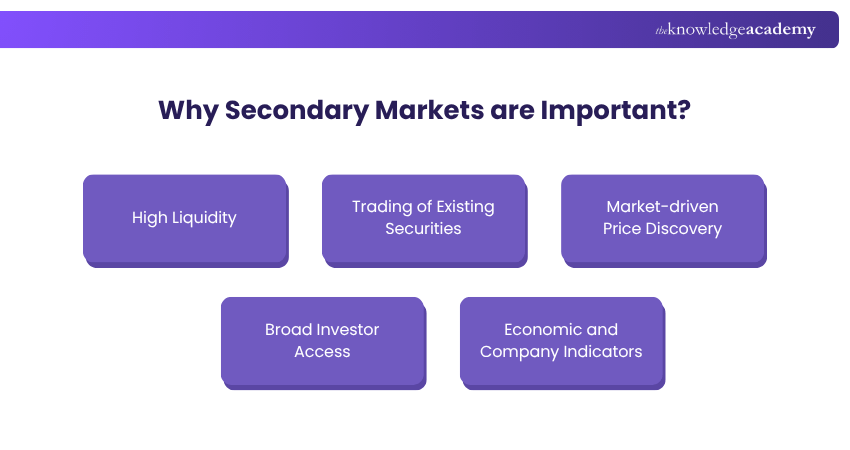
a) Trading of Existing Securities: Unlike the Primary Market where the securities are issued for the first time, the secondary market involves trading existing securities among Investors.
b) Liquidity Provision: It provides liquidity to Investors, enabling them to buy and sell securities quickly and efficiently. This liquidity is crucial for Investors looking to convert their investments into cash.
c) Price Discovery: The secondary market is instrumental in determining the securities' market price through supply and demand. This continuous price discovery process reflects the current value of the underlying assets.
d) Access to a Wider Investor Base: Securities traded in the secondary market are accessible to a range of investors including individuals and institutional Investors. This facilitates more involvement in the financial markets.
e) Market Indicators: The performance of securities in the secondary market often indicates the financial health of the issuing company and the economy at large.
f) Diversification Opportunities: Investors in the secondary market can access various securities, allowing them to diversify their investment portfolios and manage risk.
g) Regulatory Oversight: This market operates under strict regulatory oversight to ensure fair trading practices, transparency and Investor protection.
h) Role of Brokers and Exchanges: Transactions in the secondary market typically occur through stock exchanges and involve brokers and dealers who facilitate the buying and selling of securities.
i) Global Reach: The secondary market often has an international scope, allowing for cross-border Securities Trading, enhancing market depth and investment opportunities.
j) Economic Feedback Loop: The secondary market's activity provides feedback on the primary market, influencing future pricing and issuance of new securities. It also plays a role in allocating capital in the economy, as the performance of securities can direct funds to sectors and companies showing growth potential.
Functions of a Capital Market
The Capital Markets carry out a number of crucial duties which underpin the financial system and the growth of the economy. The major functions through which they connect investors, institutions, and businesses are listed below.
a) Efficient Allocation of Capital: They channel funds from savers and investors to businesses and governments that need long-term financing, supporting productive investment.
b) Risk Management: By offering a range of financial instruments, Capital Markets help participants hedge against price changes and manage financial risk.
c) Price Discovery: Continuous trading on these markets helps determine fair market prices for securities through supply and demand.
d) Facilitating Economic Growth: By enabling organisations to raise funds for expansion and innovation, Capital Markets play a vital role in broader economic development.
e) Liquidity Provision: They allow investors to buy and sell securities easily, providing liquidity and encouraging greater participation in the financial system.
Explore the Inventory Accounting And Costing Course to build accurate costing skills and support informed financial decision-making.
What are the Best-known Capital Markets?
The world’s top Capital Markets are found in major financial centres, offering high liquidity and global reach. Here are the most known markets:
a) London Stock Exchange (LSE), UK: One of the oldest exchanges, hosting global firms and offering strong regulatory oversight in Europe.
b) Euronext, Europe: A pan-European exchange operating in multiple countries with diverse cross-border listings.
c) New York Stock Exchange (NYSE), USA: The largest exchange globally, home to top firms like Coca-Cola and JPMorgan, known for its iconic trading floor and strict listing rules.
d) NASDAQ, USA: A tech-focused electronic exchange listing giants like Apple and Amazon, known for speed and innovation.
e) Tokyo Stock Exchange (TSE), Japan: Japan’s largest exchange with key listings like Toyota and Sony, crucial to Asia-Pacific markets.
f) Frankfurt Stock Exchange (FWB), Germany: Germany’s main exchange, central to European equities and global Investor access.
g) Hong Kong Stock Exchange (HKEX): A vital link between China and global markets, listing both Chinese and international companies.
h) Shanghai Stock Exchange (SSE), China: Focused on large-cap Chinese companies, supporting domestic capital growth.
Are Capital Markets the Same as Financial Markets?
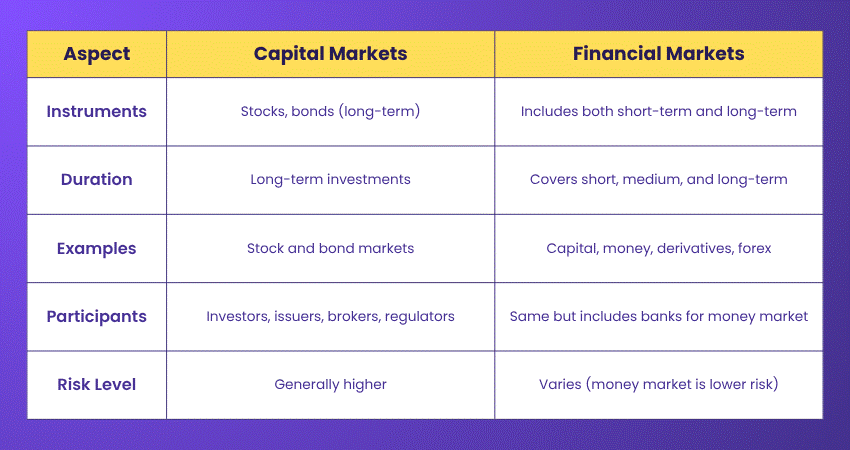
The term Capital Markets refers to a portion of the financial markets consisting only of those securities that have a long maturity such as stocks and bonds. Though the financial markets embrace all types of assets and all their durations, Capital Markets have mainly to do with the longer-term investment vehicle.
What Markets Do Firms Use to Raise Capital?
Companies usually get funds through the primary market by selling new shares or bonds, which can be in the form of initial public offerings or private placements with a chosen group of investors. Companies aren’t just getting money for expansion or daily operations but also for paying off their debts through these transactions in the primary market.
Conclusion
The Capital Markets are crucial in providing financial backing for long-term investments and thus, economic growth. Investors and firms who comprehend the structure of these markets will be able to move around confidently in the already changing fi-nancial environment of today.
Gain proficiency in Budgeting and Financial Analysis with our Accounting Courses – Sign up immediately!
Frequently Asked Questions
What are the Differences Between Capital Markets and Financial Markets?

Capital Markets are focused on the use of equity and long-term debt to obtain finances, and the financial markets, which are more comprehensive, comprise all asset categories including both short- and long-term instruments.
Which is an Example of a Capital Market?
An example of a Capital Market is the London Stock Exchange (LSE) where companies list their shares and Investors buy and sell them. Another example is the bond market, where governments raise funds by issuing long-term debt instruments.
What are the Other Resources and Offers Provided by The Knowledge Academy?
The Knowledge Academy takes global learning to new heights, offering over 3,000+ online courses across 490+ locations in 190+ countries. This expansive reach ensures accessibility and convenience for learners worldwide.
Alongside our diverse Online Course Catalogue, encompassing 17 major categories, we go the extra mile by providing a plethora of free educational Online Resources like Blogs, eBooks, Interview Questions and Videos. Tailoring learning experiences further, professionals can unlock greater value through a wide range of special discounts, seasonal deals, and Exclusive Offers.
What is The Knowledge Pass, and How Does it Work?
The Knowledge Academy’s Knowledge Pass, a prepaid voucher, adds another layer of flexibility, allowing course bookings over a 12-month period. Join us on a journey where education knows no bounds.
What are the Related Courses and Blogs Provided by The Knowledge Academy?
The Knowledge Academy offers various Accounting Courses, including the Bookkeeping Course, Project Accounting Course, and Letter Of Credit Course. These courses cater to different skill levels, providing comprehensive insights into Accounting Software.
Our Accounting and Finance Blogs cover a range of topics related to Capital Markets, offering valuable resources, best practices, and industry insights. Whether you are a beginner or looking to advance your Accounting and Finance skills, The Knowledge Academy's diverse courses and informative blogs have got you covered.

Olivia Taylor


Chartered Accountant and Financial Training Specialist
Olivia Taylor is a qualified chartered accountant with over a decade of experience in financial management, auditing and corporate reporting. Having worked with leading firms in both the public and private sectors, Olivia brings clarity to complex financial topics. Her writing focuses on helping professionals build confidence in key areas of accounting, compliance and financial planning.
View Detail
Upcoming Accounting and Finance Resources Batches & Dates
Date
 Capital Market Training
Capital Market Training
Fri 12th Jun 2026
Capital Market Training
Fri 11th Sep 2026
Capital Market Training
Fri 11th Dec 2026

 If you wish to make any changes to your course, please


