


 Top Rated Course

We may not have the course you’re looking for. If you enquire or give us a call on + 1-866 272 8822 and speak to our training experts, we may still be able to help with your training requirements.
Agile Principles: Key Concepts for Successful Project Delivery
David Evans 10 July 2026Agile Principles guide teams to deliver value faster through customer focus, collaboration, adaptability, simplicity, teamwork, and continuous improvement. By understanding these principles, organisations can improve efficiency, strengthen collaboration, manage work more effectively, and achieve successful project outcomes consistently.

Training Outcomes Within Your Budget!
We ensure quality, budget-alignment, and timely delivery by our expert instructors.
Table of Contents

What makes some teams consistently deliver better, faster, and smarter? Why do certain projects thrive while others struggle to find direction? The answer often lies in how well a team understands and applies Agile Principles. These guiding values do more than just structure workflows; they shape culture, decision-making, and collaboration in dynamic environments.
In this blog, you will learn about the 12 essential Agile Principles, why they matter, and more in a practical way, showing how they shape modern workflows and foster innovation. So, if you are ready to build teams that are responsive, resilient, and focused on delivering real value, keep reading to learn more!
Table of contents
1) What are the 12 Agile Principles?
2) Agile Principles Across Industries
3) Best Practices for Applying Agile Principles in an Organisation
4) Why are Agile Principles Important in Project Management?
5) How can a Company Start Implementing Agile Principles?
6) Conclusion
What are the 12 Agile Principles?
The Agile Manifesto outlines 12 essential Agile Principles that help teams build better products through flexibility, collaboration, and continuous improvement. Let’s look at each principle below
.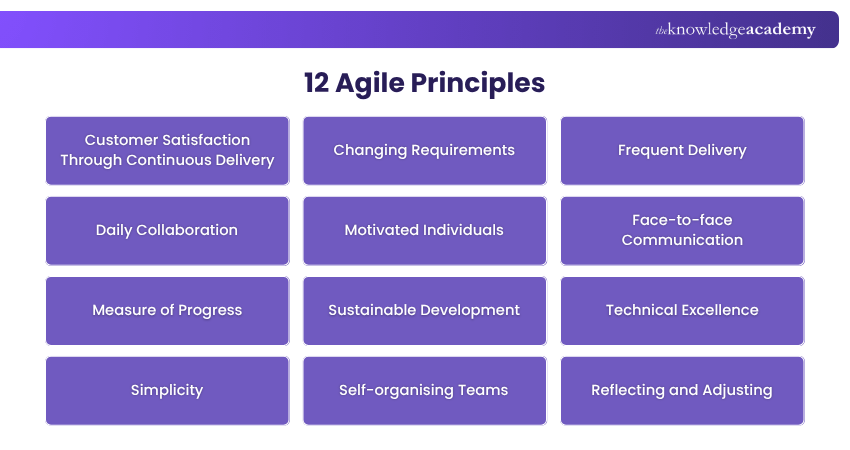
Principle 1: Customer Satisfaction Through Continuous Delivery
This principle emphasises shipping early, iterating quickly, and maintaining an ongoing relationship with customers. Agile teams aim to deliver valuable working software to customers as early as possible, allowing feedback to shape future improvements. Customer feedback continuously informs future releases and enhancements.
In Practice:
1) Launch MVPs to validate assumptions
2) Use rapid experimentation and frequent releases
3) Treat shipped software as the start of improvement, not the end

Principle 2: Changing Requirements
Agile Principle 2 encourages teams to welcome change rather than resist it. Instead of locking plans too early, Agile teams adapt based on customer feedback, market shifts, and competitive changes. This flexibility helps organisations remain relevant and deliver solutions that reflect real user needs.
In Practice:
1) Teams focus on broad strategic goals
2) Product direction changes when new insights arise
3) Stakeholder expectations are managed through frequent updates
Principle 3: Frequent Delivery
In this Agile Principle, Agile breaks work into small, manageable increments instead of long release cycles. This makes sure steady progress and enables frequent validation to reduce the potential for risks and accelerate learning.
In Practice:
1) Work is structured into short cycles or sprints of 2-4 weeks
2) Some teams use continuous deployment for even faster delivery
3) Each release validates assumptions and reduces risk
Principle 4: Daily Collaboration
This principle highlights the importance of close collaboration between business and technical teams. Continuous interaction ensures alignment, shared understanding, and that the product truly addresses customer needs. This collaboration keeps the product moving in the right direction.
In Practice:
1) Cross-functional Agile teams include business and product roles
2) Daily standups keep everyone connected and aligned
3) Catching potential misalignments early and keeping teams in sync
Principle 5: Motivated Individuals
Agile relies on empowered teams who understand the goal and are trusted to execute. Micromanagement has no place in Agile. When teams have clarity, support, and autonomy, they perform better and foster creativity.
In Practice:
1) Product explains the what and why, and engineering decides on the how
2) Teams have autonomy during development
3) Product managers support, guide, and remove obstacles
Improve collaboration and delivery with our Agile for Teams Training. Sign up today!
Principle 6: Face-to-face Communication
The sixth Agile Principle in the Agile Manifesto emphasises that real-time conversation is the fastest way to clarify ideas and solve problems. Agile values human interaction since it is helpful for reducing delays, misunderstandings, and confusion.
In Practice:
1) Conduct daily stand-ups
2) Making time for backlog grooming sessions
3) Planning sprints and conducting review meetings
Principle 7: Measure of Progress
In Agile, the primary measure of progress is working software. This principle shifts focus from documentation and processes to delivering real, usable value. By prioritising outcomes over activity, teams ensure that effort translates directly into business results.
In Practice:
1) Focus on MVPS instead of full-blown builds
2) Adopt a “fail fast” mindset to quickly learn what works and what does not
3) Ship early instead of waiting for perfection
Principle 8: Sustainable Development
In this Agile Principle, Agile promotes a steady, healthy pace that helps teams maintain it for the long term. Avoiding burnouts and unrealistic workloads leads to higher-quality work. Sustainable rhythms foster consistency and team well-being.
In Practice:
1) Teams commit only to what they can truly deliver in a sprint
2) No new work is added between sprints, except in rare cases
3) Product managers shield teams from unnecessary interruptions
Principle 9: Technical Excellence
Agile teams maintain adaptability by focusing on clean, well-structured design and code quality. Continuous attention to technical excellence prevents future bottlenecks, reduces rework, and supports long-term flexibility.
In Practice:
1) Teams track, discuss, and manage technical debt
2) Regular refactoring becomes part of the development process
3) Product allocates time for maintenance and quality improvements
Principle 10: Simplicity
Agile values are aligned only with what truly matters and avoid unnecessary work. Focusing on high-impact tasks, teams maximise efficiency and productivity. This approach is useful for eliminating waste and sharpening product direction.
In Practice:
1) Product managers prioritise using techniques, such as effort-impact analysis
2) Experiments validate ideas before they fully develop
3) Short sprints help identify wasteful or unnecessary work early
Understand the management of product backlogs and prioritisation of features. Join the SAFe® Agile Product Management Training now!
Principle 11: Self-organising Teams
Agile teams trust to organise themselves and make decisions collaboratively. This autonomy leads to faster problem-solving and stronger ownership. The best ideas often emerge from empowered cross-functional groups.
In Practice:
1) Teams take responsibility for planning, execution, and quality
2) Structures, such as “squad,” support autonomy
3) Instead of control, leaders provide direction
Principle 12: Reflecting and Adjusting
Continuous improvement is a fundamental Agile habit. Teams routinely reflect on what is working and what is not, to refine their processes. This ongoing adaptation strengthens performance over time.
In Practice:
1) Retrospectives identify wins, challenges, and improvements
2) Teams experiment with new processes as well as ideas
3) Transparency and constant feedback drive better business outcomes
Agile Principles Across Industries
Agile Principles have evolved into a universal framework for delivering value faster, adapting to change, and empowering teams across industries. It helps organisations of all types respond quickly to shifting market demands through iterative cycles, feedback loops, and self-organising teams. Let’s look at some industries that use these principles below.
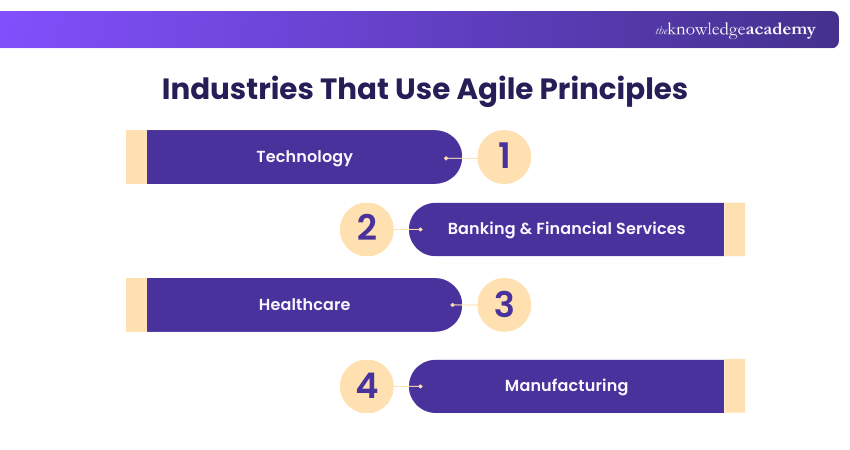
1) Technology
Technology companies were early adopters of Agile Principles to deliver value faster and offer personalised experiences. These principles support:
1) Rapid feature experiments and A/B tests to validate ideas quickly
2) Teams adapting to user preferences using real-time data
3) Innovation cycles becoming continuous instead of episodic
2) Banking & Financial Services
Modern banking requires speed, security, and seamless digital experiences. This is one of the reasons why Agile fits perfectly with its needs. Agile supports:
1) Faster development of mobile banking, digital payments, and onboarding journeys
2) Quick adaptation to regulatory changes and security requirements
3) Cross-functional squads that streamline decision-making and delivery
3) Healthcare
In the healthcare sector, responsiveness and reliability are critical. This is why Agile is important for supporting safer and more efficient care. Agile enables:
1) Process cycles and data-driven decision making to improve patient care
2) Rapid iteration in telemedicine and digital health tools
3) Enhanced collaboration among clinicians, administrators, and IT teams
4) Manufacturing
In the manufacturing sector, manufacturers use Agile to stay resilient and responsive. Agile supports:
1) Faster adaptation to market shifts, shortages, and customer demand
2) Iterative improvement in production processes and quality control
3) Shorter cycles for prototyping and product enhancements
Learn the essentials and build a solid Agile foundation with the Agile Project Management Foundation (AgilePM® V3) Course – Join now!
Why are Agile Principles Important in Project Management?
Agile Principles help project teams deliver value more effectively by promoting flexibility, collaboration, and continuous improvement. Below are some of the key reasons Agile Principles are important in Project Management.
1) Adaptability to Change: Agile Principles encourage teams to embrace changing requirements throughout the project lifecycle. This flexibility helps organisations respond quickly to market shifts, customer feedback, and evolving business needs.
2) Early and Continuous Delivery: By delivering work in smaller increments, teams can provide value sooner and gather feedback regularly. This approach improves responsiveness and accelerates time-to-market.
3) Strong Customer Alignment: Frequent customer involvement ensures that products and services meet real user needs. Regular feedback helps teams make informed decisions and deliver more relevant outcomes.
4) Improved Team Collaboration: Agile Principles promote open communication, shared responsibility, and cross-functional teamwork. This creates a more engaged workforce and improves overall project performance.
5) Reduced Project Risks: Continuous testing, reviews, and feedback allow teams to identify issues early. Addressing problems sooner reduces costly rework and increases the likelihood of project success.
Learn to apply Agile Principles with real-world confidence by joining the Agile Project Management Practitioner (AgilePM® V3) Course today!
How can a Company Start Implementing Agile Principles?
Implementing Agile Principles is most effective when approached gradually. Rather than transforming the entire organisation at once, companies should start small, encourage collaboration, and continuously refine their approach. Below are some effective ways to implement Agile Principles within an organisation.
1) Gain Leadership Support: Successful Agile Principles adoption begins with leadership commitment. Educating stakeholders on the benefits of Agile Principles helps secure the support needed to drive change across the organisation.
2) Start with a Pilot Project: Choose a small project or team to test Agile practices before scaling them across the business. This allows teams to learn, adapt, and reduce implementation risks.
3) Empower Cross-functional Teams: Create teams with diverse skills and give them the autonomy to make decisions. Empowered teams can collaborate more effectively and respond quickly to changing requirements.
4) Choose the Right Agile Framework: Select a framework that aligns with your business needs. For example, Scrum is suitable for structured, iterative work, while Kanban helps manage continuous workflows and improve visibility.
5) Establish Regular Feedback Loops: Introduce practices such as daily meetings, planning sessions, and retrospectives to review progress and identify improvements. Continuous feedback helps teams stay aligned and refine their ways of working over time.
Best Practices for Applying Agile Principles in an Organisation
Successfully applying Agile Principles requires more than adopting a framework. Organisations must create an environment that encourages collaboration, adaptability, and continuous value delivery. Let’s look at some of the best practices that can help teams apply Agile Principles effectively across the organisation below:
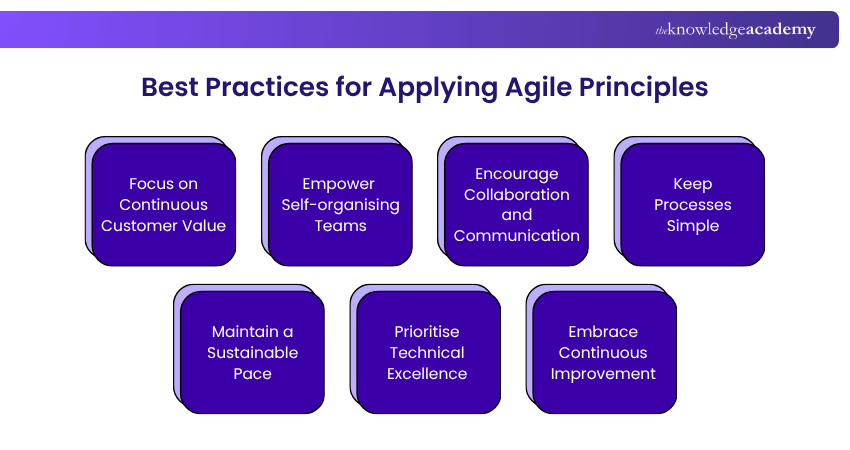
1) Focus on Continuous Customer Value: Deliver products or services in smaller, frequent increments to gather feedback early and ensure customer needs remain at the centre of development. This helps teams adapt quickly and deliver greater value over time.
2) Empower Self-organising Teams: Give teams the authority to make decisions and determine the best way to complete their work. Generally, empowered teams are more innovative, accountable, and responsive to change.
3) Encourage Collaboration and Communication: Promote regular communication between business stakeholders and delivery teams. Strong collaboration improves alignment, speeds up decision-making, and reduces misunderstandings.
4) Keep Processes Simple: Avoid unnecessary complexity in processes, documentation, and workflows. Focusing on simplicity allows teams to work more efficiently and spend more time delivering value.
5) Maintain a Sustainable Pace: Create a work environment that supports consistent productivity without overloading team members. A sustainable pace helps prevent burnout and supports long-term success.
6) Prioritise Technical Excellence: Invest in good design, quality practices, and continuous improvement of technical capabilities. This reduces rework, improves reliability, and supports future adaptability.
7) Embrace Continuous Improvement: Encourage teams to regularly review their performance, identify lessons learned, and adjust where needed. Continuous reflection helps organisations remain effective and responsive to change.
Conclusion
Agile Principles help teams deliver value, adapt to change, and collaborate more effectively. By applying these principles, organisations can improve customer satisfaction, enhance project outcomes, and support continuous improvement. In an increasingly dynamic business environment, they remain key to building resilient and high-performing teams.
Transform how you work and gain momentum with Agile Training – Sign up now!
Frequently Asked Questions
What are the Five Key Concepts of Agile Methodology?

The five key concepts of Agile are:
1) Adaptability: Teams respond quickly to changing requirements and priorities
2) Collaboration: Close communication between team members, stakeholders, and customers
3) Customer Focus: Continuous feedback ensures solutions meet user needs
4) Continuous Improvement: Teams regularly review and refine their processes
5) Simplicity: Focusing on essential work and avoiding unnecessary complexity
What is the SDLC in Agile?
The Agile Software Development Life Cycle (SDLC) is a way of developing software in small steps. It focuses on working together and getting feedback from customers. Unlike old methods, like the waterfall model, which do each step one after the other, Agile breaks the work into smaller parts that are done in short cycles.
What are the Other Resources and Offers Provided by The Knowledge Academy?
The Knowledge Academy takes global learning to new heights, offering over 3,000+ online courses across 490+ locations in 190+ countries. This expansive reach ensures accessibility and convenience for learners worldwide.
Alongside our diverse Online Course Catalogue, encompassing 17 major categories, we go the extra mile by providing a plethora of free educational Online Resources like Blogs, eBooks, Interview Questions and Videos. Tailoring learning experiences further, professionals can unlock greater value through a wide range of special discounts, seasonal deals, and Exclusive Offers.
What is The Knowledge Pass, and How Does it Work?
The Knowledge Academy’s Knowledge Pass, a prepaid voucher, adds another layer of flexibility, allowing course bookings over a 12-month period. Join us on a journey where education knows no bounds.
What are the Related Courses and Blogs Provided by The Knowledge Academy?
The Knowledge Academy offers various Agile Training, including the Agile Overview Training, Agile Programme Management (AgilePgM®) Course, and the SAFe® Agile Software Engineering Training. These courses cater to different skill levels, providing comprehensive insights into What is an Agile Epic.
Our Project Management Blogs cover a range of topics related to Agile Principles, offering valuable resources, best practices, and industry insights. Whether you are a beginner or looking to advance your Project Management skills, The Knowledge Academy's diverse courses and informative blogs have got you covered.

David Evans


Certified Project Trainer and Agile Delivery Expert
David Evans brings over a decade of hands-on experience in project delivery, Agile transformation, and team leadership. With a background in technology and business consulting, David has led cross-functional teams through Agile and Waterfall projects in both public and private sectors. He combines technical knowledge with practical insights to help readers navigate the challenges of modern project environments.

Upcoming Business Analysis Resources Batches & Dates
Date
 AgilePM® Foundation & Practitioner (AgilePM® v2)

 If you wish to make any changes to your course, please


