
Lean Six Sigma Certification Training

accredited by

Our Six Sigma course is accredited by Six Sigma

Online Instructor-led (5 days)

Online Self-paced (40 hours)

Official Lean Six Sigma Yellow Belt and Green Belt Exams

Lean Six Sigma Green Belt Course Outline

Module 1: Introduction to Lean 6 Sigma

  • What is Lean 6 Sigma?
    • Two Parts of Lean 6 Sigma
    • Focus of Lean
    • Lean Temple
    • Focus of Six Sigma
    • Making Customers Happy
    • How They Complement Each Other?
    • Key Principles of Lean 6 Sigma
  • Lean 6 Sigma Belts
    • TKA Lean 6 Sigma Belt Structure
    • Training Roadmap and Role of the Yellow Belt
    • L6S Support Network
  • Processes
    • Different Ways of Looking at Process Improvement
    • What is a Process?
    • Process Concepts
    • Types of Process
    • Comparing Process Types
  • Customers, Value, and Waste
    • What are Customers?
    • Who Wants the Outputs?
    • Tension Between the VOB and VOC
    • What Do We Mean by Value?
    • Path to Value
    • Dealing with Values
    • Muda (Waste)
    • Wastes (Muda) of Lean
    • Types of Demand
    • Case Study Exercise
  • Key Metrics

Module 2: DMAIC Cycle

  • What is DMAIC?
  • Define
    • Common Tools for Define Phase
    • Gemba Tools
    • Process Stapling
  • Measure
    • Common Tools for Measure Phase
    • Spaghetti (Movement/Transportation) Diagrams
  • Analyse
    • Common Tools for Analyse Phase
  • Improve
    • Common Tools for Improve Phase
  • Control
    • Common Tools for Control Phase

Module 3: Yellow Belt Tools and Techniques

  • Lean Triad
    • 5s
    • Poka Yoke
    • SMED
  • Voice of the Customer (and CTQ’s)
    • Customer Chains
    • Steps of VOC
    • Affinity Diagrams
    • Kano Diagrams
    • CTQs and Requirements
  • SIPOC
    • What is a SIPOC?
    • CSandF Web Fulfilment SIPOC
    • Creating a SIPOC
    • Top Tips – SIPOC
  • Value Stream Analysis
    • Value Stream Terminology
    • Process Maps
    • Aim of Value Stream Mapping
    • Swim Lanes and Typical Process Map Contents
    • Value Stream Maps
    • Headache Tablets: Value Stream Mapping
  • Heijunka
    • Heijunka in a Nutshell
    • Single Piece Flow
    • Pull
    • Kanban
    • Three-Bin System
    • Andon
  • Variation and SPC
    • Statistical Process Control (SPC)
    • Two Types of Process Variation
    • Red Bead Experiment
    • Standard Deviation (SD) and Understanding Control Charts
  • Defects and Process Capability
    • Conversion Table
    • Process Capability
    • Identifying Process Efficiency
  • Key DPMO Terms
  • Identifying the Root Cause(s)
    • 5 Whys
    • Fishbone Diagram
  • Solving Problems
    • Problem Solving Framework
    • Prioritisation Tools
    • Tools and Techniques to Generate Needed Solutions
  • Introduction to Kaizen
    • Kaizen in a Nutshell
    • Kaizen in a Business Setting
  • Lean Teams
    • Introduction to Lean Team
    • Managing Progress and Demonstrating Control

Module 4: Improvement Methodologies

  • DMAIC
  • 3Cs
  • 8Ds
  • Plan Do Check Act
  • Kaizen
  • Design for Six Sigma (DFSS)

Module 5: SPC Basics

  • Terminology
  • Data Types
  • Normal Distribution and Standard Deviation
  • Process Capability

Module 6: Lean Management and Cell Theory

  • Role of the Lean Manager
  • Work Cells
  • High Performing Teams (HPTs)
  • Rapid Action Teams (RATs)
  • Visual Management
  • Bruce Tuckman’s Group Development Model
  • Emotional Cycle of Change (ECOC)
  • Personality Styles
  • Dealing with Resistance

Module 7: Risk Management

  • Green Belt Risk Management
  • FMEA: Failure Mode and Effects Analysis

Module 8: DMAIC for Green Belts

  • Define Phase
  • Measure Phase

Module 9: SPC Tools and Techniques

  • Frequency Distribution Tables
  • Bar Charts and Histograms
  • Pareto Charts
  • Box and Whisker Plots
  • Normal Distribution and Control Charts
  • Calculating Process Efficiency
  • Scatter Diagrams and Regression

Module 10: Analyse Phase

  • Analyse
  • Process Maps
  • Process Map Levels
  • On the Ground Instructions (OTGIs)
  • Value Stream Maps
  • What is a Value Stream?
  • Creating the “As Is” VSM
  • Investigating and Understanding the Process
  • Headache Tablets: Value Stream Mapping
  • Creating a VSM: Process Borders Definition
  • Using Swim Lane Diagrams to Identify Logical Process Blocks
  • Process Boxes
  • VSM Metrics
  • Square Wave
  • Kaizen Burst
  • Creating an Improved Process
  • Layout Diagrams and Headache Tablets

Module 11: Improve Phase

  • Heijunka
  • Solutions Identified, Selected, Planned, and Implemented
  • Standardisation and Documentation
  • Communications and Training

Module 12: Control Phase

  • Embed the Change
  • Measure the Gain
  • Close the Project

Show moredown

Who Should Attend this Lean Six Sigma Green Belt Course?

The Lean Six Sigma Green Belt Training Course in Brazil is designed to benefit a wide range of individuals interested in Business Performance Development across various industries and sectors. This Lean Six Sigma Certification Course will be beneficial for the following professionals:

  • Operations Managers
  • Quality Assurance Professionals
  • Project Managers
  • Manufacturing Engineers
  • Business Analysts
  • Financial Analysts
  • IT Professionals
  • Supply Chain Professionals

Prerequisites of the Lean Six Sigma Green Belt Course

There are no formal prerequisites for this Lean Six Sigma Green Belt Training Course. However, prior experience in process management or related roles is recommended but not mandatory. Also, familiarity with basic statistical concepts would be beneficial for the delegate.

Lean Six Sigma Green Belt Course Overview

Lean Six Sigma Green Belt Training in Brazil develops a strong understanding of Lean and Six Sigma methods that improve efficiency, reduce waste, and enhance process quality.

This training helps professionals strengthen analytical and leadership skills for continuous improvement. It is ideal for those aiming to boost organisational performance and career growth.

The Knowledge Academy's Lean Six Sigma Green Belt Course of 5 days combines theory and practice. Delegates learn to identify inefficiencies, analyse data, and implement solutions that drive operational excellence.

Lean Six Sigma Green Belt Course Objectives

  • To introduce the Lean Six Sigma methodology and its importance in process improvement
  • To equip delegates with the knowledge to identify and eliminate waste in business processes
  • To enable delegates to apply Six Sigma tools and techniques to solve quality issues
  • To teach the principles of lean management and how to implement them to enhance operational efficiency
  • To develop skills in data analysis and decision-making based on statistical evidence

After completing this Lean Six Sigma Certification Course in Brazil, delegates will receive a Lean Six Sigma Green Belt Certification. This certification recognises their proficiency in Lean Six Sigma methodologies and significantly enhances their professional value.

Roadmap to Mastering the Lean Six Sigma Green Belt

Roadmap for Lean Six Sigma Green Belt Certification

The Lean Six Sigma Green Belt Course equips you with a clear, step-by-step path to certification. Let us understand every stage of your Lean Six Sigma journey and illustrate how this course fits into a broader path of continuous improvement.

  • Start with Yellow Belt: Build a basic understanding of Lean Six Sigma principles and tools.
  • Green Belt Training: Deepen your knowledge in process improvement and data-driven problem-solving.
  • Real-World Project: Apply your skills to an actual business project, driving measurable improvements.
  • Pass Certification Exam: Demonstrate your expertise and earn your globally recognised Green Belt credential.
  • Lead Improvement Projects: Take charge of initiatives that enhance quality, efficiency, and customer satisfaction.
  • Keep Learning: Continue building your skillset through advanced courses and hands-on experience.

Show moredown

What’s included in this Lean Six Sigma Green Belt Course?

  • Lean Six Sigma Yellow Belt Examination.
  • Lean Six Sigma Green Belt Examination.
  • World-Class Training Sessions from Experienced Instructors.
  • Lean Six Sigma Green Belt Certificate.
  • Digital Delegate Pack.

Show moredown

Lean Six Sigma Green Belt Qualification

The Knowledge Academy's Lean Six Sigma Green Belt is the second in the Lean Six Sigma Belt sequence, which provides delegates with essential and practical knowledge of Six Sigma and its methodology. This course combines Lean Six Sigma Yellow Belt and Lean Six Sigma Green Belt training, supplying delegates with an in-depth and comprehensive training experience. Delegates are required to take and pass the Lean Six Sigma Yellow belt and Green Belt Examinations to be awarded the Lean Six Sigma Green Belt Qualification.

Lean Six Sigma Yellow Belt Exam information:

To achieve the Lean Six Sigma Yellow Belt, candidates will need to sit for an examination. The exam format is as follows:  

  • Question Type: Multiple Choice and Scenario Based
  • Total Questions: 40
  • Pass Mark: 70%
  • Duration: 1 Hour
  • Open Book/ Closed Book: Open Book

Delegates are required to attend the Lean Six Sigma Yellow Training Course before sitting this exam. 

Lean Six Sigma Green Belt Exam information:

To achieve the Lean Six Sigma Green Belt, candidates will need to sit for an examination. The exam format is as follows:  

  • Question Type: Multiple Choice
  • Total Questions: 30
  • Pass Mark: 70%
  • Duration: 2 Hours
  • Open Book/ Closed Book: Open Book

Show moredown

accredited by

Our Six Sigma course is accredited by Six Sigma

Online Instructor-led (2 days)

Online Self-paced (16 hours)

Official Lean Six Sigma Yellow Belt Exam

Lean Six Sigma Yellow Belt Course Outline

Module 1: Introduction to Lean 6 Sigma

  • What is Lean 6 Sigma?
    • Two Parts of Lean 6 Sigma
    • Focus of Lean
    • Lean Temple
    • Focus of Six Sigma
    • Making Customers Happy
    • How They Complement Each Other?
    • Key Principles of Lean 6 Sigma
  • Lean 6 Sigma Belts
    • TKA Lean 6 Sigma Belt Structure
    • Training Roadmap and Role of the Yellow Belt
    • L6S Support Network
  • Processes
    • Different Ways of Looking at Process Improvement
    • What is a Process?
    • Process Concepts
    • Types of Process
    • Comparing Process Types
  • Customers, Value, and Waste
    • What are Customers?
    • Who Wants the Outputs?
    • Tension Between the VOB and VOC
    • What Do We Mean by Value?
    • Path to Value
    • Dealing with Values
    • Muda (Waste)
    • Wastes (Muda) of Lean
    • Types of Demand
    • Case Study Exercise
  • Key Metrics

Module 2: DMAIC Cycle

  • What is DMAIC?
  • Define
    • Common Tools for Define Phase
    • Gemba Tools
    • Process Stapling
  • Measure
    • Common Tools for Measure Phase
    • Spaghetti (Movement/Transportation) Diagrams
  • Analyse
    • Common Tools for Analyse Phase
  • Improve
    • Common Tools for Improve Phase
  • Control
    • Common Tools for Control Phase

Module 3: Yellow Belt Tools and Techniques

  • Lean Triad
    • 5s
    • Poka Yoke
    • SMED
  • Voice of the Customer (and CTQ’s)
    • Customer Chains
    • Steps of VOC
    • Affinity Diagrams
    • Kano Diagrams
    • CTQs and Requirements
  • SIPOC
    • What is a SIPOC?
    • CSandF Web Fulfilment SIPOC
    • Creating a SIPOC
    • Top Tips – SIPOC
  • Value Stream Analysis
    • Value Stream Terminology
    • Process Maps
    • Aim of Value Stream Mapping
    • Swim Lanes and Typical Process Map Contents
    • Value Stream Maps
    • Headache Tablets: Value Stream Mapping
  • Heijunka
    • Heijunka in a Nutshell
    • Single Piece Flow
    • Pull
    • Kanban
    • Three-Bin System
    • Andon
  • Variation and SPC
    • Statistical Process Control (SPC)
    • Two Types of Process Variation
    • Red Bead Experiment
    • Standard Deviation (SD) and Understanding Control Charts
  • Defects and Process Capability
    • Conversion Table
    • Process Capability
    • Identifying Process Efficiency
  • Key DPMO Terms
  • Identifying the Root Cause(s)
    • 5 Whys
    • Fishbone Diagram
  • Solving Problems
    • Problem Solving Framework
    • Prioritisation Tools
    • Tools and Techniques to Generate Needed Solutions
  • Introduction to Kaizen
    • Kaizen in a Nutshell
    • Kaizen in a Business Setting
  • Lean Teams
    • Introduction to Lean Team
    • Managing Progress and Demonstrating Control

Show moredown

Who Should Attend this Lean Six Sigma Yellow Belt Course?

The Lean Six Sigma Yellow Belt Training Course in Brazil  is designed to provide delegates with a fundamental understanding of Lean Six Sigma principles and methodologies across various industries and sectors. This course can be beneficial for a wide range of professionals, including:

  • Supervisors
  • Directors
  • Process Operators
  • Junior Project Managers
  • Quality Control Technicians
  • Customer Service Representatives

Prerequisites of the Lean Six Sigma Yellow Belt Course

There are no formal prerequisites for this Lean Six Sigma Yellow Belt Training Course. However, if you have a basic understanding of Business Performance Development concepts, proceeding with the course will be beneficial.

Lean Six Sigma Yellow Belt Course Overview

Lean Six Sigma Yellow Belt Certification provides solid foundation on methodologies of Lean Six Sigma, focusing on the essential concepts and tools for process improvement essential for optimising the workflow.

This training is ideal for professionals seeking to contribute to their organisation’s continuous improvement. It benefits in eliminating no value activities and adding excellence in operations and services

This 2-Day lean six sigma yellow belt course by The Knowledge Academy provides practical skills on how to implement the Lean Six Sigma tools to empower in improving the business performance and customer satisfaction.

Lean Six Sigma Yellow Belt  Course Objectives

  • To introduce the fundamental principles of Lean and Six Sigma methodologies
  • To enable understanding of key concepts such as waste reduction, process flow, and variation minimisation
  • To provide insights into the DMAIC (Define, Measure, Analyse, Improve, Control) methodology
  • To equip delegates with the tools necessary for identifying and solving quality problems
  • To enhance problem-solving and analytical skills applicable in a variety of business contexts

After completing this Lean Six Sigma Certification Course in Brazil , delegates will receive certification recognising their understanding of Lean Six Sigma Methodology. This certification validates their proficiency in the methodologies and enables them to contribute effectively to process improvement projects.

Job Opportunities After Completing Lean Six Sigma Yellow Belt Certification

Job Opportunities After Lean Six Sigma Yellow Belt Certification

Lean Six Sigma Yellow Belt Certification opens doors to data-driven roles, improving quality, efficiency, and processes across diverse industries. Here are some job avenues available for delegates after completing the certification:

  • Quality Technician: Collects data, inspects output, supports defect reduction, and ensures standards compliance.
  • Clinical Quality Improvement Specialist: Analyses care pathways, reduces variation, and improves safety and patient outcomes.
  • Operations Analyst: Maps processes, removes waste, improves turnaround time and customer satisfaction.
  • Supply Chain Analyst: Optimises stock, shortens lead times, lowers costs, and improves delivery reliability.
  • Quality Assurance Analyst: Designs tests, prevents defects, strengthens documentation, and supports reliable software releases.
  • Performance Improvement Officer: Uses data evidence to streamline services and reduce delays and costs.

Show moredown

What’s included in this Lean Six Sigma Yellow Belt Course?

  • Lean Six Sigma Yellow Belt Examination
  • World-Class Training Sessions from Experienced Instructors
  • Lean Six Sigma Yellow Belt Certificate
  • Digital Delegate Pack 

Show moredown

Lean Six Sigma Yellow Belt Exam information:

To achieve the Lean Six Sigma Yellow Belt, candidates will need to sit for an examination. The exam format is as follows: 

  • Question Type: Multiple Choice
  • Total Questions: 40
  • Pass Mark: 70%
  • Duration: 1 Hour
  • Open Book/ Closed Book: Open Book

Delegates are required to attend the Lean Six Sigma Yellow Training Course before sitting this exam. 

Show moredown

accredited by

Our Six Sigma course is accredited by Six Sigma

Online Instructor-led (10 days)

Online Self-paced (80 hours)

Official Lean Six Sigma Yellow Belt, Green Belt & Black Belt Exams

Lean Six Sigma Black Belt Course Outline

Module 1: Introduction to Lean 6 Sigma

  • What is Lean 6 Sigma?
  • Lean 6 Sigma Belts
  • Processes
  • Customers, Value, and Waste
  • Key Metrics

Module 2: Reviewing Process and Qualities

  • What is DMAIC?
  • Define
  • Measure
  • Analyse
  • Improve
  • Control

Module 3: Yellow Belt Tools and Techniques

  • Lean Triad
  • Voice of the Customer (and CTQ’s)
  • SIPOC
  • Value Stream Analysis
  • Heijunka
  • Variation and SPC
  • Defects and Process Capability
  • Identifying the Root Cause(s)
  • Solving Problems
  • Introduction to Kaizen
  • Lean Teams

Module 4: Improvement Methodologies

  • DMAIC
  • 3Cs
  • 8Ds
  • Plan Do Check Act
  • Kaizen
  • Design for Six Sigma (DFSS)

Module 5: SPC Basics

  • Terminology
  • Data Types
  • Normal Distribution and Standard Deviation
  • Process Capability

Module 6: Lean Management and Cell Theory

  • Role of the Lean Manager
  • Work Cells
  • High Performing Teams (HPTs)
  • Rapid Action Teams (RATs)
  • Visual Management
  • Bruce Tuckman’s Group Development Model
  • Emotional Cycle of Change (ECOC)
  • Personality Styles
  • Dealing with Resistance

Module 7: Risk Management

  • Green Belt Risk Management
  • FMEA: Failure Mode and Effects Analysis

Module 8: DMAIC for Green Belts

  • Define Phase
  • Measure Phase

Module 9: SPC Tools and Techniques

  • Frequency Distribution Tables
  • Bar Charts and Histograms
  • Pareto Charts
  • Box and Whisker Plots
  • Normal Distribution and Control Charts
  • Calculating Process Efficiency
  • Scatter Diagrams and Regression

Module 10: Analyse Phase

  • Analyse
  • Process Maps
  • Process Map Levels
  • On the Ground Instructions (OTGIs)
  • Value Stream Maps
  • What is a Value Stream?
  • Creating the “As Is” VSM
  • Investigating and Understanding the Process
  • Headache Tablets: Value Stream Mapping
  • Creating a VSM: Process Borders Definition
  • Using Swim Lane Diagrams to Identify Logical Process Blocks
  • Process Boxes
  • VSM Metrics
  • Square Wave
  • Kaizen Burst
  • Creating an Improved Process
  • Layout Diagrams and Headache Tablets

Module 11: Improve Phase

  • Heijunka
  • Solutions Identified, Selected, Planned, and Implemented
  • Standardisation and Documentation
  • Communications and Training

Module 12: Control Phase

  • Embed the change
  • Measure the gain
  • Close the project

Module 13: Role of the Black Belt

  • Black Belts’ Place in the Business
  • Black Belt Skill Set
  • Green Belts’ View of the World
  • Black Belts’ View of the World
  • How the Industry Identifies Black Belts?
  • Who does the Black Belt Work with?
  • Case Study

Module 14: Black Belt DMAIC

  • How the Black Belt helps the Green Belt During DMAIC?
  • Measure Phase
  • DMAIC Programmes
  • Governance

Module 15: Enterprise Risk Management

  • Risks Lie in Two Areas
  • Who Should Handle Risk?
  • DMAIC Risk
  • A view of Business Risk Management
  • Basic Risk Management Procedure
  • Business Risk Management in a Nutshell

Module 16: Physical Cell Design and Optimising Flow

  • In a Nutshell
  • Task & Work Cells
  • Flow Improvement Objectives
  • Practical Layout Design

Module 17: Black Belt as a Trainer

  • Characteristics of Adult Learners
  • Three Common Learning Styles
  • Preparing the Training
  • Top Tips
  • Case Study

Module 18: Statistics Basics

  • Introduction and SPC Refresh
  • Common Terminology
  • Flow Improvement Objectives
  • Measuring Uncertainty
  • Minitab Run-through

Module 19: Process Capability

  • Process Capability: Review from Green Belt

Module 20: Hypotheses Tests

  • Introduction to Hypotheses Testing
  • Working with Hypotheses Tests
  • Hypothesis Test Roadmap
  • Anderson Darling Normality Test
  • To Open the Worksheet
  • The Results
  • Testing for Means
  • t-tests Consider More than Just the Means…
  • t-test Exercise
  • Z test
  • Testing for Medians
  • Where Could I Use Median Tests?
  • Median Hypothesis Tests
  • Testing for Standard Deviation (Variance)
  • Equal Variance Hypothesis Tests
  • Exercise: Test for Equal Variance
  • Interpreting the Results
  • Using Bartlett’s Method
  • Testing for Proportions and Percentages
  • Proportions and Percentages Hypothesis Tests

Module 21: Exercise Using Minitab’s – 2 Proportion Test

  • Scenario
  • Abbreviated Instructions
  • Reviewing the Results

Module 22: Exercise Using Minitab’s - Chi-Square Test

  • Scenario
  • Abbreviated Instructions
  • Interpreting the Results

Module 23: ANOVA

  • Required conditions for ANOVA
  • The ANOVA “family”
  • ANOVA Terminology
  • Hypotheses Tests and One-way ANOVAs
  • Exercise - One-way ANOVA
  • Exercise - Multi-way ANOVAs

Module 24: Data Collection Planning for Hypotheses Tests

  • General Points
  • Sample Size
  • How a Greater Sample Size Reduces Uncertainty?
  • Case Study

Module 25: Design of Experiments (DOE)

  • Overview of DOE
  • Where to Use Design of Experiments?
  • DOE Terminology (1)
  • Design of Experiments Flow Diagram
  • Walkthrough: SB Glass Co
  • Step 1: Investigate the Process
  • Step 2: Gather Data
  • Recording the Data: Building the Worksheet
  • Minitab Creates an Initial DOE Worksheet
  • Team Completes the Worksheet
  • Step 3: Analyse Data
  • Teams’ First Analysis of the Data
  • Minitab does its Stuff

Module 26: Probability Distributions

  • Overview
  • Normal Distribution
  • Binomial Distribution
  • Poisson
  • Exponential
  • Weibull

Module 27: Advanced Control Charts

  • Introduction and Refresher
  • Key Control Charts
  • Data Collection Planning for Control Charts

Module 28: Measurement System Analysis (MSA)

  • General overview
  • Key Metrics
  • Using Lean Metrics

Module 29: Lessons from Queue Theory

  • Overview
  • Understanding Gauge R&R
  • Minitab Walkthrough

Module 30: Lean Metrics

  • Modelling Queues
  • Psychology of Queuing

Show moredown

Who should attend this Lean Six Sigma Black Belt Course?

The Lean Six Sigma Black Belt Training Course in Brazil is for everyone who is interested in Business Performance Improvement. This Lean Six Sigma Certification Course will be more beneficial for the following professionals:

  • Senior Managers
  • Project Managers
  • Quality Managers
  • Process Improvement Specialists
  • Operations Directors
  • Continuous Improvement Managers
  • Supply Chain Managers
  • Manufacturing Engineers

Prerequisites of the Lean Six Sigma Black Belt Course

There are no prerequisites for the Lean Six Sigma Black Belt Course. However, you will need to make the below-mentioned minimal arrangements before the commencement of the course:

You will need a laptop with a copy of Minitab installed for the Black Belt section of the course.

A 30-day trial version is available, and details of how to install this are included with your pre-course reading materials.

Pre-install Minitab properly, as the 30 days must cover the duration of the Black Belt course (please note that Minitab is currently unavailable for Macs).

Lean Six Sigma Black Belt Course Overview

Lean Six Sigma Black Belt Course offers an advanced understanding of Lean methodologies combined with the rigorous tools of Six Sigma. This course in Brazil equips professionals with the skills to lead significant quality improvement initiatives and projects. It's particularly relevant in the business environment, where efficiency and process improvement are crucial for competitive advantage.

Proficiency in the Lean Six Sigma Training in Brazil vital for professionals aiming to drive significant operational improvements in their organisations. It is especially beneficial for Project Managers, Quality Assurance Managers, Engineers, and any professional involved in process improvement and quality management. Proficiency in this area reduces waste and variability and improves quality, leading to increased profitability.

This intensive 10-day Lean Six Sigma Certification Training offered by The Knowledge Academy in Brazil is designed to provide delegates with a concentrated insight into the tools and methodologies of Lean Six Sigma at the Black Belt level. Delegates will learn to manage team dynamics, understand complex problem-solving, and make data-driven decisions. The course is structured to ensure that delegates can immediately apply their knowledge to efficiently lead successful process improvement projects.

Course Objectives

  • To enhance understanding of Lean Six Sigma methodologies at a Black Belt level
  • To develop skills in leading, managing, and executing process improvement projects
  • To empower delegates with advanced problem-solving and analytical tools
  • To improve capability in managing team dynamics and project leadership
  • To facilitate the application of Lean Six Sigma tools for quality improvement
  • To enable data-driven decision making for operational excellence

After completing this  Lean Six Sigma Black Belt Certification Course, delegates will receive a Lean Six Sigma Black Belts Certification. This certification validates their expertise in Lean Six Sigma methodologies and significantly enhances their professional credibility.

Show moredown

What’s included in this Lean Six Sigma Black Belt Course?

  • Lean Six Sigma Yellow Belt Examination.
  • Lean Six Sigma Green Belt Examination.
  • Lean Six Sigma Black Belt Examination.
  • World-Class Training Sessions from Experienced Instructors.
  • Lean Six Sigma Black Belt Certificate.
  • Digital Delegate Pack.

Show moredown

Lean Six Sigma Black Belt Qualification

The Knowledge Academy's Lean Six Sigma Black Belt training course is divided into two modules. The first module will teach the Lean Six Sigma Yellow Belt, which outlines the main components of Lean Six Sigma. The first module will also cover the Lean Six Sigma Green Belt, which builds upon knowledge acquired at the Yellow Belt level and introduces the Define, Measure, Analyze, Improve and Control (DMAIC) model. The second module will focus on the Black Belt itself. Delegates are required to take and pass the Lean Six Sigma Yellow, Green and Black Belt Examinations to be Awarded with the Lean Six Sigma Black Belt Qualification.

Lean Six Sigma Yellow Belt Exam information:

To achieve the Lean Six Sigma Yellow Belt, candidates will need to sit for an examination. The exam format is as follows:  

  • Question Type: Multiple Choice
  • Total Questions: 40
  • Pass Mark: 70%
  • Duration: 1 Hour
  • Open Book/ Closed Book: Open Book

Delegates are required to attend the Lean Six Sigma Yellow Training Course before sitting this exam. 

Lean Six Sigma Green Belt Examination information:

To achieve the Lean Six Sigma Green Belt, candidates will need to sit for an examination. The exam format is as follows:  

  • Question Type: Multiple Choice and Scenario Based
  • Total Questions: 30
  • Pass Mark: 70%
  • Duration: 2 Hours
  • Open Book/ Closed Book: Closed Book

Lean Six Sigma Black Belt Examination information:

To achieve the Lean Six Sigma Black Belt, candidates will need to sit for an examination. The exam format is as follows:  

  • Question Type: Scenario based questions and multi choice questions
  • Total Questions: 40
  • Pass Mark: 70%
  • Duration: 2.5 Hours
  • Open Book/ Closed Book: Closed Book

Show moredown

accredited by

Our Six Sigma course is accredited by Six Sigma

Online Instructor-led (5 days)

Online Self-paced (40 hours)

Official Lean Six Sigma Black Belt Exam

Lean Six Sigma Black Belt Upgrade Course Outline

Module 1: Role of the Black Belt

  • Black Belts’ Place in the Business
  • Black Belt Skill Set
  • Green Belts’ View of the World
  • Black Belts’ View of the World
  • How the Industry Identifies Black Belts?
  • Who does the Black Belt Work with?
  • Case Study

Module 2: Black Belt DMAIC

  • How the Black Belt helps the Green Belt During DMAIC?
  • Measure Phase
  • DMAIC Programmes
  • Governance

Module 3: Enterprise Risk Management

  • Risks Lie in Two Areas
  • Who Should Handle Risk?
  • DMAIC Risk
  • View of Business Risk Management
  • Basic Risk Management Procedure
  • Business Risk Management in a Nutshell

Module 4: Physical Cell Design and Optimising Flow

  • In a Nutshell
  • Task & Work Cells
  • Flow Improvement Objectives
  • Practical Layout Design

Module 5: Black Belt as a Trainer

  • Characteristics of Adult Learners
  • Three Common Learning Styles
  • Preparing the Training
  • Top Tips
  • Case Study

Module 6: Statistics Basics

  • Introduction and SPC Refresh
  • Common Terminology
  • Measuring Uncertainty
  • Minitab Run-through

Module 7: Process Capability

  • Process Capability: Review from Green Belt

Module 8: Hypotheses Tests

  • Introduction to Hypotheses Testing
  • Working with Hypotheses Tests
  • Hypothesis Test Roadmap
  • Anderson Darling Normality Test
  • To Open the Worksheet
  • The Results
  • Testing for Means
  • t-tests Consider More than Just the Means…
  • t-test Exercise
  • Z test
  • Testing for Medians
  • Where Could I Use Median Tests?
  • Median Hypothesis Tests
  • Testing for Standard Deviation (Variance)
  • Equal Variance Hypothesis Tests
  • Exercise: Test for Equal Variance
  • Interpreting the Results
  • Using Bartlett’s Method
  • Testing for Proportions and Percentages
  • Proportions and Percentages Hypothesis Tests

Module 9: Exercise Using Minitab’s – 2 Proportion Test

  • Scenario
  • Abbreviated Instructions
  • Reviewing the Results

Module 10: Exercise Using Minitab’s - Chi-Square Test

  • Scenario
  • Abbreviated Instructions
  • Interpreting the Results

Module 11: ANOVA

  • Required conditions for ANOVA
  • The ANOVA “family”
  • ANOVA Terminology
  • Hypotheses Tests and One-way ANOVAs
  • Exercise - One-way ANOVA
  • Exercise - Multi-way ANOVAs

Module 12: Data Collection Planning for Hypotheses Tests

  • General Points
  • Sample Size
  • How a Greater Sample Size Reduces Uncertainty?
  • Case Study

Module 13: Design of Experiments (DOE)

  • Overview of DOE
  • Where to Use Design of Experiments?
  • DOE Terminology (1)
  • Design of Experiments Flow Diagram
  • Walkthrough: SB Glass Co
  • Step 1: Investigate the Process
  • Step 2: Gather Data
  • Recording the Data: Building the Worksheet
  • Minitab Creates an Initial DOE Worksheet
  • Team Completes the Worksheet
  • Step 3: Analyse Data
  • Teams’ First Analysis of the Data
  • Minitab does its Stuff

Module 14: Probability Distributions

  • Overview
  • Normal Distribution
  • Binomial Distribution
  • Poisson
  • Exponential
  • Weibull

Module 15: Advanced Control Charts

  • Introduction and Refresher
  • Key Control Charts
  • Data Collection Planning for Control Charts

Module 16: Measurement System Analysis (MSA)

  • Overview
  • Understanding Gauge R&R
  • Minitab Walkthrough

Module 17: Lessons from Queue Theory

  • Modelling Queues
  • Psychology of Queuing

Module 18: Lean Metrics

  • General overview
  • Key Metrics
  • Using Lean Metrics

Show moredown

Who Should Attend this Lean Six Sigma Black Belt Upgrade Course?

The Lean Six Sigma Black Belt Upgrade Training Course is designed for professionals who hold the Lean Six Sigma Green Belt training and Lean Six Sigma Yellow Belt and are looking to enhance their expertise with Lean Six Sigma and become certified Black Belt. This course can be more beneficial for the following professionals:

  • Lean Six Sigma Green Belt Certified Professionals
  • Project Managers
  • Quality Assurance Managers
  • Senior Process Improvement Specialists
  • Operations Managers
  • Continuous Improvement Leaders
  • Experienced Data Analysts

Prerequisites of the Lean Six Sigma Black Belt Upgrade Course

Delegates must hold the Lean Six Green Belt Certificate to attend this course.

  • You will also need a laptop with a copy of Minitab or later installed.
  • A 30-day version is available, so details of how to install this will feature in your pre-course package.
  • Make sure to pre-install Minitab properly, as the 30 days must cover the duration of the Black Belt course (please note that Minitab is currently unavailable for Macs).

Lean Six Sigma Black Belt Upgrade Course Overview

The Lean Six Sigma Black Belt Upgrade course in Brazil is tailored for professionals aiming to deepen their understanding and expertise in Lean Six Sigma methodologies, focusing on enhancing process efficiency and quality. This course bridges the gap between previous Six Sigma certifications and the coveted Black Belt level, underscoring its relevance in today’s competitive business environment where operational excellence is not just preferred but required.

Proficiency in Lean Six Sigma methodologies is crucial for professionals seeking to lead complex projects and drive significant improvements in quality, efficiency, and customer satisfaction. This course is especially beneficial for Project Managers, Quality Assurance Engineers, and Operational Managers aiming to elevate their problem-solving capabilities and leadership skills to a strategic level.

The intensive 5-day Lean Six Sigma Black Belt Upgrade training offered by The Knowledge Academy is designed to equip delegates with advanced tools and techniques for data analysis, project management, and strategic decision-making. This intensive session enhances their ability to lead high-impact projects, mentor Green Belts, and foster a continuous improvement culture within their organisations. By the end of the day, delegates are better positioned to tackle complex challenges and deliver substantial business results.

Course Objectives

  • To deepen understanding of Lean Six Sigma principles and methodologies at the Black Belt level
  • To enhance skills in complex data analysis and process improvement strategies
  • To cultivate the ability to lead and manage high-performing project teams effectively
  • To develop proficiency in the use of advanced Six Sigma tools and techniques
  • To prepare delegates for the Lean Six Sigma Black Belt certification exam

After completing this Lean Six Sigma Certification Course in Brazil, delegates will receive certification acknowledging their enhanced expertise and readiness to take on Black Belt-level responsibilities. This certification validates advanced Lean Six Sigma skills and boosts career credibility in quality management.

Show moredown

What’s included in this Lean Six Sigma Black Belt Upgrade Course?

  • Lean Six Sigma Black Belt Upgrade Examination
  • World-Class Training Sessions from Experienced Instructors
  • Lean Six Sigma Black Belt Upgrade Certificate
  • Digital Delegate Pack

Show moredown

Lean Six Sigma Black Belt Qualification

This Lean Six Sigma Black Belt Upgrade course is designed for Lean Six Sigma Green Belt certification holders who wish to upgrade to the Black Belt. The Black Belt is a highly sought-after certification, which demonstrates Lean Six Sigma expertise and individual ability to control and guide business development projects using the Define, Measure, Analyze, Improve and Control (DMAIC) model.

Lean Six Sigma Black Belt Examination information:

To achieve the Lean Six Sigma Black Belt, candidates will need to sit for an examination. The exam format is as follows: 

  • Question Type: Scenario based questions and multi choice questions
  • Total Questions: 40
  • Pass Mark: 70%
  • Duration: 2.5 Hours
  • Open Book/ Closed Book: Closed Book

Show moredown

accredited by

Our Six Sigma course is accredited by Six Sigma

Online Instructor-led (15 days)

Online Self-paced (120 hours)

Official Lean Six Sigma Master Black Belt (MBB) Examination

Lean Six Sigma Master Black Belt Certification Course Outline 

Module 1: Understanding Lean Six Sigma Advanced Roles

  • Role of Black Belt
  • Role of the Master Black Belt
  • Board Level Champion

Module 2: Leadership

  • Why
  • Who Do You Lead?
  • Leadership and Trust
  • Leadership Style
  • Goals of Six Sigma Leaders
  • Gemba
  • Principles of Leadership
  • Key Leadership Behaviours
  • Leadership Styles

Module 3: Formal 5Ys

  • Reminder – What We Learned in Yellow Belt
  • Proportional Response
  • 5Y Workshop
  • 5Y Champion
  • Black Belt Perspective

Module 4: TPS, the Toyota Way, and the 4Ps

  • Introduction
  • 4Ps
  • 14 Principles

Module 5: Visualising and Controlling Processes Through Kanban

  • WIP
  • TOC
  • Kanban in the Office
  • Kamishibai Boards

Module 6: Total Productive Maintenance (TPM)

  • Introduction to TPM
  • A Six Step Implementation Framework

Module 7: Formal Kaizen

  • Understanding Kaizen
  • Kaizen Events: Preparation
  • Kaizen Events: Pre-Kaizen
  • Kaizen Events: Implementation
  • Kaizen Events: Follow-up

Module 8: Effective Meeting Management

  • Overview
  • Group Discussion: Why Do Meetings Go Bad?
  • What are Meetings Trying to Achieve?
  • Prerequisites for Effective Meetings
  • Black Belt Perspective

Module 9: Making the Case for Lean Six Sigma

  • Cost of Quality (COQ)
  • Financial Benefit of a High Process Sigma
  • Maximising Intangible Resources
  • Other Benefits of a Lean Six Sigma Culture
  • Business Case for Lean Six Sigma

Module 10: Dynamics of Change

  • Business Models
  • Evaluating Business Maturity
  • Combating Resistance

Module 11: Strategy for Black Belts

  • What is Business Strategy?
  • Key Stakeholders
  • Value Propositions
  • Capabilities and Core Competencies
  • Resources
  • Communicating the Strategy

Module 12: Developing a Lean Thinking Culture

  • Initialisation: Getting Started
  • Possible Approaches
  • Developing the L6S Culture

Module 13: Lean Start-up

  • Introduction
  • Models of Growth
  • Strategy in a Lean Start-up
  • Validated Learning and Innovation Accounting
  • Testing Techniques
  • Pivots

Module 14: Controlling Projects and Design for Six Sigma

  • Elements of Project Management
  • Popular Methodologies
  • Common Tools

Show moredown

Who Should Attend this Lean Six Sigma Master Black Belt (MBB) Training?

This Lean Six Sigma Master Black Belt (MBB) Training is ideal for is ideal for professionals who are aiming to lead enterprise-level process improvement initiatives and mentor other Lean Six Sigma practitioners. It is particularly beneficial for:

  • Process Improvement Manager
  • Operations Manager
  • Quality Assurance Manager
  • Business Process Analyst
  • Project Manager
  • Data Analytics Manager
  • Change Management Consultant

Prerequisites of Lean Six Sigma Master Black Belt (MBB) Training

There are no formal prerequisites to attend this Lean Six Sigma Master Black Belt (MBB) Training.

Lean Six Sigma Master Black Belt Certification Course Overview

Lean Six Sigma Master Black Belt (MBB) is an advanced certification that focuses on developing expertise in continuous improvement and operational excellence. It equips professionals with the skills to lead large-scale projects and mentor other practitioners. This training is crucial for developing high-level leadership and problem-solving abilities, optimising processes, reducing defects, and driving efficiency in business operations. For organisations, it results in increased operational efficiency, cost reductions, and improved customer satisfaction. For individuals, it enhances career prospects, opening doors to senior roles in quality management, operations, and strategy. The training prepares professionals for leadership positions and significant roles in change management and transformation.

In this training, delegates will acquire the ability to lead complex projects, mentor and coach Black Belts and Green Belts, and drive transformational change within organisations. They will learn how to integrate Lean Six Sigma methodologies with business strategy, communicate effectively with key stakeholders, and apply advanced problem-solving techniques. Key focus areas include strategic planning, operational efficiency, cost management, and team development. This course will also teach delegates how to evaluate business maturity, handle resistance to change, and create a Lean culture that fosters continuous improvement at all levels of the organisation.

Course Objectives

  • To master Lean Six Sigma methodologies for large-scale project implementation
  • To develop high-level leadership skills for guiding process improvement teams
  • To lead change management initiatives that optimise business operations effectively
  • To analyse complex business problems and implement data-driven solutions
  • To mentor Black Belts and Green Belts for sustainable organisational growth
  • To align Lean Six Sigma initiatives with strategic business objectives
  • To foster a culture of continuous improvement across all departments

After attending this Lean Six Sigma Master Black Belt (MBB) training, delegates will be equipped with the expertise to lead large-scale process improvement projects and mentor Black Belts and Green Belts effectively. They will be able to identify and solve complex business problems using advanced statistical tools and Lean Six Sigma methodologies. Delegates will also be able to align improvement initiatives with organisational strategies, ensuring long-term success.

Show moredown

What’s Included in this Lean Six Sigma Master Black Belt (MBB) Course? 

  • Lean Six Sigma Yellow Belt Examination. 
  • Lean Six Sigma Green Belt Examination. 
  • Lean Six Sigma Black Belt Examination. 
  • Lean Six Sigma Master Black Belt Examination. 
  • World-Class Training Sessions from Experienced Instructors. 
  • Lean Six Sigma Master Black Belt Certificate. 
  • Digital Delegate Pack

Show moredown

Lean Six Sigma Master Black Belt Qualification

This course and exam has been designed for delegates who have passed Six Sigma Black Belt and wish to build on their knowledge to become Six Sigma experts. During the course, you will work with case studies and learn how to respond to typical challenges which MBBs see in their working lives. Six Sigma Master Black Belt is a much sought-after qualification for experienced Six Sigma Black Belts looking to learn how to lead multiple Six Sigma teams.

Lean Six Sigma Yellow Belt Exam information:

To achieve the Lean Six Sigma Yellow Belt, candidates will need to sit for an examination. The exam format is as follows: 

  • Question Type: Multiple Choice 
  • Total Questions: 30 
  • Total Marks: 85 Marks 
  • Pass Mark: 70%, or 60/85 Marks 
  • Duration: 120 Minutes
  • Open Book/ Closed Book: Closed Book

Lean Six Sigma Green Belt Exam information:

To achieve the Lean Six Sigma Green Belt, candidates will need to sit for an examination. The exam format is as follows: 

  • Question Type: Multiple Choice 
  • Total Questions: 30 
  • Total Marks: 85 Marks 
  • Pass Mark: 70%, or 60/85 Marks 
  • Duration: 120 Minutes
  • Open Book/ Closed Book: Closed Book

Lean Six Sigma Black Belt Exam information:

To achieve the Lean Six Sigma Black Belt, candidates will need to sit for an examination. The exam format is as follows: 

  • Question Type: Multiple Choice 
  • Total Questions: 25 
  • Total Marks: 50 Marks 
  • Pass Mark: 80%, or 40/50 Marks 
  • Duration: 90 Minutes 
  • Open Book/ Closed Book: Closed Book

Lean Six Sigma Master Black Belt Exam information:

To achieve the Lean Six Sigma Master Black Belt (MBB), candidates will need to sit for an examination. The exam format is as follows: 

  • Question Type: Multiple Choice 
  • Total Questions: 25 
  • Total Marks: 50 Marks 
  • Pass Mark: 70%, or 35/50 Marks 
  • Duration: 90 Minutes 
  • Open Book/ Closed Book: Closed Book

Show moredown

accredited by

Our Six Sigma course is accredited by Six Sigma

Online Instructor-led (5 days)

Online Self-paced (40 hours)

Official Lean Six Sigma Master Black Belt (MBB) Upgrade Examination

Lean Six Sigma Master Black Belt Course Outline

Module 1: Role of the Black Belt

  • Black Belt Major Areas of Responsibility
  • How the Black Belt Helps the Green Belt During DMAIC?
  • Control Frameworks
  • Collecting Data

Module 2: Lean Management and Cell Theory

  • Role of the Lean Manager
  • Work Cells
  • High Performing Teams (HPTs)
  • Rapid Action Teams RATs
  • Visual Management
  • Bruce Tuckman’s Group Development Model
  • Emotional Cycle of Change (ECOC)
  • Personality Styles
  • Dealing with Resistance

Module 3: Project Selection Using PPI

  • Selecting Improvement Projects
  • Possible Improvement Projects
  • Introduction to Advanced Statistics
  • What Upsets Customers?
  • Aim of Statistical Modelling
  • Significance

Module 4: Language of Statistics

  • Statistics Basics
  • Descriptive and Inferential Statistics
  • Qualitative and Quantitative Data
  • Black Belt Data Types
  • Parametric and Non-Parametric Distributions
  • Population Parameters Vs Sample Statistics
  • Finding Correct Test Results
  • How Big Should my Random Sample Be?
  • Quadrats
  • Calculating the Random Sample Size
  • Top Level Road Map for Statistical Tests
  • Basic Process Improvement Methodology

Module 5: Statistics Basics: Measuring Uncertainty and Measure Phase

  • Probability (“p”)
  • Margin of Error
  • Confidence Interval
  • Degrees of Freedom
  • A Two-Step Measure Phase
  • Building the Data Collection Plan

Module 6: Statistics Basics: Minitab Run Through

  • Minitab 16 and 17 Interface
  • Example of Using Minitab to Create a Control Chart

Module 7: Distributions

  • Overview
  • Z Distribution
  • Binomial Distribution
  • Other Distributions

Module 8: Introduction to Hypotheses Testing

  • Hypotheses
  • Hypotheses Testing
  • Type I and Type II Errors
  • Values Used by Minitab

Module 9: Design of Experiments (DOE)

  • Overview of DOE
  • Where to Use Design of Experiments?
  • Factorial Approach to Designed Experiments
  • Design of Experiments Flow Diagram

Module 10: Advanced Control Charts

  • Overview
  • How to Use Control Charts?
  • What Does “Out of Control” Mean?
  • How Control Charts Differ?
  • Calculating Initial Control Limits
  • Combining Charts and Practical Control Charts
  • Control Chart Roadmap
  • Individual and Moving Range Charts
  • Configuring the Control Chart
  • X-Bar, R, and S Charts
  • Why is it a Good Idea to Chart Both Mean and Variance?
  • U, C, and P Charts

Module 11: Data Collection Planning

  • Sampling Frequency
  • Cyclic Patterns
  • When to Consider I-MR Charts?
  • When to Consider R and S Chart?
  • Sub Group/Sample Sizes
  • Control Chart

Module 12: Lean Metrics

  • Control Chart
  • OEE and TEPP
  • Dock to Dock Time
  • Build to Schedule
  • Order Fulfilment Metrics
    • Completed Orders Metrics
    • Delivery Metrics
    • Warranty Metrics
    • Customer Feedback Metrics

Show moredown

Who Should Attend this Lean Six Sigma Master Black Belt Upgrade Course?

A Lean Six Sigma Master Black Belt Upgrade Training Course in Brazil is a training program designed for individuals who already have a Lean Six Sigma Black Belt certification and want to advance their skills and knowledge to the Master Black Belt level. This course will benefit the following professionals:

  • Operations Managers
  • Quality Managers
  • Engineers
  • Data Analysts
  • Project Managers
  • Business Analysts
  • Customer Service Representatives

Prerequisites of the Lean Six Sigma Master Black Belt Upgrade Training Course

It is required that delegates have previously attained the Lean Six Sigma Black Belt qualification to join this course.

Lean Six Sigma Master Black Belt Upgrade Course Overview

Lean Six Sigma Master Black Belt symbolises the pinnacle of proficiency in the Lean Six Sigma methodology, integrating the principles of lean operations with Six Sigma's rigorous data analysis. This upgrade course is tailored for those looking to lead strategic implementations and drive significant efficiency improvements across various sectors.

Proficiency in Lean Six Sigma at the Master Black Belt level is crucial for professionals aiming to spearhead organisational transformation projects. It's particularly relevant for senior project managers, quality assurance specialists, and business process improvement consultants tasked with achieving operational excellence and fostering a culture of continuous improvement.

This intensive 5-days  Lean Six Sigma Master Black Belt Upgrade Course offered by The Knowledge Academy  is designed to equip delegates with advanced project management, statistical analysis, and change management techniques, enabling them to mentor Black Belts and Green Belts while leading complex cross-functional improvement projects with confidence and authority.

Lean Six Sigma Master Black Belt Upgrade Course Objectives

  • To enhance understanding of Lean Six Sigma methodologies at a strategic level
  • To develop skills in advanced statistical analysis and problem-solving techniques
  • To provide insights into effective leadership and change management strategies
  • To prepare delegates for leading large-scale projects and organisational changes
  • To foster capabilities in training and mentoring Black Belts and Green Belts

After completing this Lean Six Sigma Certification course in Brazil, delegates will receive a certification, signifying their expertise in leading complex improvement projects and their ability to contribute to their organisation's strategic objectives significantly. This certification enhances professional credibility and opens doors to high-level consulting roles and leadership positions within quality management and operational excellence.

Show moredown

What’s Included in this Lean Six Sigma Master Black Belt Upgrade Training Course?

  • Lean Six Sigma Master Black Belt Upgrade Training Exam
  • World-Class Training Sessions from Experienced Instructors
  • Lean Six Sigma Master Black Belt Upgrade Certificate
  • Digital Delegate Pack

Show moredown

Lean Six Sigma Master Black Belt Qualification

This course and exam has been designed for delegates who have passed Six Sigma Black Belt and wish to build on their knowledge to become Six Sigma experts. During the course, you will work with case studies and learn how to respond to typical challenges which MBBs see in their working lives. Six Sigma Master Black Belt is a much sought-after qualification for experienced Six Sigma Black Belts looking to learn how to lead multiple Six Sigma teams.

Lean Six Sigma Master Black Belt Exam information:

To achieve the Lean Six Sigma Master Black Belt (MBB), candidates will need to sit for an examination. The exam format is as follows: 

  • Question Type: Multiple Choice 
  • Total Questions: 25 
  • Total Marks: 50 Marks 
  • Pass Mark: 70%, or 35/50 Marks 
  • Duration: 90 Minutes 
  • Open Book/ Closed Book: Closed Book

Show moredown

Not sure which course to choose?

Speak to a training expert for advice if you are unsure of what course is right for you. Give us a call on +55 8000201623 or Enquire.

What is Lean Six Sigma?

Lean Six Sigma is a performance improvement methodology that develops expertise in data analysis, process optimisation, and problem-solving, enabling professionals to enhance efficiency and quality within organisations.

Lean Six Sigma Training helps in combining Lean principles of waste reduction with Six Sigma’s data-driven approach to process improvement. Accredited by Six Sigma, this globally recognised framework drives continuous improvement and supports long-term business growth.
 

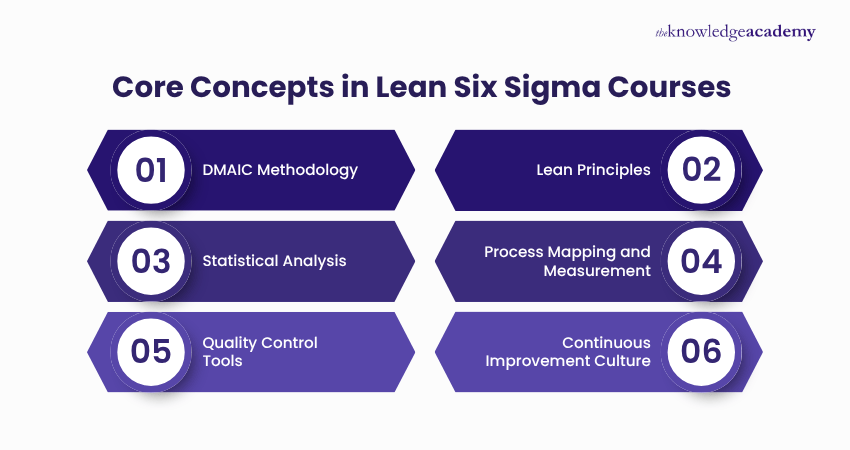
Core Concepts in Lean Six Sigma Courses

Core Concepts Included in Lean Six Sigma Courses  

The Knowledge Academy’s Lean Six Sigma Courses enable learners to achieve consistent, measurable results that are applicable across diverse industries. Below are the concepts that will be covered in these courses:

  • DMAIC Methodology: Gain knowledge about applying the five-step problem-solving method: Define, Measure, Analyse, Improve and Control. It helps identify core issues, implement practical answers, and support long-term progress.
  • Lean Principles: Learners are trained to identify and eliminate non-value-adding activities, streamlining workflows and enhancing operational efficiency.
  • Statistical Analysis: Acquire knowledge to explore, gather, and analyse data for evidence-based decision-making and performance optimisation.
  • Process Mapping and Measurement: Professionals command the use of flowcharts and metrics to visualise, monitor, and improve workflows.
  • Quality Control Tools: Learners identify issues and maintain consistency by using tools like Pareto Charts, Fishbone Diagrams, and Control Charts.
  • Continuous Improvement Culture: Professionals learn to create techniques to promote teamwork and responsibility, while maintaining consistency and continuous improvement.
Show more blue-arrow

Package deals for Lean Six Sigma Certification Training

Our training experts have compiled a range of course packages on a variety of categories in Lean Six Sigma Certification Training, to boost your career. The packages consist of the best possible qualifications with Lean Six Sigma Certification Training, and allows you to purchase multiple courses at a discounted rate.

Swipe for more. Don’t miss out!

Lean Six Sigma Certification Training FAQs

Lean Six Certification improves your quality improvement skills in processes, wastage, and quality provision with sound information techniques. It is recognised throughout the world and appreciated in any sector towards operational perfection and quantifiable business outcomes.

Yellow belt presents fundamental concepts. Green Belt is project execution oriented and project analysis-based. Complex initiatives are headed by Black Belt. Master Black Belt leads people and brings about strategic change.

These things give you problem-solving skills, net you process efficiency, and increase your career prospects. The certification also improves your credibility and makes you qualified to spearhead the quality initiatives in different industries.

You will learn how to detect inefficiencies, analyse data, utilise the DMAIC approach, and achieve improvements in the form of sustainable ones. It is also equipped with training on leadership, project management and stakeholder engagement, in order to have an impact on the real world.

The Yellow Belt is the most suitable for beginners. It presents the principles of Lean Six Sigma, its terminology, and tool usage to enable the supporting project of improvements and foundations of higher-level certification.

There will be no need for prior Project Management experience. Learners of different backgrounds are accommodated by the course as the guidance is well organised and practical examples are provided to gain confidence and the ability to.

Yes, you can balance between training and the work schedule because of flexible learning opportunities that can be offered online, self-paced courses, and online weekend courses, which make it the perfect fit for full-time professionals.

Yes, the official examination is a package of courses. You will have access to study materials, practice questions, and you will have help in ensuring that you prepare and pass the exams.

Questions usually contain multiple-choice and scenario questions in exams. You'll have to learn about DMAIC, process mapping, and statistical tools. The length and the form of the exam depend on the order of the exam.

The Yellow belt is 2 days, the Green belt is 5 days, and Black belt is 10 days. Added flexibility is also an option when choosing on a self-paced basis.

The Knowledge Academy stands out as a prestigious training provider known for its extensive course offerings, expert instructors, adaptable learning formats, and industry recognition. It's a dependable option for those seeking this certification. 

The Knowledge Academy is one of the Leading global training provider for Lean Six Sigma Certification Training.

The training fees for Lean Six Sigma Certification Training in Brazil starts from $3195

Show more down

Why we're the go to training provider for you

icon

Best price in the industry

You won't find better value in the marketplace. If you do find a lower price, we will beat it.

icon

Trusted & Approved

Recognised by leading certification bodies, we deliver training you can trust.

icon

Many delivery methods

Flexible delivery methods are available depending on your learning style.

icon

High quality resources

Resources are included for a comprehensive learning experience.

barclays Logo
deloitte Logo
Thames Water Logo

"Really good course and well organised. Trainer was great with a sense of humour - his experience allowed a free flowing course, structured to help you gain as much information & relevant experience whilst helping prepare you for the exam"

Joshua Davies, Thames Water

santander logo
bmw Logo
Google Logo
cross

Exclusive Deals Big Savings This March!

Grab up to 40% OFF and level up your skills this spring! march-madness

WHO WILL BE FUNDING THE COURSE?

close

close

Thank you for your enquiry!

One of our training experts will be in touch shortly to go over your training requirements.

close

close

Press esc to close

close close

Back to course information

Thank you for your enquiry!

One of our training experts will be in touch shortly to go overy your training requirements.

close close

Thank you for your enquiry!

One of our training experts will be in touch shortly to go over your training requirements.