


 Top Rated Course

We may not have the course you’re looking for. If you enquire or give us a call on +55 8000201623 and speak to our training experts, we may still be able to help with your training requirements.
What is Magento 2? A Comprehensive Beginner's Guide
Lily Turner 15 July 2026Want to know how Magento 2 upgraded the e-commerce experience? Compared to its predecessor, Magento 2 offers merchants greater flexibility and control over their online store's content & functionality. This blog explores What is Magento 2 by delving into its upgraded features, distinct challenges, and pricing. Read now!

Training Outcomes Within Your Budget!
We ensure quality, budget-alignment, and timely delivery by our expert instructors.
Table of Contents
Standing out in the e-commerce jungle can be a daunting task. It’s all about evolving and staying on top of the food chain in this rapidly expanding digital ecosystem. While Magento helped business owners expand their horizons in the online realm with unprecedented features and reach, Magento 2 is pushing their prospects even further through significant upgrades. But exactly What is Magento 2 and how does it compare to its predecessor?
Launched in 2015 by Adobe, Magento 2 is the latest and most powerful e-commerce offering from the Magento family. It attempts to improve online stores' performance, speed and conversion rates by providing numerous high-level capabilities. This blog sheds light on What is Magento 2 and explores why it is the ideal option for you to not just survive but thrive in the e-commerce landscape.
Table of Contents
1) What is Magento 2?
2) Why Should One Opt for Magento 2?
3) What Changed With the Launch of Magento 2?
4) What is the Cost Associated With Magento 2?
5) Common Challenges Encountered With Magento 2
6) Why Magento 2 Is a Preferred eCommerce Platform?
7) Conclusion
What is Magento 2?
Magento 2 is a powerful, open-source e-commerce platform known for its flexibility and scalability. It is ideal for large-scale online stores and offers enhanced performance, streamlined user experience (UX), and improved code accessibility compared to its predecessor.
Magento 2 has cemented itself as one of the most prominent Content Management System (CMS) for creating online stores around the world through its powerful, scalable architecture. Magento 2 enables users to update the e-commerce website automatically. It also offers rich features and an extensible codebase resulting in its usage across a wide variety of projects by organisations with both small and large operations.

Why Should One Opt for Magento 2?
Magento 2 comes with advanced features that makes it the ideal choice for aspiring online store owners. Let's explore some reasons why one should opt for Magento 2:
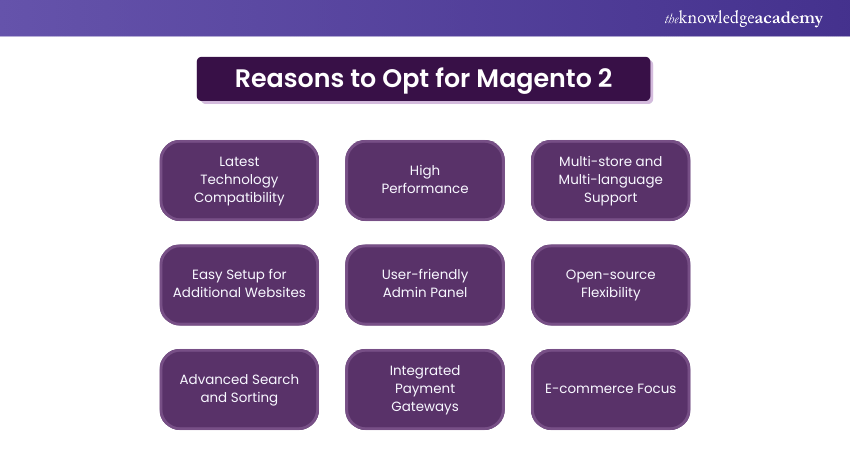
1) Latest Technology Compatibility: Magento 2 supports technologies like PHP7, which ensures faster load times compared to Magento 1.
2) High Performance: It can handle approximately 10 million page views per hour.
3) Multi-store and Multi-language Support: Magento 2 is designed to manage multiple languages and stores efficiently.
4) Easy Setup for Additional Websites: It facilitates the creation of additional websites using catalogue subsets and design variations.
5) User-Friendly Admin Panel: Magento 2 simplifies customisation, data filtering, product creation and navigation.
6) Open-source Flexibility: it enables complete customisation of your e-commerce store without compromise.
7) Advanced Search and Sorting: It provides various ways to search and sort products.
8) Integrated Payment Gateways: Magento 2 supports multiple payment methods, including Google Checkout, PayPal, and Braintree.
9) E-commerce Focus: The key difference between Magento and WordPress is that, unlike WordPress which relies on e-commerce plugins, Magento is purpose-built for e-commerce, making it the ideal choice for business websites.
Looking for a way to excel in the E-commerce landscape? Sign up for our Magento Course now!
What Changed With the Launch of Magento 2?
Magento 2 was initially planned for a 2011 release, but the beta version was launched in 2015. Magento 2 and Magento 1 co-existed for several years, until customer support for Magento 1 ended in June 2020.
Here are the notable changes that the launch of Magento 2 brought:
1) There was a major improvement in the tech stack which transformed it into a new platform. Despite this change, it makes data migration from Magento 1 to Magento 2 trickier.
2) Magento 2 switched to a PHP7 architecture, making it easier to customise and optimise.
3) Magento 2 supports HTML5, the current HTML Living Standard while Magento 1 only supported Zend Framework 1.
4) Magento 2 supports Zend Framework 1 and 2 as well as MySQL 5.6 and above.
Various other new technologies were added to Magento 2 including:
1) Composer: It's a PHP dependency management tool that allows developers to reuse third-party libraries without extension conflicts or code bundling.
2) NGINX: This open-source web server acts as a load balancer, HTTP cache, and reverse proxy.
3) Redis: This is an open-source data structure offering data caching and in-message message brokering.
4) Symfony: This PHP app framework makes Magento 2 more accessible to control in terms of appearance, functionality, and content.
5) Varnish: It’s a cost-effective web accelerator that makes Magento 2 much faster than Magento 1.
Ready to expand your App Development skills? Sign up for our Full-Stack App Development Training With Meteor Course Framework Course now!
What is the Cost Associated With Magento 2?
Each version of Magento 2 is tailored to specific business needs and encompasses everything from small startups to big enterprises. As a result, selecting a version depends on the size of the business you plan to establish and the budget you are prepared to invest. Here are some points to consider:
1) Magento 2 Commerce pricing starts at £17,061 per year (£1,421 per month) and includes a drag-and-drop page builder, a built-in B2B module, rich business intelligence reports, powerful content staging, and 24/7 support.
2) Magento Open Source is free to download, modify, code all stored data, edit any files, and host it anywhere.
3) Magento 2 Cloud pricing starts at £31,020 per year (£2,584 per month) and includes the obvious benefits of cloud hosting, security and improved page performance among other things.
4) The cost of e-commerce hosting is determined by the type of hosting you choose, which can be shared, dedicated or virtual private. The cost of a server can range from £3.1- £775 per month, depending on its features, support, and security
5) For Magento 2 website design, the cost of normal themes ranges in price from free to around £155 if you visit several Magento 2 theme marketplaces or theme vendors.
6) Employing a web design firm or a web designer could cost you more than £7,755 for custom design
7) A brand-new domain will cost you between £7.75 to £11.63 a year, depending on the domain name extension you choose. For example, Top Level Domains (TLDs) are always more expensive than other forms of registries.
8) For Magento SEO Toolkits, the Open Source Edition Starts at £314, the Magento Commerce starts at £580.8 and the Magento Commerce Cloud starts at £849.17.
Common Challenges Encountered With Magento 2
Even though Magento 2 is a considerable improvement over its predecessor, users can still face significant challenges. Listed below are the four major challenges associated with Magento 2:

1) Issues Related to SEO: Despite improvements over Magento 1, Magento 2 can still pose a challenge for SEO optimisation. It is often slower than other platforms, affecting search engine rankings. While most technical SEO issues can be resolved with help from the Magento community and user guide, these fixes often require developer resources.
2) Establishing a Blog in Magento 2: While creating content is effective for engaging customers and reducing acquisition costs, Magento does not possess a default blog function. You will need a custom extension to add a blog to your site.
3) Re-indexing Problems: Magento uses indexing to reconstruct product and category data, enhancing your store’s performance. Frequent data changes necessitate re-indexing. This could lead you to see the message: “One or more indexes are fully invalid.” Developers must run a cron job (time-based scheduler) to resolve this.
4) Challenges During Installation: Transitioning to Magento 2 is complex. Installing and configuring the software and rebuilding your site from scratch require significant developer resources and technical knowledge.
Secure a strong position in the rapidly expanding Mobile App space with our Mobile App Development Course - Sign up now!
Why Magento 2 Is a Preferred eCommerce Platform?
Magento 2 is a top eCommerce choice for both developers and merchants. Customers may not realise they are shopping on a Magento 2 site, but its features enhance the shopping experience. Here's why Magento 2 is a preferred E-commerce Platform:
1) For the Merchant: The Magento 2 admin panel is user-friendly, giving merchants transparency and control. There's no need for constant developer assistance. It supports mobile responsiveness, tiered permissions, SEO, multiple currencies, languages, and the ability to manage multiple sites from one admin panel.
2) For the Developer: Developers appreciate Open Source software, and Magento 2 requires no additional purchases. Its code enables customisation with templates, themes, and extensions. It's easy to integrate with other technologies and is compatible with current versions of PHP, MySQL, Zend Framework, and Oracle. Magento 2 also has robust built-in security features. As a result, the Magento Developer Salary is often higher due to the platform's complexity and demand for experienced developers.
3) For the Customer: Magento 2 offers easy search functionality, streamlined two-step checkout, as well as the potential for field autofill. It enables you to segment your customers on the back end, allowing for personalised user interfaces for different customer profiles.
Conclusion
Exploring What is Magento 2 is essential to harness its potential for e-commerce success. This powerful platform provides the flexibility and features needed to create a standout online store. We hope this blog helps you kickstart your journey with Magento 2 and secure your path towards digital business excellence.
Elevate your Web Development skills and your business’ online presence with our Web Application Testing with PHPUnit Framework Course – Sign up now!
Frequently Asked Questions
What Database Does Magento 2 Use?

Magento 2 operates on the MySQL database management system Additionally, Magento now supports MySQL 8. It can support Oracle Database as well.
Can We Create Multiple Websites in Magento 2?
Yes, you can create multiple store in Magento 2. You can have multiple websites under a single domain, or multiple domains with a single Magento installation.
What is The Knowledge Pass, and How Does it Work?

Lily Turner


Senior AI/ML Engineer and Data Science Author
Lily Turner is a data science professional with over 10 years of experience in artificial intelligence, machine learning, and big data analytics. Her work bridges academic research and industry innovation, with a focus on solving real-world problems using data-driven approaches. Lily’s content empowers aspiring data scientists to build practical, scalable models using the latest tools and techniques.
View Detail

 If you wish to make any changes to your course, please


