


 Top Rated Course

We may not have the course you’re looking for. If you enquire or give us a call on +55 8000201623 and speak to our training experts, we may still be able to help with your training requirements.
AI Music Production Tools: An Overview
The Knowledge Academy 03 March 2026AI Music Production uses machine learning and generative models to compose, mix, and improve music from text prompts, stems, and automated workflows. Creators can generate melodies, adjust tempo, and refine tone in minutes without complex gear. It speeds up demos and supports collaboration across remote teams and platforms for creators.

Training Outcomes Within Your Budget!
We ensure quality, budget-alignment, and timely delivery by our expert instructors.
Table of Contents
Music creation no longer needs a full studio or complex setup. Digital tools now help beginners and professionals shape sounds quickly. Ideas can move from concept to track in far less time.
With AI Music Production, artists can generate melodies, refine beats, and polish mixes effortlessly. It opens new creative options while saving effort on repetitive tasks. Now, let’s look at how it actually works behind the scenes.
Table of Contents
1) What is Meant by AI Music Production?
2) AI Music Production Tools
3) Benefits of AI Music Production Tools
4) The Role AI Plays in Modern Music Production
5) The Future of Music Production with AI
6) Conclusion
What is Meant by AI Music Production?
Music Production, once a domain primarily shaped by human creativity and skill, has undergone a remarkable revolution with Artificial Intelligence (AI) integration. AI Music Production refers to the utilisation of advanced algorithms, Machine Learning Techniques, and computational analysis to enhance various aspects of the music creation process. This fusion of human artistry and technological innovation is reshaping the way music is composed, arranged, produced, and even performed.

AI Music Production Tools
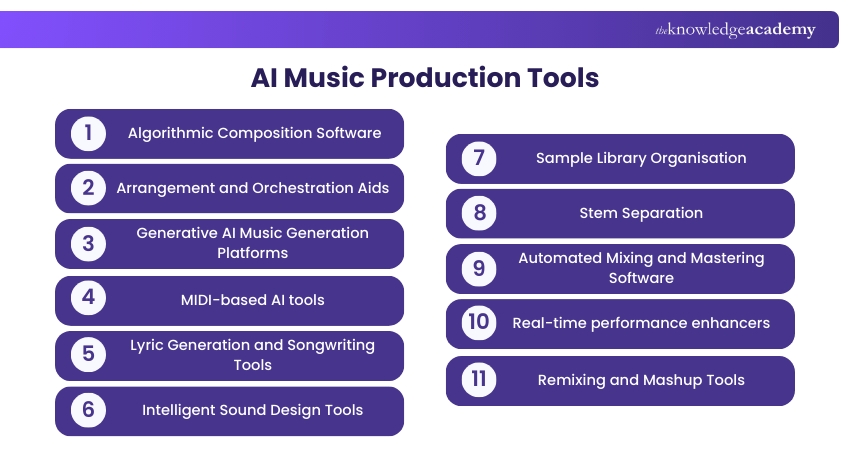
The fusion of Artificial Intelligence and Music Production has led to the development of a diverse range of tools that cater to different aspects of the creative process. These tools leverage advanced algorithms and Machine Learning (ML) techniques to offer Musicians and producers innovative ways to compose, arrange, and produce music. Let's learn about the various types of AI tools for Music Production available today:
1) Algorithmic Composition Software
Algorithmic composition tools utilise AI algorithms to generate musical compositions based on specific input parameters. Musicians can provide guidelines such as style, mood, and tempo, and the AI system creates original compositions that adhere to these specifications. This type of tool opens doors to experimental compositions and unexpected musical directions.
These tools provide Composers with fresh ideas and melodies. An example is Aiva, an AI composer that creates classical compositions by analysing a vast database of music and composing original pieces that align with specific emotions or styles.
2) Arrangement and Orchestration Aids
Arrangement tools help composers and producers optimise the orchestration of their tracks. They suggest instrument placements, dynamics, and other aspects to enhance the overall sound. AI-powered arrangement aids can analyse different arrangements to suggest improvements and bring a fresh perspective to the creative process.
These tools focus on enhancing the arrangement of musical elements. E-endless is a tool that analyses existing compositions and suggests alternative arrangements, enabling Musicians to explore different possibilities and experiment with their tracks.
Begin the Piano Course now and grow your skills while enjoying the art of expressive music.
3) Generative AI Music Generation Platforms
Generative AI music platforms create original tracks using machine learning rather than just editing existing audio. Tools like Dreamtonics Synthesiser V generate realistic vocals from lyrics, while Orb Producer Suite helps build melodies, basslines, and rhythms automatically.
There are also research-focused tools such as Google’s Magenta, which offers experimental plugins and creative music tools. OpenAI’s MuseNet and Jukebox can compose full pieces in different styles using deep neural networks.
4) MIDI-based AI tools
Musical Instrument Digital Interface (MIDI) based AI tools process MIDI data to generate music. They take existing MIDI input and transform it into new arrangements, melodies, or harmonies. These tools are valuable for Musicians looking to expand on their existing ideas.
These tools analyse existing MIDI files and convert them into new compositions or styles. For example, WaveAI's ODEIIN takes MIDI files and transforms them into various genres, showcasing the versatility of AI-driven Music transformation.
5) Lyric Generation and Songwriting Tools
AI-powered lyric generators assist Songwriters by suggesting rhymes, themes, and even entire verses. These tools analyse existing lyrics to ensure coherence and alignment with the desired lyrical style.
AI-powered lyric generators analyse themes and emotions to produce song lyrics. For example, OpenAI's MuseNet not only generates melodies but also provides lyrics, creating a complete Musical package.
6) Intelligent Sound Design Tools
AI-driven sound design tools allow Musicians to create unique and innovative sounds. These tools can modify existing sound samples by altering parameters like pitch, timbre, and rhythm. The result is a palette of custom sounds that can be used to add distinct textures and atmospheres to compositions.
Tools like Google's NSynth leverage AI to synthesise entirely new sounds by blending existing samples. NSynth can combine the characteristics of different instruments, resulting in unique textures and sonic landscapes that were previously unattainable.
7) Sample Library Organisation
AI tools like Atlas by Algonaut and Playbeat by Audiomodern help producers manage and organise large sample collections more efficiently. These VSTs use AI to sort, categorise, and present samples in searchable and playable formats, making it easier to find and use the right sound quickly.
Playbeat can even learn your preferred patterns and generate customised grooves from your samples, while Atlas offers visual maps and rhythm features that help you explore your library without leaving your DAW. This new approach speeds up sound selection and boosts creative flow during production.
8) Stem Separation
Stem separation tools use AI to break a full song into individual parts such as vocals, drums, bass, and instruments. This was once only possible if producers had access to original studio sessions, but modern tools now make it available to almost anyone.
Platforms like LALAL.AI and MOISES.AI can extract high-quality stems in different audio formats, allowing producers to remix, sample, or study tracks more easily. By isolating elements from a recording, creators gain far more flexibility when editing or reworking music.
9) Automated Mixing and Mastering Software
Automated mixing and mastering tools use AI to analyse tracks and enhance sound quality with minimal manual setup. Services like LANDR apply intelligent processing based on reference audio to balance levels, EQ, and loudness quickly.
Software such as iZotope also includes AI assistants that recommend settings and help clean up audio recordings. These tools help creators achieve polished results faster while reducing the need for advanced technical skills.
10) Real-time performance enhancers
Real-time performance enhancement tools analyse live performances and provide feedback to Musicians on the spot. They offer suggestions for improving timing, dynamics, and expression. These tools are particularly beneficial for solo artists and bands aiming to refine their live shows.
AI Music Production tools can analyse live performances and provide immediate feedback to Musicians. For example, ROLI's Equator2 uses AI to enhance performances by adapting and adjusting sounds in real time to match the player's style and expression.
11) Remixing and Mashup Tools
AI-driven remixing and mashup tools blend elements from existing songs to create fresh compositions. They analyse tempo, key, and structure to merge compatible tracks smoothly. This opens new creative possibilities for DJs and remix artists.
Platforms like Endlesss Studio support collaborative remixing in real time, allowing users to build and modify tracks together. Tools such as Jammy act as AI guitar partners, generating responsive backing tracks that adapt to a player’s style. These innovations are reshaping how musicians practise, perform, and experiment.
Start your musical journey today with our Guitar Course and play confidently in weeks now.
Benefits of AI Music Production Tools
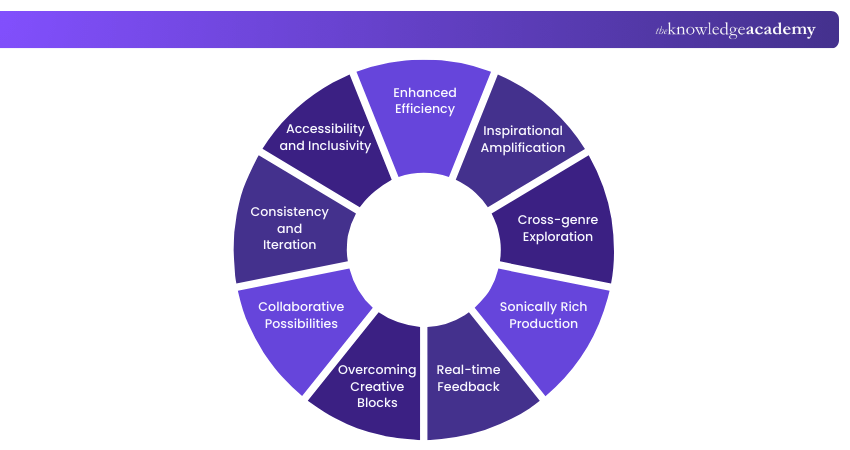
AI Music Production tools have ushered in a new era of creativity and innovation in the music industry. These tools leverage advanced algorithms and data analysis to augment the creative process for artists, producers, and musicians. Additionally, understanding different Types of Music helps artists make the most of AI-driven tools, as each genre benefits from unique production techniques. Apart from that, they provide numerous benefits that are as follows:
1) Enhanced Efficiency
AI Music Production tools streamline various aspects of the creative process, reducing the time and effort required for tasks such as composing, arranging, and sound design. This efficiency allows artists to focus more on the conceptual and emotional aspects of their work, accelerating the overall Production timeline.
2) Inspirational Amplification
AI-driven Music Production tools provide a wellspring of inspiration by suggesting novel chord progressions, melodies, and arrangements. These creative prompts serve as starting points for artists, sparking new ideas and fostering experimentation that might not have occurred otherwise.
3) Cross-genre Exploration
AI Music Production tools transcend musical genres and eras, enabling artists to explore diverse styles and experiment with hybrid compositions. This cross-genre exploration encourages Musicians to break boundaries and create unique, fusion-driven works that resonate with a broader audience.
4) Sonically Rich Production
AI Sound Design tools revolutionise the sonic palette by generating new and innovative textures. These tools offer artists the ability to create soundscapes that were previously inaccessible. As a result, they enrich the compositions with immersive and distinctive sonic elements.
5) Real-time Feedback
For live performances, AI Music Production tools analyse and adapt to Musicians' input in real time, offering instant feedback and suggestions for improvement. This fosters skill development and enhances the quality of live shows, leading to more engaging and dynamic performances.
6) Overcoming Creative Blocks
AI tools alleviate creative blocks by providing alternative ideas and solutions. When artists encounter mental roadblocks, AI-generated suggestions can reinvigorate the creative flow, leading to fresh directions and renewed motivation.
7) Collaborative Possibilities
AI-powered collaborative platforms, integrated with AI Orchestration, allow artists to work together in real time, regardless of geographical constraints. This fosters global collaboration, enabling diverse talents to merge their creativity and produce innovative compositions.
8) Consistency and Iteration
AI Music Production tools ensure consistency across various elements of a composition, helping artists maintain a cohesive sound throughout their work. It also facilitates iterative experimentation, enabling creators to refine their compositions until they achieve the desired result.
9) Accessibility and Inclusivity
AI Music tools democratise Music Production by making it accessible to more individuals, regardless of their formal musical training. This inclusivity empowers aspiring artists to express themselves and contribute to the creative ecosystem.
The Role AI Plays in Modern Music Production
AI supports modern music production by simplifying complex tasks and speeding up workflows. It allows artists to focus more on creativity while improving overall sound quality.
1) Mixing and Mastering
AI tools automate mixing and mastering to deliver balanced, polished tracks. They help artists achieve professional results with less technical effort.
2) Song Restoration
AI restores old recordings by removing noise and enhancing clarity. This makes classic tracks sound cleaner and more refined.
3) Music Inspiration
AI generates melodies, chord ideas, and backing tracks to spark creativity. It helps musicians overcome blocks and explore new sounds.
The Future of Music Production With AI
AI is expected to become even more common in music creation, giving artists access to smarter and more advanced tools. Musicians may rely on it to streamline tasks and support creative decisions while combining human intuition with machine precision. Rather than replacing artists, AI will act as a creative partner that enhances experimentation and expands opportunities.
Conclusion
Music creation is entering a new creative era where technology and artistry work side by side. With AI Music Production, artists can experiment faster, refine ideas easily, and reach wider audiences. The future of sound now belongs to those willing to explore and innovate.
Explore a world of new hobbies and interests today; Register for our Hobbies & Interests Course!
Frequently Asked Questions
Can I Sell my AI-generated Music?

Yes, you can sell AI-generated music, but your rights depend on the platform’s terms and how much human input is involved. Fully AI-generated tracks usually cannot be copyrighted, meaning others may legally reuse them.
How to Tell if a Song is Written by AI?
To identify if a song is AI-generated, check for unusual audio artifacts, repetitive structure, or generic lyrics, and verify the artist’s real-world presence. Even with advanced tools like Suno and Udio, subtle signs often still appear.
What are the Other Resources and Offers Provided by The Knowledge Academy?
The Knowledge Academy takes global learning to new heights, offering over 3,000+ online courses across 490+ locations in 190+ countries. This expansive reach ensures accessibility and convenience for learners worldwide.
Alongside our diverse Online Course Catalogue, encompassing 17 major categories, we go the extra mile by providing a plethora of free educational Online Resources like Blogs, eBooks, Interview Questions and Videos. Tailoring learning experiences further, professionals can unlock greater value through a wide range of special discounts, seasonal deals, and Exclusive Offers.
What is The Knowledge Pass, and How Does it Work?
The Knowledge Academy’s Knowledge Pass, a prepaid voucher, adds another layer of flexibility, allowing course bookings over a 12-month period. Join us on a journey where education knows no bounds.
What are the Related Courses and Blogs Provided by The Knowledge Academy?
The Knowledge Academy offers various Hobbies & Interests Courses, including the Music Production Course, Mixing and Mastering Course, and Filmmaking Course. These courses cater to different skill levels, providing comprehensive insights into Keyboard vs Piano.
Our Business Skills Blogs cover a range of topics related to AI Music Production Tools, offering valuable resources, best practices, and industry insights. Whether you are a beginner or looking to advance your AI‑powered DAW Skills, The Knowledge Academy's diverse courses and informative blogs have got you covered.

The Knowledge Academy


Global Training Provider
The Knowledge Academy is a world-leading provider of professional training courses, offering globally recognised qualifications across a wide range of subjects. With expert trainers, up-to-date course material, and flexible learning options, we aim to empower professionals and organisations to achieve their goals through continuous learning.

Upcoming Business Skills Resources Batches & Dates
Date
 Music Production Course
Music Production Course
Fri 31st Jul 2026
Music Production Course
Fri 2nd Oct 2026

 If you wish to make any changes to your course, please


