


 Top Rated Course

We may not have the course you’re looking for. If you enquire or give us a call on + 1-866 272 8822 and speak to our training experts, we may still be able to help with your training requirements.
AI in Marketing: Benefits, Real-World Applications, and Examples
Lily Turner 27 April 2026AI in Marketing helps businesses automate tasks, analyse customer data, and deliver personalised campaigns that improve engagement and performance. It is transforming how organisations plan and execute their strategies with smarter decisions and deeper insights, helping marketers identify trends, optimise campaigns, and improve targeting.
Home
 Resources
Data, Analytics & AI
AI in Marketing: Benefits, Real-World Applications, and Examples
Resources
Data, Analytics & AI
AI in Marketing: Benefits, Real-World Applications, and Examples
Resources
Data, Analytics & AI
AI in Marketing: Benefits, Real-World Applications, and Examples

Training Outcomes Within Your Budget!
We ensure quality, budget-alignment, and timely delivery by our expert instructors.
Table of Contents
Marketing today feels like trying to read minds, understanding what customers want, when they want it, and how they prefer to engage. Preferences shift, trends evolve, and expectations keep rising. This is where AI in Marketing comes in, bringing clarity and turning guesswork into informed decisions backed by real insights.
By blending data, automation, and intelligent analysis, it allows marketers to refine strategies with confidence and adapt in real time. It supports smarter targeting, sharper messaging, and meaningful engagement, helping businesses keep the human touch that customers value. In this blog, you will learn about What is AI in Marketing, its benefits, real-world applications, examples, and more. Let's begin!
Table of Contents
1) What is AI Marketing?
2) Why AI is a Game Changer?
3) Benefits of AI in Marketing
4) Challenges of AI in Marketing
5) Real-world Applications of AI in Marketing
6) Examples of AI in Marketing
7) How to Implement AI in Your Marketing Strategy?
8) Best Practices for Using AI in Marketing
9) AI and the Future of Marketing
10) Conclusion
What is AI Marketing?
AI Marketing refers to the use of Artificial Intelligence (AI) to improve and automate marketing activities. It helps businesses analyse data, identify patterns, and make real-time decisions that improve campaign performance. By integrating AI into marketing strategies, organisations can deliver personalised experiences and improve efficiency across channels.
It is powered by technologies like Machine Learning (ML) and Natural Language Processing (NLP), enabling marketers to predict customer behaviour and optimise campaigns. It is widely used for content creation, personalised recommendations, data analysis, and chatbot-driven customer support, helping businesses create targeted and engaging strategies.

Why AI is a Game Changer?
AI has been part of marketing for years, mainly working behind the scenes to analyse data, identify patterns, and automate routine tasks. While it helped improve efficiency, its role was largely limited to supporting decision-making instead of directly shaping customer interactions. As a result, marketers relied on manual creativity and interpretation to deliver personalised experiences.
Today, advancements like Large Language Models (LLMs) and generative AI have transformed AI’s role completely. Now, it can create content, mimic human communication, and respond in real time, making it an active part of marketing. This allows businesses to produce personalised content at scale, engage customers effectively, and move faster in a highly competitive market.
Benefits of AI in Marketing
AI in marketing is helping businesses work smarter. It enables teams to make faster decisions, understand customers better, and optimise campaigns with greater precision, helping marketers achieve stronger results. Let’s explore the key benefits below:
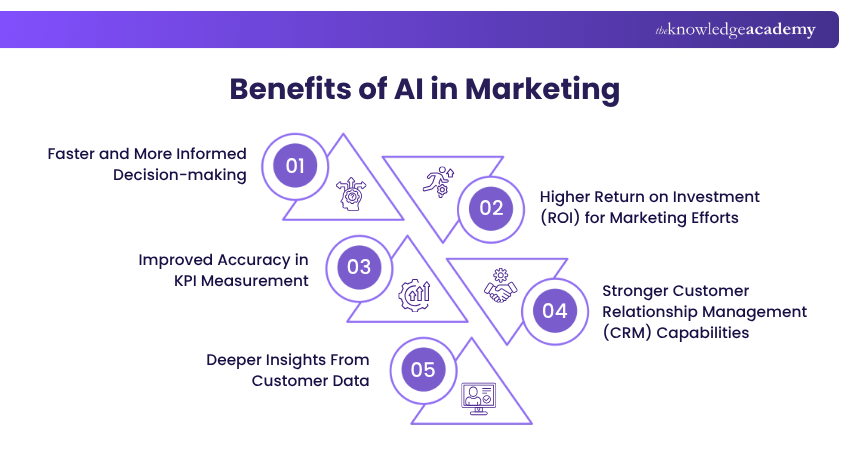
1) Faster and More Informed Decision-making
AI enables marketing teams to analyse data in real time, helping them understand campaign performance instantly. With Machine Learning (ML) and sentiment analysis, it recommends data-driven actions, allowing marketers to adjust strategies and make informed decisions.
2) Higher Return on Investment (ROI) for Marketing Efforts
AI helps identify the most effective channels, audience segments, and ad placements based on customer behaviour. By providing actionable insights during campaigns, it ensures resources are used efficiently and maximises the return on marketing investments.
3) Improved Accuracy in KPI Measurement
With large volumes of campaign data, tracking performance can be challenging. AI-powered tools simplify this by linking results to specific actions. This helps marketers clearly measure success and identify areas for improvement.
4) Stronger Customer Relationship Management (CRM) Capabilities
AI improves CRM by automating routine tasks such as data processing and segmentation. Additionally, it enables personalised communication, reduces human error, and helps identify customers who may need additional engagement or support.
5) Deeper Insights From Customer Data
AI can process large amounts of customer data quickly using predictive analytics. It identifies patterns, anticipates future behaviour, and suggests personalised content. This is useful for marketers to create more relevant and impactful campaigns.
Streamline operations with intelligent AI automation and reduce manual effort with the AI Automation Course For Operations – Join now!
Challenges of AI in Marketing
While AI offers significant benefits, it comes with several challenges that organisations must address to use it effectively. Understanding these limitations helps businesses implement AI responsibly and maximise its value. Let’s look at its key challenges below:
1) Risk of AI Bias
AI systems are reliant on training data, and if that data contains biases, the outcomes can be inaccurate. This may lead to inaccurate customer segmentation or unfair targeting, reducing campaign effectiveness and limiting audience reach. Addressing bias requires continuous monitoring and the use of diverse, high-quality data.
2) Data Privacy Concerns
AI in Marketing uses sensitive customer data, such as browsing behaviour and purchase history. Mishandling this information can lead to data breaches, legal issues, and a loss of customer trust. Strong data governance and compliance practices are essential to protect customer information.
3) Complexity and Lack of Skilled Professionals
AI tools can be complex to implement and manage. Many marketing teams may lack the required technical expertise, making it necessary to invest in training or hire skilled professionals. Choosing user-friendly tools and upskilling teams can help bridge this gap effectively.
4) Difficulty in Integrating With Existing Systems
Integrating AI with existing or legacy systems can be difficult. Compatibility issues and data silos may reduce its efficiency and limit the full potential of AI-driven marketing strategies. A well-planned integration approach is crucial for ensuring a smooth adoption and scalability.
5) Limited Transparency and Explainability
Some AI models operate as “black boxes,” making it difficult to understand how decisions are made. This lack of clarity can impact trust and make it harder for marketers to refine and justify their strategies. Improving explainability helps build confidence and supports better decision-making.
Automate sales and close deals faster with the AI Automation Training For Sales – Sign up now!
Real-world Applications of AI in Marketing
AI is a practical tool that is actively shaping modern marketing. It helps businesses engage customers more effectively, analyse data faster, and optimise strategies with precision. Let’s look at some of its real-world applications below to better understand how to use AI in Marketing:
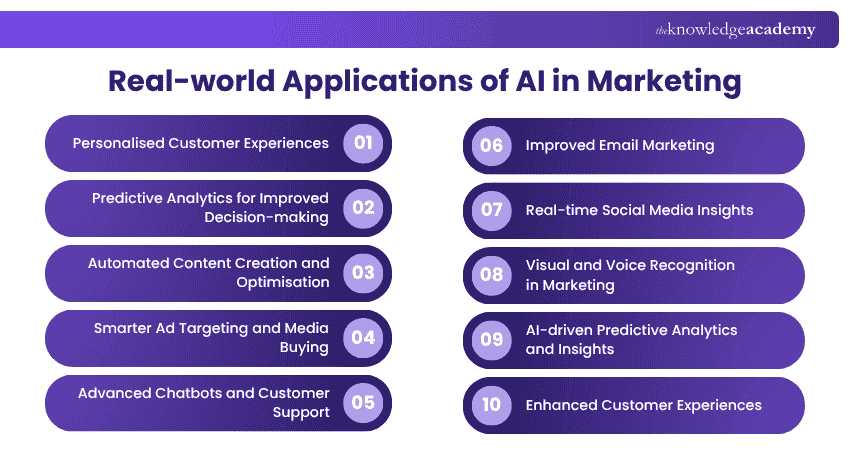
1) Personalised Customer Experiences
AI analyses customer data to deliver tailored content, product recommendations, and offers. This helps businesses create relevant interactions and improve engagement throughout the buyer’s journey. As a result, customers are more likely to connect with brands that understand their needs.
2) Predictive Analytics for Improved Decision-making
AI uses historical data to predict customer behaviour, trends, and campaign outcomes. This allows marketers to make proactive decisions and optimise strategies for better results. Additionally, it reduces risks by enabling more accurate forecasting.
3) Automated Content Creation and Optimisation
AI tools can generate blogs, ads, and social media content quickly. They also analyse engagement data to refine and optimise content, ensuring it resonates with the target audience. This allows teams to maintain quality while producing content at scale.
4) Smarter Ad Targeting and Media Buying
AI automates ad placements and bidding processes, ensuring campaigns reach the most relevant audience. This improves efficiency and increases the chances of higher conversions. It also helps reduce wasted ad spend by focusing on high-value audiences.
5) Advanced Chatbots and Customer Support
AI-powered chatbots provide instant, 24/7 responses to customer queries. They improve customer experience while allowing human teams to focus on more complex tasks. This leads to faster resolution times and increased customer satisfaction.
6) Improved Email Marketing
AI helps to personalise email campaigns by optimising subject lines, send times, and content. This increases open rates, engagement, and overall campaign effectiveness. It also ensures that messages are delivered at the most relevant moments.
7) Real-time Social Media Insights
AI tools monitor social media to track trends, sentiment, and audience behaviour. Marketers can use these insights to adjust strategies and engage with audiences in real time. This helps brands stay relevant in fast-changing digital environments.
8) Visual and Voice Recognition in Marketing
AI enables features like image-based search and voice assistants, creating new ways for customers to interact with brands. This enhances accessibility and opens innovative marketing opportunities. It also supports more intuitive and seamless user experiences.
9) AI-driven Predictive Analytics and Insights
AI analyses large volumes of historical and real-time data to identify patterns and predict future customer behaviour, trends, and campaign performance. This helps marketers make proactive, data-driven decisions, optimise strategies, and personalise experiences effectively. It enables businesses to spot hidden opportunities and respond quickly to changing market demands.
10) Enhanced Customer Experiences
AI improves the customer experience by reducing response times, personalising interactions, and simplifying the buying journey. This helps to build stronger relationships and long-term customer loyalty. Ultimately, it leads to the creation of a smoother and more satisfying customer journey.
Automate product workflows and build smarter products with AI automation by joining the AI Automation Course For Product Management now!
Examples of AI in Marketing
AI is widely used across industries, helping businesses improve customer engagement, optimise strategies, and deliver personalised experiences. The following examples highlight how organisations apply AI in practical marketing scenarios. Let’s look at them below:
1) Chatbots and Virtual Assistants: AI-powered chatbots are used on websites and apps to provide instant support and personalised recommendations. For example, Sephora uses chatbots to suggest products based on customer preferences and past purchases.
2) Predictive Analytics: AI-driven predictive analytics helps businesses forecast customer behaviour using historical data. Retailers like Target use it to send personalised offers and anticipate customer needs.
3) Dynamic Pricing: AI enables real-time price adjustments based on demand, competition, and other factors. Companies like Uber use dynamic pricing to maximise revenue during peak demand periods.
4) AI-generated Content: Generative AI tools are used to create content, such as news updates, blogs, and marketing copy. For instance, The Washington Post uses AI to generate short reports during live events.
5) Social Media Listening and Sentiment Analysis: AI tools analyse social media conversations to understand customer sentiment and trends. Brands like Starbucks use this to monitor feedback and respond in real time.
6) Programmatic Advertising: AI automates the buying and placement of ads, ensuring they reach the right audience. Companies such as Audi use programmatic advertising to target users interested in premium products.
7) Voice Search Optimisation: With the growth of voice assistants, AI helps businesses optimise for voice-based queries. For example, Some Pizza brands enables customers to place orders through voice commands.
How to Implement AI in Your Marketing Strategy?
Implementing AI in Marketing requires a structured approach to ensure it delivers real value. By aligning AI with clear goals and gradually integrating it into existing processes, businesses can maximise its impact while minimising risks. Let's look at some of the effective steps below:
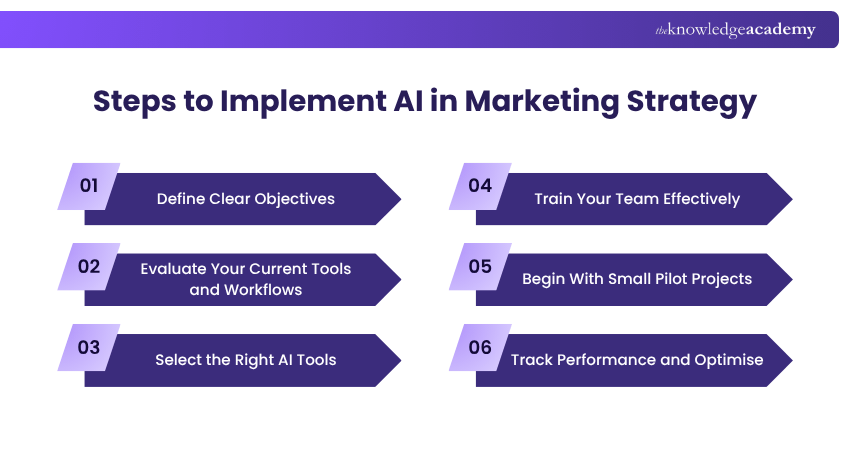
1) Define Clear Objectives
Start by defining what you want to achieve, such as improving personalisation, increasing efficiency, or boosting engagement. Clear goals ensure your AI efforts align with the marketing Key Performance Indicators (KPIs). This helps focus your strategy and measure success effectively.
2) Evaluate Your Current Tools and Workflows
Evaluate your existing marketing tools and processes to identify areas where AI can add value. Focus on tasks that are time-consuming or repetitive, such as data analysis or content creation. This helps to ensure a smoother and more effective integration.
3) Select the Right AI Tools
Select AI tools based on your specific needs, whether it’s automation, analytics, or audience segmentation. Consider factors like ease of use, integration capabilities, and scalability. Choosing the right tools ensures better outcomes and long-term business value.
4) Train Your Team Effectively
Ensure your team understands how to use AI tools effectively and interpret the insights they provide. Proper training helps maximise the value of AI and improves adoption across the organisation. A skilled team can use AI more strategically and efficiently.
5) Begin With Small Pilot Projects
Begin with small yet effective AI initiatives, such as automating a single campaign or personalising content for a specific audience segment. This allows you to test effectiveness and refine your approach before scaling. Additionally, it helps reduce risks and build confidence.
6) Track Performance and Optimise
Continuously track the performance of AI-driven campaigns to evaluate their impact. Use insights to refine strategies, improve ROI, and enhance campaign effectiveness over time. This ensures your AI efforts remain aligned with business goals.
Turn ideas into AI-powered campaigns and create smarter marketing strategies with Generative AI in Marketing Training – Join today!
Best Practices for Using AI in Marketing
To maximise the value of AI in Marketing, businesses must follow structured practices that ensure accuracy, efficiency, and ethical use. Let’s look at some of the best practices below:
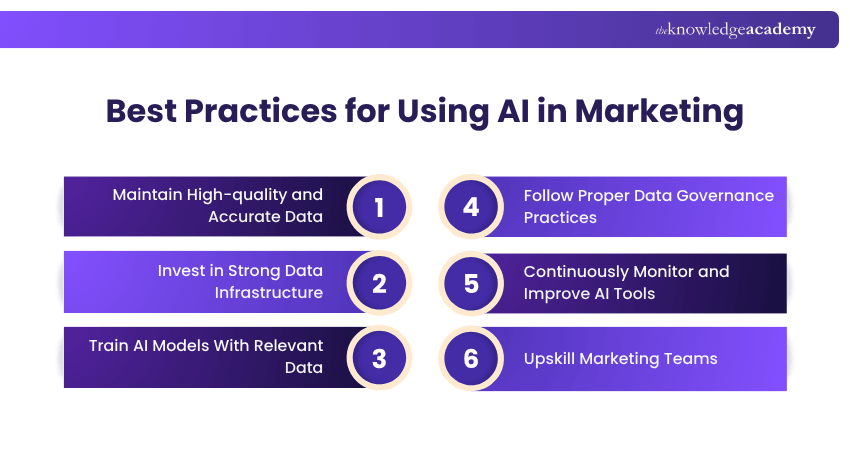
1) Maintain High-quality and Accurate Data
AI systems rely on accurate and relevant data to perform effectively. Poor-quality or biased data can lead to incorrect insights and decisions. Cleaning and standardising datasets is essential to ensure reliable outcomes.
2) Invest in Strong Data Infrastructure
AI works best when data flows seamlessly across systems. Integrating platforms such as CRM, analytics tools, and sales systems enables real-time data processing. This helps deliver accurate insights and more personalised customer experiences.
3) Train AI Models With Relevant Data
AI tools need to be trained with the right datasets to perform specific tasks effectively. Using customer behaviour and preference data improves accuracy and relevance. Task-specific training enhances the overall performance of AI systems.
4) Follow Proper Data Governance Practices
Since AI uses sensitive customer information, it is important to follow data protection laws and ethical standards. Transparent data usage builds trust and reduces the risk of legal or reputational issues.
5) Continuously Monitor and Improve AI Tools
AI tools should be regularly monitored to ensure they meet performance goals. Tracking results and refining strategies helps to improve accuracy and maximise Return on Investment (ROI) over time.
6) Upskill Marketing Teams
Training employees to use AI tools effectively is crucial for successful adoption. Also, it helps teams understand when human input is needed alongside AI. A well-trained team can leverage AI more strategically and efficiently.
AI and the Future of Marketing
AI is set to play a bigger role in marketing by enabling more personalised, efficient, and data-driven experiences. Marketers will increasingly use AI to analyse unstructured data like emails, chats, and reviews for deeper insights and faster decisions. Also, first-party data will be key to ensuring AI outputs remain relevant, accurate, and aligned with brand goals.
As AI adoption grows, trust, privacy, and security will become more important. Businesses will need strong safeguards to protect data, reduce bias, and maintain transparency. AI may reshape the entire marketing process by supporting campaign planning, content creation, and performance analysis, while keeping human oversight central.
Conclusion
AI in Marketing is transforming how businesses engage customers through data, automation, and smarter insights. It helps marketers improve decisions, personalise experiences, and boost results. With a strategic approach, organisations can overcome challenges and stay competitive in an ever-evolving digital landscape.
Transform everyday tasks into automated wins and boost productivity with AI Automation Training – Join now!
Frequently Asked Questions
Is AI in Marketing Secure and Reliable?

AI in Marketing is effective but not fully secure without proper oversight. While it improves productivity and efficiency, it brings risks like data privacy issues, bias, and inaccurate outputs. Strong governance, monitoring, and human control are key to a safe and reliable use.
What is the Difference Between AI Marketing and Traditional Marketing?
AI marketing uses data, automation, and machine learning for personalised, real-time campaigns. Traditional marketing relies on manual processes and mass communication. AI offers faster insights and measurable ROI, while traditional methods are less flexible and less targeted.
What are the Other Resources and Offers Provided by The Knowledge Academy?
The Knowledge Academy takes global learning to new heights, offering over 3,000+ online courses across 490+ locations in 190+ countries. This expansive reach ensures accessibility and convenience for learners worldwide.
Alongside our diverse Online Course Catalogue, encompassing 17 major categories, we go the extra mile by providing a plethora of free educational Online Resources like Blogs, eBooks, Interview Questions and Videos. Tailoring learning experiences further, professionals can unlock greater value through a wide range of special discounts, seasonal deals, and Exclusive Offers.
What is The Knowledge Pass, and How Does it Work?
The Knowledge Academy’s Knowledge Pass, a prepaid voucher, adds another layer of flexibility, allowing course bookings over a 12-month period. Join us on a journey where education knows no bounds.
What are the Related Courses and Blogs Provided by The Knowledge Academy?
The Knowledge Academy offers various AI Automation Training, including the AI Automation Course For Marketing, AI Automation Course For Operations, and AI Automation Course For Product Management. These courses cater to different skill levels, providing comprehensive insights into Types of AI Models.
Our Data, Analytics & AI Blogs cover a range of topics related to AI in Marketing, offering valuable resources, best practices, and industry insights. Whether you are a beginner or looking to advance your Artificial Intelligence skills, The Knowledge Academy's diverse courses and informative blogs have got you covered.

Lily Turner


Senior AI/ML Engineer and Data Science Author
Lily Turner is a data science professional with over 10 years of experience in artificial intelligence, machine learning, and big data analytics. Her work bridges academic research and industry innovation, with a focus on solving real-world problems using data-driven approaches. Lily’s content empowers aspiring data scientists to build practical, scalable models using the latest tools and techniques.
View Detail
Upcoming Data, Analytics & AI Resources Batches & Dates
Date
 AI Automation Course for Marketing
AI Automation Course for Marketing
Fri 14th Aug 2026
AI Automation Course for Marketing
Fri 6th Nov 2026

 If you wish to make any changes to your course, please


