


 Top Rated Course

We may not have the course you’re looking for. If you enquire or give us a call on +1800812339 and speak to our training experts, we may still be able to help with your training requirements.
What is Timeboxing in Scrum?: Complete Overview
The Knowledge Academy 28 April 2026Timeboxing in Scrum sets fixed time limits for events like sprints and stand-ups, boosting focus, efficiency and keeping work on track within set timeframes. This blog explores the Scrum Timebox and various Scrum events. It also discusses the pros and cons related to it. Additionally, it shows how it can boost your team's productivity.

Training Outcomes Within Your Budget!
We ensure quality, budget-alignment, and timely delivery by our expert instructors.
Table of Contents

In the fast-paced world of software development, staying organised is essential. In this regard, Scrum Timebox is helpful. This is because it breaks down work into fixed time periods. Therefore, this is all you should know on What is Timeboxing in Scrum. That's right! It keeps teams focused and this brings in improved decision-making. This ensures a steady progress. With clear time limits on tasks and meetings, projects stay on track and goals are met more smoothly.
In this blog, we will explore the various Scrum Timebox events, weigh the pros and cons, and show you how adopting this approach can supercharge the team's productivity and focus. Get ready to transform the way you work! You’ll also learn how timeboxing supports team alignment and ensures consistent delivery. Plus, we’ll touch on practical tips to manage timeboxes more effectively. This will help you know What is Timeboxing in Scrum.
Table of Contents
1) What is Timeboxing in Scrum?
2) Timeboxed Events in Scrum
3) What Are the Benefits of Timeboxing in Scrum?
4) What is an Example of a Timebox?
5) What is the Timeboxing Rule?
6) Conclusion
What is Timeboxing in Scrum?
Timeboxing is a key concept in Scrum, an Agile method used in Software Development and Project Management. It involves setting a fixed, and maximum duration for activities, ensuring tasks are completed within a specified period. It fosters a sense of urgency, helping teams prioritise essential tasks and manage their time effectively, ultimately keeping projects on track and promoting continuous progress.

Timeboxed Events in Scrum
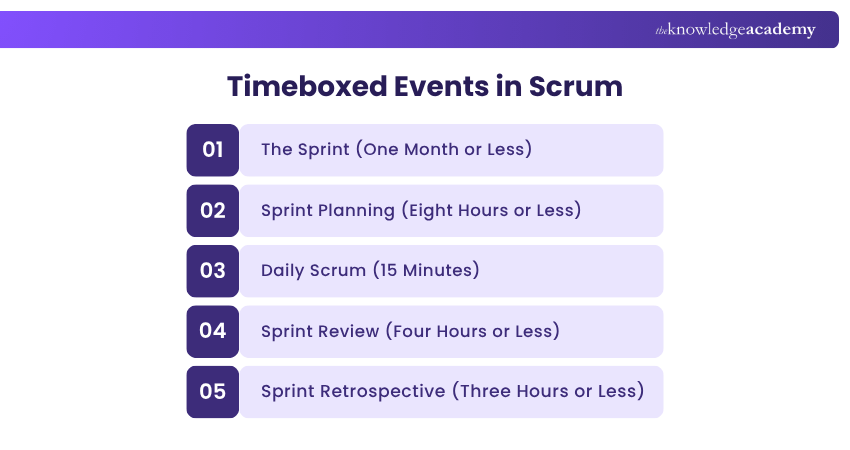
Timeboxing in Scrum ensures that key activities, including Scrum Estimation Techniques, are completed within a fixed duration. This approach facilitates continuous improvement throughout the Software Development process. The following are the five events in Scrum.
The Sprint (One Month or Less)
The Sprint, a core component of Scrum, is Timeboxed to one month or less. During this period, a set amount of work must be completed and reviewed. Short Sprints ensure frequent feedback and enable quick adaptation to changes.
Sprint Planning (Eight Hours or Less)
Sprint Planning is Timeboxed to a maximum of eight hours for a one-month Sprint. The Scrum team defines the Sprint Goal and selects items from the Product Backlog. This focused planning helps Improve Scrum Team Productivity, prevents delays, and ensures efficient use of time.
Daily Scrum (15 Minutes)
The Daily Scrum is a brief, 15-minute Timeboxed event. It allows the team to synchronise activities and plan for the next 24 hours. This concise meeting ensures quick alignment and minimises disruptions.
Sprint Review (Four Hours or Less)
The Sprint Review is Timeboxed to four hours for a one-month Sprint. The team presents completed work to stakeholders for feedback. This structured meeting keeps discussions focused and productive.
Sprint Retrospective (Three Hours or Less)
The Sprint Retrospective is Timeboxed to three hours for a one-month Sprint. The team reflects on the past Sprint to identify improvements. This dedicated time fosters continuous improvement and enhances team effectiveness.
Learn techniques for Sprint Planning and backlog grooming with our Scrum for Teams Training – join today!
What Are the Benefits of Timeboxing in Scrum?
Timeboxing is one of the cornerstones of Scrum. Essentially, it plays a key role in keeping teams aligned, productive, and purposeful. By placing clear time limits on activities, teams avoid distractions and overplanning. All of this is done while staying focused on delivering real value. Thus, below are some of the merits of how timeboxing helps to make smooth:
Supports Focus
When there’s a fixed time limit, people naturally cut out distractions. Timeboxing forces the team to concentrate on what truly matters. Instead of drifting into long debates or unnecessary work, focus sharpens. Everyone knows they only have so much time to deliver, which boosts efficiency. This keeps the team's attention locked on key tasks.
Provide Value Over Chasing Perfection
Time limits prevent endless tweaking and polishing. With timeboxing, the team learns to deliver what works now rather than chasing an unattainable perfect version. It encourages shipping usable features that bring immediate value. Teams can always improve later based on feedback. Real progress beats perfect plans.
Protects Time
Timeboxing gives structure to the day and safeguards hours for actual work. Without it, meetings or tasks can sprawl and eat into development time. Boundaries help ensure each item gets just enough attention. That balance protects the team from burnout and lost productivity. It also leaves space for rest and thinking.
Creates Predictability
Scrum thrives on rhythm, and timeboxing builds it in naturally. Each sprint, meeting, or task has a defined start and end. This predictability helps teams plan their workload and stakeholders manage expectations. It reduces chaos and builds trust over time. Everyone knows what to expect and when.
Purposeful Events, Not Endless Meetings
Scrum events stay focused because they’re timeboxed. That means stand-ups don’t drag and retrospectives stay sharp. When people know there’s a hard stop, they come prepared and stay on point. The result? Meetings that feel useful, not like wasted hours. Time is spent with intent, not out of habit.
Disadvantages of Timeboxing in Scrum
As much as Scrum is essential, it also brings with it certain disadvantages. This, in itself, gives a lesson that one must not dive in its merits alone. Therefore, keeping this mind, look at the cons down below. This will help you gain the additional quest of knowledge that you require about Scrum Management:
a) Pressure and stress: The strict time limits imposed by Timeboxing can create pressure and stress, especially if teams consistently struggle to complete tasks within the allotted time
b) Potential for rushed work: To meet time constraints, there is a risk that teams might rush their work, potentially compromising quality.
c) Inflexibility: While Timeboxing promotes discipline, it can also lead to inflexibility. Teams may find it challenging to extend time for activities that genuinely require more attention.
d) Difficulty in estimation: Accurately estimating the time required for tasks can be challenging, particularly for complex or unfamiliar work, leading to either underestimation or overestimation.
Acquire the essential skills to lead teams with our Scrum Master Certification – join today!
What is an Example of a Timebox?
In a Scrum team building a mobile app, the Sprint lasts exactly two weeks. This fixed period is used for planning, coding, testing, and reviewing features. Once it starts, no extra tasks are added. The team stays focused and works towards clear goals.
Every morning, they have a 15-minute Daily Scrum. Each member quickly shares progress, plans, and any blockers. The brief format avoids long talks and keeps things efficient. It ensures alignment and helps the team move forward without delays.
What is the Timeboxing Rule?
The Timeboxing Rule in Scrum refers to setting a maximum fixed duration for an activity, meaning the event must end when the time is up, regardless of whether the task is finished. Below are the key points of the rule:
a) Fixed time limits: Each Scrum event has a strict time limit that cannot be extended.
b) Focus on outcomes: Teams aim to achieve the goal within the timebox rather than strive for perfection.
c) Encourages discipline: Everyone must come prepared and stay on track to make the most of the time.
d) Timebox ends on time: Even if discussions or work are unfinished, the session stops at the end of the timebox to maintain rhythm and efficiency.
This rule promotes better planning, faster feedback, and a consistent pace across the project.
Conclusion
Therefore, this is all you need to learn on What is Timeboxing in Scrum. Using it in Agile work can greatly improve the team's efficiency and focus. By setting strict time limits for tasks and meetings, Scrum helps keep everything on track and ensures steady progress. Timeboxing has many benefits. However, it can also create stress if it is not used well. This is why it should be used effectively.
Learn the benefits of using Agile alongside Scrum with our Managing Agile Projects with Scrum – join today!
Frequently Asked Questions
Can Scrum Timeboxing be Applied to Non-Software Development Projects?

Yes, Scrum Timeboxing can be applied to Non-Software Development projects, providing structure and focus for any team working towards specific goals within a set timeframe.
What Tools or Techniques Can Assist Teams in Managing their Timeboxes Effectively?
Tools and techniques such as task management software (e.g., Trello, Jira) and visual aids like Kanban boards can help teams manage their Timeboxes effectively.
What Are the Other Resources and Offers Provided by the Knowledge Academy?
The Knowledge Academy takes global learning to new heights, offering over 3,000+ online courses across 490+ locations in 190+ countries. This expansive reach ensures accessibility and convenience for learners worldwide.
Alongside our diverse Online Course Catalogue, encompassing 17 major categories, we go the extra mile by providing a plethora of free educational Online Resources like Blogs, eBooks, Interview Questions and Videos. Tailoring learning experiences further, professionals can unlock greater value through a wide range of special discounts, seasonal deals, and Exclusive Offers.
What Is the Knowledge Pass, and How Does It Work?
The Knowledge Academy’s Knowledge Pass, a prepaid voucher, adds another layer of flexibility, allowing course bookings over a 12-month period. Join us on a journey where education knows no bounds.
What Are Related Courses and Blogs Provided by the Knowledge Academy?
The Knowledge Academy offers various Scrum Certification, including Scrum Master Certification, Scrum Product Owner Training and Scrum Developer Training. These courses cater to different skill levels, providing comprehensive insights into Agile Project Management With Scrum.
Our Project Management Blogs cover a range of topics related to Scrum, offering valuable resources, best practices, and industry insights. Whether you are a beginner or looking to advance your Project Management skills, The Knowledge Academy's diverse courses and informative blogs have you covered.

The Knowledge Academy


Global Training Provider
The Knowledge Academy is a world-leading provider of professional training courses, offering globally recognised qualifications across a wide range of subjects. With expert trainers, up-to-date course material, and flexible learning options, we aim to empower professionals and organisations to achieve their goals through continuous learning.

Upcoming Project Management Resources Batches & Dates
Date
 Scrum Master Certification
Scrum Master Certification
Thu 2nd Jul 2026
Scrum Master Certification
Thu 3rd Sep 2026
Scrum Master Certification
Thu 5th Nov 2026

 If you wish to make any changes to your course, please


