


 Top Rated Course

We may not have the course you’re looking for. If you enquire or give us a call on +1800812339 and speak to our training experts, we may still be able to help with your training requirements.
What Are Proximity Sensors? Types, Working & Applications
The Knowledge Academy 25 April 2026Proximity Sensors are non-contact devices that detect nearby objects using electric and magnetic fields or sound-based signals. They find their applications in smartphones, elevators, and automation systems and offer fast response, durability, and versatility across manufacturing, agriculture, and logistics industries.

Training Outcomes Within Your Budget!
We ensure quality, budget-alignment, and timely delivery by our expert instructors.
Table of Contents

Have you ever wondered how automatic doors open exactly when you approach them? Or how does a smartphone turn off its screen near your ear? These everyday miracles are powered by Proximity Sensor. Without them, automation would be slower, less accurate, and more prone to breakdown.
However, how do they work, and why are they so reliable? This blog will explore Proximity Sensors, explain how they function, detail their types and applications, and highlight their most important benefits.
Table of Contents
1) What are Proximity Sensors?
2) How Do Proximity Sensors Work?
3) Proximity Sensor Applications
4) Advantages of Proximity Sensors
5) Conclusion
What are Proximity Sensors?
Proximity Sensor are the non-contact sensors that detect nearby objects (often referred to as “Targets”) when they enter their sensor field. The most common applications can be seen in smartphones, Recycling Plants, self-driving cars, IoT and elevators.
Proximity Sensors can be compared to the sixth machine sense that allows them to "feel" the object's presence without physical contact. Just as our skin detects nearby surfaces, these Types of Sensors identify targets in their field, enabling devices to quickly interact with their environment.

How Do Proximity Sensors Work?
Proximity Sensor detects the objects' presence or absence without physical contact by converting this information into an electrical signal. When an object comes under the sensor's range, it triggers an ON signal. Different types are there that operate on distinct principles:

1) Capacitive Proximity Sensor: These sensors detect Capacitance changes between the sensor and an object. Factors such as distance and object size influence the Capacitance, and the sensor identifies any variations.
2) Inductive Proximity Sensor: These sensors detect Eddy currents that cause magnetic losses on conductive surfaces through a detection coil that generates an AC magnetic field. Any impedance changes resulting from the eddy currents are then detected.
3) Magnetic Proximity Switches: These switches function using a magnet to operate a reed switch. When the reed switch is activated (turned ON), the sensor also turns ON.
4) Ultrasonic Proximity Sensor: It utilises ultrasonic sound waves to measure the object's distance. A Transducer then sends and receives Ultrasonic pulses while the sensor calculates the time-based proximity it takes for the pulses to return.
Learn how to design, deploy, and secure scalable IoT Networks- Sign up for our Internet of Things IoT Systems And Applications Training today!
Proximity Sensor Applications
Proximity Sensor’s non-contact nature makes them ideal for applications that involve delicate or unstable items. Some of its key applications include:
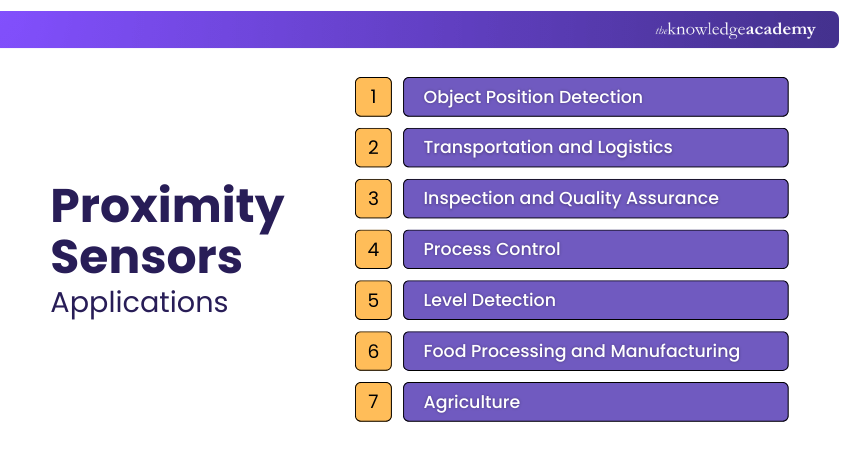
1) Object Position Detection: Accurately determines the component's position in automated systems, ensuring precise operations.
2) Transportation and Logistics: Monitors the movement and placement of goods movement and placement, enhancing tracking and inventory management.
3) Inspection and Quality Assurance: Detects defects or inconsistencies in products during manufacturing, upholding quality standards.
4) Process Control: Regulates machinery and processes through material presence sensing, contributing to efficient production workflows.
5) Level Detection: Measures levels of container’s liquids or solids, crucial for inventory control and process management.
6) Food Processing and Manufacturing: Ensures hygiene and precision through item detection without direct contact, maintaining product integrity.
7) Agriculture: Monitors equipment positions and crop levels, aiding in efficient farm management.
In addition, Proximity Sensors are employed in oil or water-prone environments, offering advantages over other detection methods. They are also suitable in fluctuating or extreme temperature areas, typically operating within a range of -50°C to 100°C.
Leverage the full potential of 5G networking with our 5G Wireless Course- Join today!
Advantages of Proximity Sensors
Proximity Sensors offer numerous advantages that make them essential in various applications. Here are some key benefits:

1) Fast Response Time
Proximity Sensor provides rapid detection of objects, enabling quick system responses. This swift reaction enhances the efficiency and performance of automated processes.
2) Insensitive To Surface Conditions
These sensors operate effectively regardless of an object's surface characteristics, such as colour or texture. They detect physical presence based on changes in physical properties, ensuring consistent performance across different materials and finishes.
3) Non-contact Detection
By detecting objects without physical contact, Proximity Sensor minimises wear and tear, leading to longer operational life. This non-invasive approach is particularly beneficial for handling delicate or hazardous materials.
4) High Durability In Harsh Environments
Designed to withstand challenging conditions, the Proximity Sensor functions reliably in environments with dust, moisture, and extreme temperatures ranging from -40°C to 200°C. This resilience makes them suitable for industries like manufacturing and automotive.
Gain expertise in cutting-edge face Detection techniques- Register for our Face Recognition Training today!
Conclusion
The role of Proximity Sensor goes far beyond what we see at first glance. They are the reason automatic doors open at the right time and machines stop when objects are near. Built for speed and reliability, these sensors work silently behind the scenes in nearly every modern system. Learning about how they function, and their many benefits, helps us understand why they are key components in technology and innovation.
Advance your skills in Acoustic Modelling and Language Processing- Join our CMUSphinx Training today!
Frequently Asked Questions
What Are the Limitations of Proximity Sensor?

Proximity Sensors can have a limited detection range. Thus, they may struggle with very small or non-conductive objects (depending on the type) and can be affected by environmental factors like dust, moisture, or temperature changes. Secondly, they can typically detect only within a specific sensing area.
How Accurate Are Proximity Sensors?
The accuracy of Proximity Sensor depends on their type and application. Generally, they offer good precision within short ranges often within ±1 mm. Ultrasonic and Laser-based sensors provide higher accuracy, while Inductive and Capacitive types are more suited for reliable short-distance detection.
What are the Other Resources and Offers Provided by The Knowledge Academy?
The Knowledge Academy takes global learning to new heights, offering over 3,000+ online courses across 490+ locations in 190+ countries. This expansive reach ensures accessibility and convenience for learners worldwide.
Alongside our diverse Online Course Catalogue, encompassing 19 major categories, we go the extra mile by providing a plethora of free educational Online Resources like Blogs, eBooks, Interview Questions and Videos. Tailoring learning experiences further, professionals can unlock greater value through a wide range of special discounts, seasonal deals, and Exclusive Offers.
What is The Knowledge Pass, and How Does it Work?
The Knowledge Academy’s Knowledge Pass, a prepaid voucher, adds another layer of flexibility, allowing course bookings over a 12-month period. Join us on a journey where education knows no bounds.
What are the Related Courses and Blogs Provided by The Knowledge Academy?
The Knowledge Academy offers various Advanced Technologies Courses, including Sensor and Data Fusion Training, Internet of Things (IoT) Systems and Applications Training, and 5G Wireless Training. These courses cater to different skill levels, providing comprehensive insights into Quantum Computing.
Our Advanced Technology Blogs cover a range of topics related to Sensors, offering valuable resources, best practices, and industry insights. Whether you are a beginner or looking to advance your Technological Knowledge, The Knowledge Academy's diverse courses and informative blogs have got you covered.

The Knowledge Academy


Global Training Provider
The Knowledge Academy is a world-leading provider of professional training courses, offering globally recognised qualifications across a wide range of subjects. With expert trainers, up-to-date course material, and flexible learning options, we aim to empower professionals and organisations to achieve their goals through continuous learning.

Upcoming Advanced Technology Resources Batches & Dates
Date
 Sensor and Data Fusion Training
Sensor and Data Fusion Training
Fri 21st Aug 2026
Sensor and Data Fusion Training
Fri 30th Oct 2026

 If you wish to make any changes to your course, please


