




We may not have the course you’re looking for. If you enquire or give us a call on +44 1344 203 999 and speak to our training experts, we may still be able to help with your training requirements.
Written Communication: The Importance of Effective Writing
ByNaveena VenkatesanLast updated on: 18 September 2026
Make an impact with your words by mastering the art of writing. In this blog, we will understand the essence of written communication, its types, aspects that make writing effective, and the ways to improve it. Also learn about practical strategies to enhance your writing skills.
A Quick Overview
1. Written communication conveys information through written words across emails, reports, messages, and other formats.2. Effective writing should be clear, concise, coherent, consistent and correct.3. The appropriate writing style depends on the audience, purpose, context and communication channel.4. Good writing skills are valuable in the workplace, supporting professional relationships, documentation, and informed decision-making.5. Writing skills can improve through practice, feedback, careful editing and appropriate use of technology.
Though technology has prevented us from taking our pen on many occasions in this digital age, written communication is far from outdated! According to the IC Index 2025, 53% of employees prefer to receive information about their organisation’s plans and priorities in written form, highlighting the continued preference for well-structured written information.
Think about it. Written words serve as a record, prevent misunderstandings, and keep things crystal clear. Just like we pay attention to body language and tone in face-to-face conversations, there are key elements that make written communication effective.
So, how do you make your writing clear, engaging, and impactful? Let’s dive into the essentials of written communication and how you can sharpen your skills!
What is Written Communication?
Written communication involves conveying ideas and information through the written word. It includes various formats such as emails, reports, letters, and online posts. The written word provides a permanent record that can be referenced later, ensuring accountability and clarity. This skill is fundamental in both personal and professional contexts.
Effective written communication improves clarity and minimises misunderstandings. It needs careful drafting and editing to convey the intended message accurately. Today, the ability to write well is more crucial than ever for engaging diverse audiences.
Why is Written Communication Important?
Written communication is important because it enables information to be documented, shared and reviewed. In professional and academic settings, it can support clear instructions, consistent information and accountability. Here are the reasons why it matters:
1) Creates a Record: Written messages can be stored and revisited when required. Emails, reports, policies and other documents can therefore provide useful records of information, decisions and agreements.
2) Improves Clarity: Writing gives the sender an opportunity to organise and refine a message before sharing it. Clear wording and logical structure can make complex information easier for readers to understand.
3) Supports Accountability: Written documents can establish what was communicated, when it was communicated and, depending on the context, who was responsible for particular decisions or actions.
4) Enables Consistent Communication: A written message can help ensure that multiple readers receive the same core information. This can be particularly useful for policies, procedures, instructions and organisational updates.
5) Supports Professional Communication: Emails, proposals, reports and other written documents are widely used in professional environments. Strong writing skills can help individuals communicate information clearly and appropriately.
Example
Imagine a manager writing, “Please finish the report soon.” One employee may interpret “soon” as today, while another may think it means this week. Writing “Please send the completed report by 3 PM on Thursday” provides a clearer expectation.
Types of Written Communication
Written communication can be broadly categorised into four types, each customised to different contexts and audiences. These styles are designed to convey ideas clearly and effectively in professional, academic, or casual settings. Here are four key categories that highlight the versatility and importance of written communication:
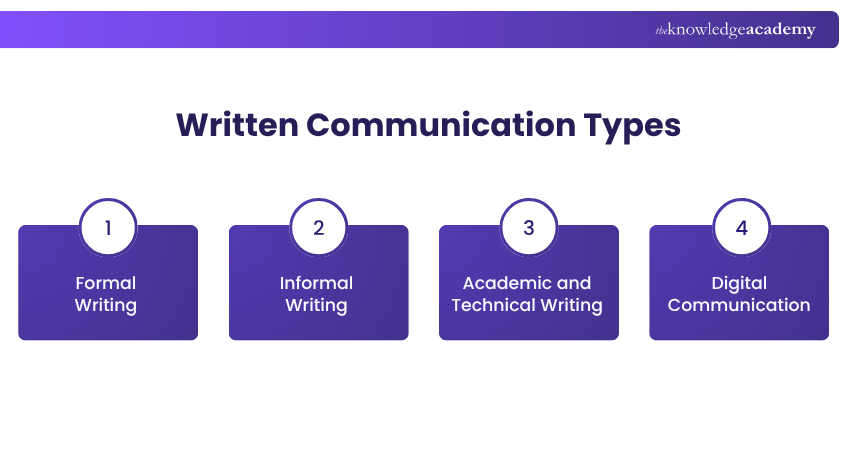
1) Formal Writing
Formal written communication is used in business and legal documents. It is structured, uses a professional tone, and follows strict grammar and punctuation rules. Common examples include reports, proposals, and official letters, which ensure clarity and accountability.
2) Informal Writing
Informal written communication is more relaxed and is often used in personal emails, text messages, and social media posts. It allows for a conversational tone and creative expression without rigid formatting rules. This style is adaptable to everyday interactions and helps convey personality and warmth.
3) Academic and Technical Writing
Academic and technical writing is known for its precision and depth, commonly found in research papers, dissertations, and technical manuals. It involves detailed analysis, critical evaluation, and accurate referencing of sources. This form of writing supports learning and the dissemination of specialised knowledge.
4) Digital Communication
Digital communication has evolved alongside technology and now includes blogs, online articles, and forum discussions. Depending on the audience and purpose, it often blends formal and informal elements. Its immediacy and wide reach have transformed how information is shared and consumed.
NOTE
These categories can overlap. A digital email to a senior stakeholder, for example, may still require a formal writing style.
The 5 Cs of Effective Written Communication
The 5 Cs include clarity, conciseness, coherence, consistency, and correctness. They serve as a framework to enhance the quality of your written communication. Let's check each of them in detail:
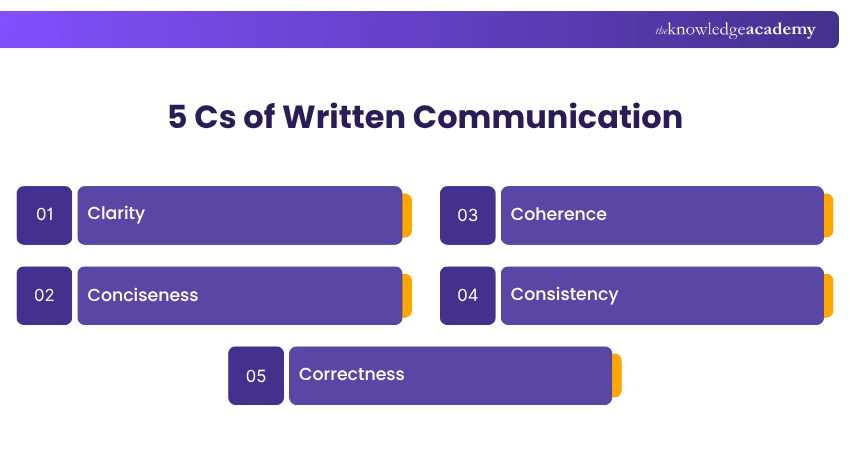
1) Clarity
Clarity is the foundation of effective writing. Using clear language helps the reader easily understand your message. Avoid jargon and ambiguous terms, especially when addressing a wide audience. Gathering your ideas before writing can help ensure that every sentence serves a clear purpose.
2) Conciseness
Conciseness is about conveying your message in as few words as needed without losing meaning. In a world where readers often skim content, being succinct helps maintain their attention and ensure your message is not lost in unnecessary details. Every word should serve a purpose, and eliminating repetition can greatly enhance readability.
Pro Tip
While editing, remove repeated ideas, filler words and unnecessary qualifiers to make your writing clearer and more concise without changing its meaning.
3) Coherence
It is the logical flow of ideas within your writing. Your content should be organised so that each point naturally leads to the next, forming a seamless narrative. Transitional phrases and clear topic sentences can help ensure that the structure of your writing guides the reader through your thought process.
4) Consistency
It is about maintaining the same tone and style throughout your writing. Whether you are writing a business report or an informal blog post, consistent use of language and structure reinforces the professionalism and dependability of your content. Inconsistencies can divert the reader and undermine the main theme.
5) Correctness
This includes grammar, punctuation, and overall linguistic accuracy. Mistakes can lower your credibility and lead to misinterpretation. Proofread your work carefully to ensure correctness. If necessary, use editing tools to find errors. In professional and academic contexts, a high level of correctness is essential.
The 5 Cs Quick Check
Before sending or publishing your writing, ask:
Clarity: Is my main message easy to understand? Conciseness: Have I removed unnecessary words and repetition? Coherence: Do my ideas follow a logical sequence? Consistency: Is my terminology, tone and formatting consistent? Correctness: Have I checked grammar, spelling, punctuation and key facts?
Discover techniques to make your writing more vivid with Creative Writing Course – Register today!
Pros and Cons of Written Communication
Like other forms of communication, written communication has strengths and limitations. Understanding both can help you decide when writing is appropriate and when another communication method may work better.
1) Pros
Here are the key pros of written communication:
a) Permanent Record: Written communication can provide a record that can be stored and referred to later. This is useful where documentation is important.
b) Thoughtful Composition: Writing allows time to draft, revise and refine a message before it reaches the recipient.
c) Wide Reach: Digital channels can distribute written information quickly to readers across different locations.
d) Accountability and Clarity: Written documents can make information, responsibilities and decisions easier to review and reference.
2) Cons
There are some cons of written communication to watch out for:
a) Delayed Feedback: Written communication may not provide the immediate feedback available during a live conversation.
b) Limited Non-verbal Cues: Written messages usually lack facial expressions, gestures and vocal tone, which can make some messages easier to misinterpret.
c) Time-consuming: Detailed documents may require considerable time to draft, review and proofread.
d) Potential for Ambiguity: Readers may interpret wording differently, particularly when a message lacks sufficient context or precision.
Make sure every one of your emails, proposals and reports tells a clear story with our Business Writing Course – Sign up now!
How to Improve Written Communication Skills?
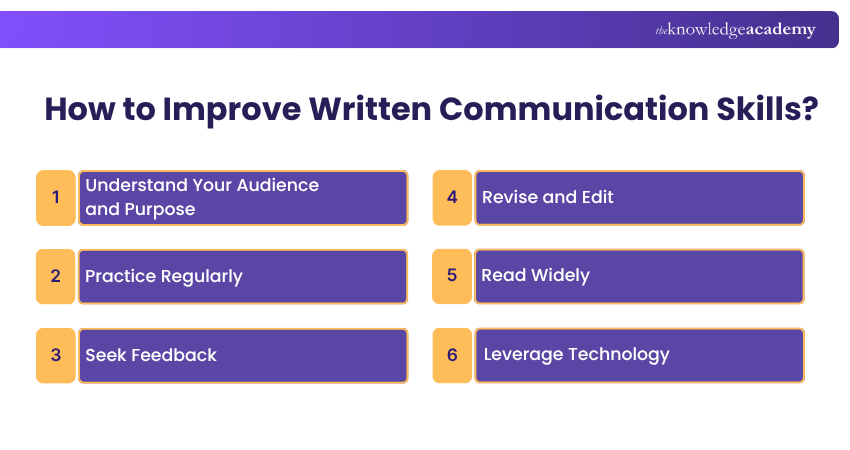
To improve your written communication Skills, you need strong drafting and editing to convey your intended message accurately, along with constructive criticism and an openness to new ideas. Several techniques can help you write better, whether you're producing emails, scholarly papers, or creative content:
1) Understand Your Audience and Purpose
Before you begin writing, consider who will be reading your work and why. Customising your message to suit the needs and expectations of your audience is key to effective communication. A clear purpose, whether to inform, persuade, or entertain, will guide the tone, style and structure of your writing.
2) Practice Regularly
Writing improves with practice. Engage in regular writing exercises, whether through journaling or blogging. The more you write, the more you will develop your voice and style. Set aside time each day or week to write, even if it’s just for a short period, to build consistency and confidence.
3) Seek Feedback
Feedback plays a crucial role in enhancing your writing skills. Share your work with peers, mentors, or writing groups and ask for constructive criticism. Be open to suggestions and willing to revise your work based on the input you receive. Over time, you will learn to recognise common mistakes and develop strategies to avoid them.
4) Revise and Edit
Editing is a critical part of the writing process. After drafting your content, take the time to review and refine it. Look for areas to improve clarity and ensure your ideas flow logically. You can also use certain tools to proofread the content and identify errors that need correction.
5) Read Widely
Exposure to a variety of writing styles, genres and formats can greatly enhance your writing. Read articles, books and essays from a variety of sources. Pay attention to how authors structure their arguments, develop their narratives, and use language creatively. This not only broadens your perspective but also provides inspiration for your writing projects.
6) Leverage Technology
Nowadays, numerous tools are available to help you improve your written communication. From grammar and plagiarism checkers to style and readability analysis software, these tools can assist you in producing error-free and engaging content. Experiment with different applications to see which ones best complement your writing process.
Written Communication Checklist
Before sending an important email, report or document, check:
Is the purpose of the message clear? Have I considered the audience? Is the most important information easy to find? Are my sentences clear and concise? Does the information follow a logical structure? Is the tone appropriate for the situation? Have I explained unfamiliar terminology where necessary? Have I removed unnecessary repetition? Have I checked important facts, figures and names? Have I proofread the final version?
Build the writing skills needed for academic and professional success with our Academic Writing Course – Sign up now!

Naveena Venkatesan is a Content Editor with 2+ years of experience in content writing, editing and linguistic quality assurance. Her research, fact-checking and editorial experience enable her to develop accurate, accessible resources across Business Skills, Human Resources, and Accounting and Finance.
View Detail

 If you wish to make any changes to your course, please


