




We may not have the course you’re looking for. If you enquire or give us a call on +44 1344 203999 and speak to our training experts, we may still be able to help with your training requirements.
What is Pricing: An Introduction to Pricing Strategies
ByThe Knowledge AcademyLast updated on: 02 October 2026
Curious to know about what is pricing? Pricing is more than just numbers - it's a powerful tool that shapes consumer perception and drives business success. In this blog, uncover the secrets behind pricing strategies, explore psychological pricing, and learn how to set prices that captivate your audience for maximum profitability.

Overview
1. Pricing involves more than covering costs: Businesses should consider customer value, market behaviour, competition and internal financial goals when setting prices.2. Pricing should support business priorities: The right approach may help a company enter a market, strengthen its positioning, improve revenue or support long-term profitability.3. Customer behaviour influences price decisions: Understanding buying habits, price sensitivity and perceived value can help businesses choose more suitable price points.4. External conditions can change pricing decisions: Demand, economic changes, seasonal trends, competitor activity and regulations can all affect how prices are reviewed.5. There is no single pricing strategy for every business: Penetration, premium, competitive and value-based pricing are suited to different products, markets and objectives.
Understanding what is pricing is like deciphering the secret language of business success. It’s not just about assigning a number to a product or service; it’s about crafting a narrative that aligns with your customers’ needs, desires, and perceptions. Imagine it as tuning a musical instrument for each note must be perfect to create harmony. Mastering this art means you’re not merely selling a product but delivering value that deeply resonates with your audience.
Exploring what pricing is unveils a myriad of strategies that can revolutionise your business's customer engagement. Let’s delve into the various aspects of pricing and discover how you can leverage its power to make a lasting impact in your market.
Understanding What is Pricing
Pricing is the process a business uses to decide how much customers will pay for its products or services. It plays a key role in business strategy and directly influences revenue and profitability. You need to consider how much it costs to produce or offer what you're selling, what customers are willing to pay, and what similar products or services are priced at.
Pricing concerns the determination of what customers need to pay for a certain product or service that adds value to their lives. It is both a science and an art, as there are many factors to consider, including the Cost of Sales, to ensure the price accurately reflects its value and market conditions. Pricing aims to find a balance that attracts customers while simultaneously ensuring the achievement of the financial goals set by the business.

Importance of Pricing
Effective pricing can support revenue, market positioning and wider business objectives. Some key reasons pricing is important include:
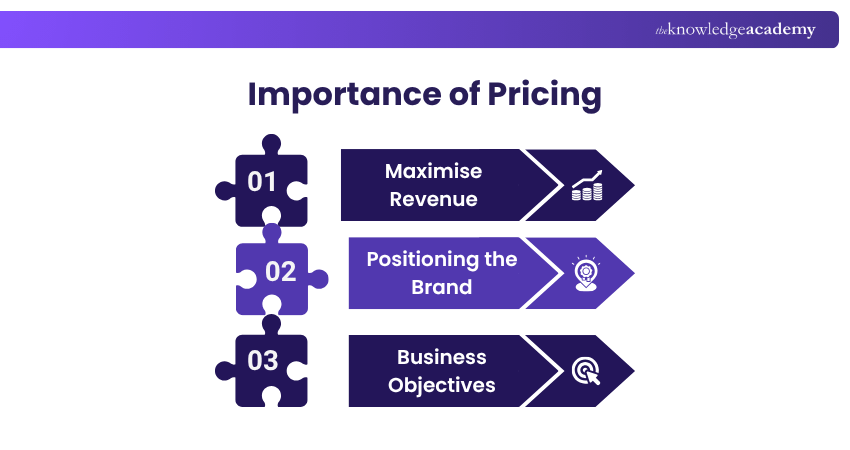
1) Maximise Revenue: Pricing can support objectives such as revenue growth, profit maximisation and market-share expansion. The optimal price depends on demand, costs, competition and the organisation’s wider business goals.
2) Positioning the Brand: Price acts as an indicator about the positioning of the Branding. For instance, luxury brands take the high pricing approach in general to denote exclusivity and the best possible quality, while the budget brands choose lower pricing levels to cater to price-sensitive customers.
3) Business Objectives: Pricing strategies are set to realise various business objectives. For example, a firm can use a penetration price to gain substantial market share in the shortest period or use a premium price in a differentiated product offering to realise maximum profits.
Trainer's Insight
Prices should be reviewed periodically as costs, customer expectations and market conditions change. Businesses that rely on the same pricing structure for too long may miss changes in demand or profitability.
Key Considerations for Pricing Setup
Setting the right price involves a delicate balance between many issues. The following section examines some of the most relevant factors in detail:
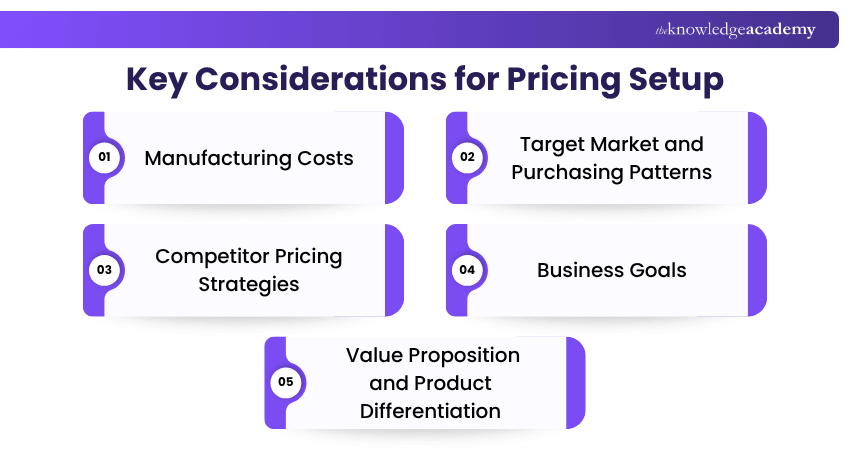
1) Manufacturing Costs
Cost of production is one of the bases of pricing anything. The constituents of manufacturing cost are listed below:
a) Raw Materials: The cost of materials needed to produce it.
b) Labour: Salaries and benefits of the labour forces involved in its production.
c) Overheads: Utility, rent, and equipment costs.
The ability of the price to cover these costs with a profit margin therein is important for business sustainability. Knowing these costs helps in price setting in such a way that it covers the expenses as well as supports profitability.
Pricing Myth vs Reality
Myth: A higher price always means higher profit.Reality: Profit depends on factors such as costs, sales volume, demand and the overall pricing strategy.
2) Target Market and Purchasing Patterns
Knowing your target audience is of the essence to have effective Pricing. Consider:
a) Price Sensitivity: How sensitive is your audience to any change in prices? Knowing this will help in setting a price that meets their expectations without deterring potential sales.
b) Purchasing Habits: What influences their buying decisions? For example, some might be totally influenced by discounts and promotions, while others would gladly pay for convenience or quality.
Setting the right price to meet expectations and behaviour of the targeted customers will help in winning and maintaining customers.
3) Competitor Pricing Strategies
By analysing the pricing strategies of competitors, the following can be deciphered:
a) Market Trend: By observing the competitors, one could trace the trend and accordingly price their product or service competitively.
b) Pricing Gaps: Identifying gaps in competitors’ pricing can offer opportunities to differentiate your pricing strategy.
Knowing how competitors' price their products or services will give business an idea for setting a proper market price in which to set themselves apart.
4) Business Goals
A pricing strategy should be in harmony with other broader business objectives, which are:
1) Market Penetration: In the event of entry into new markets, perhaps there might be some initial low price to gain quick penetration of customers.
2) Revenue Maximisation: Revenue maximisation focuses on increasing total sales revenue, whereas profit maximisation considers both revenue and costs. The appropriate objective depends on the organisation’s strategy and market conditions
3) Market Development: Price adjustment may also be used to meet the requirements of any new market segments or regions. Such price adjustment could lead to market development.
Alignment of pricing with your business objectives would ensure value is retained towards a bigger strategic goal.
5) Value Proposition and Product Differentiation
The perceived value of your product or service influences Pricing:
1) Differentiators: Products with distinctive features or benefits may be able to support a premium price when customers perceive sufficient additional value.
2) Brand Equity: High brand equity allows one to focus on premium pricing because people pay more for well-recognised or prestigious brands.
Clearly articulating value and benefits associated with your offering provides price justification and equates to customer willingness to pay.
Key Factors Influencing Pricing Decisions
Pricing decisions don’t happen in a vacuum; they’re shaped by various external and internal factors. Here’s a closer look at what influences your pricing strategy:
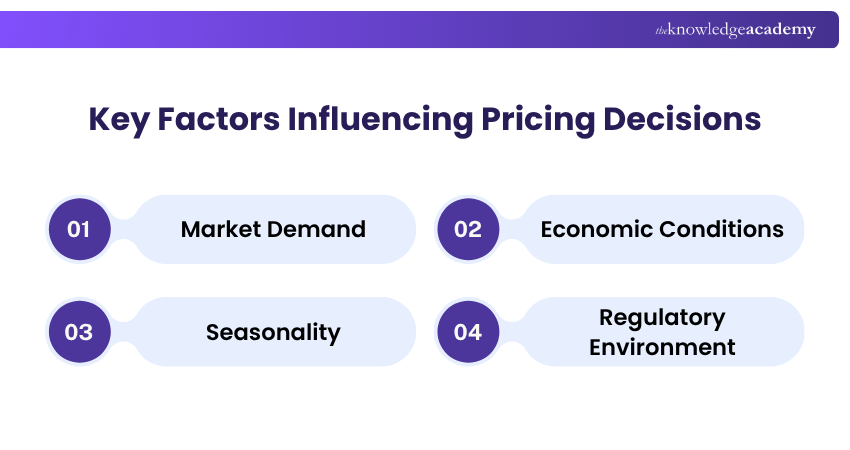
1) Market Demand: If the demand of your products is high in the market, then you increase your rates because people will pay a premium price. And if it is low, you must decrease prices to attract buyers and push the volume of sales higher.
2) Economic Conditions: This is the broader economic setting that has a bearing. During periods of inflation, costs rise, and consumers may cut down on spending; it may reduce what they are willing or can afford to pay. In a recession, you may have to lower prices to remain competitive and lure customers who are on strained budgets.
3) Seasonality: The demand for some products peaks in season, such as holiday decorations and summer clothes. You will want to price higher during those high seasons of the year so that the market will have more interest in your product. Lower the prices or give some discounts during the off-season to keep the sales and clear your inventories.
4) Regulatory Environment: Pricing can also be determined by regulatory factors. Price controls, taxes, or tariffs might be legislated to affect how much you can charge. It is important to keep current with relevant legislation about the appropriateness of your pricing strategy.
Examples of Pricing Strategies
Different pricing strategies will accomplish different things. Here are a few examples:
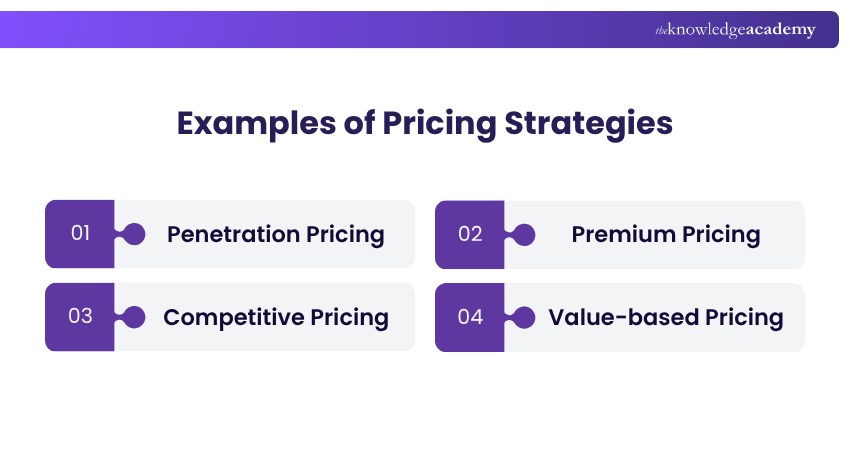
1) Penetration Pricing: A coffee shop opens its doors with relatively low prices to attract consumers and build a loyal clientele; then as their status in the market improves, they raise the price over time.
2) Premium Pricing: Luxury brands, such as Rolex, use high prices to convey exclusivity and quality. The high price has brand prestige tagged to it.
3) Competitive Pricing: The supermarket chains will also revise the prices to meet or exceed their competitors. This helps to capture and hold market share, especially for those who believe in shopping based on prices.
4) Value-based Pricing: In technology companies, Pricing of software can be based on its value to the end user. For instance, a tool saving or increasing productivity might fetch a higher price because it brings value when used.
Transform your Business Impact! Join our Business Sustainability Course and Turn Green Goals into Real Gains.

The Knowledge Academy develops accessible learning content across Project Management, IT, Cybersecurity, Data Science, Business Analysis, HR, Accounting and Finance, Leadership and Health and Safety. Its resources combine subject research with clear explanations to help professionals build practical knowledge across a wide range of disciplines.
View Detail

 If you wish to make any changes to your course, please


