


 Top Rated Course

We may not have the course you’re looking for. If you enquire or give us a call on +44 1344 203 999 and speak to our training experts, we may still be able to help with your training requirements.
Competitive Intelligence: Definition, Key Concepts, and Benefits
Richard Harris 29 July 2026Get a complete overview of Competitive Intelligence, including its types, objectives, methods, benefits, risks, and how businesses use it to stay competitive. It is the process of gathering and analysing publicly available information to support informed decision-making, identify opportunities, and adapt to changing market conditions.

Training Outcomes Within Your Budget!
We ensure quality, budget-alignment, and timely delivery by our expert instructors.
Table of Contents
In today's competitive market, success depends on making informed decisions, not assumptions. Competitive Intelligence helps organisations understand competitors, customers, and market trends, enabling them to identify opportunities, minimise risks, and respond confidently to changing business conditions.
Whether you are entering a new market or launching a product, understanding what is Competitive Intelligence provides valuable insights for smarter decision-making. In this blog, you will explore its definition, types, objectives, methods, and more. So, let’s get started to help you stay ahead of the competition.
Table of Contents
1) What is Competitive Intelligence?
2) How is Competitive Intelligence Used?
3) Objectives of Competitive Intelligence
4) Types of Competitive Intelligence
5) How Does Competitive Intelligence Work?
6) Risks and Downsides to Competitive Intelligence
7) The Cycle of Competitive Intelligence
8) Methods for Acquiring Competitive Intelligence
9) How Does Competitive Intelligence Differ from Market Research?
10) Conclusion
What is Competitive Intelligence?
Competitive Intelligence is the process of gathering and analysing publicly available information about competitors, customers, and the market to support informed business decisions. It helps organisations identify opportunities, anticipate challenges, and develop effective strategies to stay competitive.
By providing insights into market trends, competitor activities, and customer behaviour, Competitive Intelligence enables businesses to make proactive decisions and strengthen their competitive advantage. It is important to note that it should always be conducted ethically and within legal boundaries.

How is Competitive Intelligence Used?
Competitive Intelligence is used to support strategic decision-making by collecting and analysing information about competitors, customers, and market trends. Organisations use these insights to develop better products, refine pricing strategies, identify market gaps, improve customer experiences, and plan successful market entry strategies.
Also, it is used to monitor competitor activities, track industry developments, and anticipate market changes. By turning market insights into actionable strategies, businesses can respond effectively to customer needs, reduce risks, and maintain a competitive advantage.
Objectives of Competitive Intelligence
The primary objective of Competitive Intelligence (CI) is to enable businesses to make informed strategic decisions by gathering, analysing, and interpreting data about competitors, market trends, and the overall industry environment. Key objectives include:
a) Understanding Competitor Strategies: To identify and evaluate the strengths, weaknesses, opportunities, and threats of competitors' strategies.
b) Anticipating Market Trends: To stay ahead of market shifts by analysing industry patterns and consumer behaviour.
c) Improving Decision-making: To provide actionable insights that support strategic planning and risk management.
d) Identifying Opportunities: To uncover new market opportunities, partnerships, or areas for innovation.
e) Enhancing Competitive Advantage: To develop strategies that strengthen market positioning and differentiate the business from competitors.
f) Monitoring Regulatory and Industry Changes: To ensure compliance and adapt to evolving industry standards and policies.
By leveraging Competitive Intelligence, organisations can make proactive decisions, minimise risks, and maintain a sustainable edge in the marketplace.
Become the business intelligence expert every organisation need with the Business Intelligence Analyst Course – Join now!
Types of Competitive Intelligence
After learning about what is Competitive Intelligence, it’s time to understand its types. This process is divided into Tactical and Strategic activities. Tactical efforts are short-term, addressing goals like market share and revenue increase. Strategic Intelligence looks at longer-term concerns, such as key risks and opportunities for the enterprise. Here's a detailed explanation of these types:
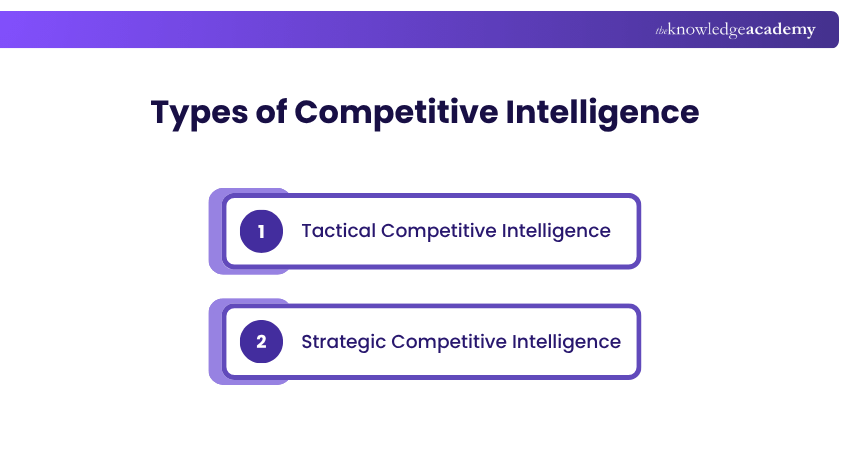
1) Tactical Competitive Intelligence
Tactical Competitive Intelligence involves short-term activities geared towards achieving specific business objectives. This includes gathering data to inform decisions related to immediate challenges, such as capturing market share and enhancing revenue streams. The focus is on obtaining actionable insights that contribute directly to the operational efficiency and competitiveness of the business in the near term.
2) Strategic Competitive Intelligence
On the other hand, Strategic Competitive Intelligence is a longer-term approach that addresses overarching issues that influence the enterprise's future. It revolves around identifying and understanding key risks and opportunities that may shape the business landscape in the extended horizon. This form of Intelligence guides high-level decision-making and aids in formulating comprehensive strategies for sustainable success.
How Does Competitive Intelligence Work?
Competitive Intelligence works performing the following:
a) Systematically gathering and analysing information about competitors
b) Studying market trends
c) Industry dynamics to inform strategic decision-making
This process includes collecting data from various sources, such as public records, industry reports, and competitor communications. Analysts then evaluate and interpret this information to identify competitors' strengths, weaknesses, opportunities, and threats.
The gathered insights help businesses anticipate market changes and understand competitor strategies. Thus, they can adapt their own approaches to get a competitive edge.
Transform complex data into clear insights with the Tableau Desktop Training today!
Risks and Downsides to Competitive Intelligence
Competitive Intelligence is valuable for strategising and staying ahead in the market. However, it comes with certain risks and downsides that need to be carefully managed. Some of them include:
1) Ethical and Legal Risks
Competitive Intelligence can sometimes blur the line between ethical practices and questionable activities. Gathering information about competitors should always be done legally and ethically. Unauthorised access to confidential data, industrial espionage, or misrepresenting one's identity to obtain information can lead to serious legal repercussions and damage a company's reputation.
2) Misinterpretation of Data
Another risk is the potential for misinterpreting the data collected. Competitive Intelligence relies on accurate and relevant information. If the data is misunderstood or taken out of context, it can lead to poor strategic decisions. This misinterpretation can result in wasted resources, missed opportunities, or even harm to the company's competitive position.
3) Overreliance on Competitors' Actions
Finally, there is a danger in placing too much focus on what competitors are doing. It's important to be aware of the competition. However, focusing too heavily on their actions can lead to reactive strategies rather than proactive ones. This overreliance can stifle innovation and prevent the company from pursuing unique opportunities that set it apart in the marketplace. It's important to balance Competitive Intelligence with a clear vision and strategy that aligns with the company's goals and strengths.
Learn bhow to Turn Business Data Into Powerful Business Decisions with our range of Business Intelligence Reporting Courses - Sign up now!
The Cycle of Competitive Intelligence
Fouad Benyoub outlines a six-step closed loop for the Competitive Intelligence cycle. Here's a complete breakdown of this cycle:
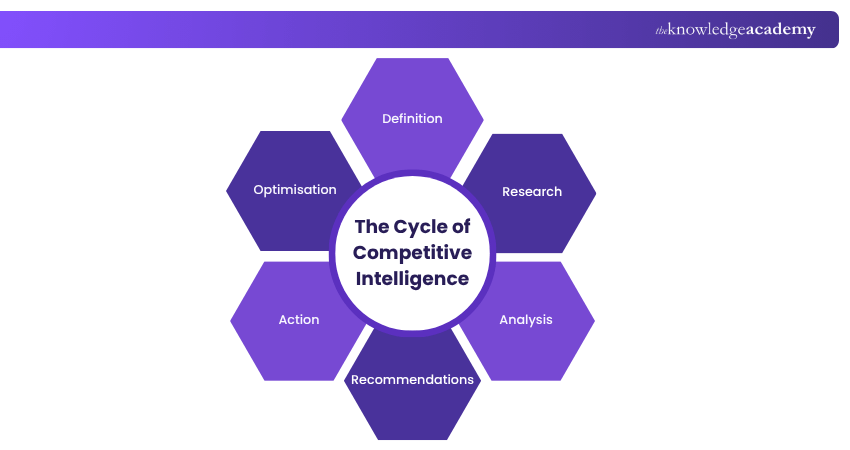
a) Definition: The cycle initiates by identifying needs, metrics, and key areas for Intelligence research.
b) Research: Competitive Intelligence analysts employ tools like Crunchbase, MOAT, SimilarWeb, SpyFu, Talkwalker, Visualping, and Owler to gather intelligence.
c) Analysis: Data is analysed to generate meaningful information during the Competitive Intelligence process.
d) Recommendations: Alongside presenting information, Competitive Intelligence offers recommendations for optimising business operations.
e) Action: The success of a Competitive Intelligence program is measured by its impact on building brand loyalty, customer connection, repeat e-commerce sales, and client retention, depending on the actions taken.
f) Optimisation: Often overlooked, this phase requires the Competitive Intelligence analyst to actively seek and assess feedback. This helps ensure a continuous improvement in the quality of recommendations throughout the Competitive Intelligence cycle.
Learn how to turn business data into actionable intelligence by joining the Microsoft BI Training now!
Methods for Acquiring Competitive Intelligence
It's time to explore five dependable methods for acquiring Competitive Intelligence to enhance your digital marketing strategies. So, let’s have a quick look at all of them:
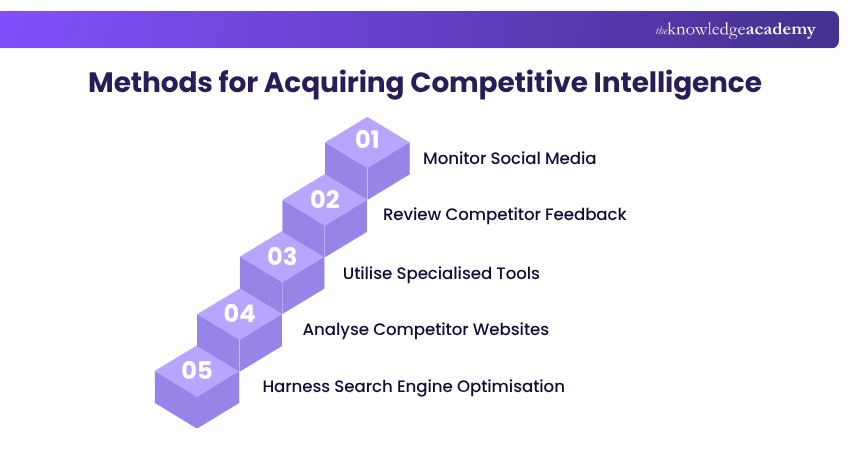
a) Monitor Social Media: Keep a close eye on all the social media platforms, letting customer comments provide valuable insights into how your products are perceived relative to competitors.
b) Review Competitor Feedback: Examine customer reviews for both your products and those of competitors. As a result, you can gain insights into strengths, weaknesses, and areas for improvement in your offerings.
c) Utilise Specialised Tools: Employ various tools designed for competitive analysis. This will enable you to stay abreast of changes in your competitors' strategies and proactively respond to shifts in their positioning within your customer base.
d) Analyse Competitor Websites: Investigate your competitors' websites for comprehensive information on their products and services. This can serve as a prime source for staying updated on their offerings.
e) Harness Search Engine Optimisation: Leverage SEO tools to assess the dependence of your competitors' traffic on specific keywords, enabling you to monitor changes in their page rankings and inform your own strategic decisions.
How Does Competitive Intelligence Differ from Market Research?
Competitive Intelligence focuses on gathering and analysing information about competitors and the competitive landscape. It helps organisations understand competitor strategies, strengths, weaknesses, and market positioning to support informed business decisions.
In contrast, market research has a broader scope, focusing on customer needs, preferences, buying behaviour, and overall market trends. While Competitive Intelligence helps businesses stay ahead of competitors, market research provides insights into the wider market to support product development, marketing, and business growth
Conclusion
Understanding what is Competitive Intelligence is key to maintaining a competitive edge. Numerous methods exist for gathering valuable insights from industry rivals, providing an advantage and boosting profits. So, embrace this process, anticipate market changes and respond strategically.
Unlock the power of Business Objects with our Business Objects Reporting Course –sign up now for exclusive business intelligence and reporting skills.
Frequently Asked Questions
How do you Build a Competitive Intelligence Team?

To build a Competitive Intelligence team, hire diverse experts in market research, data analysis, and strategy. Equip them with tools for data collection and analysis. Foster collaboration and ensure clear goals, focusing on monitoring competitors, trends, and market dynamics.
What is a SWOT Analysis in Competitive Intelligence?
SWOT analysis evaluates Strengths, Weaknesses, Opportunities, and Threats in Competitive Intelligence. It identifies internal capabilities and external factors influencing a company. This helps in crafting strategies to outperform competitors and mitigate risks effectively.

Richard Harris


Senior Full Stack Developer and Technology Educator
Richard Harris is a highly experienced full-stack developer with deep expertise in both frontend and backend technologies. Over his 12-year career, he has built scalable web applications for startups, enterprises and government organisations. Richard’s writing combines technical depth with clear explanations, ideal for developers looking to grow in modern frameworks and tools.


 If you wish to make any changes to your course, please


