


We may not have the course you’re looking for. If you enquire or give us a call on 01344203999 and speak to our training experts, we may still be able to help with your training requirements.
Project Scheduling Process: A Step-by-Step Guide
ByGrace MitchellLast updated on: 14 October 2026
The project scheduling process involves planning the timeline and resources. With a well-crafted schedule, you can ensure that tasks are completed on time, resources are utilised effectively, and project goals are met successfully.

What You’ll Learn in this Blog
1. Project scheduling establishes realistic timelines by organising activities, resources and dependencies.2. Identifying task relationships helps Project Managers determine the appropriate sequence of work.3. Duration estimates should account for available resources, working calendars and uncertainty.4. Critical path analysis, Gantt charts and resource levelling help develop and evaluate schedules.5. Regular monitoring and controlled adjustments help teams respond to delays and changing project requirements.
Are you tired of your projects running over budget and missing deadlines? The key to mitigating these common pitfalls lies in mastering the project scheduling process. By creating a well-structured plan, you can ensure your projects are on track and within budget. The project scheduling process makes this possible, helping you manage resources efficiently, meet deadlines consistently, and achieve your project goals with ease.
Read this blog to learn more about the project scheduling process. It looks at why scheduling matters and how to implement it effectively. It also shows how prioritising the process can improve a project management approach and contribute to greater business success.
Steps in the Project Scheduling Process
The project scheduling Process brings together project activities, task relationships, resources and duration estimates to establish a workable timeline. The following step approach provides a practical way to develop, review and maintain a project schedule:
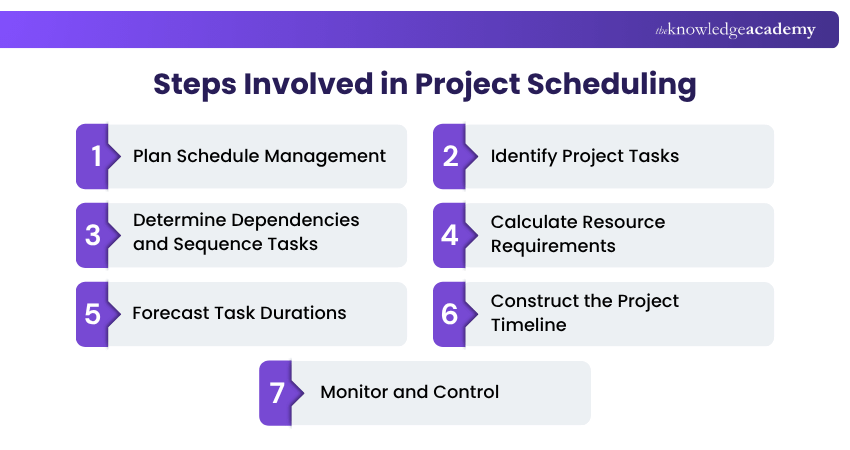
1) Plan Schedule Management
The first step in project scheduling is to establish the procedures, company policies, and documentation guidelines that will govern your project. This plan outlines the available resources and anticipates potential uncertainties. It identifies the project stakeholders and designates those responsible for approving the schedule, as well as others who need to receive a copy.
Additionally, this document specifies who has the authority to make schedule changes and details the process team members should follow to request a change. A project communication plan should also be created to ensure the team is promptly informed of any changes made during the project.

2) Identify Project Tasks
The second step is to create a list of tasks that should be completed to deliver your project. This list can help you organise tasks easily into a chart, especially when dealing with complex tasks. In the chart, you can visualise the project tasks and their sub-tasks, staying organised and efficient at work.
One challenge you may encounter at this stage is knowing how to divide activities. This is where the 8/80 rule comes in handy. According to this rule, a single activity should take between eight and eighty work hours.
In team task management, tasks requiring fewer than eight hours can be grouped with others, while tasks over eighty hours are likely too large and should be broken down further. All these actions should be measurable, easily estimated and related to both project deliverables and budgeted cost.
3) Determine Dependencies and Sequence Tasks
After listing all the project activities, each one should be reviewed carefully to identify the tasks that rely on others to be completed. For example, when constructing a house, the roof cannot go on until the frame is finished. The most common relationship is finish-to-start, where one activity must finish before the next can start. Defining dependencies correctly is important because it allows tasks to be scheduled accurately and helps avoid project delays.
Once the dependencies are identified, the tasks can be arranged in sequence. No time constraints, such as work hours or deadlines, are applied at this point. The focus is on the order in which all project activities should be completed to create the most effective flow of work.
4) Calculate Resource Requirements
Resources for each task in your project will include labour, the price of hiring subcontractors, workspace, and tools (which might be digital or physical, such as software). Don't forget to consider additional resources unique to your project or industry. Calculate the approximate resources required for every project task.
Keep in mind that how resources are allocated will impact your timeline. That means a team member cannot work on numerous project tasks at the same time.
5) Forecast Task Durations
This important step identifies the duration of each project activity. If you underestimate the duration, it will cause you to fall behind schedule and eventually annoy your customer. On the other hand, if you overestimate, team members or other resources can stay idle while you wait for the completion of the tasks. Therefore, using data from similar previous jobs is the most accurate method to estimate duration.
Some of the commonly used techniques for task duration estimation include:
a) Analogous Estimating: Uses information from similar previous activities or projects to estimate durations.
b) Parametric Estimating: Applies historical rates or statistical relationships to calculate activity durations.
c) Three-point Estimating: Considers optimistic, most likely and pessimistic outcomes to account for uncertainty.
d) Expert Judgement: Uses the knowledge and experience of relevant specialists to estimate activity durations.
6) Construct the Project Timeline
At this step, the information gathered earlier is brought together to build the schedule. Using the resource requirements and the duration of each activity, start and due dates can be assigned to every activity in the agreed sequence. Several methods can be used to build the timeline, including the critical path method, the critical chain method and resource levelling.
Choose the method that suits the project, and then check the calendar. Review vacation requests from the team and include factors such as national holidays, corporate functions, stakeholder events and any other occasions that may affect the schedule. If the entire company shuts down for a holiday week, that time needs to be added to the due dates, and customer expectations should be managed accordingly.
7) Monitor and Control
Unlike the other steps, monitoring and control is an ongoing process that continues throughout the project. The Project Manager continuously monitors and controls the project schedule. At this step, progress reports are produced, performance is tracked, team communication is maintained and progress is compared with the approved schedule baseline.
If schedule adjustments are necessary, they should be implemented and communicated in line with the Schedule Management Plan prepared in the first step. Throughout the project, the Project Manager checks whether tasks are on track and assesses whether any delays call for corrective action.
Trainer’s Pro Tip
The approved schedule baseline is the reference point for measuring performance. Updating the current schedule to show progress does not change the baseline, and any baseline change should go through the project’s formal change control procedures.
Advantages of Project Scheduling
Project scheduling can make a big impact on a company’s productivity. Here are a few advantages of creating an effective project schedule:
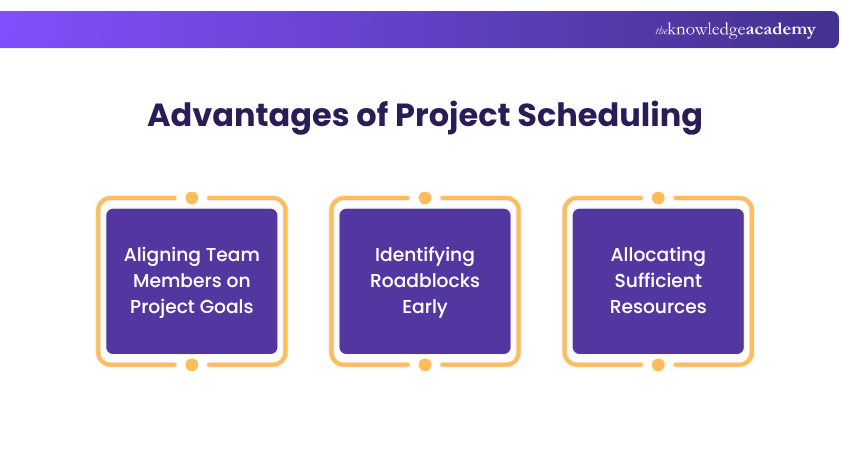
1) Aligning Team Members on Project Goals
Your team won’t know what they are expected to do or when they are expected to do it without a project schedule. Therefore, scheduling removes uncertainty and maintains everyone's alignment. This accelerates the project's progress toward its end goal. Projects are completed on schedule and within budget when team members can move swiftly between tasks and assign their work to the next team member as needed.
2) Identifying Roadblocks Early
Nothing is worse than starting a project and running into an unforeseen roadblock halfway through. In addition to the extra costs and effort required to conquer the new task, there's a chance you'll have to redo some of the previously finished tasks. Creating a thorough timetable in advance allows you to anticipate issues and find solutions before they cause your project to fall apart.
3) Allocating Sufficient Resources
A project needs the right finances, labour, supplies and equipment to be completed successfully. A detailed project schedule helps make sure that no tasks have been missed and that everything needed to finish the work by the deadline is in place.
These advantages lead to more positive results for an organisation. For example, team members are more motivated to complete their work when they can see the project goals and the resources they need to succeed. Motivated, engaged staff are among a business’s most valuable assets, and they set an example for the rest of the organisation.
Do you want to learn how to align projects to achieve strategic goals? Sign up for the PMI Scheduling Professional PMI-SP® Training now!
Project Scheduling Techniques
There are several project scheduling Techniques that can help you break down your project into small, manageable tasks. Let’s explore some of these techniques in detail:
1) Task Lists
This is the simplest scheduling technique and works well for small projects without many interdependencies. However, for larger projects, it may not be the best choice as tracking progress can become challenging. A task list includes the list of tasks and subtasks, alongside the team members assigned to them. Using online project management software can be beneficial when managing task lists.
2) Calendars
Calendars can be used to depict the project timelines for all tasks throughout the course of the project. They provide a clear view of overlaps between activities. However, this approach has limitations in assigning tasks and viewing dependencies.
3) Gantt Charts
Gantt charts are the most common tools used by Project Managers to visualise timelines and dependencies in a project. Each task is plotted as a bar on a timeline, showing when it is set to start and end and how long it will last. Dependencies between tasks are shown with connecting lines, and overlaps between activities are easy to see. Gantt charts are especially useful for managing complex projects with many interdependent tasks.
4) Critical Path Method (CPM)
The Critical Path Method identifies the longest path through a project schedule network, based on activity durations and dependencies. This path determines the project's earliest possible completion under the scheduling assumptions used. Activities on the critical path normally have no total float.
Delays to these activities can affect the project's completion date unless corrective action is taken. CPM helps Project Managers identify schedule-sensitive activities and prioritise monitoring.
5) Critical Chain Method
The Critical Chain Method, also known as Critical Chain Project Management (CCPM), considers task dependencies and resource constraints when developing a schedule. Instead of padding every individual task, it removes the extra safety time from each estimate and places it in buffers at key points in the schedule, which protects the project completion date against uncertainty. This method can be useful when resource availability and variability have a significant influence on project delivery.
6) Resource Levelling
Resource levelling adjusts activity dates to resolve situations where resources are overallocated or unavailable. For example, if a specialist is assigned to two activities at the same time, the schedule may need to be adjusted to reflect their availability. Resource levelling can improve feasibility, but it may also extend the project's completion date.
Accelerate your career with PMI-RMP® Certification Training and master advanced risk management skills today!
Checklist: Is Your Project Schedule Ready?
□ Are the project objectives and scope clearly defined?□ Have all necessary activities and milestones been identified?□ Are task dependencies and sequences documented?□ Have activity durations been estimated realistically?□ Has resource availability been considered?□ Have calendars, holidays and non-working days been reviewed?□ Have scheduling conflicts and critical activities been assessed?□ Has the schedule been reviewed and approved where required?□ Are progress monitoring and schedule update procedures established?

Grace Mitchell creates practical Project Management content covering project delivery, governance, stakeholde engagement and programme coordination. Her knowledge of established methodologies helps readers understand complex project environments and approach project delivery with greater structure and confidence.
View Detail

 If you wish to make any changes to your course, please


