


 Top Rated Course

We may not have the course you’re looking for. If you enquire or give us a call on +44 1344 203 999 and speak to our training experts, we may still be able to help with your training requirements.
Project Management Courses for Career Progression: A Complete Guide
The Knowledge Academy 08 September 2026Explore the best Project Management Courses for different career stages and learn how to choose the right qualification for your professional goals.
Home
 Resources
Project Management
Project Management Courses for Career Progression: A Complete Guide
Resources
Project Management
Project Management Courses for Career Progression: A Complete Guide
Resources
Project Management
Project Management Courses for Career Progression: A Complete Guide

Training Outcomes Within Your Budget!
We ensure quality, budget-alignment, and timely delivery by our expert instructors.
Table of Contents
Key Takeaways
a) Project Management Courses serve different experience levels and career goals.b) PRINCE2 provides a structured and tailorable Project Management method.c) APM qualifications and PMI certifications cover broad Project Management knowledge.d) AgilePM and Scrum support different responsibilities in adaptive environments.e) Certification prerequisites and renewal requirements should be checked before registering.
Imagine you are talking to a colleague over coffee.
They tell you they want to progress in their career and ask:
“I’m considering taking one of the Project Management Courses, but which one is right for me?”
It sounds like a simple question, but the answer depends on their experience, preferred working environment, and career goals. With options such as APM, CAPM, PRINCE2, PMP, AgilePM and Scrum, choosing the right path can feel confusing.
So, how would you help them decide?
This blog explores popular Project Management Courses, compares who they suit and explains how to choose a qualification that supports your professional goals. Let’s begin!
How Project Management Courses Support Career Progression?
Project Management Courses can support career progression by helping professionals develop structured ways to initiate, plan, deliver and close projects. Depending on the course, learners may study areas like scope, scheduling, budgeting, risk, governance, stakeholder engagement and team leadership.
A recognised course can also provide evidence of professional development. This may be useful when applying for positions such as Project Coordinator, Project Manager, Scrum Master, or Programme Manager. However, employers may assess a combination of qualifications, practical experience, industry knowledge and interpersonal skills.
Project Management Courses for Different Career Stages
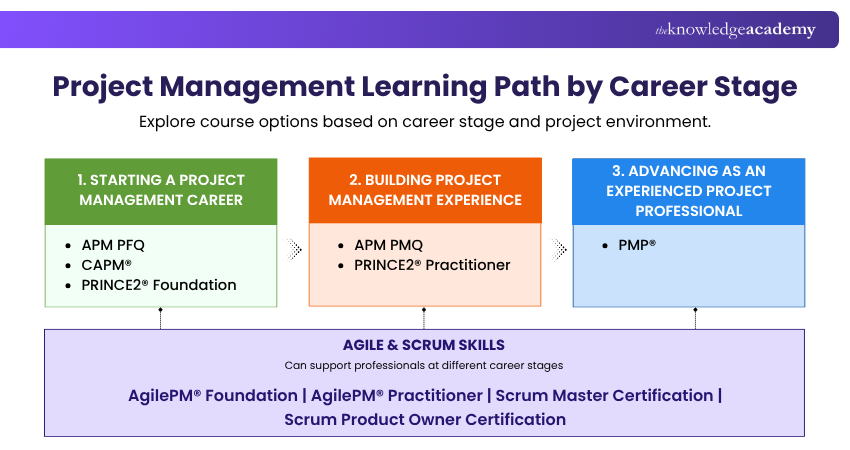
The right course depends on your existing knowledge, experience, preferred project environment and future role. The following options serve different career stages and learning needs:
1) Starting a Project Management Career
Professionals who are new to Project Management can begin with courses that introduce fundamental concepts, terminology and structured ways of working. Suitable options include:
a) APM Project Fundamentals Qualification (PFQ): Introduces essential Project Management terminology and principles. It requires no previous knowledge or experience, making it suitable for beginners and project team members.
b) CAPM® Certification Training Course: This entry-level course prepares learners for the Certified Associate in Project Management (CAPM)® Certification. It covers Project Management fundamentals, predictive approaches, Agile frameworks and business analysis.
c) PRINCE2 Project Management Foundation: Introduces PRINCE2 principles, people, practices and processes. It is suitable for beginners, project team members and professionals working in PRINCE2 environments.
2) Building Project Management Experience
Professionals with some Project Management knowledge or experience may choose qualifications that develop broader capabilities or focus on applying a structured method in practical situations. Suitable options include:
a) APM Project Management Qualification (PMQ): Develops broader knowledge across key Project Management areas. It generally suits professionals with two to three years of project experience or those completing a relevant apprenticeship or degree.
b) PRINCE2 Project Management Practitioner: Focuses on applying and tailoring the PRINCE2 method to different project situations. Candidates must hold an accepted prerequisite qualification.
Turn project challenges into structured success with our PRINCE2® Foundation & Practitioner Training – Join now!
3) Advancing as an Experienced Project Professional
Experienced professionals who already manage projects and want to strengthen their capabilities may consider more advanced certifications. Suitable options include:
a) PMP® Certification Training Course: Prepares experienced professionals for the Project Management Professional (PMP)® Certification. It develops capabilities in leading projects across predictive, Agile and hybrid environments while focusing on value, outcomes and business impact.
4) Building Skills for Agile and Scrum Environments
Career progression does not always follow a single path. Professionals working in adaptive environments may choose Agile or Scrum-focused courses based on their responsibilities and preferred way of working. Suitable options include:
a) AgilePM Foundation: Introduces AgilePM principles, roles, lifecycle and practices. It has no formal prerequisite and suits learners who are new to the approach.
b) AgilePM Practitioner: Focuses on applying and tailoring AgilePM in practical project situations. Candidates must meet the current prerequisite requirements.
c) Scrum Master Certification: Validates knowledge of the Scrum framework and Scrum Master accountabilities.
d) Scrum Product Owner Certification: This course focuses on product vision, stakeholder collaboration, value maximisation and Product Backlog management.
These options provide a general guide rather than a compulsory progression route. The most suitable course depends on your experience, intended role, employer expectations and the Project Management approach used in your working environment.
Turn teamwork into faster, smarter delivery with our Scrum Master Training – Join now!
How to Choose the Right Project Management Course?
Selecting a course based only on popularity can lead to learning that does not match your career needs. Consider the following factors before making your decision:
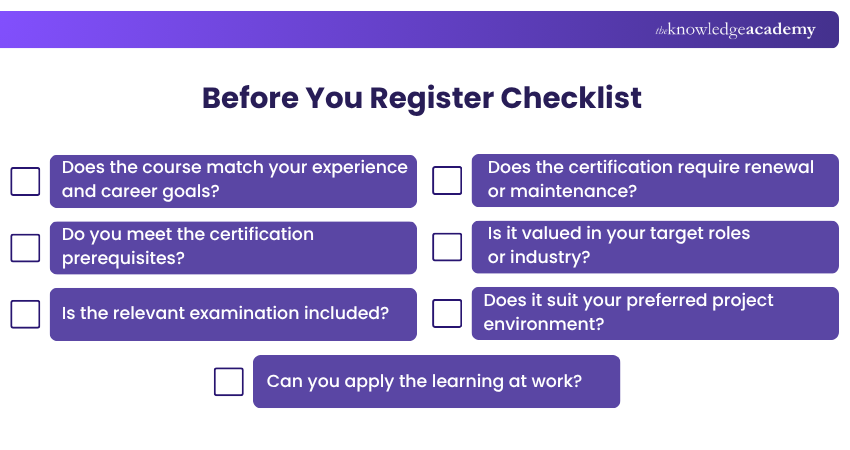
a) Assess Your Experience: Consider whether you are starting your Project Management career, building experience or already managing projects. Choose a course whose level and requirements match your current experience.
b) Identify Your Intended Role: Consider the responsibilities and working methods associated with your target role. Some positions may value broad Project Management knowledge, while others may require experience with a specific method, Agile approach or Scrum responsibility.
c) Check Employer and Industry Preferences: Review job descriptions in your target industry and location. Employers may value specific qualifications, certifications or Agile experience depending on their working environment.
d) Understand the Course Focus: APM qualifications and PMI qualifications cover broad Project Management knowledge. PRINCE2 provides a structured and tailorable Project Management method, AgilePM provides an Agile Project Management approach, while Scrum provides a framework with defined accountabilities.
e) Confirm the Prerequisites: Check whether the certification or examination requires prior qualifications, project experience, training hours or approved course attendance. Not every option is suitable for beginners.
f) Consider Renewal Requirements: Project Management certifications require maintenance or renewal. Scrum requirements vary by provider, while APM PFQ and PMQ do not follow the same renewal model.
g) Apply Your Learning: Use your knowledge in real projects by practising planning, risk assessment, stakeholder communication and progress reporting. Practical application helps reinforce learning.
Learn to lead bigger projects with confidence by signing up for the PMP® Certification Training today!
Conclusion
The right Project Management Courses can turn career goals into a clear learning path. Choose a course that matches your experience, target role and preferred way of working. A qualification alone cannot guarantee success, but combined with practical experience, it can strengthen your skills, confidence and career opportunities.
Bring AI into your project strategy and make smarter decisions with our Artificial Intelligence for Project Managers Training.
Frequently Asked Questions
Do I Need a Degree to Take a Project Management Course?

Not necessarily. Many introductory courses do not require a degree. However, some certifications use education level to determine their eligibility routes. Always check the current requirements of the relevant awarding body before registering.
Can I Move Into Project Management From a Different Career?
Yes. People moving into Project Management can bring transferable skills such as communication, organisation, budgeting, problem-solving and stakeholder management from previous roles. A foundational course can help them learn Project Management terminology and identify gaps in their knowledge.
Is One Project Management Qualification Enough for an Entire Career?
Not always. Career needs may change as professionals move into larger projects, Agile delivery, programme management or specialist areas. Continuing professional development, practical experience and targeted learning remain important after obtaining a qualification.
Is a Project Management Qualification Better Than Practical Experience?
Neither replaces the other. A qualification demonstrates assessed knowledge, while experience shows that you can apply knowledge in workplace situations. Employers may consider both, alongside industry expertise, leadership ability and evidence of successful delivery.

The Knowledge Academy


Global Training Provider
The Knowledge Academy is a world-leading provider of professional training courses, offering globally recognised qualifications across a wide range of subjects. With expert trainers, up-to-date course material, and flexible learning options, we aim to empower professionals and organisations to achieve their goals through continuous learning.


 If you wish to make any changes to your course, please


