




We may not have the course you’re looking for. If you enquire or give us a call on +41 315281584 and speak to our training experts, we may still be able to help with your training requirements.
Home
 Resources
Programming & DevOps
History of Java Programming Language: Origin, Evolution and Key Milestones
Resources
Programming & DevOps
History of Java Programming Language: Origin, Evolution and Key Milestones
Resources
Programming & DevOps
History of Java Programming Language: Origin, Evolution and Key Milestones
History of Java Programming Language: Origin, Evolution and Key Milestones
ByRichard HarrisLast updated on: 09 September 2026
Discover the history of the Java Programming Language, from its early development and major milestones to its evolution into one of the world’s most widely used programming languages.
Few programming languages created in the early days of the World Wide Web remain as widely recognised as Java. Yet Java did not begin as a language for websites, enterprise systems or cloud applications. Its origins were tied to a very different problem: creating reliable software that could work across different types of consumer devices.
The History of Java Programming Language therefore tells more than the story of successive Java versions. It explains how requirements such as portability, simplicity, security and hardware independence influenced the language from the beginning and helped it adapt as computing moved from embedded devices to the web, mobile applications and modern distributed systems. Read on!
What is the History of Java Programming Language?
Java traces its origins to the early 1990s at Sun Microsystems. The original research project explored software for network devices and embedded systems, where programs needed to work reliably across different hardware environments. C++ was initially considered, but its complexity encouraged the team to develop a new language platform instead.
The resulting language combined object-oriented programming with portability, automatic memory management and a runtime environment designed to support different systems. This foundation would later help Java move far beyond its original purpose.

The Birth and Origin of Java
The origin of Java is an interesting story shaped by changing technology needs, experimentation and a vision for creating software that could work across different devices. Let's check that below:
The Green Project and Java's Beginnings
Java was developed by a team led by James Gosling, with Patrick Naughton and Mike Sheridan among the early team members. The project began in 1991 and initially targeted consumer technologies such as set-top boxes and other electronic devices.
This early focus explains an important part of Java language history. Software for consumer devices could not depend on one computer architecture or operating system. The team needed a language that could remain reliable across different environments.
From Greentalk to Oak and Oak to Java
During its early development, the project was associated with the name Greentalk, while the developing language later became known as Oak. The name Oak is widely reported to have been inspired by an oak tree outside James Gosling's office.
Oak reflected the experimental stage of the project. The Oak name was eventually replaced before Java's public launch, and the team selected Java as the new name.
How Did Oak Become Java?
The name of Oak had to be renamed. The development team considered several alternatives before choosing Java, a name commonly associated with coffee.
By 1995, Java had begun its public journey. Oracle marks 23 May 1995 as the date of Java's first appearance, while the first final Java Development Kit (JDK 1.0) release followed in January 1996.
DID YOU KNOW?
Java's famous browser applets helped define its early web era, but that chapter has now formally ended. JDK 26 removed the Applet API, demonstrating how Java can retire technologies associated with its earliest years while continuing to develop new capabilities.
Why was Java Created?
Java's original objective was broader than simply creating another programming language. The team wanted software that could operate across different hardware systems while remaining small, reliable and portable. Initially, it was intended for consumer electronic devices such as televisions and VCRs, where developers needed a language that was flexible enough to work across different systems.
Java's Original Goals and Objectives
Oracle's early Java documentation identifies characteristics including simplicity, object orientation, robustness, security, architecture neutrality, portability and multithreading. These qualities were important because software increasingly had to work across heterogeneous networks and different computing platforms.
Influence of C and C++
Java retained a syntax familiar to C and C++ programmers, but its designers deliberately removed several sources of complexity. For example, Java avoided explicit pointer arithmetic and used automatic garbage collection for memory management. This gave developers something recognisable without simply reproducing C++.
Elevate your web development skills with Web Development Using Java Training. Sign up now!
How Did the JVM Shape Java's Evolution?
One of the most important developments in the evolution of Java was the Java Virtual Machine (JVM). Instead of producing code that works only on one machine architecture, Java source code is compiled into an intermediate form called bytecode. A compatible JVM can then execute that bytecode on the target system.
For example, a developer could compile:
HelloWorld.java → HelloWorld.class
The resulting .class file contains Java bytecode. Rather than rewriting the program for Windows, Linux or another supported platform, the appropriate JVM handles execution on that system.
Write Once, Run Anywhere
This architecture became associated with Java's well-known Write Once, Run Anywhere principle. The idea was straightforward: separate the application from the underlying hardware as much as possible.
The JVM therefore became one of the major reasons platform independence is so closely associated with Java programming.
Java's Launch and Early Growth
This period marked a major turning point for Java, as it moved beyond its experimental beginnings and started gaining wider recognition among developers.
Java's First Public Release
Java's public emergence in 1995 coincided with the rapid growth of the World Wide Web. JDK 1.0 reached its final release in January 1996, providing the foundation from which the Java platform expanded.
Early Java included technologies such as the Abstract Window Toolkit (AWT) and support for applets.
Java Applets and the Rise of Web Development
Java Applets were small programs that could be embedded within web pages to provide interactive functionality. At a time when much web content was relatively static, this gave Java considerable visibility among Web Developers.
The growing web also gave Java's portability a practical use case. Software downloaded across a network needed to work across machines with different operating systems and hardware configurations, exactly the type of challenge Java had been designed to address.
Java After 1995
Java gradually expanded beyond browser-based applications. Its portability, libraries, object-oriented structure and runtime environment helped it find roles in desktop software, enterprise applications, web systems and later mobile and cloud-based development.
Myth vs Fact about JavaMythJava was created for web development.FactJava originated from research into software for networked consumer and embedded devices. The web became an important use later.
Evolution of Java Versions
The history of Java versions shows how the language moved from relatively large, infrequent releases to a predictable release cycle. Some releases introduced changes that significantly influenced everyday Java development.
Early Java Versions: JDK 1.0 to Java 1.4
JDK 1.0 established the original platform. Java 1.1 added features including inner classes and Java Database Connectivity (JDBC), while Java 1.2 introduced the Collections Framework and Swing. Java 1.4 later brought capabilities including regular expressions, assertions and New I/O.
Java 5 to Java 8: Major Language Improvements
Java 5 represented a substantial language update with Generics, annotations, autoboxing and the enhanced for loop. Java 7 later introduced try-with-resources and support for strings in switch statements.
Java 8 became another major milestone by introducing lambda expressions, the Stream API and the modern Date and Time API. Oracle's Java Language Specification describes Java SE 8 as a particularly significant evolution of the language.
Java 9 and the Modern Release Era
Java 9 introduced the module system and JShell. Java 10 followed Java 9 just six months later, reflecting Java's shift to its modern six-month release cadence.
Later, Long-Term Support releases include Java 11, 17, 21 and 25. As of August 2026, Java 26 is the latest general-availability release, while Java 25 is the latest LTS release.
Transform your ideas into powerful applications with Java Programming Training – Sign up soon!
Key Milestones in the History of Java
A few milestones help summarise more than three decades of Java development:
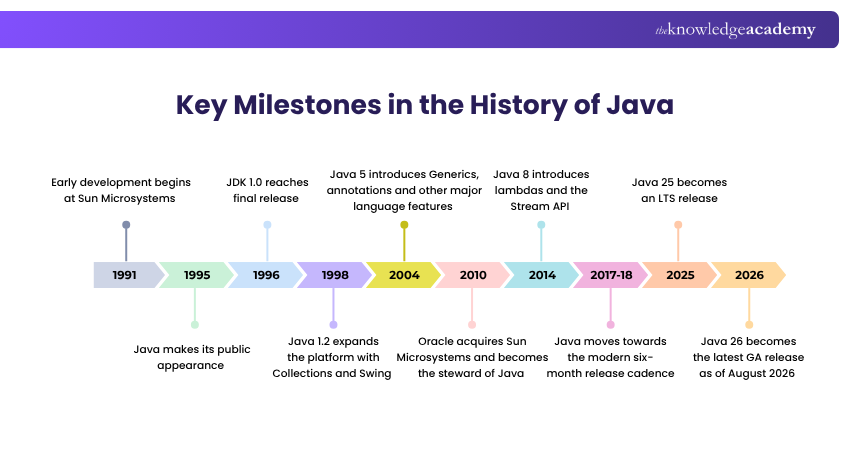
Oracle currently identifies Java 8, 11, 17, 21 and 25 as LTS releases.
Why Java Became Very Important?
Java gained importance because several qualities designed into its early architecture remained useful as software development changed. Here are the reasons why it matters:
1) Platform Independence and Portability
Java bytecode and the JVM reduced developers' dependence on one hardware or operating-system environment. That portability became particularly valuable as applications expanded across increasingly varied computing systems.
2) Enterprise and Web Development
Java's object-oriented model, extensive libraries and mature ecosystem supported its adoption for large server-side and enterprise applications. Frameworks and tools built around Java further expanded what developers could build.
3) Android Development
Java also became one of the foundational languages used for Android application development. This extended its influence from desktop and server software into the mobile era.
4) Cloud, Big Data and IoT
The existing Java ecosystem has also been used across cloud applications, Big Data systems and Internet of Things (IoT) solutions, demonstrating how a language originally designed around portability could adapt to new computing models.
Trainer's Pro Tips
Understanding Java becomes easier when you connect its features with the problems they were originally designed to solve. Consider these practical learning tips:
1. Learn the JVM Early: Understanding bytecode, the JVM and the JDK makes Java's portability much easier to grasp.2. Study Milestone Releases: Focus first on Java 5, 8, 9, 11, 17, 21 and 25 rather than memorising every Java version.3. Practise Modern Java: Historical features provide context, but use current language conventions when writing new applications.4. Connect Features to Purpose: For example, learn not only how garbage collection works but why automatic memory management helped Java simplify some problems associated with C and C++.

Richard Harris creates technically detailed yet accessible content on full-stack development, software architecture and modern development frameworks. His knowledge of frontend and backend technologies helps developers understand how scalable, efficient and high-performing applications are designed and built.
View Detail

 If you wish to make any changes to your course, please


