




We may not have the course you’re looking for. If you enquire or give us a call on 01344203999 and speak to our training experts, we may still be able to help with your training requirements.
Design Thinking Problems and Solutions
ByThe Knowledge AcademyLast updated on: 02 October 2026
Design thinking problems and solutions explores how design thinking can address complex challenges through user-focused research, ideation, prototyping, and testing. It covers common problems, real-world examples, and challenges teams may face when applying the approach.
Design thinking provides a human-centred approach to solving problems by understanding user needs, exploring ideas, and testing potential solutions.
It can be applied across business, product development, processes, organisations, and social challenges.
This blog explores common Design thinking Problems and Solutions, real-world examples, and challenges teams may encounter when applying the approach.
Design Thinking Problems and Solutions
Design thinking can help address complex or unclear problems by understanding user needs, exploring perspectives, and testing ideas. Common applications include business, product and service, process, organisational, and social challenges.
The following problems highlight where Design thinking can be used and how teams can develop suitable solutions.
1) Difficulty Understanding Customer Needs
Businesses may struggle to understand what customers actually need, particularly when assumptions are based on limited feedback or existing data. This can result in products, services, or experiences that do not address the real user problem.
Solution: Design thinking addresses this by starting with empathy and user research. Teams can use interviews, observation, surveys, and other research methods to understand users' needs, behaviours, and pain points before developing solutions.

2) Challenges in Developing New Products and Services
Creating new products, features, or services can be difficult when user requirements are unclear or there are several possible solutions. Committing to one idea too early can also lead to wasted time and resources.
Solution: Design Thinking allows teams to explore multiple ideas, develop prototypes, and test them with users before investing heavily in development. Feedback from testing can then be used to refine the solution.
3) Inefficient Processes and Workflows
Inefficient processes can create delays, unnecessary effort, or poor experiences for employees and customers. Identifying the underlying cause can be difficult when teams are accustomed to existing ways of working.
Solution: Design Thinking helps teams examine the process from the perspective of the people who use or experience it. By identifying pain points, generating alternatives, and testing improvements, teams can refine processes based on actual user feedback.
4) Complex Business and Strategic Problems
Business strategies and policies often involve different stakeholders with competing needs, making it difficult to define a single problem or identify an appropriate solution.
Solution: Design Thinking encourages teams to understand different stakeholder perspectives, define the problem clearly, and explore several possible approaches. Prototyping and testing can then help determine which ideas are most suitable before wider implementation.
5) Organisational and Employee Challenges
Organisations may face challenges related to employee engagement, collaboration, or workplace experiences. These problems can be difficult to address when the needs of different employees or departments vary.
Solution: Design Thinking brings different perspectives into the problem-solving process. Research, collaboration, and user feedback can help teams understand employee experiences and develop solutions that respond to identified needs.
Want to stand out in a competitive design landscape? Register today for Instructional Design Training!
6) Complex Social and Community Problems
Social and community problems often involve diverse groups, interconnected needs, and circumstances that can change over time. A solution that works for one group may not work equally well for another.
Solution: Design Thinking helps teams understand the experiences of the people affected by a problem and involve them in developing potential solutions. Iterative prototyping and testing allow solutions to be refined based on feedback and changing needs.
How Does Design Thinking Help Solve Problems?
Design Thinking helps teams move from unclear challenges to tested solutions through a structured, user-focused process. Instead of jumping directly to an answer, it encourages teams to understand the problem, explore different ideas and refine solutions through feedback.
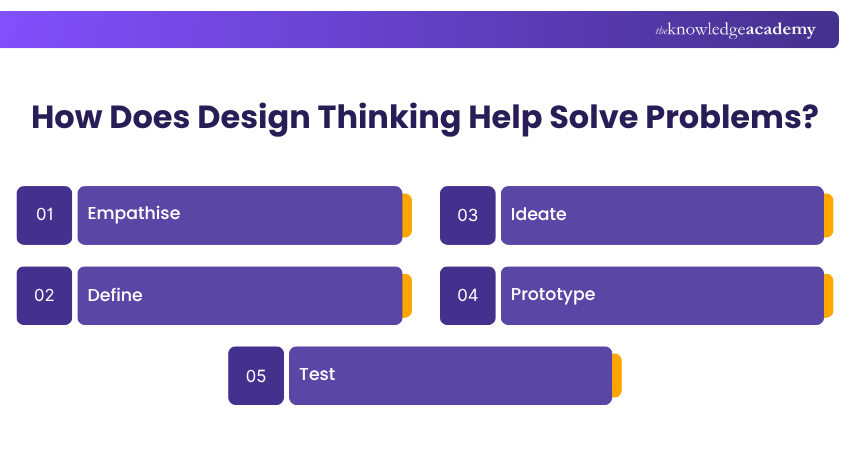
a) Empathise: Understand users, their needs, behaviours and pain points through research and observation.
b) Define: Use the research findings to create a clear and focused problem statement.
c) Ideate: Generate a range of possible solutions instead of relying on the first idea.
d) Prototype: Develop simple versions of promising ideas to see how they might work in practice.
e) Test: Gather user feedback, identify improvements and refine the solution before wider implementation.
This iterative approach helps teams reduce assumptions, learn from users and develop solutions that better respond to real needs.
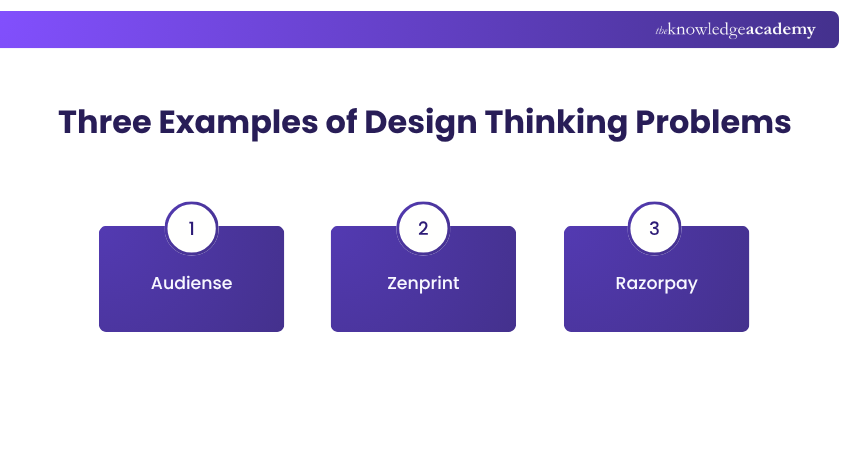
Three Examples of Design Thinking Problems
The following historical case examples illustrate how user research and iterative problem-solving have been applied to identify and address user-experience problems. These statements show how this human-centred approach addresses diverse challenges:
1) Audiense
a) Challenge: Audiense observed a significant increase in users abandoning the registration process before its completion.
b) Problem Statement: Users were abandoning the sign-up process, but the cause of the sudden drop in conversions was unclear.
c) Resolution: Led by Juan Fernandez, Head of Product, the team used Hotjar Session Recordings to investigate the issue and discovered that the autocomplete feature was broken. After fixing it, conversions recovered immediately.
2) Zenprint
a) Challenge: The Zenprint team used Google Analytics to analyse bounce rates across various pages, identifying areas of underperformance within the ordering process.
b) Problem Statement: In addressing the problem, it became apparent that prospective customers required a more coherent understanding of the next steps, given the high bounce rate on the current page.
c) Resolution: The team turned to Hotjar Heatmaps to analyse user behaviour on the page and determine its effectiveness. Users spent considerable time on the pricing page, prompting an A/B test to refine its UX design. The chosen design provided clearer guidance, with the case study reporting a 7% reduction in page drop-off and a 2% increase in conversions.
3) Razorpay
a) Challenge: Razorpay undertook a redesign of their dashboard and rolled it out incrementally to small user segments. However, with users rating the design at just 6.2/10, it was obvious that improvements were necessary.
b) Problem Statement: The redesigned dashboard received low user ratings, but the team needed qualitative feedback to understand what users disliked and what should be improved.
c) Resolution: Razorpay gathered open-ended feedback from users who gave low ratings and used these insights to improve the dashboard. The case study reported that the average user rating increased from 6.2 to 8.7 after the changes.
Common Challenges When Applying Design Thinking
Design thinking may look simple on paper, but applying it effectively can bring its own set of hurdles. From understanding users to gaining stakeholder support, teams may encounter challenges that affect the process. Some common challenges include:
Lack of Empathy: Difficulty understanding users' experiences.
Poor Problem Definition: Unclear, overly broad or overly narrow problem statements.
Limited Ideation: Few ideas due to time or criticism.
Inadequate Prototyping: Insufficient time or resources to develop and test useful prototypes.
Insufficient Testing: Limited user testing or feedback that does not provide enough evidence to refine the solution.
Resistance to Change: Reluctance to adopt new approaches.
Limited Resources: Shortage of time, people, or materials.
Poor Collaboration: Lack of cross-functional perspectives.
Unlock your leadership potential with our comprehensive Leadership Training courses! Sign up now!
Key Learnings
1. Design thinking helps address complex problems by focusing on user needs.2. Clear problem statements help teams identify the right challenges.3. Ideation encourages teams to explore multiple potential solutions.4. Prototyping and testing help refine ideas through user feedback.5. Teams may face challenges such as poor testing, limited resources, and resistance to change.

The Knowledge Academy develops accessible learning content across Project Management, IT, Cybersecurity, Data Science, Business Analysis, HR, Accounting and Finance, Leadership and Health and Safety. Its resources combine subject research with clear explanations to help professionals build practical knowledge across a wide range of disciplines.
View Detail

 If you wish to make any changes to your course, please


