




We may not have the course you’re looking for. If you enquire or give us a call on +44 1344 203 999 and speak to our training experts, we may still be able to help with your training requirements.
Change Management: Advantages and Disadvantages
ByThe Knowledge AcademyLast updated on: 10 October 2026
Uncover the world of change management, an essential organisational process. Explore the advantages that change management offers, as well as the potential disadvantages. This comprehensive exploration will provide valuable insights into the dynamics of change within organisations. Read more to learn.
Change is an inevitable part of any organisation's journey towards growth and success. However, managing change effectively is crucial to ensure a smooth transition and minimise any negative impact on the business.
By understanding the pros and cons of change management, businesses can implement strategies to facilitate successful organisational changes. This blog will tell you all you need to know about change management advantages and disadvantages and help you make informed decisions for your organisation.
Advantages of Change Management
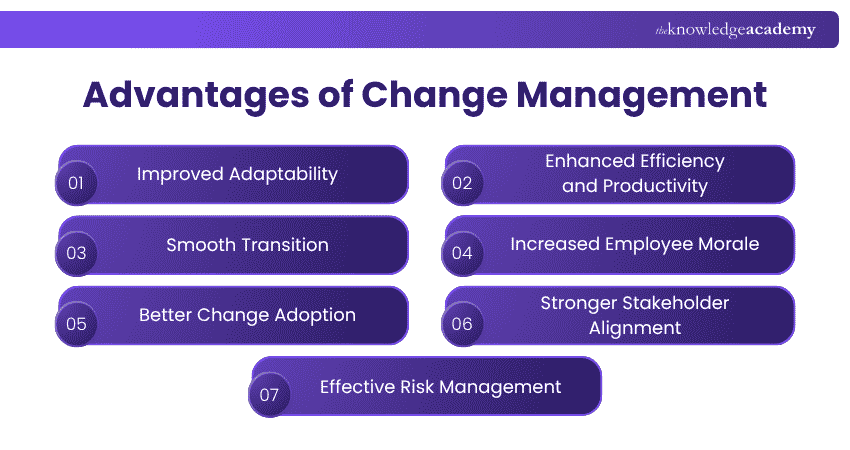
Change management offers a multitude of advantages for organisations, empowering them to navigate transitions effectively and seize opportunities for growth and development through the implementation of a change management plan. Let's delve deeper into the various benefits that change management brings:
1) Improved Adaptability
In today's rapidly evolving business landscape, adaptability is crucial for survival. Change management promotes a culture of adaptability within organisations by encouraging employees to embrace change, learn new skills, and adjust to shifting market conditions. This adaptability can help organisations respond more effectively to changing market conditions and emerging opportunities.

2) Enhanced Efficiency and Productivity
By evaluating existing processes, identifying inefficiencies, and streamlining workflows, organisations can eliminate bottlenecks and optimise resource allocation. This optimisation not only enhances operational efficiency but also empowers employees to work more effectively, resulting in higher productivity levels across the board.
3) Smooth Transition
Change, if not managed properly, can disrupt operations and create uncertainty among employees. Change management provides a structured framework and clear roadmap for navigating transitions smoothly. It ensures effective communication channels, transparent information sharing, and comprehensive stakeholder engagement, all of which can contribute to a more manageable and coordinated transition.
4) Increased Employee Morale
Change management places a strong emphasis on employee involvement and engagement throughout the change process. By seeking input, addressing concerns, and actively involving employees in decision-making, organisations promote a sense of ownership and empowerment. This involvement can help employees feel heard and supported, which may improve engagement and morale during the transition.
5) Better Change Adoption
Effective change management helps employees understand why a change is necessary, what is expected of them, and how they can adapt to new ways of working. Through clear communication, training and ongoing support, organisations can improve adoption of new processes, systems and behaviours. This helps the intended change become part of everyday operations rather than remaining a short-term initiative.
6) Stronger Stakeholder Alignment
Change management helps bring employees, leaders and other stakeholders together around a shared understanding of the change. Clearly communicating objectives, responsibilities and expected outcomes can reduce confusion and conflicting priorities. Stronger alignment also makes it easier for teams to coordinate their efforts and support the change consistently across the organisation.
7) Effective Risk Management
Change management enables organisations to detect and address any risks associated with the change. By conducting thorough risk assessments and developing mitigation strategies, organisations can minimise the impact of potential disruptions. It emphasises the importance of monitoring and evaluating the progress of change initiatives, allowing for timely adjustments and corrective actions to mitigate risks.
Pro Tip
Use short feedback cycles during implementation to identify emerging issues early and refine the approach before they escalate.
Gain the skills to support successful organisational transformation with Change Management Foundation Course – Register now!
Disadvantages of Change Management
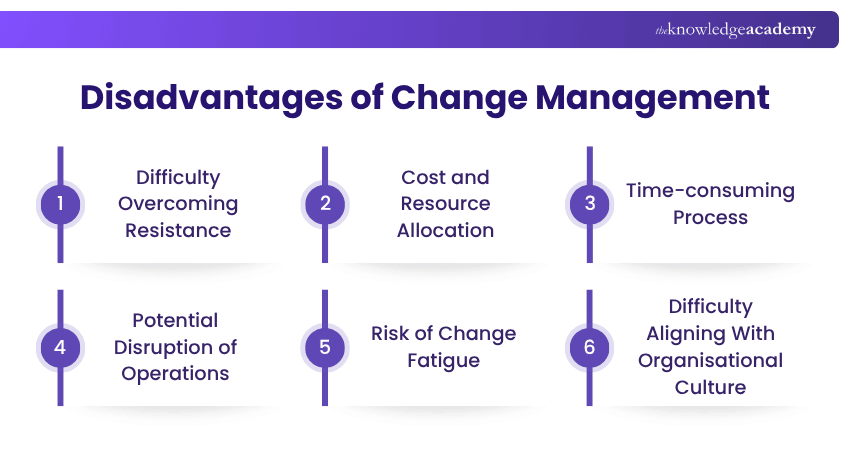
While change management offers numerous benefits, it is important to recognise and address its potential disadvantages. Although change management can improve the likelihood of successful adoption, implementing a structured change approach can also require significant time, resources and organisational effort. Let's explore some of the common disadvantages of change management:
1) Difficulty Overcoming Resistance
One of the primary disadvantages of change management is that it can face resistance from individuals or groups within the organisation. Change disrupts familiar routines and introduces uncertainty, leading to resistance and reluctance to embrace the proposed changes. Overcoming resistance requires effective communication, building trust, addressing concerns, and involving employees in the entire change process.
2) Cost and Resource Allocation
Implementing the change management process often involves significant costs, both in terms of financial resources and personnel. Organisations need to allocate sufficient funds and manpower to support the planning, implementation, and evaluation of the change initiative. Insufficient resources or budget constraints can hinder the effectiveness of efforts and lead to suboptimal outcomes.
Remember:
Set clear success measures before implementation so you can distinguish genuine progress from simple activity completion.
3) Time-consuming Process
Another disadvantage of change management is that it is a time-consuming process that requires careful planning, stakeholder engagement, and continuous monitoring. It involves assessing the current state, defining the desired future state, creating a roadmap, implementing changes, and evaluating the results. Organisations must allocate adequate time and resources to ensure a thorough and well-executed change initiative.
4) Potential Disruption of Operations
Change, by its nature, can disrupt business operations and create temporary disruptions or challenges. It may lead to productivity declines, delays in delivering products or services, or conflicts among employees. Failure to address and mitigate potential disruptions can have a negative impact on the organisation's performance and employee morale.
5) Risk of Change Fatigue
Change often introduces uncertainty and can create stress among employees. The fear of the unknown, coupled with the additional workload and learning curves associated with change, can contribute to stress and anxiety. Failure to address employee concerns and manage stress levels can result in reduced productivity, decreased morale, and even resistance to the change itself.
6) Difficulty Aligning With Organisational Culture
Change management may face obstacles in organisations with deeply entrenched cultures or resistance to change. The existing organisational culture, values, and norms can influence how change is perceived and received. Aligning the proposed changes with the organisation's values and effectively communicating the benefits of the change can help overcome cultural barriers and increase acceptance.
Keep This in Mind
1. Change management works best when it is treated as an ongoing process rather than a one-time activity.2. The benefits of change management often depend on how well the approach is planned and applied.3. Not every change requires the same level of structure, communication, or support.4. Some disadvantages, such as cost, time and resource demands, may be necessary to reduce larger risks during organisational change.5. A balanced approach helps organisations gain the benefits of change management without adding unnecessary complexity.
Upgrade your change management expertise and unlock new career opportunities with our Change Management Practitioner Course - Join now!

The Knowledge Academy develops accessible learning content across Project Management, IT, Cybersecurity, Data Science, Business Analysis, HR, Accounting and Finance, Leadership and Health and Safety. Its resources combine subject research with clear explanations to help professionals build practical knowledge across a wide range of disciplines.
View Detail

 If you wish to make any changes to your course, please


