




We may not have the course you’re looking for. If you enquire or give us a call on + 1-866 272 8822 and speak to our training experts, we may still be able to help with your training requirements.
Top 15 Challenges for Supervisors: An Overview
ByNilotpal SarmahLast updated on: 03 October 2026
The role of a Supervisor involves overseeing and guiding employees, ensuring tasks are completed efficiently, and maintaining a productive work environment. This blog offers a comprehensive exploration of the challenges faced by Supervisors across various industries and sectors. Read this blog to learn more.

Quick Preview
1. Supervisors face challenges involving communication, motivation, employee performance, workload and workplace relationships.2. Clear communication, delegation and collaboration help teams work towards shared objectives.3. Employee motivation and engagement can be supported through recognition, development opportunities and attention to workplace concerns.4. Organisational change and remote working can create additional supervisory challenges that require communication and support.5. New Supervisors may need additional guidance as they adjust to leadership responsibilities and changing workplace relationships.
Starting the day with a clear plan, only to find that one employee is absent, another needs help resolving a conflict and an important deadline has suddenly moved forward; these are the kind of issues Supervisors can face on a daily basis. So balancing people, priorities and performance can make every day different.
Supervisors need to motivate employees, communicate expectations, manage workloads and help teams adapt to change. Understanding these challenges can make it easier to recognise problems early and choose an appropriate response. In this blog, we'll explore the common Supervisors, the additional difficulties new Supervisors may encounter and practical ways to address them.
Top Challenges Faced by Supervisors
Supervisors manage people, tasks and priorities while helping teams meet organisational objectives. The following challenges can arise across different supervisory environments:
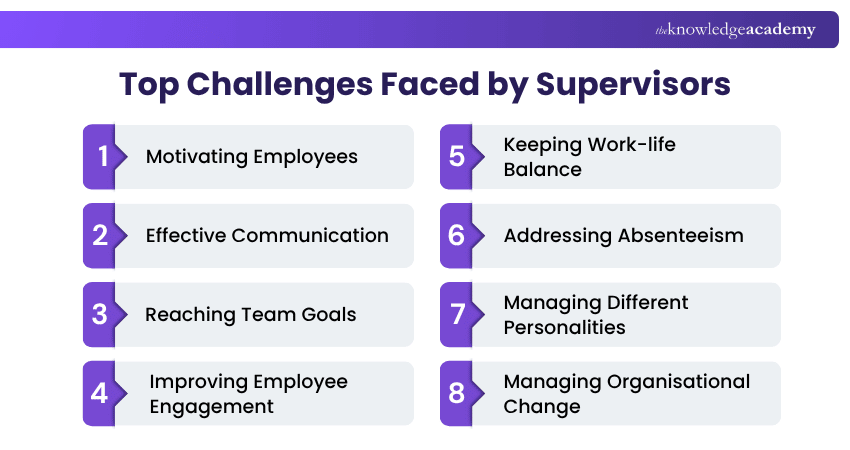
1) Motivating Employees
Keeping employees motivated can be challenging because individuals respond to different incentives and forms of support. Supervisors can encourage motivation by recognising achievements, providing opportunities for growth and creating a positive working environment where employees feel valued.
2) Effective Communication
Clear communication is essential for successful supervision. Supervisors need to explain expectations, provide guidance and ensure employees understand team objectives. They should also encourage open discussions, listen to concerns and provide opportunities for employees to ask questions.

3) Reaching Team Goals
Achieving team goals requires Supervisors to coordinate individual efforts towards shared objectives. Effective delegation, collaboration and regular progress monitoring can help keep the team focused while allowing potential obstacles or conflicts to be addressed early.
4) Improving Employee Engagement
Employee engagement grows when people feel valued, involved and connected to their work. Supervisors can encourage engagement by recognising achievements, providing development opportunities and addressing concerns that may affect employee motivation or morale.
5) Keeping Work-life Balance
Supporting a healthy Work-life Balance can be challenging when employees face demanding workloads and deadlines. Here are some steps to encourage work-life balance in a team:
a) Promote effective scheduling and task prioritisation.
b) Offer flexible work arrangements where appropriate.
c) Encourage clear boundaries between work and personal life.
d) Demonstrate healthy work-life balance practices.
e) Provide relevant resources and support for managing workplace stress.
6) Addressing Absenteeism
Frequent or unexpected absence can affect workloads and team productivity. Supervisors should manage attendance according to applicable organisational policies while seeking to understand factors contributing to repeated absenteeism. Where appropriate, this may involve discussing attendance expectations and directing employees towards relevant workplace support.
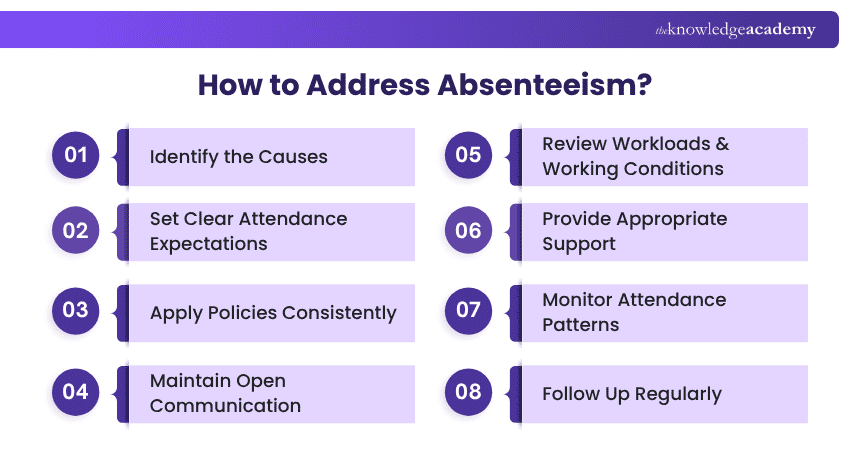
Here are the steps you can take to address absenteeism:
7) Managing Different Personalities
Teams often consist of employees with different personalities, strengths, communication preferences and working styles. Supervisors need to understand these differences and adapt their approach while maintaining consistent expectations. Encouraging open communication, collaboration and constructive conflict resolution can help create a more cohesive working environment.
Trainer Insight
Fair supervision does not always mean communicating with every employee in exactly the same way. Adapting your communication approach to different working styles can improve collaboration while keeping expectations consistent.
8) Managing Organisational Change
Supervisors often act as an important link between organisational decisions and employees during periods of change. They need to communicate changes clearly, address concerns and provide guidance while teams adapt to new processes, systems or responsibilities.
To manage organisational change:
a) Communicate: Explain the reasons for the change openly and transparently.
b) Involve: Encourage employees to participate through feedback and involvement.
c) Support: Provide appropriate training, guidance and resources to help employees adapt.
Change may be inevitable, but success is in your control. Learn how to lead transitions with the Managing Organisational Change Effectively Course – Sign up now!
9) Managing Workplace Conflict
Disagreements between team members can affect relationships, collaboration and productivity if they are not handled appropriately. Supervisors should encourage constructive discussion, listen to the perspectives involved and help employees work towards an appropriate resolution. Strong interpersonal and conflict-resolution skills can help Supervisors address disagreements before they escalate.
10) Managing Underperformance
Managing underperformance requires Supervisors to identify where an employee is not meeting expected standards and understand what may be contributing to the issue. Clear expectations, constructive feedback, appropriate training and development opportunities can help employees understand areas for improvement.
11) Managing Administrative Work
Supervisors may be responsible for administrative tasks such as reporting, record-keeping and maintaining relevant workplace documentation. This can include keeping accurate records of performance reviews and disciplinary matters according to organisational policies and applicable requirements. Effective organisation and time management can help Supervisors balance administrative duties with their other responsibilities.
12) Managing Competing Priorities and Workload
Supervisors often need to balance competing priorities, deadlines and changing demands while maintaining team performance. This can become particularly challenging in fast-paced or uncertain working environments. Effective prioritisation, delegation, time management and decision-making can help Supervisors manage workloads while remaining adaptable when circumstances change.
Pro Tip
Separate urgent work from important long-term responsibilities. Regularly reviewing priorities can help manage immediate deadlines without losing sight of wider team goals.
13) Preventing Employee Burnout
Heavy workloads and prolonged workplace pressure can contribute to employee burnout. Supervisors should pay attention to workloads, working patterns and signs that employees may be struggling. Steps to help prevent employee burnout can include:
a) Encourage regular breaks and time to recharge.
b) Promote work-life balance and flexible schedules where appropriate.
c) Recognise and reward achievements.
d) Offer opportunities for skills development and career growth.
e) Cultivate a supportive and collaborative working environment.
14) Managing Remote Employees
Managing remote employees requires clear communication and appropriate use of digital collaboration tools. Supervisors need to establish expectations, maintain regular communication and ensure employees have the resources required to perform their responsibilities effectively. Creating opportunities for collaboration and team interaction can also help remote employees maintain a sense of connection with colleagues.
15) Handling Employee Dismissals
Employee dismissal can be one of the more sensitive responsibilities associated with supervision. Where Supervisors are involved in the process, they need to communicate professionally and respectfully while following relevant organisational procedures. Clear communication and careful handling of the process can help maintain professionalism and dignity throughout a difficult situation.
How Can Supervisors Overcome Workplace Challenges?
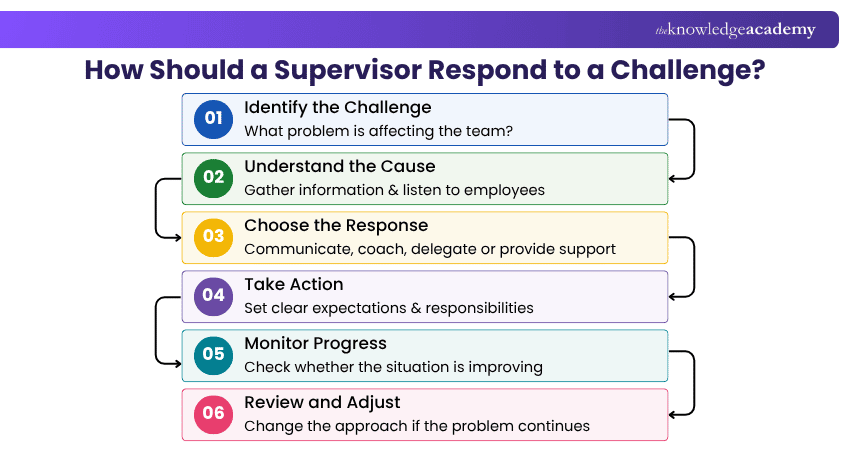
There is rarely one solution that works for every supervisory challenge. The first step is to identify the type of problem, understand what may be contributing to it and then choose an appropriate response. Here are the basic steps:
Challenges Faced by New Supervisors
Moving into a supervisory role introduces a different set of responsibilities. New Supervisors may need to shift from completing their own tasks to directing others, making decisions and taking responsibility for team performance. Here are some challenges familiar to new Supervisors:
1) Building Confidence as a New Supervisor
Moving from an individual contributor role into supervision can create uncertainty about whether someone has the skills required to lead others. Regular coaching, mentoring and organisational support can help new Supervisors develop confidence as they become familiar with their responsibilities.
2) Transitioning From Team Member to Leader
New Supervisors must adjust from following instructions to providing direction to others. This transition can require stronger communication, listening, delegation and conflict-management skills. They may also need to become comfortable making decisions that are not always popular with former peers.
Trainer Insight
Moving into supervision requires a change in mindset. Success is no longer measured only by what you personally complete, but also by how effectively you help the team perform.
3) Understanding New Responsibilities
New Supervisors may be unfamiliar with responsibilities such as performance reviews, organisational procedures or disciplinary processes. Clear induction, guidance and continuing training can help them understand their responsibilities and relevant organisational policies.
4) Managing Relationships With Former Peers
Moving from team member to Supervisor can change existing workplace relationships. New Supervisors may need to balance positive relationships with former colleagues while establishing appropriate leadership boundaries and carrying out their new responsibilities.
5) Dealing With Isolation
New Supervisors may sometimes feel caught between their team and management. Regular check-ins, one-to-one meetings and greater involvement in management discussions can provide opportunities to raise concerns and receive support.
At the heart of every bit of exemplary teamwork is an inspiring Supervisor. Learn how to be on with the Introduction to Supervising a Team Training – Sign up now!
Quick Check
Ask yourself:
□ Do employees understand what is expected of them?□ Do I listen as well as provide instructions?□ Am I delegating responsibilities appropriately?□ Do I address performance problems early?□ Am I monitoring team workload and competing priorities?□ Do I provide useful feedback and recognition?□ Do I know when an issue should be escalated?

Nilotpal Sarmah is a Senior Content Writer with 11+ years of overall experience spanning engineering, operations and content development. His technical knowledge and extensive writing experience enable him to simplify specialised topics across IT and Tech, Business Skills, Project Management, Health and Safety, and ISO and Compliance.
View Detail

 If you wish to make any changes to your course, please


