




We may not have the course you’re looking for. If you enquire or give us a call on 01344203999 and speak to our training experts, we may still be able to help with your training requirements.
Capital Market Instruments: Explained Briefly
ByNaveena VenkatesanLast updated on: 25 September 2026
Read this blog to understand the capital market and the various types of capital market instruments available. The blog describes each instrument allowing you to make informed decisions about investing in the capital market.

Quick Preview
1. Capital markets connect organisations seeking longer-term funding with investors providing capital.2. Equities represent ownership, while debt securities represent borrowing obligations.3. Capital market instruments differ in their structure, liquidity, potential returns and risks.4. ETFs, ABS and REITs provide exposure to portfolios, pooled assets or real estate.5. Understanding how an instrument generates returns and carries risk is essential when comparing alternatives.
When it comes to understanding financial markets, the complexity and variety of capital market instruments present a significant challenge. This often leads to confusion and difficulty in making informed investment decisions. Understanding these instruments, such as stocks, bonds, derivatives, and more, is crucial for effectively navigating the intricate world of capital markets.
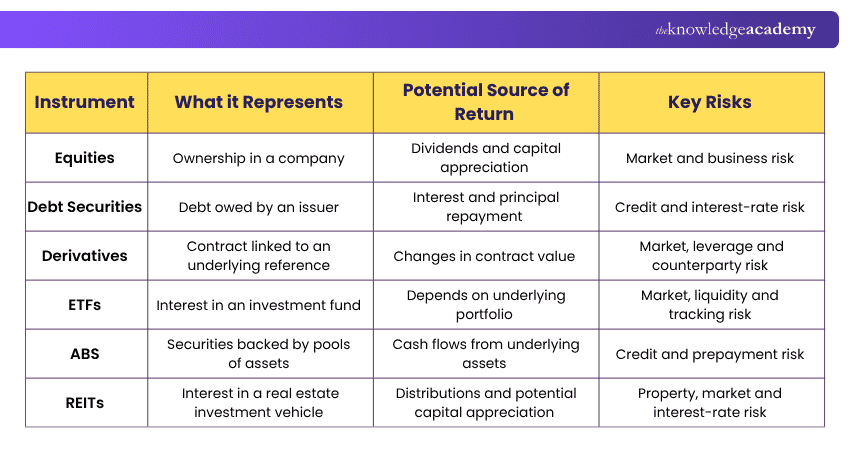
The sections below compare these instruments and the risks associated with them. Let's dive in to learn more!
Types of Capital Market Instruments
Capital market instruments are the financial instruments issued and traded in the capital market, representing the lenders' claims on the borrowers, as well as the rights and obligations of both parties in the market in financial instruments directive. These instruments can be classified into various types, such as equities, debt securities, derivatives, and more. Let’s explore these instruments further below:
1) Equities
Equities are instruments that represent the ownership of a company. They are also called stocks or shares. The holders of equities are called shareholders or stockholders. They have the right to receive dividends, vote on important matters, and share in the profits or losses of the company.
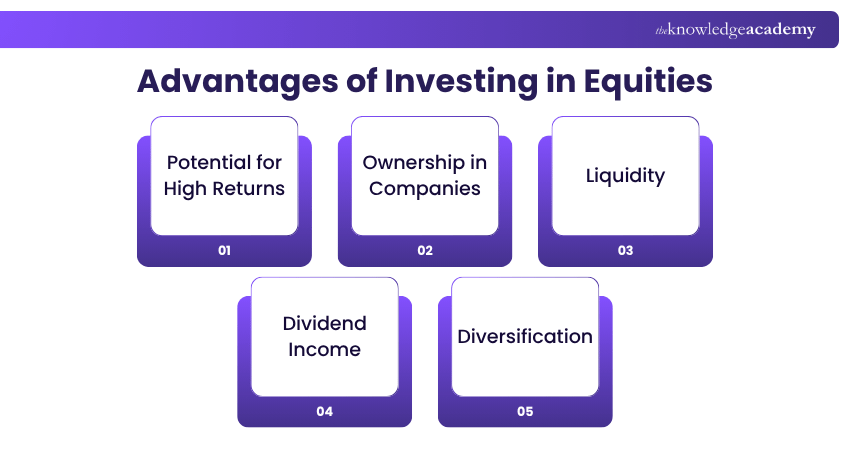
Equities are issued by the company in a primary market and traded in secondary market. Equities are risky, as they are subject to market fluctuations and business uncertainties. However, they also offer high returns, as they appreciate in value over time and pay dividends.

2) Debt Securities
Debt securities are instruments that represent money borrowed by an issuer from investors. They are also called bonds or debentures. The holders of debt securities are called bondholders or debenture holders. They have the right to receive interest, principal, and collateral in case of default.
Debt securities are issued by the borrower in the primary market and traded in secondary market. Their risk varies with the issuer’s ability to repay, the security’s terms and changes in interest rates. Some pay fixed interest, while others have different payment structures. Returns are therefore not always low, and repayment is not guaranteed if the issuer defaults.
Trainer Insight
Avoid assuming that every bond is automatically low risk. Credit quality, maturity, interest-rate changes and other features can significantly affect a debt security's risk.
3) Derivatives
Derivatives are the instruments that derive their value from an underlying asset like a stock, a bond, a commodity, a currency, or an index. They are also called futures, options, swaps, or warrants. The holders of derivatives are called Traders or speculators. They have the right to sell or buy the underlying asset at a predetermined price and time.
Derivatives are issued by intermediaries in the primary market and traded in the secondary market. Derivatives are very risky, as they are subject to market volatility and leverage. However, they also offer high returns, as they can be used for hedging, arbitrage, or speculation like short selling.
Build valuable knowledge of capital markets, futures, options and financial instruments. Sign up for the Capital Markets and Derivatives Training now!
4) Exchange-Traded Funds (ETF)
ETFs are those instruments that track the performance of a basket of securities, such as a stock index, a bond index, a commodity index, or a currency index. The holders of ETFs are called investors. They have the right to receive dividends, interest, or capital gains from the underlying securities.
ETFs are issued by the Fund Managers in the primary market and traded in secondary market. They are moderately risky, as they are subject to market movements and tracking errors. However, they also offer moderate returns, providing diversification, liquidity, and low costs.
Trainer Insight
Look beyond potential returns when comparing instruments. Consider market, credit, liquidity and interest-rate risks alongside your time horizon to understand the instrument's broader risk profile.
5) Asset-backed Securities (ABS)
Asset-backed securities are instruments backed by a pool of assets, such as mortgages, loans, receivables, or leases. The holders of asset-backed securities are called investors. They have the right to receive interest and principal from the cash flows created by the underlying assets. Asset-backed securities are issued by the originators or the issuers in the primary market and traded in the secondary market.
Asset-backed securities are moderately risky, as they are subject to credit and prepayment risks. However, they offer moderate returns, providing diversification, liquidity, and credit enhancement.
Shape your financial future with the Financial Modelling and Forecasting Training – Sign up now!
6) Real Estate Investment Trusts (REITs)
Real estate investment trusts are the instruments that invest in real estate properties like residential, commercial, industrial, or retail. The holders of real estate investment trusts are called shareholders. They have the right to receive dividends, capital gains, and tax benefits from the income and appreciation of the properties.
Real estate investment trusts are issued by Trust Managers in the primary market and traded in the secondary market. Real estate investment trusts are moderately risky, as they are subject to market conditions and property management. However, they also offer moderate returns, providing diversification, income, and growth.

Naveena Venkatesan is a Content Editor with 2+ years of experience in content writing, editing and linguistic quality assurance. Her research, fact-checking and editorial experience enable her to develop accurate, accessible resources across Business Skills, Human Resources, and Accounting and Finance.
View Detail

 If you wish to make any changes to your course, please


