




We may not have the course you’re looking for. If you enquire or give us a call on 01344203999 and speak to our training experts, we may still be able to help with your training requirements.
What is Budget Constraint: Working & Formula Explained
BySubiksha ArulprakashLast updated on: 18 September 2026
Learn what a budget constraint is and how it occurs when a consumer's income limits the combinations of goods they can afford at a given set of prices.
Quick Snapshot
1. A budget constraint shows the combinations of goods or services a consumer can afford based on income and prices.2. The standard budget relationship is expressed as P₁Q₁ + P₂Q₂ = m, where prices and quantities determine how the available income is allocated.3. The budget line represents combinations that use the available budget, while changes in prices alter the choices available.4. Budget constraints help explain the trade-offs consumers and businesses make when resources are limited.5. A budget set includes all affordable combinations, while the budget constraint defines the limit of those choices.
Have you ever found yourself juggling expenses, trying to make ends meet? Fear not. Understanding the concept of budget constraint can be your key to unlocking financial clarity. Mastering budget constraints isn’t just about numbers; it’s about making intentional, strategic decisions. Every choice you make about spending involves a trade-off, and recognising that trade-off is often the first step toward better financial control. So, let’s explore together and transform your financial game.
What is a Budget Constraint?
A budget constraint represents the limit on what a person or business can purchase, based on available income and the prices of goods. It shows that total spending cannot exceed total income, which forces a choice between different combinations of goods rather than allowing unlimited consumption.
This concept applies just as much to a household choosing between two products as it does to a business allocating a fixed budget across competing priorities. Understanding it helps explain how spending decisions are made when resources are limited.

How Do Budget Constraints Work?
Calculating a budget constraint usually involves multiple items, but it's easiest to understand with just two. A consumer could spend their entire budget on one item, spend it all on the other, or split it between both in some combination.
What makes it a constraint is that spending more on one item automatically means spending less on the other, since total spending can never exceed total income. This trade-off, and exactly how much of one item must be given up to afford more of the other, is what the budget constraint equation calculates.
Budget Constraint Equation
You can use the following equation to calculate a budget constraint:

In this equation, (P_1) is the cost of the first item, (P_2) is the cost of the second item, and (m) is the total amount of money available. (Q_1) and (Q_2) represent the quantities of each item you are purchasing. Verbally, this equation states that the total cost of (X) items plus the total cost of (Y) items must equal your available income.
If you plot this equation on a graph, with the x-axis representing the quantity of one item and the y-axis representing the quantity of the other, it will form a straight diagonal line sloping downwards from left to right. This line is known as the budget line.
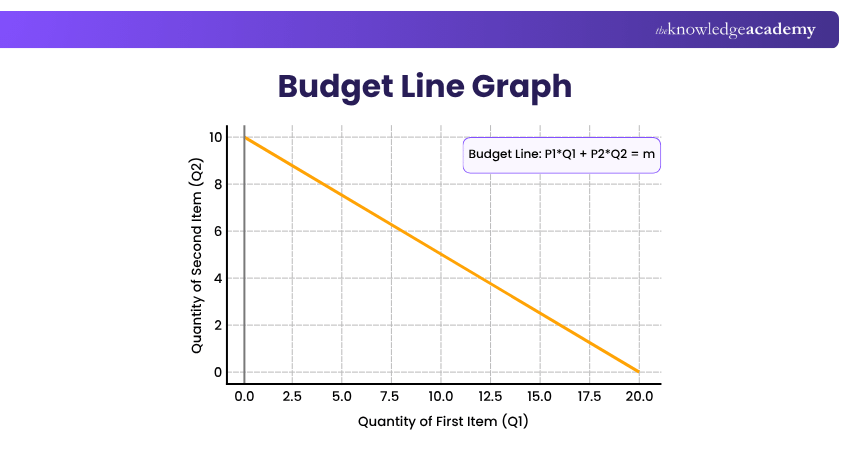
Any point on this line represents the quantities of each item you can buy within your flexible budget. If the price of either or both items changes, you’ll need to adjust this line to reflect the new prices.
Budget Constraint Example
If you have a budget of £1,000 for promotional items, this sets the maximum limit on your purchases. The cost of each item and the minimum quantity required will determine how many you can buy within this budget.
Similarly, imagine a marketing team with a fixed £1,000 budget to split between print flyers and paid social media ads. If flyers cost £5 each and ads cost £20 per placement, the team must decide how many of each they can afford without exceeding their budget. Buying more flyers means fewer paid ads, and vice versa, the same trade-off shown in the budget constraint equation, just applied to a real marketing decision.
Pro Tip
Before deciding that something is ‘too expensive’, calculate its opportunity cost. Ask what you would have to give up a to afford it. Budget constraints become far more useful when you compare trade-offs rather than looking at prices in isolation.
Join our Strategic Planning and Thinking Course and gain the tools to anticipate challenges - Start shaping your future success.
Difference Between Budget Set and Budget Constraint
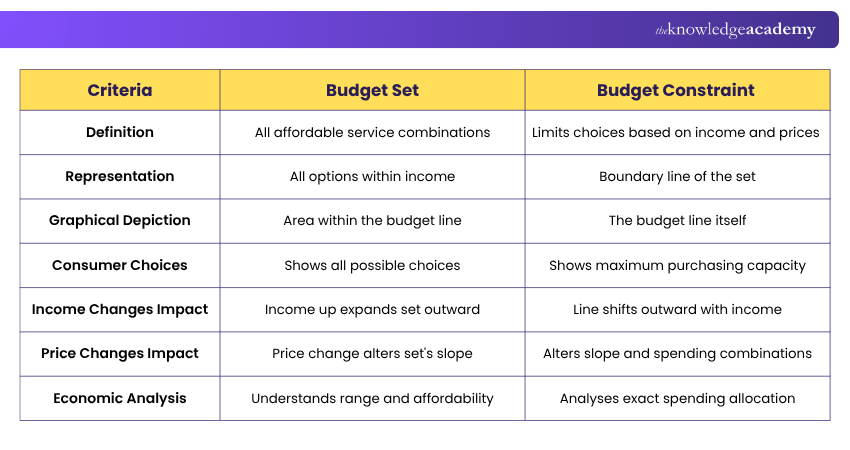
The budget set contains all affordable combinations of goods a consumer can choose from, while the budget constraint is the boundary of that set, the specific combinations that use the entire available budget.
Think of it this way: the budget set is like a menu of everything you can afford, while the budget constraint is the line marking exactly how far your money stretches across that menu. If income increases, the budget set grows, and the budget constraint shifts outward. If prices change, the budget set's shape shifts, and the budget constraint's slope changes accordingly.
In short, the budget set shows the range of possibilities, while the budget constraint marks the limit within that range based on income and prices. Understanding the difference between the two is crucial for effective financial planning. Let's look at them in detail in the table below:
Plan smarter campaigns with better budgeting skills with our Marketing Budget Course – Register now!

Subiksha Arulprakash is a Copywriter with 5+ years of experience in content writing, editing, content development and digital marketing. Her experience researching and writing about Business Skills, ISO standards and compliance enables her to produce clear, accessible content for different audiences.
View Detail

 If you wish to make any changes to your course, please


