


We may not have the course you’re looking for. If you enquire or give us a call on +41 315281584 and speak to our training experts, we may still be able to help with your training requirements.
Home
 Resources
IT Service Management
5 Whys Technique in Root Cause Analysis: Definition, Steps and Applications
Resources
IT Service Management
5 Whys Technique in Root Cause Analysis: Definition, Steps and Applications
5 Whys Technique in Root Cause Analysis: Definition, Steps and Applications
ByVishnu SankarLast updated on: 19 October 2026
The 5 Whys technique is an effective problem-solving approach used to identify the root cause of an issue by repeatedly asking “why” to find lasting solutions. It encourages critical thinking, reduces repeated failures and helps teams address problems at their source. It supports continuous improvement and ensures more reliable processes.

A Quick Look
1. The 5 Whys technique explores the relationship between problems and their underlying causes.2. The number of questions can vary depending on the issue being investigated.3. Supporting evidence helps distinguish actual causes from assumptions.4. Complex problems may require additional analysis methods.5. Corrective actions and follow-up checks help prevent problems from recurring.
Ever wondered how repeatedly asking “Why?” could lead you straight to the root of a problem? The 5 Whys of root cause analysis does just that. It’s a powerful yet straightforward tool used to peel back the layers of an issue until you reach its core. Whether you're solving technical glitches or improving business processes, asking “why” five times can reveal insights that surface-level fixes often miss.
Popular across industries such as IT, healthcare, and manufacturing, the 5 Whys methodology encourages critical thinking, reduces repeated failures, and supports long-term improvement. In this blog, we’ll explore what it is, how it works, and where it can be used. So read on and make a real difference in your workflow.
What is the 5 Whys Technique in Root Cause Analysis?
The 5 Whys is a simple problem-solving method used to investigate the underlying causes of an issue by repeatedly asking “Why?”. The approach helps teams move beyond immediate symptoms and explore possible root causes that can then be verified.
Developed by Sakichi Toyoda and closely associated with Toyota’s problem-solving approach, the 5 Whys technique is now widely applied across areas such as IT, manufacturing, healthcare, and quality management. Its simplicity and flexibility make it suitable for both individual and team-based problem solving. Used correctly, it builds critical thinking skills, encourages continuous improvement and helps organisations prevent recurring problems.
Trainer Insight
The goal of 5 Whys is not to ask exactly five questions. Some problems may need fewer questions, while others require more. What matters is reaching an underlying cause that can be supported by evidence and addressed through corrective action.

How to Conduct the 5 Whys of Root Cause Analysis?
The 5 Whys can be applied through a structured investigation that begins with clearly defining the problem and continues through questioning, verification, and corrective action. The following practical steps can help teams conduct the analysis effectively:
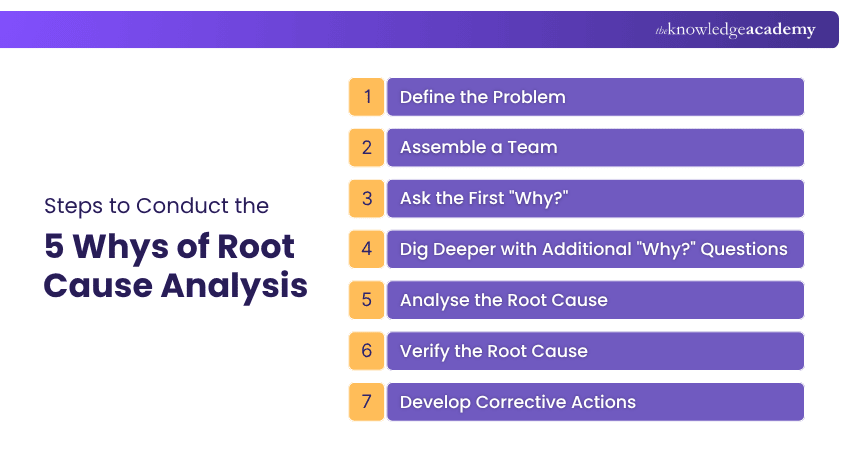
Step 1: Define the Problem
Begin by pinpointing the exact problem that requires analysis. Clarify the issue to ensure that your analysis is targeted and effective. This initial step lays a powerful groundwork for the entire investigative process, steering all subsequent actions towards discovering the root cause.
Step 2: Assemble a Team
Form a team with a direct connection to or knowledge of the issue. Incorporating a variety of viewpoints can enhance the analysis, leading to a more thorough understanding. Moreover, a team approach can provide a broader examination of the problem.
For example, when attempting to fix the ERR_CONNECTION_TIMED_OUT Error, having a team with diverse expertise can help in identifying the root cause more effectively, whether it's related to network issues, server configurations, or other technical factors.
Step 3: Ask the First "Why?"
Kick off the inquiry by posing the initial question: “Why did this problem arise?” Focus on identifying the immediate reason the problem occurred and document the answer clearly. Team members with relevant knowledge can contribute evidence and observations to help distinguish plausible causes from assumptions.
Step 4: Dig Deeper with Additional "Why?" Questions
Following each response from Step 3, continue the inquiry by asking “Why?” again, connecting each query to the preceding response. Continue this line of questioning to peel back the layers of causation.
Continue asking “Why?” for as many levels as needed to understand the causal chain. Some problems may require fewer than five questions, while others may require additional investigation. This iterative questioning process is designed to reveal underlying causes, moving past immediate and apparent factors.
Step 5: Analyse the Root Cause
After progressing through the iterative “Why?” questions, scrutinise the final response you’ve arrived at following the fifth inquiry. This response indicates the fundamental cause, which is the primary factor whose resolution can avert the recurrence of the issue.
Step 6: Verify the Root Cause
Verify the suspected root cause using relevant data, observations, records, tests, or other available evidence. Check whether the proposed cause logically explains the problem and whether alternative causes have been considered or ruled out before confirming it.
Step 7: Develop Corrective Actions
Utilising the insights derived from your analysis, engage in brainstorming to formulate suitable corrective measures. These measures should be designed to confront the fundamental cause directly. They should address the verified cause and reduce the likelihood or impact of recurrence.
Focus on creating practical and achievable solutions that address the root cause and avert similar issues in the future. Following this structured approach will help you apply the 5 Whys technique effectively in root cause analysis. It’s also important to involve key stakeholders, encourage open communication, and continuously look for ways to improve. Monitor the results after implementation to confirm whether the corrective action is effective.
Before You Finish Your 5 Whys Analysis, Check:
□ Is the problem clearly defined?□ Have the relevant people been involved?□ Does each answer logically explain the previous cause?□ Are the suspected root causes supported by evidence?□ Have corrective actions and follow-up checks been planned?
5 Whys Example
Here's an example showing how the 5 Whys technique works in practice.
Problem Statement: The latest software updates newsletter was not dispatched as scheduled.
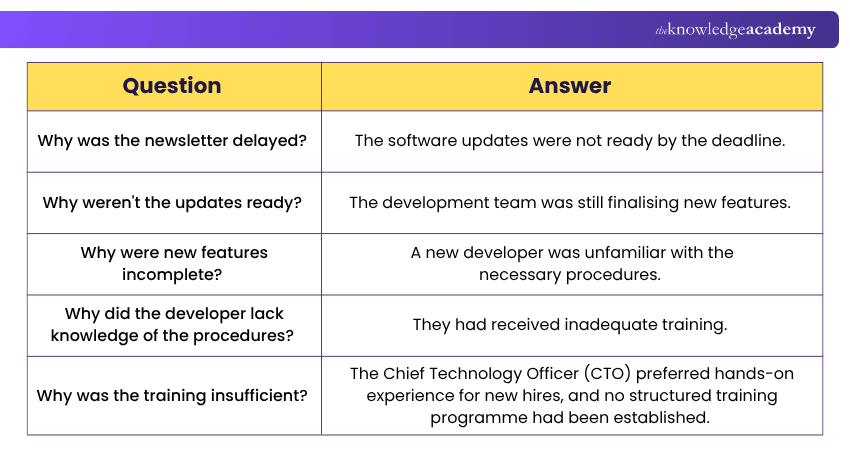
Possible Root Cause: The absence of a structured onboarding and training process may have contributed to the delay.
This analysis shows how an apparent technical delay can be connected to broader organisational processes. However, the team would need to verify each explanation, including whether training gaps actually caused the missed deadline, before confirming the root cause.
Suggested Corrective Actions:
1) Introduce a structured onboarding programme for new developers.
2) Provide clear documentation of development procedures.
3) Establish training checks before assigning critical tasks.
4) Review project deadlines and dependencies to identify potential delays earlier.
5) Monitor subsequent releases to assess whether the improvements are effective.
Trainer Insight
When an employee makes a mistake, the investigation should not stop at human error. Inadequate training, unclear procedures or missing checks may have contributed to the issue. Exploring these factors helps teams identify corrective actions that strengthen the overall process.
When to Use a 5 Whys Analysis?
The 5 Whys technique is particularly useful when a problem has a reasonably clear starting point and a manageable chain of possible causes. It helps teams investigate recurring issues, process failures and operational difficulties without requiring complex tools.
It can be applied in situations such as:
1) Investigating repeated equipment failures, production delays or quality defects in manufacturing.
2) Exploring the reasons behind system errors, service disruptions or recurring technical problems in the Information Technology (IT) sector.
3) Examining process-related issues, such as delays in patient services or administrative errors in healthcare.
4) Identifying causes of workflow inefficiencies, missed deadlines or communication gaps in business operations
5) Investigating recurring defects and opportunities for process improvement in quality management.
Learn how to drive smarter business decisions by uncovering hidden opportunities in the Business Analysis Training - sign up now!
How to Use a 5 Whys Template?
A 5 Whys template is a structured tool that helps teams document their investigation, organise questions and track possible causes. It provides a clear record of how the analysis progresses from the initial problem to the corrective actions.
A useful template typically includes a problem statement, successive "why" questions, their answers, supporting evidence, identified causes and recommended corrective actions. Depending on the complexity of the issue, a 5 Whys worksheet can be organised as a single causal chain or expanded into multiple lines of questioning.
1) Single-lane Template
A single-lane template follows one sequence of questions and answers, making it suitable for investigating a focused problem with a relatively straightforward chain of causes. Each question builds upon the previous answer, helping teams explore the issue systematically without introducing unnecessary complexity.
2) Multiple-lane Template
A multiple-lane template can be used when a problem involves several possible causes or different departments. Instead of following only one questioning sequence, teams can document separate causal chains and examine how different factors contribute to the same problem.
Advantages and Limitations of the 5 Whys Technique
The 5 Whys in root cause analysis offers several advantages in uncovering the underlying problem. However, like any tool, it also has its limitations. Therefore, understanding its advantages and limitations is crucial for practical application. Let’s explore them:
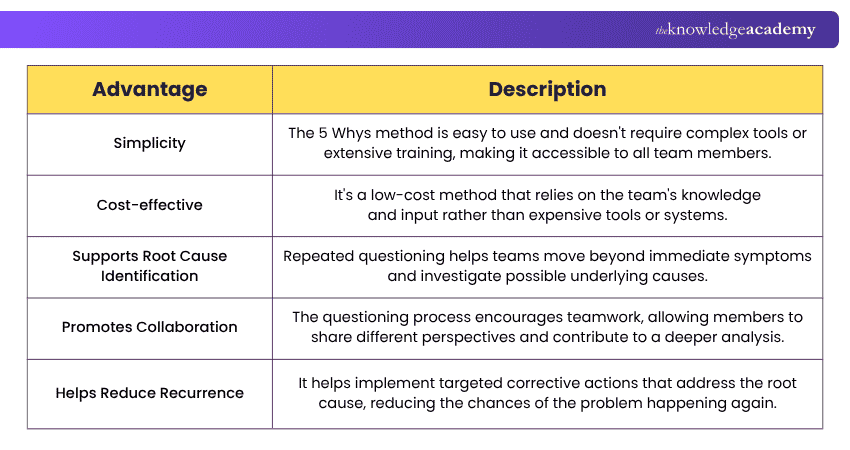
1) Advantages of 5 Whys Technique
The following are the key advantages of using the 5 Whys method in RCA:
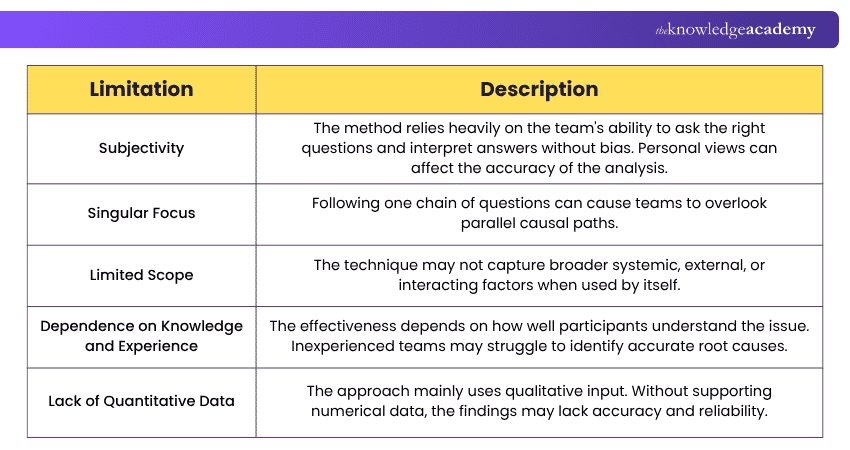
2) Limitations of 5 Whys Technique
Despite its existing advantages, there are some limitations of using the 5 Whys method in RCA as summarised below:
Tips for Using the 5 Whys in Root Cause Analysis Technique
Here are some tips for effectively using the 5 Whys technique:
a) Ask Clear, Evidence-based Questions: Keep each “Why?” directly connected to the previous answer and use available evidence to support the reasoning before moving to the next question.
b) Flexibility in Application: The number “5” in the 5 Whys is merely a benchmark. Depending on the complexity of the problem, it may be necessary to delve deeper with additional “Why?” questions to identify the Root Cause.
c) Judicious Conclusion: Determine the appropriate moment to end the inquiry. Cease the “Why?” questions when you have collected enough relevant information, thus avoiding premature conclusions and ensuring a meticulous evaluation.
Common Mistakes to Avoid While Using the 5 Whys
Use this checklist to avoid common mistakes and improve the accuracy of your analysis.
□ Define the Problem Clearly: Avoid vague problem statements and describe the issue precisely before starting.□ Verify Every Answer: Do not rely on assumptions□ Go Beyond Five Questions if Needed: Avoid stopping at exactly five questions if further investigation is necessary□ Look Beyond Human Error: Examine process gaps, inadequate training and system weaknesses instead of blaming individuals□ Consider Multiple Causes: Explore other contributing factors rather than following only one chain of questioning□ Monitor Corrective Actions: Check whether the implemented solutions effectively address the causes and prevent recurrence
Strengthen your service management skills with ITIL® 5 Service Certification – Join soon!

Vishnu Sankar is a Senior Content Writer with 5+ years of experience across content development, software development, web development and system administration. His technical background and professional training support his expertise in IT and Tech, while his extensive research and writing experience covers Project Management and Health and Safety.
View Detail

 If you wish to make any changes to your course, please


