


 Top Rated Course

We may not have the course you’re looking for. If you enquire or give us a call on +44 20 4538 6376 and speak to our training experts, we may still be able to help with your training requirements.
Project Manager Cover Letter Format and Writing Guide
Grace Mitchell 27 April 2026To write a Project Manager Cover Letter, start with a personalised greeting and clearly state the role you're applying for. Highlight your relevant experience, key skills, and measurable achievements. Show knowledge of the company and explain why you're a good fit. End with a professional thank-you and a call to action.

Training Outcomes Within Your Budget!
We ensure quality, budget-alignment, and timely delivery by our expert instructors.
Table of Contents
Your resume may tick all the boxes, but without a great cover letter, it might never get read. If you're applying for a Project Manager role, your cover letter is more than a formality. It can be a chance to lead the project. It’s where you showcase leadership, communication, and initiative, all in a few short paragraphs.
In this blog, we break down everything you need to know to write a Project Manager Cover Letter that will be impressive. From nailing your opening lines to showcasing results and certifications, you’ll learn how to highlight your leadership and land interviews. Let’s get your career timeline moving in the right direction!
Table of Contents
1) Project Manager Cover Letter Writing Tips
2) What to Include in Your Project Manager Cover Letter?
3) Project Manager Cover Letter Examples
4) Project Manager Experience Requirements
5) Project Manager Education and Training Requirements
6) Conclusion
Project Manager Cover Letter Writing Tips
Here are some of the most common tips to write a creative and catchy cover letter for Project Manager:
1) Write the Cover Letter to a Certain Recipient
Before writing your cover letter, try to find out who will be reading it. This is often the hiring manager or someone from the HR department. Using their actual name, like “Dear Sarah Johnson”, shows that you’ve done your research and care about making a connection.
If you can’t find a name, Dear Hiring Manager is a professional and acceptable alternative. Avoid generic greetings like: to whom it may concern, as they feel outdated and impersonal.
Tip: Find the name of the hiring manager or use “Dear Hiring Manager” if unknown.
Example:
“Dear Ms. Jane Smith,”

2) Highlight Your Qualifications
Hiring managers review dozens, sometimes hundreds of applications. That’s why your letter should begin with a strong opening that instantly shows why you’re qualified for the role.
Mention your job title, years of experience, and any Project Management Certifications like Diploma in Project Management. These quickly show that you have the background they’re looking for and make them want to read the rest of your letter.
Tip: Start strong by stating your experience and certifications.
Example:
“As a certified Project Manager with over 7 years of experience delivering IT infrastructure projects, I’m confident in my ability to drive results and lead cross-functional teams.”
Learn to plan, lead, and deliver successful projects with our Jira Training now!
3) Professional Self-introduction
You can begin your introduction by stating the role you're applying for and expressing your interest in the company. For example, "I’m excited to apply for the Project Manager position at [Company Name].”
Explain how this job matches what you want in your career and why you’re excited about this company. Look at the job ad and mention a few key things they’re looking for, then show how your own skills or experience fit those needs.
Tip: Mention the role and why you’re applying.
Example:
I am excited to apply for the Project Manager position at XYZ Company. Your commitment to digital innovation aligns with my passion for tech-enabled project delivery.
4) Showcase Relevant Skills
Project Managers need a mix of hard skills (like budgeting, scheduling, Agile, MS Project) and soft skills (like communication, teamwork, leadership). Use your cover letter to list the most relevant ones, ideally the same ones mentioned in the job description.
Even if you have extra skills, such as basic coding or graphic design, you can feel free to include them if they add value to the position.
Tip: List a mix of hard and soft skills.
Example:
I bring strong skills in stakeholder engagement, risk assessment, Agile methodologies, and effective cross-department communication.
5) Use Quantifiable Achievements
When you talk about your previous jobs, try to include results with numbers. This makes your achievements clearer and more believable. Instead of saying something general, use facts and figures to show the real impact of your work.
Tip: Add data to your impact.
Example:
I oversaw a £950K cloud migration for a global client, completed 10% under budget and boosted system efficiency by 35%.
6) Demonstrate Company Knowledge
Hiring managers appreciate it when candidates take the time to learn about their company. Mention something specific, like a project the company recently completed, their mission statement, or their leadership style, and explain why it matters to you.
Also, if your own values align with theirs, say so. This shows you’re not just looking for a job; you’re interested in this job.
Tip: Prove you’ve done your homework.
Example:
I admire your company’s ecent expansion into sustainable tech solutions. I’m eager to contribute to projects that align with my values around innovation and impact.
7) Clearly State Intentions and Preferences
Explain why this role interests you and how it fits into your career journey. If it’s a promotion or a move into a specific industry, share that motivation.
This helps the hiring team understand your direction and shows them how your goals align with theirs. Be enthusiastic and genuine companies want people who are excited to work with them.
Tip: State why you want the role.
Example:
I’m looking to grow within an organisation that values collaboration and continuous improvement, which I see clearly reflected in your mission.
Your next promotion starts with expert Project Management Office Green Belt Training - Join today.
8) Provide Educational Background Details
If you have a degree in Project Management, business, engineering, or related field, you should mention it. Also include any relevant certifications such as PMP, PRINCE2, or Agile.
If your education helped you gain key skills like time management or stakeholder communication, explain that briefly. Highlighting your training shows that you’re committed to learning and growth.
Tip: Include relevant academic and professional credentials.
Example:
I hold a BSc in Business Administration and a PMP Certification, both of which have prepared me for high-level project planning and delivery.
9) Customise Each Letter for the Position
It’s tempting to reuse the same cover letter for multiple applications, but personalising each one makes a big difference. Tailor your letter to match the specific job description. Mention the company’s name, the role title, and the exact skills they’re looking for.
Use relevant keywords; this not only shows that you’re paying attention but also helps your application pass through automated systems, like Applicant Tracking System (ATS)./p>
Tip: Use keywords from the job posting.
Example:
My experience in Risk Management and Agile project delivery aligns closely with the role requirements listed in your advertisement.
10) Convey Appreciation
Appreciate about the role and look forward to hearing from them. Include your contact details (email and phone number) so they can reach out easily. A friendly yet professional close leaves a positive final impression.
Tip: End with gratitude and contact info.
Example:
Thank you for considering my application. I would welcome the opportunity to discuss how my experience can contribute to your team. You can reach me at [email] or [phone number].
11) Offer Additional Insights
Your cover letter is your chance to show personality. Share what inspires you about Project Management, or how you developed your passion for leading teams.
Mention if there’s a personal story, mentor, or project that shapes your interests. This helps the hiring manager connect with you on a human level, beyond just your qualifications.
Tip: Show a personal connection to your work.
Example:
I first discovered my passion for Project Management while leading a university charity event. Seeing a plan come to life through collaboration sparked a career path I’m still passionate about today.
12) Keep it Concise
A good cover letter is one page, no more. Aim for 3–4 short paragraphs. Use clear, simple language and avoid jargon or long-winded explanations. Every sentence should serve a purpose, if it doesn’t, cut it. Busy recruiters appreciate brevity and clarity.
Tip: One-page, clear paragraphs, no fluff.
Example:
Use three to four brief paragraphs, each with a clear point, e.g., introduction, skills/experience, alignment with the company, and closing.
13) Ensure Error-free Writing
Since Project Management demands attention to detail, your letter should reflect that. Spelling mistakes, grammatical errors, or poor formatting can hurt your chances. Use tools like Grammarly or ask a friend to proofread it. A polished, error-free letter shows professionalism and care.
Tip: Double-check spelling, grammar, and tone.
Example:
After writing, use a tool like Grammarly or ask a friend to review your letter before sending it.
What to Include in Your Project Manager Cover Letter?
Here is the information that are necessary for your Project Manager Cover Letter:
1) Contact Information (Header)
This section is the most important one as it includes:
a) Your name
b) Phone number
c) Email address
d) LinkedIn profile (optional but recommended)
e) City and postcode (optional)
2) Date and Employer’s Contact Information
Here is the basic information that needs to be added:
a) The date you’re writing
b) Hiring manager’s name (if known)
c) Company name
d) Company address
3) Greeting/Salutation
Use a personal greeting when possible
If the name isn’t available, use “Dear Hiring Manager”
Tip: Avoid “To whom it may concern” it’s outdated and impersonal.
4) Opening Paragraph for Strong Introduction
a) State the position you're applying for
b) Mention how you found the job listing
c) Briefly express your enthusiasm and fit
5) Body Paragraphs: Highlight Key Skills and Achievements
a) Relevant Experience and Skills
Showcase your Project Management experience. Mention specific tools like MS Project, Jira, Trello. Add methodologies like Agile, Waterfall and soft skills like leadership and communication. Emphasise your ability to manage budgets, timelines, and risks
b) Quantifiable Achievements
Add metrics to your accomplishments to make them credible and results-focused
6) Paragraph on Cultural Fit and Company Knowledge
a) Show that you’ve researched the company
b) Align your values or goals with theirs
c) Express why you’re interested in working there
7) Education and Certifications
a) Mention relevant degrees (e.g., Business, IT, Engineering)
b) Include certifications like PMP, PRINCE2, Scrum Master, or AgilePM
8) Closing Paragraph – Call to Action
a) Reaffirm your interest
b) Thank the reader for their time
Mention your availability and include a call to action (e.g., “I’d love the opportunity to discuss how...”)
9) Sign-off
Use a professional closing like:
a) “Kind regards”
b) “Sincerely”
c) “Best regards”
Learn about various leadership styles and approaches with our Running Small Projects Course – Register today!
Project Manager Cover Letter Examples
Here are some of the examples that will help you to create a perfect cover letter:
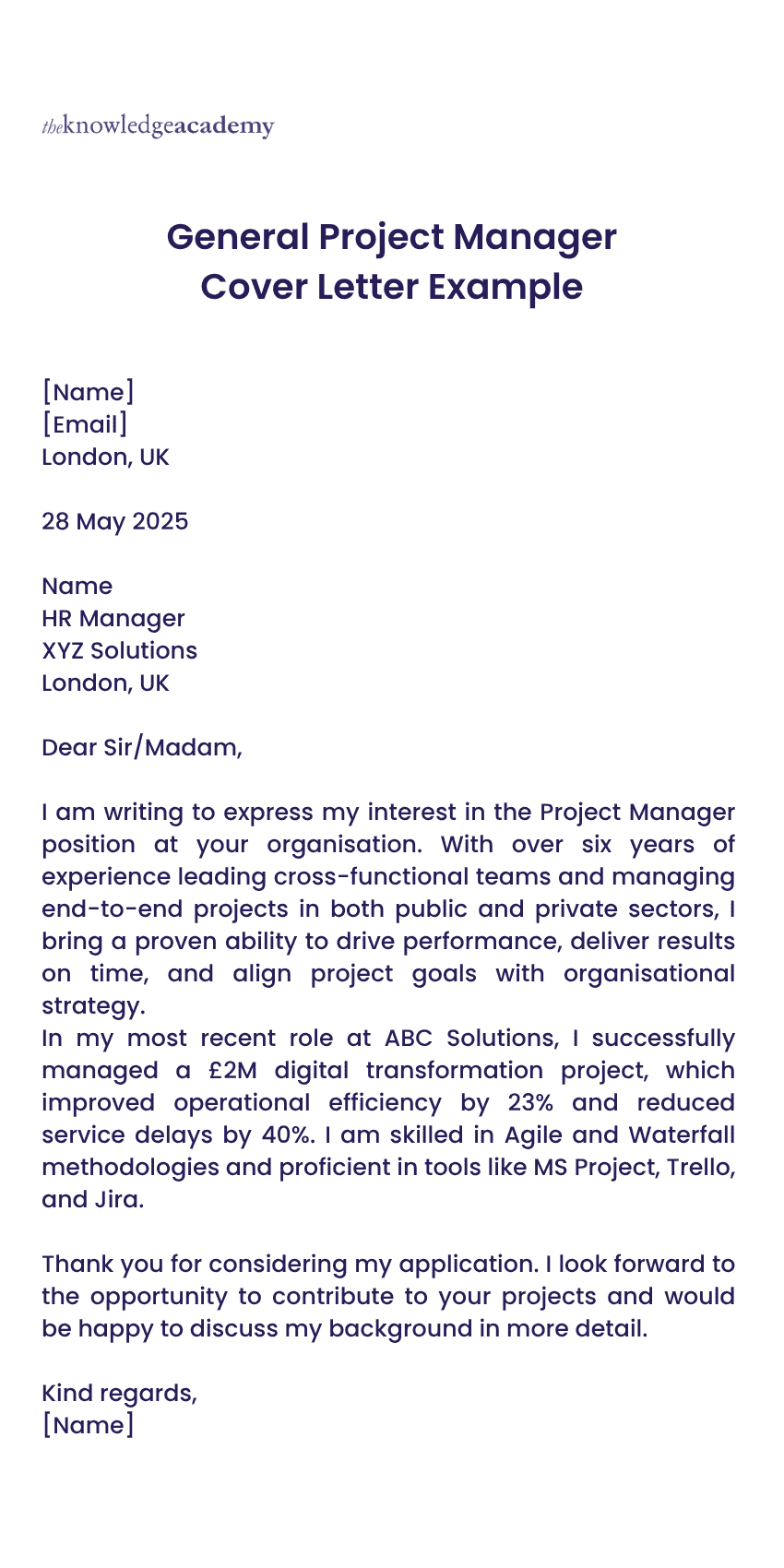
Example 1: General Project Manager Cover Letter (Mid-level Experience)
This example is ideal for mid-level professionals with several years of Project Management experience across various industries.
Example 2: Entry-Level Project Manager Cover Letter
You can use this version if you're a recent graduate or transitioning into Project Management from another role.

Project Manager Experience Requirements
Project Managers are typically expected to have several years of experience managing projects, teams, or related operations within their industry. This experience often includes leading cross-functional teams, handling budgets, managing timelines, and working with stakeholders.
Employers may look for proven success in delivering projects on time and within budget, along with familiarity in Project Management methodologies like Agile, Scrum, or Waterfall. Experience in using Project Management tools such as Jira, Trello or MS Project is also required.
Project Manager Education and Training Requirements
Most Project Manager roles require a bachelor’s degree in business, management, engineering, IT, or a related field. Some positions may also ask for a master’s degree or MBA, especially in more strategic positions.
In addition to formal education, professional certifications such as PRojects IN Controlled Environments (PRINCE2), Project Management Professional (PMP), or AgilePM are highly valued. These certifications demonstrate a solid understanding of Project Management frameworks, tools, and best practices, and often serve as key qualifiers for mid-to-senior level roles.
Conclusion
Writing a great Project Manager Cover Letter doesn’t have to be complicated. By keeping it clear, personal, and tailored to the job, you can make a strong impression from the very start. With the right tone and structure, your cover letter can open the door to exciting new opportunities. You've got this!
Frequently Asked Questions
When Should a Cover Letter be Included?

You can always include a cover letter with a job application unless the job listing specifically states not to. It offers a chance to introduce yourself and highlight why you are a suitable candidate for the position.
What Should you Avoid When Preparing a Cover Letter?
Avoid sending a generic cover letter, using incorrect company names, and making spelling or grammar mistakes. Also, avoid making the letter too long or too formal without personality. Tailor each cover letter to the specific role.
What are the Other Resources and Offers Provided by The Knowledge Academy?
The Knowledge Academy takes global learning to new heights, offering over 3,000+ online courses across 490+ locations in 190+ countries. This expansive reach ensures accessibility and convenience for learners worldwide.
Alongside our diverse Online Course Catalogue, encompassing 19 major categories, we go the extra mile by providing a plethora of free educational Online Resources like Blogs, eBooks, Interview Questions and Videos. Tailoring learning experiences further, professionals can unlock greater value through a wide range of special discounts, seasonal deals, and Exclusive Offers.
What is The Knowledge Pass, and How Does it Work?
The Knowledge Academy’s Knowledge Pass, a prepaid voucher, adds another layer of flexibility, allowing course bookings over a 12-month period. Join us on a journey where education knows no bounds.
What are the Related Courses and Blogs Provided by The Knowledge Academy?
The Knowledge Academy offers various Project Management Courses, including Introduction to Project Management Certification Course and Project Management Masterclass. These courses cater to different skill levels, providing comprehensive insights into Project Management Trends.
Our Project Management Blogs cover a range of topics related to Project Management Skills, offering valuable resources, best practices, and industry insights. Whether you are a beginner or looking to advance your skills in Project Management, The Knowledge Academy's diverse courses and informative blogs have you covered.

Grace Mitchell


Senior Project Management Consultant and Author
Grace Mitchell is a highly experienced project management professional with over 15 years of expertise in leading large-scale projects across industries, including construction, IT, and finance. With qualifications in PRINCE2®, PMP®, AgilePM®, and MSP®, Grace specialises in delivering complex programmes with precision and clarity. Her writing is grounded in real-world application and focuses on helping learners build confidence in project delivery and stakeholder management.
View Detail
Upcoming Project Management Resources Batches & Dates
Date
 CGPM (Certified Global Project Manager) Course
CGPM (Certified Global Project Manager) Course
Mon 15th Jun 2026
CGPM (Certified Global Project Manager) Course
Mon 21st Sep 2026
CGPM (Certified Global Project Manager) Course
Mon 21st Dec 2026

 If you wish to make any changes to your course, please


