


 Top Rated Course

We may not have the course you’re looking for. If you enquire or give us a call on +44 20 4538 6376 and speak to our training experts, we may still be able to help with your training requirements.
AI in Customer Service: Strategies for Modern Businesses In 2026
Lily Turner 08 June 2026AI in Customer Service boosts efficiency by automating tasks like ticketing, responses, and routing, reducing wait times and enabling faster, accurate support. This also improves service quality through consistent, data-driven responses. Additionally, it enables personalised experiences while supporting agents with real-time insights.
Home
 Resources
Data, Analytics & AI
AI in Customer Service: Strategies for Modern Businesses In 2026
Resources
Data, Analytics & AI
AI in Customer Service: Strategies for Modern Businesses In 2026
Resources
Data, Analytics & AI
AI in Customer Service: Strategies for Modern Businesses In 2026

Training Outcomes Within Your Budget!
We ensure quality, budget-alignment, and timely delivery by our expert instructors.
Table of Contents
Think about the last time you reached out to customer support, maybe for a delayed order, a billing issue, or a simple query. You likely expected a quick reply, clear answers, and a smooth experience without repeating yourself. Today, this level of service is no longer a bonus but a basic expectation, which is why AI in Customer Service is becoming essential for modern businesses.
From chatbots that respond instantly to systems that understand your preferences, AI is making support faster and more seamless. It reduces wait times, supports agents with real-time insights, and ensures consistent service across channels. In this blog, you will explore how AI is transforming Customer Service, its benefits, and how to implement it effectively. Let’s get started!
Table of Contents
1) What is AI in Customer Service?
2) Benefits of AI in Customer Service
3) Ways to Use AI in Customer Service
4) How to Implement AI in Customer Service?
5) Important Factors to Consider for AI-powered Customer Service
6) Conclusion
What is AI in Customer Service?
AI in Customer Service refers to the use of Artificial Intelligence technologies such as machine learning, natural language processing, and automation to manage and improve customer interactions. It helps businesses deliver faster, more accurate, and personalised support experiences.
These systems can understand customer queries, provide instant responses, and assist human agents with relevant information. By analysing large volumes of data, AI in Customer Service enables organisations to make smarter decisions and continuously improve service quality while reducing operational costs.

Benefits of AI in Customer Service
Artificial Intelligence (AI) offers multiple benefits that help businesses improve efficiency, reduce costs, and enhance customer experiences. By combining automation, data analysis, and intelligent systems, AI enables faster responses, greater accuracy, and more personalised support across multiple channels. Let’s explore the key benefits below:
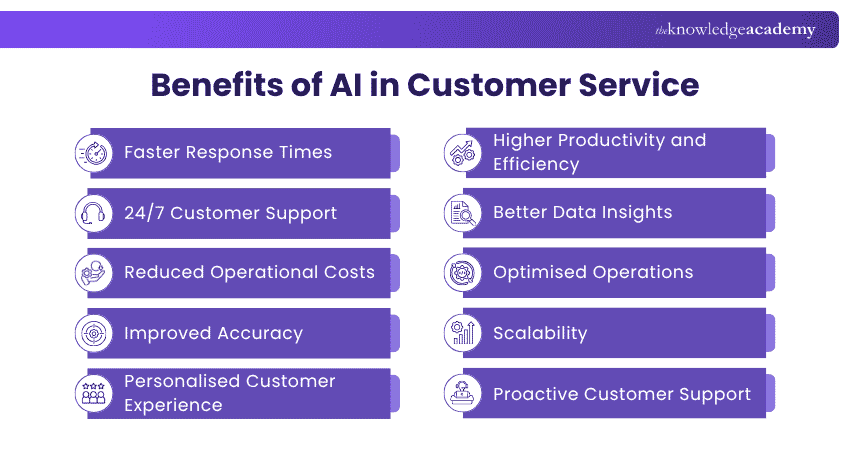
1) Faster Response Times: AI tools like chatbots deliver instant answers to common queries, reducing wait times and improving customer satisfaction, especially during peak periods when demand is high.
2) 24/7 Customer Support: AI systems operate continuously without breaks, ensuring customers receive assistance anytime, regardless of time zones, improving accessibility and service experience.
3) Reduced Operational Costs: By automating repetitive tasks, AI reduces dependency on large teams and helps businesses handle more queries efficiently, leading to long-term cost savings.
4) Improved Accuracy: AI provides consistent, data-driven responses, minimising errors and ensuring customers receive reliable information, which strengthens trust in service delivery.
5) Personalised Customer Experience: AI uses real-time customer data such as preferences and history to deliver tailored interactions, creating more relevant and engaging support experiences.
6) Higher Productivity and Efficiency: AI assistants support agents by suggesting responses, summarising conversations, and retrieving information instantly, reducing manual effort and improving overall efficiency.
7) Better Data Insights: AI analyses customer interactions to identify trends and performance gaps, helping organisations make informed decisions and continuously improve services.
8) Optimised Operations: AI streamlines workflows, improves ticket routing, and enhances knowledge management, making Customer Service processes more efficient and effective.
9) Scalability: AI systems can handle increasing volumes of customer queries without affecting performance, allowing businesses to scale operations easily as demand grows.
10) Proactive Customer Support: AI predicts customer needs using data insights, enabling early issue resolution, timely reminders, and personalised recommendations to improve customer satisfaction.
Automate repetitive sales tasks to improve productivity and pipeline efficiency with our AI Automation Training for Sales – Register today!
Ways to Use AI in Customer Service
AI improves Customer Service by enabling faster responses, automating workflows, and supporting smarter decision-making. It allows organisations to handle large volumes of queries efficiently while maintaining high service quality. Below are key ways businesses can use AI:
1) Utilise AI-powered Agents
AI-powered agents are advanced systems designed to handle customer interactions using conversational AI. Unlike basic chatbots, these agents are trained on real Customer Service data, allowing them to understand complex queries and provide accurate responses.
They can manage entire conversations from start to finish, resolving issues without human intervention. This helps reduce response times, improve efficiency, and free up human agents to focus on more complex and high-value tasks.
2) Provide Proactive Support to Agents
AI assists human agents by providing real-time suggestions, recommended responses, and relevant information during customer interactions. This support helps agents resolve issues faster and improves overall efficiency in handling queries.
By analysing customer data and past interactions, AI predicts potential issues and suggests solutions. This proactive approach ensures agents are better prepared, leading to improved customer satisfaction and reduced handling time.
3) Automate Workflows
AI automates repetitive tasks such as ticket routing, data entry, and follow-ups. This reduces manual effort and ensures processes are completed quickly and accurately without delays or errors in operations.
Automation improves consistency and allows teams to focus on higher-value activities. It also enhances productivity, reduces operational costs, and ensures smoother workflows across Customer Service processes and systems.
4) Optimise Workforce Management
AI helps organisations manage workforce planning by analysing demand patterns and predicting Customer Service needs. This ensures the right number of agents are available at the right time to handle customer queries efficiently.
It also supports scheduling, performance monitoring, and resource allocation. By optimising workforce management, businesses can reduce costs, improve efficiency, and maintain high service levels during peak and off-peak periods.
5) Enhance Service Quality
AI improves service quality by analysing interactions and identifying areas for improvement. It helps ensure consistent responses, accurate information, and better handling of customer queries across all communication channels.
Through continuous monitoring and feedback, AI highlights gaps and suggests improvements. This allows organisations to refine their processes, train agents effectively, and deliver a higher standard of Customer Service consistently.
6) Improve Call Management
AI enhances call management by analysing voice interactions, transcribing conversations, and identifying key insights. This helps businesses understand customer needs and improve call handling processes more effectively.
It also enables features such as intelligent call routing and real-time assistance. These capabilities reduce wait times, improve resolution rates, and ensure customers are connected to the right agents quickly.
7) Upgrade Your Help Center
AI improves help centres by organising content, suggesting relevant articles, and enabling smart search capabilities. Customers can quickly find answers without needing to contact support, improving self-service experiences.
By analysing user behaviour, AI identifies gaps in knowledge content and suggests improvements. This ensures help centres remain updated, relevant, and effective in addressing common customer queries.
8) Analyse Sentiment and Intent
AI uses advanced algorithms to understand customer sentiment and intent from messages, emails, and calls. This helps businesses identify customer emotions and respond appropriately to different situations.
By detecting frustration, satisfaction, or urgency, AI enables more personalised interactions. It also helps prioritise critical issues, ensuring customers receive timely support and improving overall service quality.
9) Gain Insights for Continuous Improvement
AI collects and analyses data from customer interactions to identify trends, patterns, and performance gaps. These insights help organisations understand what is working and where improvements are needed.
By using data-driven insights, businesses can refine strategies, improve processes, and enhance customer experiences. Continuous improvement ensures organisations remain competitive and responsive to changing customer expectations.
Understand how AI tools analyse customer behaviour and product performance data with our AI Automation Course for Product Management – Join now!
How to Implement AI in Customer Service?
Implementing AI requires a structured approach that aligns with business goals and customer needs. A well-planned implementation ensures smoother adoption, minimises risks, and delivers measurable results over time. Organisations must carefully plan, test, and scale AI solutions to maximise their impact. Let’s explore the steps below:
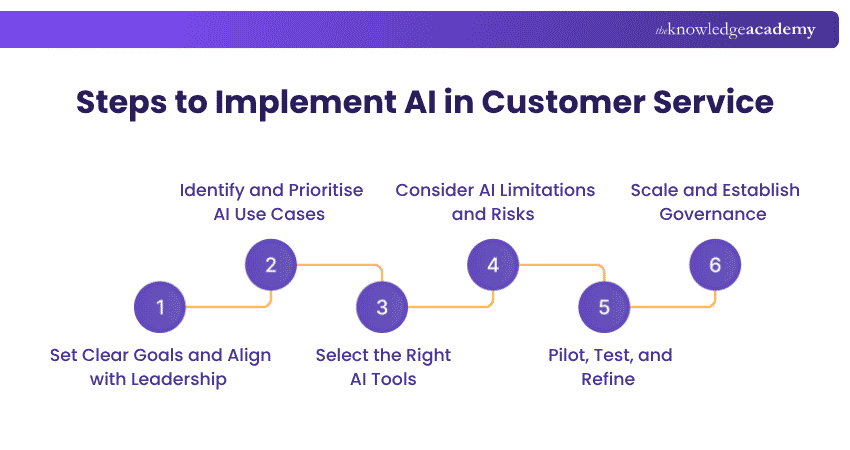
1) Set Clear Goals and Align with Leadership
Organisations must define clear objectives for implementing AI in Customer Service. These goals should align with business priorities, such as improving response times, reducing costs, or enhancing customer satisfaction.
Leadership support is essential to ensure resources, budget, and strategy are aligned. Clear goals and strong leadership commitment help drive successful AI adoption and ensure long-term value for the organisation.
2) Identify and Prioritise AI Use Cases
Businesses should identify areas where AI can deliver the most value, such as chatbots, automation, or analytics. Prioritising use cases ensures resources are focused on high-impact initiatives.
By evaluating potential benefits and feasibility, organisations can implement AI solutions that deliver measurable outcomes. This approach reduces risks and ensures efficient use of time and resources.
3) Select the Right AI Tools
Choosing the right AI tools is crucial for successful implementation. Organisations should evaluate tools based on functionality, scalability, integration capabilities, ease of use, and overall long-term business value.
The right tools should align with business needs and support existing systems. Selecting suitable technology ensures smooth implementation and maximises the benefits of AI in Customer Service operations.
4) Consider AI Limitations and Risks
AI systems have limitations, such as handling complex queries or understanding context in certain situations. Organisations must recognise these limitations and plan accordingly to avoid service disruptions.
It is also important to address risks related to data privacy, bias, and security. By managing these risks effectively, businesses can ensure safe, ethical, and reliable use of AI technologies across all operations.
5) Pilot, Test, and Refine
Before full implementation, organisations should run pilot projects to test AI solutions in real scenarios. This helps identify issues, measure performance, and gather feedback from users and agents.
Testing and refining AI systems ensures they meet business requirements and deliver expected outcomes. Continuous improvement during this stage helps optimise performance and reduce potential risks.
6) Scale and Establish Governance
Once AI solutions are tested, organisations can scale them across different departments and processes. Scaling ensures broader impact and maximises the value of AI investments across the entire organisation effectively.
Establishing governance frameworks ensures proper management, monitoring, and compliance. This includes setting policies, defining responsibilities, and ensuring ethical use of AI technologies across the organisation.
Explore AI techniques that support personalised marketing and audience segmentation. Join our AI Automation Course for Marketing today!
Important Factors to Consider for AI-powered Customer Service
When implementing AI in Customer Service, organisations must consider factors such as budget, timelines, security, and accuracy. These factors play a critical role in ensuring successful adoption and long-term sustainability. Let’s explore them below:
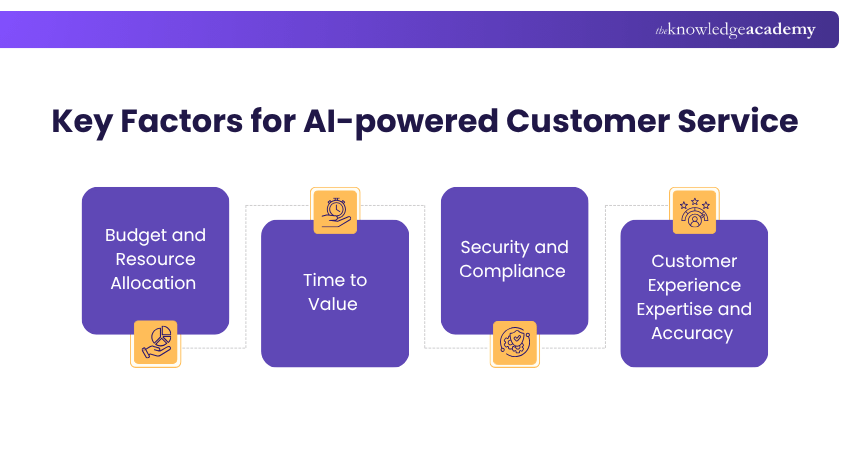
1) Budget and Resource Allocation
Implementing AI requires investment in technology, training, and infrastructure. Organisations must plan budgets carefully to ensure they can support both initial implementation and ongoing maintenance.
Proper resource allocation ensures teams have the skills and tools needed for success. It also helps avoid delays and ensures efficient execution of AI initiatives across Customer Service operations.
2) Time to Value
Businesses should evaluate how quickly AI solutions can deliver measurable results. Time to value is an important factor in determining the success and return on investment of AI initiatives.
Faster implementation and quick results help build confidence and support within the organisation. It also ensures businesses can adapt quickly to changing customer needs and market conditions.
3) Security and Compliance
AI systems handle large volumes of customer data, making security and compliance critical considerations. Organisations must ensure data protection, privacy, and adherence to regulatory requirements.
Implementing strong security measures and compliance frameworks helps build trust with customers. It also reduces risks and ensures safe use of AI technologies in Customer Service operations.
4) Customer Experience Expertise and Accuracy
AI systems must deliver accurate and reliable responses to maintain customer trust. Organisations should ensure AI solutions are trained properly and aligned with customer expectations.
Combining AI with human expertise ensures high-quality service delivery. This approach helps balance automation with personal interaction, improving overall customer experience and satisfaction.
Conclusion
AI in Customer Service is transforming how businesses deliver faster, smarter, and more personalised support. By adopting the right strategies and tools, organisations can improve efficiency, reduce costs, and enhance customer satisfaction. Embracing this approach will help businesses stay competitive and meet evolving customer expectations.
Gain practical experience using modern AI tools and automation techniques with our AI Automation Training – Join now!
Frequently Asked Questions
What are the 3 C's of AI?

The 3 C’s of AI are Computation, Cognition, and Communication. Computation refers to processing large amounts of data, Cognition involves understanding and learning from that data, and Communication enables AI to interact with users effectively through text, voice, or other interfaces.
What is the Future of AI in Customer Service?
The future of AI in Customer Service will focus on advanced automation, hyper-personalisation, and human-AI collaboration. Businesses will use predictive insights and real-time data to deliver faster, more accurate support, improving efficiency, and enhancing customer experience across channels.
What are the Other Resources and Offers Provided by The Knowledge Academy?
The Knowledge Academy takes global learning to new heights, offering over 3,000+ online courses across 490+ locations in 190+ countries. This expansive reach ensures accessibility and convenience for learners worldwide.
Alongside our diverse Online Course Catalogue, encompassing 17 major categories, we go the extra mile by providing a plethora of free educational Online Resources like Blogs, eBooks, Interview Questions and Videos. Tailoring learning experiences further, professionals can unlock greater value through a wide range of special discounts, seasonal deals, and Exclusive Offers.
What is The Knowledge Pass, and How Does it Work?
The Knowledge Academy’s Knowledge Pass, a prepaid voucher, adds another layer of flexibility, allowing course bookings over a 12-month period. Join us on a journey where education knows no bounds.
What are the Related Courses and Blogs Provided by The Knowledge Academy?
The Knowledge Academy offers various AI Automation Training, including the AI Automation Training for Customer Services, AI Automation Course for Marketing, and the AI Automation Course for Operations. These courses cater to different skill levels, providing comprehensive insights into Attention Mechanism.
Our Data, Analytics & AI Blogs cover a range of topics related to AI for Customer Service, offering valuable resources, best practices, and industry insights. Whether you are a beginner or looking to advance your Data, Analytics & AI skills, The Knowledge Academy's diverse courses and informative blogs have got you covered.

Lily Turner


Senior AI/ML Engineer and Data Science Author
Lily Turner is a data science professional with over 10 years of experience in artificial intelligence, machine learning, and big data analytics. Her work bridges academic research and industry innovation, with a focus on solving real-world problems using data-driven approaches. Lily’s content empowers aspiring data scientists to build practical, scalable models using the latest tools and techniques.
View Detail
Upcoming Data, Analytics & AI Resources Batches & Dates
Date
 AI Automation Course for Marketing
AI Automation Course for Marketing
Fri 17th Jul 2026
AI Automation Course for Marketing
Fri 16th Oct 2026

 If you wish to make any changes to your course, please


