


 Top Rated Course

We may not have the course you’re looking for. If you enquire or give us a call on +39 800580270 and speak to our training experts, we may still be able to help with your training requirements.
Benefits of ISO 22301: Key Advantages for Business Continuity
The Knowledge Academy 04 September 2026This blog explores the key ISO 22301 Benefits, from improving resilience and disruption preparedness to protecting critical operations and building stakeholder confidence.

Training Outcomes Within Your Budget!
We ensure quality, budget-alignment, and timely delivery by our expert instructors.
Table of Contents
Key Takeaways
1. ISO 22301 provides a structured framework for managing Business Continuity and preparing for disruptions.2. It helps organisations identify priority activities, dependencies and potential disruption impacts.3. Clear roles, response procedures and continuity strategies support more coordinated incident response.4. An effective BCMS can strengthen organisational resilience and stakeholder confidence.5. Regular exercises, reviews and improvements help Business Continuity arrangements remain effective as organisations change.
Quick question: if your organisation could not operate normally tomorrow, what would absolutely need to keep running?
Now comes the harder part.
Who would make the decisions? Which customers and services would be affected? Which systems and suppliers would you depend on? How quickly would teams know what to do?
ISO 22301 helps organisations answer these questions before they become urgent. It brings structure to Business Continuity so that priorities, responsibilities and response arrangements are clearer when disruption occurs.
That is where its real value begins. Let’s uncover the ISO 22301 Benefits that can help organisations stay prepared, responsive and resilient when disruption strikes.
What is ISO 22301?
ISO 22301 is an international standard for Business Continuity Management Systems (BCMS). It provides requirements for establishing, implementing, maintaining and continually improving a BCMS that helps organisations prepare for, respond to and recover from disruptions.
The standard helps organisations identify priority activities, understand the impact of disruptions and establish appropriate Business Continuity strategies and response arrangements. This structured approach supports the continuity and recovery of priority operations when unexpected events occur.
ISO 22301 can be applied to organisations of any size or sector, with the scope and complexity of the BCMS tailored to their operations and Business Continuity requirements. The current published edition is ISO 22301:2019, with Amendment 1:2024 covering climate action changes. A third edition is under development but has not yet replaced ISO 22301:2019.

What are the Benefits of ISO 22301?
The Benefits of ISO 22301 come from replacing an informal or reactive approach to disruption with a structured Business Continuity Management System. The specific benefits depend on an organisation's operations, risks and maturity, but the sections below cover the ones that matter most in practice.
1) Stronger Organisational Resilience
Unexpected disruptions can test how quickly an organisation can adapt and continue operating. ISO 22301 helps organisations prepare for such situations before they occur.
By establishing Business Continuity priorities, strategies and response arrangements, organisations can strengthen their ability to withstand disruption, adapt to changing circumstances and recover priority activities.
2) Better Business Continuity Preparedness
ISO 22301 encourages organisations to prepare continuity arrangements before disruption occurs. This includes determining what resources are needed, establishing appropriate procedures and ensuring relevant employees understand their responsibilities.
As a result, organisations can approach disruptions with established arrangements rather than creating a response from scratch.
Pro Tip
Do not measure preparedness by the number of pages in a continuity plan. A useful plan is one that the right people can understand and use when normal operations are disrupted.
3) Better Understanding of Disruption Risks
Organisations cannot prepare effectively without understanding what could disrupt important activities and what the consequences might be. ISO 22301 supports structured risk assessment alongside Business Impact Analysis (BIA).
Risk assessment helps organisations identify and evaluate risks of disruption, while BIA helps determine how disruption could affect priority activities and Business Continuity requirements. It also supports more informed decisions about where additional controls or continuity arrangements may be needed.
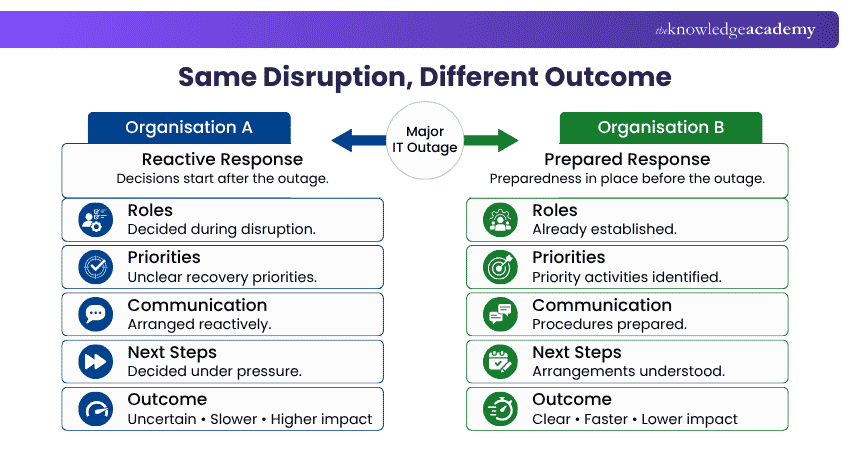
4) Faster and More Structured Disruption Response
During a disruption, unclear responsibilities can delay important decisions. A well-established BCMS defines response structures, responsibilities, escalation arrangements and communication procedures before an incident occurs.
Employees therefore have clearer guidance on what actions should be taken and who has the authority to make key decisions. This can support a more coordinated response and reduce avoidable confusion during critical situations.
5) Protection of Critical Products and Services
Not every activity has the same importance during a disruption. Organisations need to understand which activities should receive priority. Business Impact Analysis (BIA) helps identify activities that support priority products and services and assess the effects of their disruption.
This allows organisations to focus continuity strategies and resources where they matter most, supporting the delivery of priority products and services at an acceptable predefined capacity during disruption.
6) Clearer Roles and Responsibilities
Business Continuity arrangements can become less effective when employees are unclear about who should make decisions or take action. ISO 22301 requires organisations to establish appropriate roles, responsibilities and authorities within the BCMS. This can improve accountability and coordination across Business Continuity activities.
During a disruption, clearer responsibilities can help teams understand who leads the response, who communicates with stakeholders and who manages different aspects of continuity and recovery.
Gain expertise in leading audits with our ISO 22301 Lead Auditor Training – Register now!
7) Greater Stakeholder Confidence
Customers, suppliers, partners and other stakeholders may want assurance that an organisation can manage significant operational disruptions. A structured BCMS demonstrates that Business Continuity is being actively managed rather than considered only after an incident occurs.
Where an organisation obtains independent ISO 22301 Certification, it can also provide external evidence that its BCMS has been assessed against the applicable requirements of the standard.
Did You Know?
ISO 22301 Certification does not guarantee zero downtime or uninterrupted service. Certification by an independent certification body provides assurance that an organisation's BCMS has been assessed against the applicable requirements of ISO 22301.
8) Support for Legal, Regulatory and Contractual Obligations
Some organisations have Business Continuity requirements arising from legislation, regulations, contracts or agreements with customers and other stakeholders. ISO 22301 provides a framework for identifying and considering relevant obligations within the BCMS. This can help organisations manage Business Continuity requirements more systematically.
However, implementing or becoming certified to ISO 22301 does not automatically guarantee compliance with every applicable law or regulation. Organisations must still identify and meet the specific requirements that apply to them.
9) Better Supply Chain Preparedness
Business disruptions do not always begin within the organisation. Problems affecting important suppliers, outsourced services, logistics providers or other external dependencies can also interrupt operations.
ISO 22301 encourages organisations to understand dependencies that support priority activities and consider how their disruption could affect Business Continuity.
This understanding can inform appropriate continuity strategies, such as alternative sourcing, contingency arrangements or other measures suited to the organisation's requirements.
10) Reduced Impact of Disruptions
Disruptions can result in downtime, delayed services, additional operating costs and other consequences. ISO 22301 cannot eliminate these risks entirely, but preparation can help organisations manage their impact.
By establishing continuity priorities and appropriate response and recovery arrangements before an incident, organisations may reduce avoidable disruption and support a more controlled recovery.
11) Continual Improvement
Business Continuity arrangements need to evolve alongside the organisation. New technologies, suppliers, locations, processes and operating models can introduce different dependencies and risks.
ISO 22301 includes requirements for monitoring, measurement, analysis, evaluation, internal audit and management review. Organisations can use these activities, along with exercises and lessons from incidents, to identify weaknesses and opportunities for improvement.
Continual improvement helps keep the BCMS aligned with organisational changes and evolving Business Continuity needs.
Conclusion
The ISO 22301 Benefits go beyond simply preparing for unexpected events. A structured Business Continuity approach helps organisations protect priority activities, respond with greater clarity, strengthen resilience and maintain stakeholder confidence when disruption occurs. It turns Business Continuity into a structured, continually improving capability rather than a reactive response.
Gain practical skills in implementing and maintaining ISO 22301 standards with our ISO 22301 Foundation Training – Join now!
Frequently Asked Questions
What is the Difference Between ISO 22301 and a Business Continuity Plan?

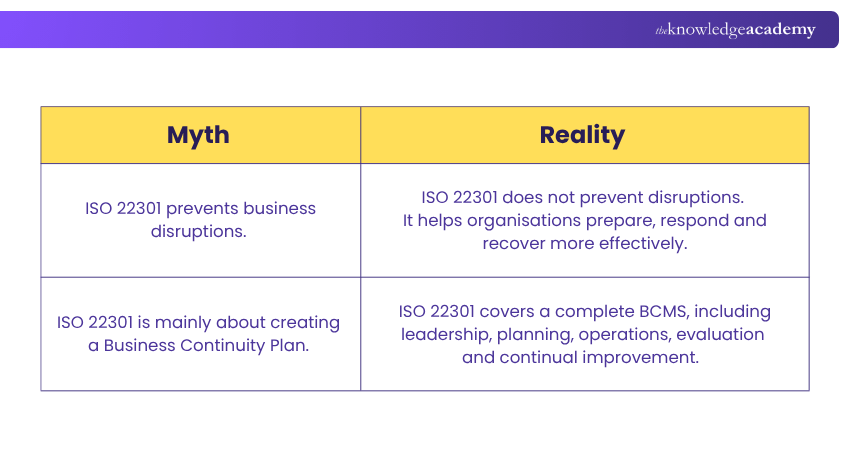
A Business Continuity Plan (BCP) contains arrangements for responding to and recovering from disruption. ISO 22301 covers the broader Business Continuity Management System, including leadership, planning, operational arrangements, performance evaluation and continual improvement.
Is ISO 22301 Certification Mandatory?
ISO 22301 Certification is not inherently mandatory. Organisations can implement the standard without seeking certification. However, certification may be pursued to demonstrate that a BCMS has been independently assessed against ISO 22301 requirements, while particular contractual or regulatory requirements may apply in some sectors.
Is ISO 22301 Certification Mandatory?
Yes. ISO 22301 can be applied to organisations of different sizes and types. A smaller organisation can establish a BCMS proportionate to its operations, resources, risks and Business Continuity requirements rather than adopting unnecessary complexity.
What Happens if an Organisation Does Not Have an Effective Business Continuity Plan?
Without effective Business Continuity arrangements, an organisation may find it harder to coordinate its response and recovery when disruption occurs. Depending on the incident, consequences can include longer downtime, interrupted services, financial losses, contractual problems and reputational damage.

The Knowledge Academy


Global Training Provider
The Knowledge Academy is a world-leading provider of professional training courses, offering globally recognised qualifications across a wide range of subjects. With expert trainers, up-to-date course material, and flexible learning options, we aim to empower professionals and organisations to achieve their goals through continuous learning.


 If you wish to make any changes to your course, please


