


We may not have the course you’re looking for. If you enquire or give us a call on +44 20 4538 6376 and speak to our training experts, we may still be able to help with your training requirements.
Key Benefits of the Sarbanes-Oxley Act
ByThe Knowledge AcademyLast updated on: 18 November 2026
Explore the key benefits of the Sarbanes-Oxley Act, including improved financial reporting, stronger internal controls, enhanced corporate governance and greater investor confidence.

At a Glance
The Sarbanes-Oxley Act strengthens financial reporting and corporate accountability through several important requirements:1. Financial Transparency: Encourages reliable and accurate corporate financial disclosures.2. Internal Controls: Requires applicable companies to assess the effectiveness of their internal controls over financial reporting.3. Executive Accountability: Establishes certification responsibilities for principal executive and financial officers.4. Investor Protection: Strengthens confidence in financial information through greater oversight.5. Independent Auditing: Supports audit quality through PCAOB regulation and oversight.
The Sarbanes-Oxley Act (SOX) has brought significant changes to the corporate world since its introduction in 2002. Created in response to major corporate accounting scandals, the act aims to strengthen financial transparency, accountability and investor protection.
Although it is a US federal law, its requirements can also apply to non-US companies that are subject to applicable US securities reporting requirements. The benefits of the Sarbanes-Oxley Act go beyond meeting regulatory requirements, helping companies improve financial reporting and internal controls. In this blog, we will explore its key benefits and impact on financial integrity.
Benefits of the Sarbanes-Oxley Act
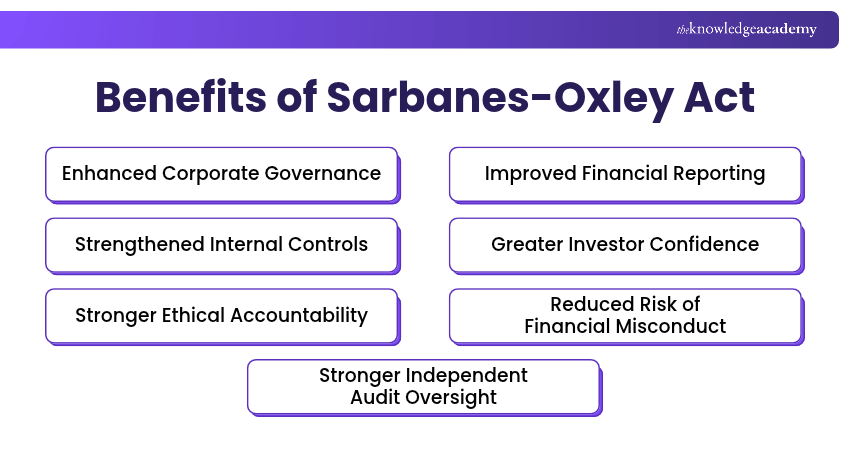
The Sarbanes-Oxley Act strengthens corporate governance by introducing stricter financial reporting, internal control and audit oversight requirements for companies within its scope. Here are the key benefits of the Sarbanes-Oxley Act:
1) Enhanced Corporate Governance
Enhanced corporate governance is one of the key benefits of the Sarbanes-Oxley Act. By establishing stronger requirements for audit committee independence and oversight at applicable listed companies, the act helps protect shareholder interests and improve oversight of financial reporting.
These committees are responsible for overseeing the appointment, compensation and work of external auditors and must establish procedures for receiving and handling accounting or auditing concerns, including confidential, anonymous employee submissions
By strengthening independent oversight, SOX helps reduce potential conflicts of interest, improve accountability and promote greater transparency in corporate financial reporting.

2) Improved Financial Reporting
The Sarbanes-Oxley Act introduced stricter requirements to improve the accuracy and overall transparency of corporate financial reporting. Under Section 302, CEOs and CFOs of relevant companies must certify periodic financial reports, including statements about their fair presentation in all material respects.
This reinforces executive responsibility for financial disclosures and encourages organisations to maintain reliable reporting processes, helping investors and stakeholders make more informed decisions.
3) Strengthened Internal Controls
At the core of the Sarbanes-Oxley Act is its emphasis on strengthening internal control over financial reporting (ICFR). Under Section 404(a), management of applicable companies must assess and report annually on the effectiveness of ICFR.
Section 404(b) requires independent auditor attestation for certain companies, while others, including non-accelerated filers and eligible emerging growth companies, are exempt from that attestation requirement.
These measures help organisations identify control weaknesses, reduce reporting errors and address potential financial risks. Companies may also use compliance software and automated monitoring to improve control documentation, testing and reporting.
Trainer's Insight
Financial control is only useful when it works as intended. For example, requiring approval for payments is not enough if those approvals are regularly bypassed. Organisations must assess whether controls are properly designed, consistently performed and supported by suitable evidence.
4) Greater Investor Confidence
Investor confidence plays an important role in maintaining trust in financial markets. The Sarbanes-Oxley Act supports this confidence by strengthening financial disclosures, executive accountability and independent audit oversight.
When companies provide reliable financial information and demonstrate effective governance, investors are better equipped to assess risks and make informed investment decisions. These measures can improve trust in corporate reporting and support the integrity of financial markets.
5) Stronger Ethical Accountability
The Sarbanes-Oxley Act promotes ethical accountability by strengthening requirements for corporate disclosures and reporting concerns. Under Section 406 and the Securities and Exchange Commission's (SEC) implementing rules, applicable companies must disclose whether they have adopted a code of ethics for their principal executive and senior financial officers and explain why if they have not.
The act also requires applicable listed companies to establish procedures for confidential, anonymous employee reporting of accounting or auditing concerns under Section 301. Separately, Section 806 provides anti-retaliation protections for eligible whistleblowers who report specified types of suspected misconduct. These measures encourage responsible behaviour and help organisations identify potential misconduct.
6) Reduced Risk of Financial Misconduct
The requirements of the Sarbanes-Oxley Act help deter financial misconduct by strengthening internal controls, financial reporting and corporate oversight. Executive certifications, independent audit committees and procedures for reporting concerns can make financial irregularities more difficult to conceal.
These safeguards also help organisations identify potential problems and take corrective action. Although SOX cannot eliminate fraud or prevent every financial scandal, it provides important measures for reducing misconduct risks and supporting financial integrity.
7) Stronger Independent Audit Oversight
One of the significant reforms introduced by the Sarbanes-Oxley Act was the establishment of the Public Company Accounting Oversight Board (PCAOB). The PCAOB oversees audits of public companies and certain other entities within its regulatory remit through audit-firm registration, standards, inspections and enforcement activities.
This independent oversight helps identify audit quality deficiencies, strengthen professional accountability and encourage more reliable financial audits, supporting investor protection and confidence in financial reporting.
Learn to lead with integrity and govern with confidence by signing up with the Corporate Governance Training now!
Best Practices for Effective SOX Compliance
Effective Sarbanes-Oxley compliance requires structured internal controls, proactive risk management and regular monitoring. Here are some of the best practices to strengthen compliance and maintain reliable financial reporting:
a) Adopt a Top-down Risk Assessment: Identify significant financial accounts, disclosures and processes that could lead to material misstatements. Prioritise high-risk areas and use recognised frameworks, such as COSO, to assess internal controls effectively.
b) Strengthen IT General Controls and Change Management: Protect systems relevant to financial reporting through access restrictions, regular permission reviews and secure authentication. Ensure system changes are authorised, tested and documented to maintain data integrity.
c) Enforce Segregation of Duties: Separate responsibilities for initiating, approving and recording financial transactions to reduce errors and fraud risks. Where complete separation is impractical, introduce independent reviews or other suitable compensating controls.
d) Monitor and Test Controls Regularly: Review key controls throughout the year to confirm they operate effectively. Maintain clear records of testing results and supporting evidence, using centralised documentation or compliance tools where appropriate.
e) Address Control Deficiencies Promptly: Investigate control weaknesses and assess whether they constitute significant deficiencies or material weaknesses. Implement corrective measures, assign clear responsibilities and set deadlines. Retest the affected controls to confirm that the identified issues have been resolved.
f) Foster a Culture of Accountability: Define control responsibilities and provide regular training on financial reporting, ethics and fraud prevention. Encourage employees to report concerns and maintain evidence of completed control activities.
The Sarbanes-Oxley Act has strengthened corporate accountability by introducing stricter financial reporting requirements, improving internal controls and reinforcing independent audit oversight. By following effective compliance practices and addressing control weaknesses, companies can enhance financial transparency, reduce risks and maintain long-term financial integrity.

The Knowledge Academy develops accessible learning content across Project Management, IT, Cybersecurity, Data Science, Business Analysis, HR, Accounting and Finance, Leadership and Health and Safety. Its resources combine subject research with clear explanations to help professionals build practical knowledge across a wide range of disciplines.
View Detail

 If you wish to make any changes to your course, please


