


We may not have the course you’re looking for. If you enquire or give us a call on +358 942454206 and speak to our training experts, we may still be able to help with your training requirements.
Top 10 Benefits of Market Research for Businesses
ByThe Knowledge AcademyLast updated on: 18 November 2026
Market research helps businesses understand customer needs, evaluate competitors and identify opportunities for growth. This blog explores the benefits of market research, explains its practical applications and outlines common research challenges with effective ways to overcome them.

Business Owner: “We think customers will love this product.”
Marketing Manager: “But have we asked them?”
That simple question reveals an important gap between business assumptions and customer expectations. Market research helps organisations explore what people need, how competitors respond and where opportunities may exist. Instead of relying only on predictions, businesses can use relevant evidence to guide their next move.
So, what makes market research valuable beyond understanding customers? Let's explore its key benefits and how they support better business decisions.
Top 10 Benefits of Market Research
Market research involves systematically gathering, analysing and interpreting information about customers, competitors and market conditions. Primary research collects new information for a specific research objective, while secondary research uses and analyses existing information.
The following ten benefits show how businesses can apply market research across different activities.
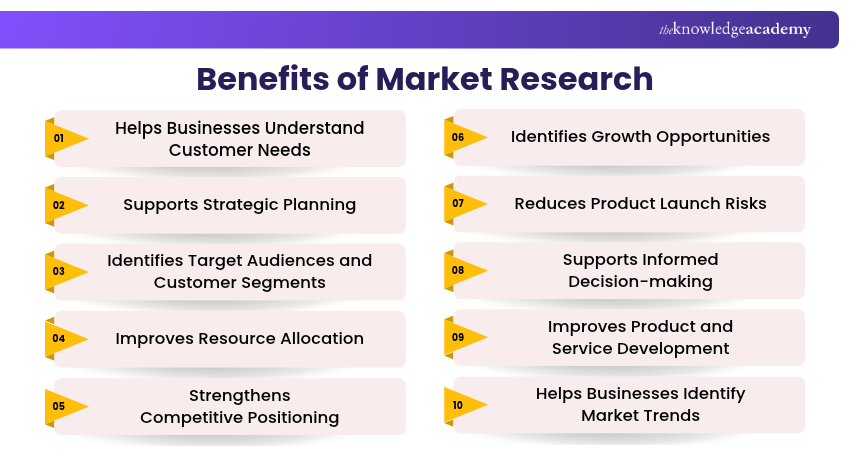
1) Helps Businesses Understand Customer Needs
Understanding what customers expect is important when developing products, services and marketing strategies. Market research allows businesses to explore customer preferences, purchasing behaviour, satisfaction levels and common challenges through surveys, interviews, customer feedback and other relevant data sources.
These findings can help organisations recognise unmet needs and identify areas where their offerings require improvement. For example, a cafe may discover through customer feedback that many visitors prefer quicker takeaway options during morning hours. It can then assess whether introducing a faster collection service would better meet customer expectations.

2) Supports Strategic Planning
Strategic planning involves establishing business objectives and determining suitable actions to achieve them. Market research supports this process by providing information about market size, customer demand, competitive conditions and emerging opportunities. These insights help businesses evaluate whether proposed strategies are realistic and aligned with market conditions.
Research findings can also inform the opportunities and threats considered in a SWOT analysis, while internal business information helps assess strengths and weaknesses. For example, a company planning to enter a new region can examine local demand, competitor offerings and customer preferences before deciding how to position its products.
Trainer Insight – Test Your Assumptions
Before committing to a strategy, identify its most important assumptions and evidence supporting them. Prioritise further research where uncertainty could significantly affect the decision.
3) Identifies Target Audiences and Customer Segments
Not every customer has the same needs, preferences or purchasing behaviour. Market research helps businesses divide a broader market into meaningful customer segments using relevant characteristics such as location, buying habits, interests, requirements and spending patterns.
Businesses can use these insights to develop research-informed customer personas and create more relevant messages, products and customer experiences. For example, a fitness business may identify separate segments interested in beginner programmes, flexible online sessions or advanced strength training. Understanding these differences helps the business tailor its services to each group's needs.
4) Improves Resource Allocation
Businesses have limited budgets, time and operational resources. Market research helps them assess where these resources may be most useful by examining customer demand, market opportunities and the potential effectiveness of different marketing or distribution channels.
For example, a small clothing retailer may compare customer engagement, conversion rates and marketing costs across its website, social media and physical store before deciding where to focus its promotional budget. Although market research does not guarantee cost savings, it can help businesses allocate resources more effectively by identifying opportunities supported by customer and market evidence.
Pro Tip – Match Research to the Decision
Not every business question requires a large research project. Begin by identifying the decision you need to make, the information required and a research method that balances reliability, suitability and available resources. This can help businesses manage research costs while gathering information relevant to their decisions.
5) Strengthens Competitive Positioning
Businesses need to understand how their products and services compare with available alternatives. Market research supports competitive positioning by examining competitor offerings, pricing, customer perceptions and market messaging. This helps organisations recognise their relative strengths and identify where meaningful differentiation may be possible.
For example, a software company may find through competitor reviews, product comparisons or user research that some competing products offer extensive functionality but are difficult for beginners to navigate. This insight could encourage the company to explore a simpler interface or a more accessible onboarding experience.
6) Identifies Growth Opportunities
Market research helps businesses discover potential opportunities beyond their existing customers, products or geographical areas. By examining market demand, customer behaviour and underserved segments, organisations can assess whether expansion into new markets or product categories may be worthwhile.
For example, a skincare company may find evidence of growing interest in fragrance-free products among its target customers. It can investigate demand, competing alternatives and purchasing preferences before deciding whether to explore a new product range. Such research supports opportunity assessment but does not guarantee profitable growth.
Learn to build customer satisfaction and brand loyalty in the business environment with our Strategic Marketing Course – Sign up now!
7) Reduces Product Launch Risks
Launching a new product or service involves uncertainty about demand, suitability and customer acceptance. Market research can reduce some of this uncertainty through concept testing, customer interviews, prototype feedback and limited market trials.
For example, a food business planning a new packaged snack could test different flavours, packaging designs and price points with suitable potential customers before investing in wider production. Feedback may reveal concerns that can be addressed before launch, helping the business refine its concept and avoid some preventable mistakes.
8) Supports Informed Decision-making
Market research helps businesses evaluate different options before making decisions about pricing, products, marketing or customer experiences. By comparing relevant data and potential outcomes, organisations can make more informed choices and reduce their reliance on assumptions.
For instance, a retailer considering a price adjustment may examine customer willingness to pay, competitor pricing and previous sales patterns before deciding on an approach. Although research cannot predict every outcome, it helps organisations make decisions using relevant information rather than relying entirely on intuition.
9) Improves Product and Service Development
Market research plays an important role in refining existing offerings and identifying improvements that matter to customers. Businesses can gather feedback on product features, usability, service experiences and recurring problems to understand where changes could provide value.
For example, an online learning provider may discover that learners find its course navigation confusing. By analysing feedback and observing how users interact with the platform, the provider can identify areas for improvement and test a more intuitive learning experience.
10) Helps Businesses Identify Market Trends
Customer preferences, technologies and competitive conditions can change over time. Market research enables businesses to monitor these developments using industry reports, customer feedback, sales patterns and other suitable information sources.
For example, a hospitality business may observe increasing customer interest in flexible booking arrangements. By comparing customer enquiries, booking behaviour and wider industry developments, it can assess whether changing its reservation options would be appropriate.
Quick Decision Guide: Which Market Research Method Should You Choose?
Different business questions require different research methods. This guide offers a useful starting point.
|
Business Question |
Suitable Research Methods |
|
What do customers think about our service? |
Customer surveys, interviews and feedback analysis |
|
Why are customers struggling with a product? |
User interviews, observation and usability testing |
|
How large is our potential market? |
Relevant industry reports, official statistics, market sizing estimates and other suitable secondary research |
|
How do competitors position their offerings? |
Competitor analysis and publicly available market information |
|
Will customers respond positively to a new concept? |
Concept testing, prototype feedback and limited trials |
The right research method depends on your objectives, available resources and the information required. Combining qualitative and quantitative methods can also provide a more comprehensive understanding of customer needs and market conditions.
Key Challenges of Market Research and Ways to Overcome Them
Market research can involve challenges related to costs, time, data quality and applying findings effectively. Here are four common challenges and ways to address them:
1) Research Costs
Market research can involve considerable expenses, particularly when using specialist tools, external agencies or paid participant recruitment.
How to Overcome: Define clear research objectives, use relevant existing data and choose cost-effective methods suited to your research needs and budget.
2) Time Constraints
Designing research, collecting responses and analysing findings can take time, potentially delaying important business decisions.
How to Overcome: Prioritise essential research questions, establish realistic timelines and choose efficient data collection methods while maintaining appropriate research quality.
3) Data Quality and Bias
Unrepresentative samples, leading questions, outdated sources and inaccurate responses can affect the reliability of research findings.
How to Overcome: Use suitable sampling methods, write neutral questions, verify data sources and compare findings from multiple sources to identify inconsistencies and reduce the risk of bias.
4) Applying Research Findings
Businesses may collect valuable information but struggle to translate their findings into meaningful decisions or improvements.
How to Overcome: Identify actionable recommendations, assign clear responsibilities and monitor the outcomes of decisions made using the research findings.
Keep This in Mind
Even well-conducted market research cannot eliminate uncertainty. Businesses should consider sample limitations, changing market conditions and other relevant evidence before making significant decisions.
Learn brand management strategies to build and maintain a strong identity with our Marketing Courses – Register now!

The Knowledge Academy develops accessible learning content across Project Management, IT, Cybersecurity, Data Science, Business Analysis, HR, Accounting and Finance, Leadership and Health and Safety. Its resources combine subject research with clear explanations to help professionals build practical knowledge across a wide range of disciplines.
View Detail

 If you wish to make any changes to your course, please


