


 Top Rated Course

We may not have the course you’re looking for. If you enquire or give us a call on 01344203999 and speak to our training experts, we may still be able to help with your training requirements.
What are the Benefits of Design Thinking?
The Knowledge Academy 28 August 2026Design Thinking helps teams understand users, define problems clearly, explore ideas and test solutions before major investment. This blog explores the key Benefits of Design Thinking and explains how its user-centred, iterative approach supports better problem-solving and innovation.

Training Outcomes Within Your Budget!
We ensure quality, budget-alignment, and timely delivery by our expert instructors.
Table of Contents
Key Takeaways
1. Design Thinking keeps user needs at the centre of problem-solving.2. Early prototyping and testing can reveal problems before full implementation.3. Collaboration helps teams consider different perspectives and generate broader ideas.4. Design Thinking is iterative, so teams can revisit problems and improve solutions as they learn.5. The approach is particularly useful when problems are uncertain, complex or poorly understood.
Solving the wrong problem efficiently is still solving the wrong problem. Organisations can invest significant time and resources in products, services or processes only to discover that they do not fully address what users need.
Design Thinking offers a user-centred way to understand problems, explore possibilities and test ideas before committing fully to a solution.
In this blog, we'll focus on the Benefits of Design Thinking, how these benefits are created and the situations in which the approach can provide the most value.
What is Design Thinking?
Design Thinking is a human-centred approach to problem-solving that combines user understanding, idea generation, experimentation and learning. Rather than beginning with a predetermined solution, teams explore the problem, consider different possibilities and use feedback to improve their ideas.
It can be applied beyond traditional design work to products, services, processes and other complex challenges. Design Thinking is also iterative rather than strictly linear, meaning teams can return to earlier activities when new information changes their understanding of the problem.

Key Benefits of Design Thinking
The value of Design Thinking comes from combining user understanding, creative exploration and iterative testing. This helps teams develop solutions that are more relevant, practical and informed by feedback. The key benefits include:
1) Builds a Better Understanding of User Needs
Design Thinking encourages teams to explore how people experience a problem before proposing solutions. This helps reveal needs, behaviours and frustrations that may otherwise be overlooked.
Example: A public transport provider interviews commuters and discovers that unclear timetable information causes confusion during peak hours. By understanding these user frustrations, the organisation redesigns its information displays to make travel planning easier.
2) Helps Define Problems More Clearly
Teams examine the underlying causes of a problem instead of reacting only to visible symptoms. A clearer problem definition helps direct effort towards what genuinely needs to change.
Example: An e-commerce company notices a high rate of abandoned shopping carts. Rather than immediately changing product prices, the team investigates the issue and identifies a complicated checkout process as the primary cause.
3) Encourages Creative Problem-solving
Design Thinking encourages teams to explore multiple ideas before selecting a direction. This creates space for alternative approaches and solutions that may not emerge through conventional thinking.
Example: A university seeks ways to improve student engagement in online learning. Through brainstorming workshops, the team develops several innovative ideas, including interactive discussion tools and personalised learning pathways.
4) Reduces Risk Through Early Testing
Simple prototypes allow teams to test ideas before committing significant resources. Early feedback can expose weaknesses and assumptions while changes are still easier to make.
Example: A mobile app developer creates a basic prototype of a new feature and shares it with users for feedback. The testing reveals navigation issues that can be corrected before full development begins.
5) Strengthens Team Collaboration
Design Thinking brings people with different expertise and perspectives together around a shared challenge. Collaborative exploration can improve communication and create a more complete understanding of the problem.
Example: A manufacturing company forms a team of engineers, designers and customer service staff to improve product usability. Combining different viewpoints helps the team identify issues that a single department may have missed.
6) Supports Faster Learning and Improvement
Teams can use prototypes and feedback to learn what works and what requires further development. This supports continuous refinement instead of waiting until final implementation to identify problems.
Example: A software company releases an early version of a tool to a small group of users. Feedback from this group allows the team to make improvements quickly and improve the final product.
7) Supports More Relevant Solutions
By testing ideas against real user feedback, teams can identify whether a proposed solution actually addresses the problem it was designed to solve. This helps reduce the gap between what a team assumes users need and what users find useful in practice.
Example: A food delivery platform assumes customers want more restaurant choices, but testing reveals that faster delivery times matter more. The company adjusts its strategy to focus on delivery efficiency.
8) Balances Desirability, Feasibility and Viability
Design Thinking encourages teams to consider whether a solution is desirable for users, feasible to deliver and viable for the organisation. This helps move ideas beyond creativity alone towards solutions that can work in real-world conditions.
Example: A healthcare organisation develops a digital appointment system. Before implementation, the team evaluates whether patients want the service, whether it can be supported by existing technology and whether it fits within budget constraints.
9) Improves Customer Experience
Design Thinking focuses on understanding how people interact with products, services or processes throughout their journey. This helps organisations identify pain points and opportunities to create smoother, more satisfying experiences.
Example: A healthcare provider maps the patient journey and discovers that appointment scheduling is causing frustration. By redesigning the booking process based on patient feedback, the organisation reduces waiting times and improves patient satisfaction.
10) Encourages a Customer-Centred Culture
Design Thinking promotes a mindset where decisions are guided by user needs rather than assumptions. Over time, this can help embed customer-centred thinking across teams and departments.
Example: A retail company regularly involves customers in product development discussions. Insights from these interactions guide decision-making, helping teams create products that better align with customer expectations.
11) Increases Adaptability to Change
The iterative nature of Design Thinking helps teams respond more effectively to changing user expectations, market conditions and emerging challenges. Continuous learning allows organisations to adjust solutions as circumstances evolve.
Example: A software company receives feedback that users' priorities have shifted following new industry regulations. By revisiting earlier stages of the Design Thinking process, the team quickly adapts the product to meet changing requirements.
12) Promotes Innovation Across the Organisation
Design Thinking provides a structured approach for exploring new ideas and opportunities. It encourages experimentation while keeping innovation focused on solving meaningful problems.
Example: A financial services organisation uses Design Thinking workshops to explore ways of improving digital services. Through collaborative ideation and testing, the team develops a new mobile feature that simplifies customer transactions and increases engagement.
IMyth vs Fact
Myth: Design Thinking is only useful for designers.Fact: Design Thinking can be used to approach products, services, processes and other complex problems where understanding people and testing possible solutions are important.
What Are the Five Design Thinking Modes?
The benefits of Design Thinking come from the way teams move between understanding, creating and testing rather than committing immediately to one solution.
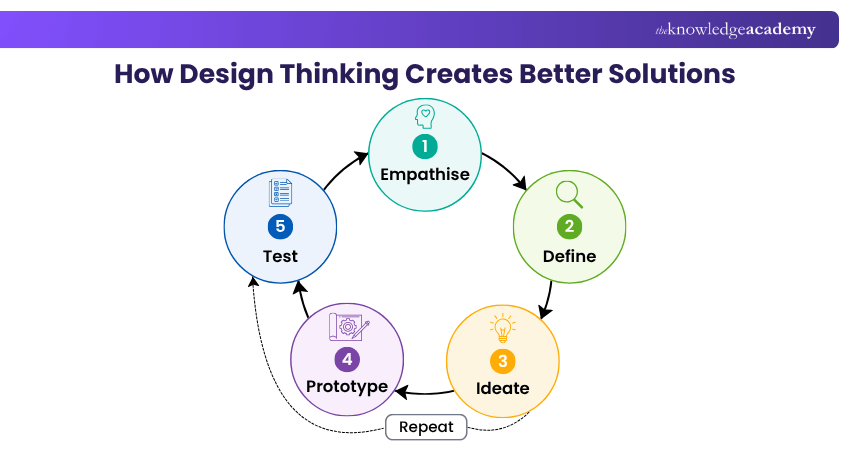
A commonly used framework identifies five Design Thinking modes:
1) Empathise → Understand the people affected by the problem
2) Define → Clarify the problem that needs attention
3) Ideate → Generate different possible solutions
4) Prototype → Make promising ideas tangible enough to explore
5) Test → Gather feedback and identify what should change
These modes are iterative rather than strictly sequential. Teams can return to earlier activities when new information changes their understanding of the problem or solution.
ITrainer's Tip
Use prototypes to learn, not to prove that your first idea is correct. A prototype that exposes a weakness early can be more valuable than one that simply confirms what the team already believes.
Advance your innovation skills with our Design Thinking For R&D Engineers Training and develop solutions – Join now!
IIs Design Thinking a Good Fit?
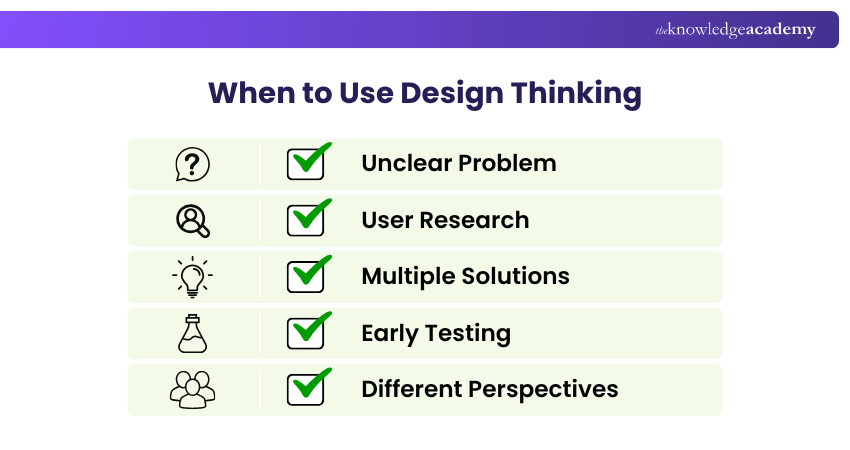
Before choosing the approach, ask:Is the problem poorly understood? ✓Do user needs require further investigation? ✓Are several solutions possible? ✓Could early testing reduce uncertainty? ✓Do different perspectives need to be considered? ✓The more of these questions you answer yes to, the more useful a Design Thinking approach may be.
Conclusion
The value of Design Thinking lies in helping teams learn before they commit. By understanding users, testing assumptions and refining ideas through feedback, teams can make more informed decisions about which solutions deserve further development. Its benefits are strongest when the approach remains flexible, evidence-informed and connected to real user and organisational needs.
Build stronger decision-making skills with our Practical Thinking Course and approach workplace challenges with greater clarity!
Frequently Asked Questions
How Long Does the Design Thinking Process Take?

There is no fixed duration. The time required depends on the complexity of the problem, the amount of user research needed and how many rounds of prototyping and testing are required.
Can Small Businesses Use Design Thinking?
Yes. Design Thinking does not require complex resources. Smaller organisations can use activities such as interviews, simple sketches, basic prototypes and user feedback to explore ideas before making larger commitments.
Does Design Thinking Guarantee a Successful Solution?
No. Design Thinking can reduce uncertainty by helping teams understand users, explore alternatives and test ideas early, but it cannot guarantee that a solution will be technically feasible, commercially viable or successful after implementation.

The Knowledge Academy


Global Training Provider
The Knowledge Academy is a world-leading provider of professional training courses, offering globally recognised qualifications across a wide range of subjects. With expert trainers, up-to-date course material, and flexible learning options, we aim to empower professionals and organisations to achieve their goals through continuous learning.


 If you wish to make any changes to your course, please


