


We may not have the course you’re looking for. If you enquire or give us a call on +971 8000311193 and speak to our training experts, we may still be able to help with your training requirements.
Key Benefits of COBIT® for Organisations
ByThe Knowledge AcademyLast updated on: 21 November 2026
Explore the key benefits of COBIT, from improving IT governance and risk management to enhancing decision-making, compliance and operational efficiency.
In a Nutshell
1. COBIT helps organisations align information and technology with business objectives.2. It strengthens IT governance by clarifying accountability and decision-making responsibilities.3. COBIT supports risk management, compliance oversight and performance improvement.4. Its holistic approach connects people, processes and technology to support effective governance.
Imagine a company investing heavily in new technologies, only to struggle with rising IT costs, security risks and decisions that fail to support business goals. Despite having advanced systems, the organisation lacks the governance needed to manage them effectively. This is where COBIT makes a difference.
Developed by the Information Systems Audit and Control Association (ISACA), COBIT helps organisations align IT with business objectives, manage risks and improve accountability. But what makes this framework so valuable? This blog explores the key benefits of COBIT and how they support effective IT governance and organisational performance.
Key Benefits of COBIT®
COBIT offers several benefits for organisations seeking to strengthen IT governance, manage risks and improve the value of their technology investments. Let's explore the key benefits of COBIT below:
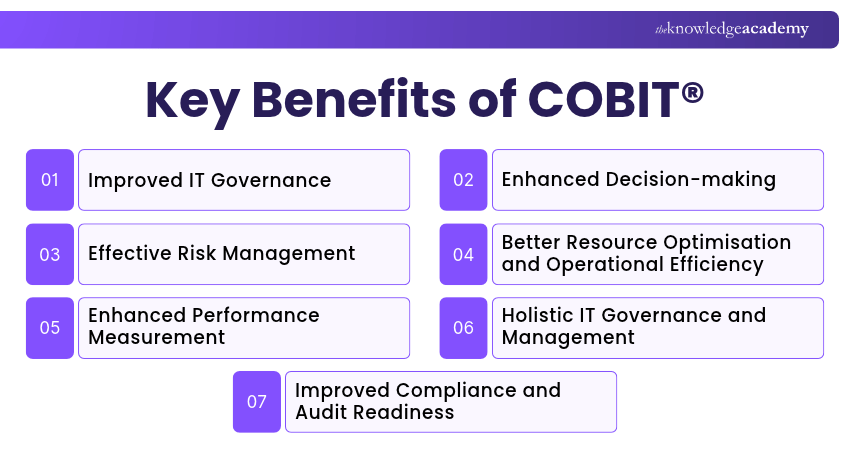
1) Improved IT Governance
COBIT establishes a structured approach to defining roles, responsibilities and decision-making processes within an organisation. It helps clarify accountability and align technology-related decisions with business objectives.
By distinguishing governance from management, COBIT reduces ambiguity, supports effective oversight, and clarifies responsibilities for setting direction and managing activities.

2) Enhanced Decision-making
COBIT helps organisations make informed decisions about technology investments, projects and strategic initiatives. It provides a structured approach to evaluating IT priorities and ensuring that resources support business goals.
By connecting enterprise objectives with governance and management activities, COBIT helps decision-makers assess competing priorities and focus on initiatives that deliver organisational value.
Pro Tip
A technology investment may appear attractive because of its features, but its real value depends on how well it supports business goals. COBIT encourages organisations to consider that connection when making decisions.
3) Effective Risk Management
COBIT supports organisations in identifying, assessing and managing technology-related risks that could affect business operations. It provides guidance for evaluating risks associated with information systems, infrastructure, security and business processes.
By establishing appropriate governance responsibilities and controls, organisations can strengthen risk oversight, address vulnerabilities and manage potential disruptions.
4) Better Resource Optimisation and Operational Efficiency
COBIT helps organisations align IT activities with business priorities, supporting effective resource allocation and operational efficiency. Its governance objectives encourage businesses to evaluate how technology, people and processes contribute to organisational goals.
By evaluating how technology, people and processes contribute to organisational goals, businesses can identify inefficiencies, improve coordination and make better use of available resources. This supports more consistent service delivery and operational performance.
5) Enhanced Performance Measurement
COBIT provides guidance for evaluating the effectiveness of governance and management activities through relevant goals, metrics and performance assessments. These measures help organisations monitor progress and identify areas requiring improvement.
Its performance management approach also supports process capability assessments, helping organisations evaluate how effectively selected activities are implemented and performed.
Trainer's Insight
Completing more IT activities does not always mean better governance. The real question is whether those activities improve performance, reduce risks or contribute to business objectives.
6) Holistic IT Governance and Management
COBIT takes a holistic approach by considering processes, organisational structures, information, people, policies and technology. By connecting these elements, organisations can coordinate governance and management activities rather than managing them in isolation.
It can also complement established frameworks and standards, such as ITIL and ISO/IEC 27001, supporting a more consistent approach to managing technology, security and service delivery.
7) Improved Compliance and Audit Readiness
COBIT helps organisations establish governance responsibilities, evaluate controls and monitor compliance-related activities. By documenting responsibilities, monitoring performance and reviewing controls, organisations can strengthen their audit readiness and improve compliance oversight.
However, adopting COBIT does not automatically guarantee regulatory compliance. Organisations must still implement appropriate controls and meet their specific legal and regulatory obligations.
COBIT provides a flexible foundation for effective governance, but its benefits depend on how well organisations align their practices with business priorities and requirements.
Build stronger governance and make every technology decision count with the COBIT 7 Foundation Training – Sign up now!

The Knowledge Academy develops accessible learning content across Project Management, IT, Cybersecurity, Data Science, Business Analysis, HR, Accounting and Finance, Leadership and Health and Safety. Its resources combine subject research with clear explanations to help professionals build practical knowledge across a wide range of disciplines.
View Detail

 If you wish to make any changes to your course, please


