


 Top Rated Course

We may not have the course you’re looking for. If you enquire or give us a call on 01344 203999 and speak to our training experts, we may still be able to help with your training requirements.
What Is Residual Risk? A Complete Guide and Use Cases
Grace Mitchell 12 May 2026Residual Risk is the remaining level of risk after applying controls and mitigation measures to reduce the original inherent risk to an acceptable level. It cannot be fully eliminated and must be monitored regularly. Organisations assess it to ensure it stays within acceptable limits and supports informed decision-making.

Training Outcomes Within Your Budget!
We ensure quality, budget-alignment, and timely delivery by our expert instructors.
Table of Contents
Risk management does not end once controls are in place; it continues through careful evaluation and informed decisions. Understanding Residual Risk helps organisations recognise what threats remain and how they should be managed. This blog explores its meaning, importance, and role in effective risk management.
Table of Contents
1) What is Residual Risk?
2) Why is Residual Risk Important?
3) Residual Risk vs Inherent Risk
4) Management Strategies for Residual Risk
5) Proactive Tips to Minimise Residual Risk
6) Examples of Residual Risk
7) Conclusion
What is Residual Risk?
Residual Risk refers to the risk that still exists despite having implemented all conceivable precautions. Regardless of how robust your security features or protective procedures may be, a certain degree of risk will always remain. Consider it similar to putting on a seatbelt when driving—you lower the risk, yet accidents can still occur.
In fields like business, cybersecurity, finance, or Project Management, Residual Risk is an element that organisations need to recognise and prepare for. The objective isn't to eradicate all risks (which is almost unfeasible) but to handle them prudently and be prepared for any unforeseen obstacles.
Residual risk is a crucial concept as it demonstrates the dangers that still exist despite the implementation of control measures, showing that no security measure can ever be 100% effective. Knowing it enables firms to set risk levels in line with their tolerance and keep their compliance up to date.
Handling residual risk gives organisations the chance to decide what to do next and where to use their resources most efficiently. This process of constantly knowing what is going on in the world of risks and threats not only enhances security posture but also lessens the effect of surprise threats.
Why is Residual Risk Important?
Residual Risk is important because it represents the level of risk that remains even after all security controls and mitigation efforts have been applied. Since risks can never be completely eliminated, organisations must understand and manage what is left to ensure business continuity and security.
One key reason for its importance is regulatory compliance. Standards such as ISO 27001 require organisations to assess and manage residual risk before sharing data or working with third parties, making it a critical part of information security frameworks.
Residual Risk also helps organisations determine whether the remaining risk is acceptable. By comparing it against defined risk tolerance levels, businesses can decide whether to accept the risk, reduce it further, or implement additional controls.
Another important aspect is its role in strengthening cybersecurity strategies. Residual risk management combines internal controls with external monitoring, especially for third-party and vendor risks, ensuring that hidden vulnerabilities are continuously identified and addressed.
Finally, it supports better decision-making and proactive risk management. By understanding the risks that still exist, organisations can prioritise resources, improve their security posture, and stay prepared for potential threats rather than assuming all risks have been eliminated.
Residual Risk vs Inherent Risk
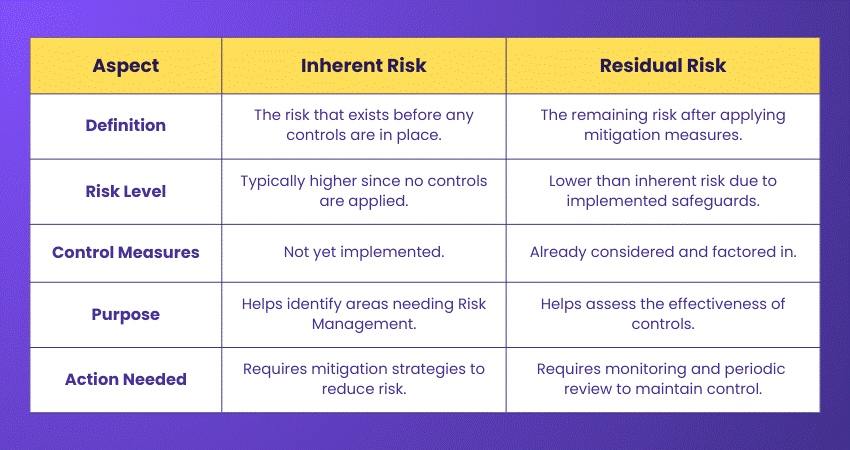
Residual Risk is what remains after you have taken actions to reduce the inherent risk. Inherent Risks means the risk you face before adopting any controls. Risk isn't eliminated, but it can be mitigated. Knowing both enables you to make better decisions about security, safety, and handling risks.
Management Strategies for Residual Risk
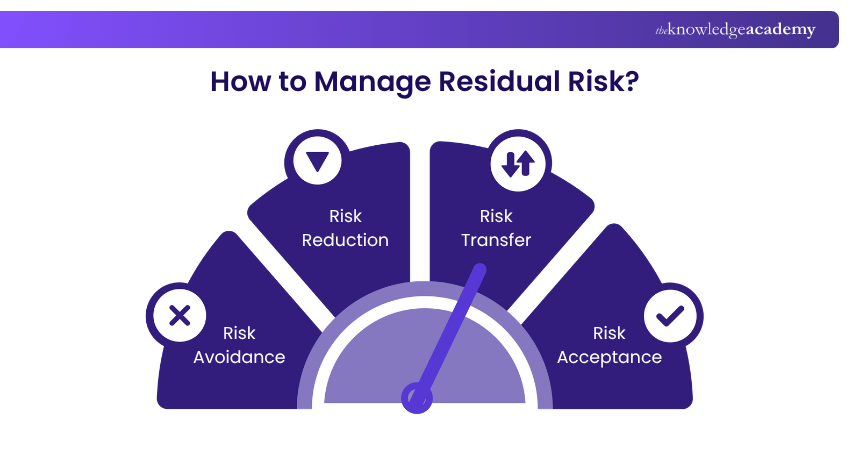
Effectively managing Residual Risk is essential for organisations to operate efficiently while mitigating potential threats. Since no Risk Management strategy can entirely eliminate all risks, businesses must adopt a structured approach to handling Residual Risk. This can be achieved through four key strategies: risk avoidance, risk reduction, risk transfer, and risk acceptance.
Risk Avoidance
Risk avoidance involves completely eliminating activities, processes, or decisions that could lead to high levels of risk. Organisations may choose to avoid entering certain markets, using specific technologies, or engaging in business practices that expose them to unnecessary threats.
While this approach reduces the likelihood of encountering Residual Risk, it may also limit opportunities for growth and innovation.
Risk Reduction
Risk reduction focuses on minimising the probability or impact of risks that cannot be entirely avoided. This can be achieved by implementing stronger internal controls, adopting best practices, and utilising technology to identify and mitigate risks.
Regular training and awareness programs help employees understand potential risks and take appropriate preventive measures. Organisations that invest in risk reduction enhance their resilience and preparedness for unexpected challenges.
Enhance decision-making with our MoR® 4 Practitioner Risk Management Certification – Register now!
Risk Transfer
Risk transfer involves shifting the financial or operational burden of risk to another entity. This can be done through insurance policies, outsourcing high-risk tasks to specialised vendors, or establishing contractual agreements that distribute responsibility.
By transferring risks, organisations can protect themselves from significant financial losses and focus on their core activities while ensuring that experts manage specific risk-prone areas.
Risk Acceptance
Risk acceptance occurs when an organisation acknowledges that some risks are inevitable and decides to operate within an acceptable level of risk. This approach is used when the cost of further risk mitigation outweighs the potential benefits.
Companies that accept Residual Risk often implement monitoring systems and contingency plans to respond effectively if the risk materialises.
Learn to manage risks with our Management Of Risk (MoR®) Foundation V3 Course – Register today!
Proactive Tips to Minimise Residual Risk
Minimising Residual Risk requires a proactive approach. You can’t eliminate all risks, but you can stay ahead with regular risk assessments, strong safety measures, and contingency plans. Training your team, updating policies, and using technology to monitor threats will also help. In this section, you’ll discover practical steps to reduce your exposure.
a) Conduct Regular Risk Assessments: Continuously evaluate risks to identify new threats and update mitigation strategies.
b) Implement Strong Internal Controls: Strengthen policies, procedures, and compliance measures to minimise vulnerabilities.
c) Enhance Employee Training: Educate staff on risk awareness, security protocols, and best practices to reduce human errors.
d) Leverage Technology and Automation: Use advanced tools for real-time monitoring, threat detection, and risk mitigation.
e) Diversify Risk Management Strategies: Apply a mix of risk avoidance, reduction, transfer, and acceptance to balance risk exposure.
f) Develop Comprehensive Contingency Plans: Create backup strategies and response plans to handle unexpected risks efficiently.
Examples of Residual Risk
A company implements firewalls and encryption to protect its Data, but a small risk of cyberattacks still exists due to evolving threats. This remaining risk, despite security measures, is known as Residual Security risk. Regular monitoring and updates help minimise its impact.
Conclusion
Although Residual Risk can't be completely eliminated, how you deal with it makes a significant impact. You can remain alert by being mindful of its effects and employing sensible strategies like acceptance, transfer, and risk reduction. Proactive management is important; evaluate, adjust, and maintain awareness. By taking the right approach, you can control risks while safeguarding your future.
Turn your risks into opportunities with our Management Of Risk (MoR®) Foundation V3 Course – Join today!
Frequently Asked Questions
What is Residual Risk in ISO 31000?

Residual risk in ISO 31000 is the risk that remains after controls and risk treatments are applied. It cannot be fully removed, so organisations assess it to ensure it stays within acceptable risk levels.
What is the Difference Between Acceptable Risk and Residual Risk?
Residual risk is the term used to describe the risk that continues to exist despite the implementation of controls and mitigation measures. Acceptable risk is the risk level that a company determines it can bear.
What are the Other Resources and Offers Provided by The Knowledge Academy?
The Knowledge Academy takes global learning to new heights, offering over 3,000+ online courses across 490+ locations in 190+ countries. This expansive reach ensures accessibility and convenience for learners worldwide.
Alongside our diverse Online Course Catalogue, encompassing 17 major categories, we go the extra mile by providing a plethora of free educational Online Resources like Blogs, eBooks, Interview Questions and Videos. Tailoring learning experiences further, professionals can unlock greater value through a wide range of special discounts, seasonal deals, and Exclusive Offers.
What is The Knowledge Pass, and How Does it Work?
The Knowledge Academy’s Knowledge Pass, a prepaid voucher, adds another layer of flexibility, allowing course bookings over a 12-month period. Join us on a journey where education knows no bounds.
What are the Related Courses and Blogs Provided by The Knowledge Academy?
The Knowledge Academy offers various MoR® Management of Risk Courses, including Certified Risk Management Professional CRMP Course, Management Of Risk (MoR®) Foundation V3 Course, and MoR® 4 Practitioner Risk Management Training. These courses cater to different skill levels, providing comprehensive insights into Project Risk Management.
Our Project Management Blogs cover a range of topics related to Residual Risk, offering valuable resources, best practices, and industry insights. Whether you are a beginner or looking to advance your Project Management skills, The Knowledge Academy's diverse courses and informative blogs have got you covered.

Grace Mitchell


Senior Project Management Consultant and Author
Grace Mitchell is a highly experienced project management professional with over 15 years of expertise in leading large-scale projects across industries, including construction, IT, and finance. With qualifications in PRINCE2®, PMP®, AgilePM®, and MSP®, Grace specialises in delivering complex programmes with precision and clarity. Her writing is grounded in real-world application and focuses on helping learners build confidence in project delivery and stakeholder management.
View Detail
Upcoming Project Management Resources Batches & Dates
Date
 Certified Risk Management Professional CRMP
Certified Risk Management Professional CRMP
Mon 27th Jul 2026
Certified Risk Management Professional CRMP
Mon 26th Oct 2026

 If you wish to make any changes to your course, please


