


 Top Rated Course

We may not have the course you’re looking for. If you enquire or give us a call on 01344 203999 and speak to our training experts, we may still be able to help with your training requirements.
What are Story Points in Agile? Improve Your Team’s Velocity
Sophia Ellis 18 April 2026In Agile Project Management, a Story Point is a unit of measure that estimates the effort required to complete a user story or a piece of work. Explore how Agile Story Points help you estimate effort, planning, and smarter work with practical steps and use them successfully in your projects. Cut the confusion and stick to the estimation.

Training Outcomes Within Your Budget!
We ensure quality, budget-alignment, and timely delivery by our expert instructors.
Table of Contents

The world is evolving and with it comes the evolution of humankind and technology. The business world is no exception. Agile methodologies are used to cope with inevitable changes that happen in any business. While implementing Agile practices for your entire business or teams, you need to calculate the effort and time required.
In Agile development, you might need to figure out how much effort a task will take. Unlike traditional methods that use hours or days, Agile takes a different approach with story points. This blog will help you explore what are Story Points in Agile, its benefits, limitations and a lot more. Let's get started!
Table of Contents
1) What are Agile Story Points?
2) Six Steps to Implement and Estimate Story Points
3) Benefits of Using Story Points in Agile
4) What are Story Points and Planning Poker?
5) What is the Difference Between Hours vs. Story Points?
6) Limitations with Using Story Points
7) Conclusion
What are Agile Story Points?
Story points are a way to estimate the overall effort needed to complete a task. They represent relative complexity, risk, and effort instead of time. They use numbers that help Agile teams estimate how hard or complicated a task is.
For example, if a simple login page is 2 points and a full checkout system is 8 points, you will say that the second one is about four times more complex. It is not that it takes four times longer. Numbers from the Fibonacci sequence (1, 2, 3, 5, 8, 13, etc.) are used because it stops from overthinking and makes estimating simpler. These points are based on effort, complexity, and risk, thereby eliminating the factor of time.

Six Steps to Implement and Estimate Story Points
Now that you know what are Story Points in Agile, it is time to implement it for your business. Here are the six steps on how to implement and also estimate the Story Points for you:
1) Introduce Story Points to Your Team
The initial step is to help your team understand that story points are about relative effort, not oriented over time. You need to explain to them that it is the comparison between tasks that matters instead of the numbers themselves. This shared understanding is key to making accurate, consistent estimates across future scrum or sprints.
2) Determine Your Story Point Scale
Once you have explained about Story Points in Agile to your team, you can choose a story point sequence that fits your team. The modified Fibonacci sequence (e.g. 1, 2, 3, 5, 8, 13) is popular. Alternatively, you can try using t-shirt sizes (S, M, L) for simpler comparison. You need to choose the one that feels easiest for your team to understand and use.
3) Create a Story Point Matrix
A story point matrix is a chart that shows what each point number means using real examples. Examples include task size, effort, and risk. You can use familiar tasks as a baseline. It helps the team to compare new tasks with the old ones. As your team gains experience, you can update the matrix to reflect what you have learned from each sprint.
4) Hold a Planning Poker Meeting
Planning Poker is a fun way to estimate tasks as a group. Each employee picks a number card in private and then shows it at the same time. If there is a big difference, then employees will discuss and pick a final number together. This method encourages some kind of input from everyone and reduces bias in estimation.
5) Plan and Execute Your Sprint
Now, you can use your team’s best guess to choose how many story points to include in your first sprint. It is also referred to as sprint velocity. It might not be perfect on your first try, but that is alright. Track what gets done and adjust the number of story points in future scrums or sprints as you learn more.
6) Continuously Improve Your Story Point Estimations
After each sprint, you can check and review how well the estimates matched the actual effort. Analyse it by asking what worked, what didn’t work, and the reasons. Use these reviews to rectify your matrix, scale, and process. Agile is all about learning, and estimation gets better over time with team reflection.
Discover the principles, values, and practices that power high-performing teams by registering for our Agile Overview Training today!
Benefits of Using Story Points in Agile
While knowing about Agile Story Points and its implementation processes, it is crucial to know its benefits too. So, here are the benefits of Agile Story Points:
1) Faster and Easier Sprint Planning
1) Story points use task comparison, not time guesses
2) Teams plan quicker by using past tasks as a mentor
3) Estimation becomes faster and more accurate with practice
4) Reduces time spent in planning meetings
2) Take Risk and Uncertainty into Account
1) Accounts for complexity, unknowns, and effort
2) Helps reduce surprises during development
3) Gives a fuller picture than just time estimates
4) Leads to more accurate sprint scoping
3) Removes Skill-level Bias
1) Depends on collaborative level instead of individual experience levels
2) Encourages group input and shared understanding
3) Fairer for junior and senior members alike
4) Promotes better collaboration through discussion
4) More Realistic Deadlines
1) Deadlines are based on effort, not guesswork
2) Helps avoid setting random or rushed timelines
3) Builds trust with stakeholders through reliable planning
4) Matches delivery of the products or services to team capability
5) Better Estimations Over Time
1) Each sprint helps improve future estimates
2) Employees learn what is working with the products and adjust their matrix
3) Estimations become more consistent and predictable
4) Supports long-term growth in planning accuracy
What are Story Points and Planning Poker?
As you have got to know that Story Points in Agile are used to measure how tricky a task is and not how long it takes, let’s explore what planning poker is. In simple terms, Planning Poker is a fun way for your employees to agree on story point values.

It is an exercise conducted that starts with Story Points. A team generally takes an item from the backlog, has a brief discussion, and each member mentally formulates an estimate.
This is followed by all members holding up a card with the number reflecting their estimate. Now if the whole team is in an agreement, it is a positive sign. Otherwise, they can take more time to understand the reasons behind various estimates.
Equip yourself with strategies and mindset to adapt dynamically with our Agile Programme Management (AgilePgM®) Training – Sign up soon!
What is the Difference Between Hours vs. Story Points?
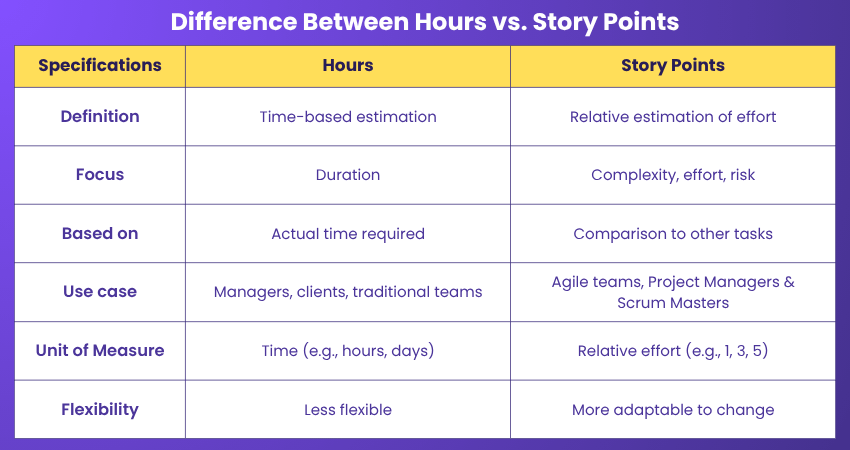
Story Points in Agile are used to measure the tasks, whereas hours are used to measure the time range of how long a task is expected to take. Let's have a brief look at their differences with the help of the table below:
Limitations with Using Story Points
While Story Points have many benefits, they also have a few limitations that can affect their effectiveness. Let’s check what those limitations are:
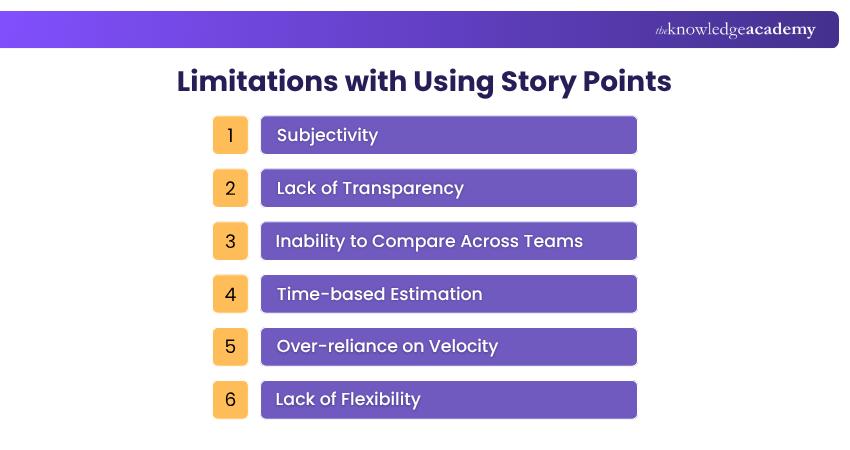
1) Subjectivity: The estimation of Story Points is inherently subjective, and different teams may assign different points to the same task based on their own understanding and perspective. This can often lead to inconsistencies and inaccuracies in estimation.
2) Lack of Transparency: Story Points fail to provide a clear explanation of what they represent, and that makes it difficult particularly for stakeholders. They are not deeply involved in the process to understand what is being estimated.
3) Inability to Compare Across Teams: Since they are assigned relative to each other, Story Points cannot be used to have a comparison across various other teams. This makes it difficult to track the progress across multiple projects or teams.
4) Time-based Estimation: Story Points are often used as a proxy for time-based estimation, but determinants like team capacity, resource availability, or external dependencies that can impact the actual time taken are not taken into consideration.
5) Over-reliance on Velocity: Teams might become overly concentrated on velocity, or the number of Story Points accomplished per iteration. With full attention to the potential deadline approaching, the quality of work being delivered can be affected.
6) Lack of Flexibility: In many organisations, Story Points are objects of fixed estimates. This can create firmness, leading to inflexibility in the development process. It makes it difficult to adjust the estimates as new information becomes available.
Conclusion
Story Points in Agile offer a smarter, more flexible way to estimate work. Instead of trying to predict how long something will take, teams focus on how complex and risky a task is. It leads to better planning, stronger collaboration, and a healthier pace. By implementing story points, and using tools like Planning Poker, you can improve delivery, reduce burnout, and build trust across the organisation.
Establish the frameworks to enhance project adaptability and successful delivery by joining our Agile Project Management Practitioner (AgilePM® V3) Course now!
Frequently Asked Questions
How Do You Calculate Story Points in Agile?

Story Points in Agile are calculated by comparing tasks based on effort, complexity, and risk and not on time. Agile teams often use a reference story, the Fibonacci sequence, or T-shirt sizing and Planning Poker to reach a shared estimate through discussion.
How Many Hours are 3 Story Points in Agile?
In Agile, 3 story points don’t directly equal to a set number of hours. However, sometimes a rough mapping is created based on historical data. For example, if 1 story point means 4 hours, then 3 story points would be 12 hours. But this is not a rule, just a team-specific estimation.
What are the Other Resources and Offers Provided by The Knowledge Academy?
The Knowledge Academy takes global learning to new heights, offering over 3,000 online courses across 490+ locations in 190+ countries. This expansive reach ensures accessibility and convenience for learners worldwide.
Alongside our diverse Online Course Catalogue, encompassing 19 major categories, we go the extra mile by providing a plethora of free educational Online Resources like Blogs, eBooks, Interview Questions and Videos. Tailoring learning experiences further, professionals can unlock greater value through a wide range of special discounts, seasonal deals, and Exclusive Offers.
What is The Knowledge Pass, and How Does it Work?
The Knowledge Academy’s Knowledge Pass, a prepaid voucher, adds another layer of flexibility, allowing course bookings over a 12-month period. Join us on a journey where education knows no bounds.
What are the Related Courses and Blogs Provided by The Knowledge Academy?
The Knowledge Academy offers various Agile Training, including Agile Overview Course, Agile for Teams Course and AgilePM® Foundation & Practitioner (AgilePM® V3) Training. These courses cater to different skill levels, providing comprehensive insights into Risk Assessment.
Our Project Management Blogs cover a range of topics related to Agile Story Points, offering valuable resources, best practices, and industry insights. Whether you are a beginner or looking to advance your Project Management skills, The Knowledge Academy's diverse courses and informative blogs have got you covered.
Upcoming Project Management Resources Batches & Dates
Date
 AgilePM® Foundation & Practitioner (AgilePM® v3)
AgilePM® Foundation & Practitioner (AgilePM® v3)
Mon 29th Jun 2026
AgilePM® Foundation & Practitioner (AgilePM® v3)
Mon 6th Jul 2026
AgilePM® Foundation & Practitioner (AgilePM® v3)
Mon 13th Jul 2026
AgilePM® Foundation & Practitioner (AgilePM® v3)
Mon 20th Jul 2026
AgilePM® Foundation & Practitioner (AgilePM® v3)
Mon 27th Jul 2026
AgilePM® Foundation & Practitioner (AgilePM® v3)
Mon 3rd Aug 2026
AgilePM® Foundation & Practitioner (AgilePM® v3)
Mon 10th Aug 2026
AgilePM® Foundation & Practitioner (AgilePM® v3)
Mon 17th Aug 2026
AgilePM® Foundation & Practitioner (AgilePM® v3)
Sat 22nd Aug 2026, Sun 23rd Aug 2026
AgilePM® Foundation & Practitioner (AgilePM® v3)
Mon 24th Aug 2026
AgilePM® Foundation & Practitioner (AgilePM® v3)
Tue 1st Sep 2026
AgilePM® Foundation & Practitioner (AgilePM® v3)
Mon 7th Sep 2026
AgilePM® Foundation & Practitioner (AgilePM® v3)
Mon 14th Sep 2026
AgilePM® Foundation & Practitioner (AgilePM® v3)
Mon 21st Sep 2026
AgilePM® Foundation & Practitioner (AgilePM® v3)
Mon 28th Sep 2026
AgilePM® Foundation & Practitioner (AgilePM® v3)
Mon 5th Oct 2026
AgilePM® Foundation & Practitioner (AgilePM® v3)
Sat 10th Oct 2026, Sun 11th Oct 2026
AgilePM® Foundation & Practitioner (AgilePM® v3)
Mon 12th Oct 2026
AgilePM® Foundation & Practitioner (AgilePM® v3)
Mon 19th Oct 2026
AgilePM® Foundation & Practitioner (AgilePM® v3)
Mon 26th Oct 2026
AgilePM® Foundation & Practitioner (AgilePM® v3)
Mon 2nd Nov 2026
AgilePM® Foundation & Practitioner (AgilePM® v3)
Mon 9th Nov 2026
AgilePM® Foundation & Practitioner (AgilePM® v3)
Mon 16th Nov 2026
AgilePM® Foundation & Practitioner (AgilePM® v3)
Mon 23rd Nov 2026
AgilePM® Foundation & Practitioner (AgilePM® v3)
Mon 30th Nov 2026
AgilePM® Foundation & Practitioner (AgilePM® v3)
Mon 7th Dec 2026
AgilePM® Foundation & Practitioner (AgilePM® v3)
Sat 12th Dec 2026, Sun 13th Dec 2026
AgilePM® Foundation & Practitioner (AgilePM® v3)
Mon 14th Dec 2026
AgilePM® Foundation & Practitioner (AgilePM® v3)
Mon 21st Dec 2026

 If you wish to make any changes to your course, please


