


 Top Rated Course

We may not have the course you’re looking for. If you enquire or give us a call on + 1-866 272 8822 and speak to our training experts, we may still be able to help with your training requirements.
What are Leadership Qualities? A Complete Guide
Elizabeth Clark 14 July 2026Strong Leadership is essential for team success, fostering teamwork, and motivating individuals. It drives beneficial transformation and cultivates a culture of development and creativity. In this blog, we’ll explore Leadership Qualities that help you make decision-making effectively and ensure long-term success of your business.

Training Outcomes Within Your Budget!
We ensure quality, budget-alignment, and timely delivery by our expert instructors.
Table of Contents
Are you finding it difficult to motivate your team or questioning why your business is not achieving its maximum capabilities? The solution could be found by comprehending and improving essential Leadership Qualities. Successful Leadership involves more than just overseeing responsibilities—impacting, inspiring, and directing individuals towards a common goal. Through developing strong qualities of Leadership, you can tap into your team's full potential, foster innovation, and establish a successful work atmosphere that enhances productivity and development.
This blog will examine the key Leadership Qualities that can enhance your business, including communication abilities, decision-making, and emotional intelligence. Continue reading to change your Leadership style and enable your business to thrive.
Table of Contents
1) What is Leadership?
2) What are Leadership Qualities?
3) 12 Qualities of a Leader You Must Possess
4) Ways to Develop Leadership Qualities
5) How to Improve Your Leadership Skills?
6) Conclusion
What is Leadership?
Leadership is the capacity to motivate and lead others towards a common goal. It involves inspiring others with a clear vision and goal that stimulates and motivates them. Effective leaders build trust by being honest, ethical, and reliable, as well as responding to and taking feedback carefully.
Leadership entails making quick and decisive judgments, allocating work, and motivating team members. Great leaders evaluate things accurately and make difficult choices when needed. They also create a sense of responsibility among their followers.
Leadership demands an unwavering dedication to continuous learning and development, along with the willingness to embrace mistakes. At its core, Team Leader Qualities revolve around a commitment to others' success and making a meaningful contribution to the greater good.
What are Leadership Qualities?
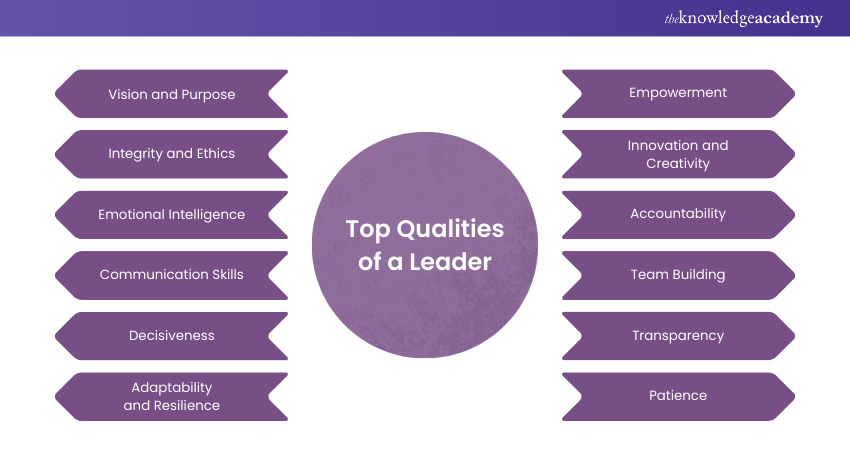
Leadership qualities are the essential attributes that set effective leaders apart from the rest. These traits include a variety of leadership skills, such as vision and purpose, integrity and ethics, Emotional Intelligence (EI), communication, decisiveness, adaptability, resilience, empowerment, innovation, creativity, accountability, and team building. In addition to these qualities, Developing leadership skills is crucial for enhancing your leadership capabilities. To explore these qualities in greater detail, refer to our Characteristics of Leadership PDF for a comprehensive understanding.
A great leader possesses a clear vision, communicates effectively, and leads with integrity and empathy. They inspire and empower their team, promote innovation, and adapt to change with resilience. Approaches like Situational Leadership highlight the importance of adapting leadership styles based on team needs and specific situations. Accountability and team building are also crucial in creating a strong, cohesive unit. Nurturing these qualities is key to becoming a successful and influential leader.
12 Qualities of a Leader You Must Possess
Now, it’s time to learn about the qualities of Leadership that you must possess. Here's a complete overview:
1) Vision and Purpose
A successful Leader has a vision for the future that motivates and brings together their team. This vision serves as a blueprint, leading everyone toward common objectives. Leaders inspire their team to support the common goal by showing a clear path to success.
Work gains significance, and employees remain dedicated and resilient during challenging periods when they possess a clear sense of purpose. Ensuring that teamwork is in line with the organisation's mission guarantees unified advancement.
Leaders must concentrate on strategic planning and introspection to cultivate this trait. They should also use storytelling to convey their vision and actively solicit feedback to improve and ensure its relevance.

2) Integrity and Ethics
Integrity lies at the core of successful Leadership. Leaders who demonstrate honesty and integrity will earn their employees' and stakeholders' confidence and commitment, creating a culture of openness and reliability. Understanding the Principles of Team Leadership helps reinforce the importance of integrity in fostering trust and effective collaboration.
Demonstrating integrity involves focusing on enduring principles rather than immediate benefits and serving as a robust role model for others to emulate. These Leaders ensure they and their teams are responsible for maintaining ethical standards. To develop this trait, practice self-examination and remain loyal to your beliefs.
Promote honest discussions on ethics, establish a secure environment for issues, and create a culture that acknowledges honesty, guaranteeing long-term prosperity.
3) Emotional Intelligence
Emotional Intelligence (EI) involves identifying, comprehending, and controlling emotions within oneself and others. It boosts empathy, communication, and conflict resolution abilities, helping Leaders cultivate a supportive atmosphere where team members feel appreciated and listened to. Leaders with emotional solid intelligence manage conflicts tactfully, develop more robust relationships, and encourage teamwork.
Begin by focusing on self-awareness and practicing active listening to cultivate emotional intelligence. Recognise your emotional triggers and prejudices and engage in open communication to better understand others' emotions. Integrate mindfulness practices and promote emotional vulnerability among your team members.
Prioritising emotional intelligence establishes a secure environment for all individuals to feel empowered to voice their thoughts, resulting in a more productive and cohesive work setting.
Enhance your Leadership and Management skills by taking our Leadership and Management Course!
4) Communication Skills
Successful Leadership relies on effective communication, connecting vision with action. It is essential for Leaders to effectively communicate their objectives, vision, and input, adapting their approach to connect with their listeners. By promoting bidirectional communication, Leaders inspire a variety of viewpoints and ignite innovation.
To enhance your communication abilities, consider taking public speaking classes or workshops, and welcome constructive criticism to develop. Use various communication methods like meetings, emails, and social media to ensure your team is all on the same page and involved.
5) Decisiveness
Taking decisive action is a fundamental aspect of successful Leadership. In challenging and rapidly changing settings, Leaders need to make prompt decisions, even when uncertainty is present. A strong Leader combines thorough analysis with the importance of quickly collecting information, considering choices, and consulting with experts when necessary.
Delaying action can result in overlooked chances and reduced team spirit, making it essential to act promptly. Enhance this ability by practising scenario planning and anticipating challenges. Promote a culture that welcomes strategic risks and appreciates the bravery to make daring choices to keep your team adaptable and robust.
6) Adaptability and Resilience
Adaptability includes being receptive to new concepts, welcoming change, and modifying approaches to accommodate changing requirements. Agile Leaders detect trends quickly and adjust plans to remain competitive, promoting a culture of ongoing learning among their teams.
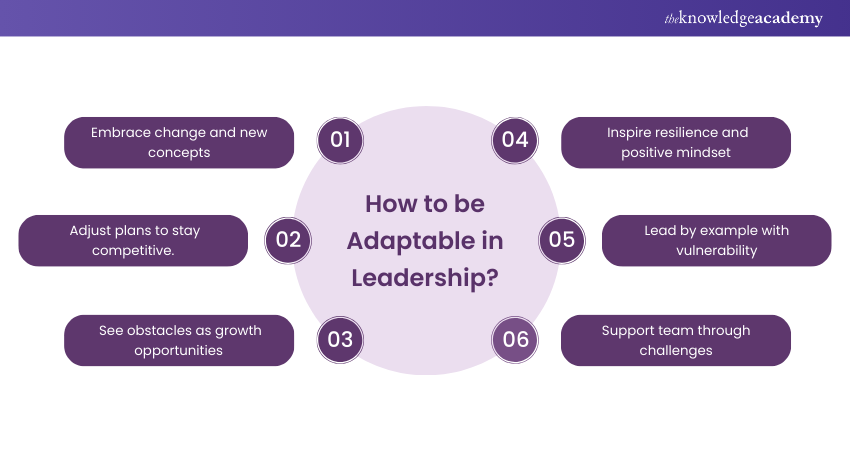
Outstanding Leaders view obstacles as chances to develop and expand, keeping a positive attitude and motivating their team to keep moving forward. They promote resilience by fostering a growth mindset, setting a good example, and displaying vulnerability. Encouraging work-life balance and providing support through obstacles aids in creating a team that excels in adaptability and stays strong in times of change.
7) Empowerment
Innovation Leadership involves combining teamwork, imagination, and strategic thinking to boost business performance. It encourages employees to develop skills that enhance overall performance by harnessing their creative potential.
Influential Leaders empower their teams to take risks, experiment, and explore new ideas by creating a supportive atmosphere. They focus on idea generation, appreciate different perspectives, and foster an environment of ongoing development.
Furthermore, being a creative Leader is not only about coming up with ideas but also about making those ideas a reality with the proper resources and steadfast support.
Master the art of People Management and team Leadership with our Successful People Management And Team Leadership Course today!
8) Innovation and Creativity
Leadership is the catalyst for organisational creativity and innovation, which are critical factors for success in today's fast-paced world. Although culture, strategy, and technology are essential, a Leader's skill in motivating and enabling their team to think outside the box is what really sets them apart.
Good Leaders establish a setting that fosters creativity by supporting and promoting innovation and learning from mistakes. They appreciate various viewpoints and encourage teamwork across different functions, believing that input from all levels can drive innovation and result in groundbreaking solutions.
9) Accountability
Accountability is a critical element for successful Leadership. It is the cornerstone of trust and team unity. Great Leaders are accountable for their actions and encourage their teams to be responsible. Begin by establishing transparent expectations and attainable objectives and regularly offer feedback and evaluations on performance. Acknowledge achievements and tackle areas requiring development.
Take responsibility for your choices, view mistakes as chances to learn, and make efforts to rectify them. Promote an environment of honesty and communication, fostering open discussions and promptly addressing any issues. Setting an example will motivate others to be accountable as well.
Curious about growth? Discover What are Leadership Skills? and how they can elevate your career. Click here to learn more!
10) Team Building
Leadership succeeds through the skill of constructing and leading a high-achieving team. This includes utilising each member's strengths, promoting teamwork, and cultivating strong relationships.
Successful team building begins with the hiring process. Seek candidates who align with your organisation's values and culture. Embrace a diverse range of backgrounds and perspectives to foster creativity and flexibility. For additional strategies on effective team building, refer to the Leadership Tools PDF for valuable insights.
Promote connections outside of work through team-building events, workshops, or retreats to enhance communication. Foster an environment where sharing knowledge and mentoring are encouraged, reinforcing the Skills for Cross Functional Leadership and ensuring each member feels valued. Engaged and appreciated teams are more committed to achieving common goals.
Learn what makes a great mentor with the Qualities of a Good Mentor Guide!
11) Transparency
Transparent Leaders prioritise honesty and openness, sharing information, decisions, and intentions with their teams. They outline organisational goals, strategies, and challenges, helping employees understand their roles. By acknowledging errors and learning from them, they model development and transparency, encouraging idea exchange and feedback.
Transparent Leaders involve the team in decision-making, explaining choices and organisational goals, fostering a collective vision. They are accessible, actively seek feedback, and address concerns promptly, building trust and teamwork, ensuring team members feel valued and respected.
12) Patience
Patient Leaders are vital for effective decision-making, team support, and long-term success. In today’s fast-paced world, patience helps Leaders tackle challenges calmly, resulting in strategic decisions. They manage uncertainty by collecting data and considering outcomes, avoiding hasty decisions.
Patient Leaders mentor team members, acknowledging diverse learning speeds and skills, fostering a positive atmosphere. They excel at conflict resolution by understanding root causes and seeking lasting solutions, enhancing team dynamics and unity.
Patient Leaders can make effective decisions, develop their team and achieve long term success. In this fast-paced uncertain world of Leadership, Patience aids Leaders in facing challenges with calmness and composure, enabling them to make well informed decisions.
Master ethical Leadership skills with our Ethical Leadership Training - join today and transform your approach to leading others!
Ways to Develop Leadership Qualities
Now that understanding effective Leadership traits is established, there are methods to cultivate and hone these skills. When preparing for Leadership Interview Questions, keep in mind these key traits and how they have shaped your leadership journey, as they can help you stand out in interviews. Crafting a path toward becoming a more adept leader and attaining personal and professional aspirations begins with these steps:
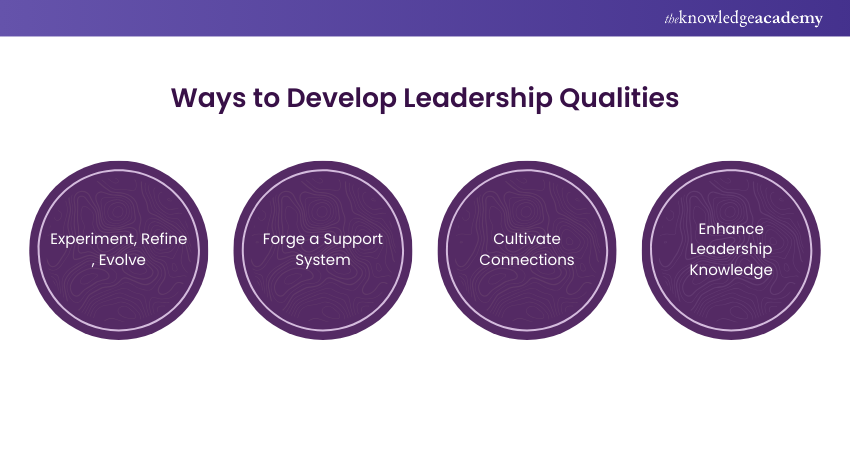
a) Experiment, Refine, Evolve: Commence by making incremental modifications and seeking feedback from peers or friends. Leverage the qualities of strong leaders as a foundation, selecting a couple of attributes to improve upon and experimenting with them. For instance, to enhance self-awareness, try different meeting approaches and seek input from colleagues to gauge alignment with your intentions.
b) Forge a Support System: Engage with a few individuals who can serve as mentors or accountability partners. Mentors offer fresh perspectives on workplace behaviours and perceptions, while accountability partners aid in adhering to devised plans. Identify someone you respect and seek their guidance or collaboration.
c) Cultivate Connections: Proficient leaders thrive on robust relationships. Begin by engaging with a few colleagues weekly, expanding your network gradually. Through consistent effort, you'll amass a broad network of associations.
d) Enhance Leadership Knowledge: Join courses or a comprehensive degree program. For example, augment your bachelor's degree with a concentration in Leadership to deepen your understanding of effective Leadership practices.
Elevate your Leadership abilities with Agile Leadership Training - join today and lead your team to new heights!
How to Improve Your Leadership Skills?
Let’s explore valuable Leadership skills that can improve your effectiveness as a leader:
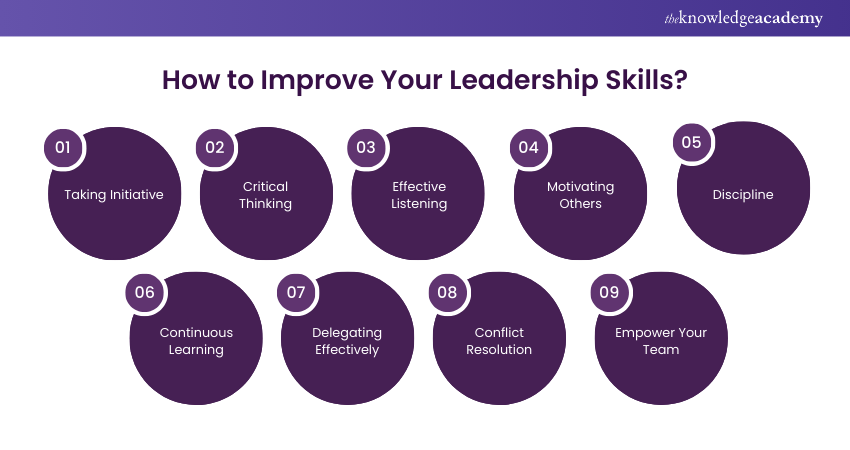
1) Taking Initiative:
a) Don’t wait for tasks to be assigned
b) Get out of your comfort zone, learn, and demonstrate your willingness to improve
c) Consistently taking the initiative helps others recognise your Leadership potential
2) Critical Thinking:
a) Good leaders anticipate problems and find preventive solutions
b) Be proactive—don’t wait for issues to arise
c) Work together with your team to identify causes and implement preventive measures
3) Effective Listening:
a) Communication is essential for Leadership
b) Encourage dialogue, understand perspectives, and observe body language
c) Encourage open dialogue, understand perspectives, and observe body language
4) Motivating Others:
a) Recognise what your team members need and want
b) When someone loses motivation, offer recognition and listen attentively
c) Empower team members to be more involved
d) Create a positive work environment with rewards for hitting goals
5) Discipline:
a) Discipline is crucial for effective execution
b) Without discipline, even great ideas fall short
c) As a leader, be self-disciplined and ensure your team follows suit
6) Continuous Learning:
a) Leadership and learning go hand in hand
b) Study other leaders, incorporate their traits, and adapt
c) different Leadership Models like Democratic Leadership , Autocratic Leadership , Strategic Leadership, and VUCA Leadership can be plotted on a grid
7) Delegating Effectively:
a) Don’t micromanage - delegate tasks to empower your team
b) Oversee projects, assign tasks based on skills, and establish clarity
8) Conflict Resolution:
a) Address difficult situations honestly and directly
b) Listen to both sides before taking action
9) Empower Your Team:
a) Recognise the value of team members and learn from them
b) Encourage others to learn from specialised colleagues
c) Support new ideas and step out of your comfort zone
d) Be a believer in your team’s potential
Transform your Leadership skills with our comprehensive Leadership Courses – sign up today
Conclusion
We hope that after reading this blog, you have understood "What are Leadership Qualities?". Leadership skills and qualities are not innate but can be developed through dedication, self-awareness, and continuous learning. For a deeper dive into these essential traits, referring to a Characteristics of Leadership PDF can provide valuable insights. For a deeper understanding, you can refer to the Leadership Theories PDF, which explores various leadership models and their practical applications. Aspiring leaders should cultivate these qualities to effectively guide their teams and organisations.
Elevate your Leadership skills with our Leadership Skills Training – Sign up now!
Frequently Asked Questions
How can Developing Leadership Qualities Benefit Individuals in Both Professional and Personal Settings?

Enhancing Leadership qualities improves decision-making, communication, and problem-solving skills, enabling individuals to inspire others, overcome challenges, and reach goals in professional and personal contexts.
How do Integrity and Ethical Behaviour Contribute to Establishing Trust and Quality of a Good Leader?
Integrity and ethical conduct establish trust through honesty and accountability, promoting respect and dependability. A leader who consistently follows these principles gains loyalty and is a positive role model for others.

Elizabeth Clark


Senior Leadership Trainer and Business Strategist
Elizabeth Clark is a senior trainer and strategist with a strong background in leadership, business management, and operational improvement. With more than 15 years of experience, she has worked with leaders across industries to enhance their influence, communication, and strategic planning skills. Her writing is known for being insightful and focused on real-world leadership challenges.
View Detail

 If you wish to make any changes to your course, please


