


 Top Rated Course

We may not have the course you’re looking for. If you enquire or give us a call on 01344 203999 and speak to our training experts, we may still be able to help with your training requirements.
How to Create a Marketing Budget? Maximise Your ROI
James Smith 24 April 2026To Create a Marketing Budget, review current efforts, study competitors, test campaigns, scale what works, and track how spending affects your business. Clear budgeting helps you allocate resources wisely and avoid unnecessary costs. Regular analysis ensures that every investment supports growth and delivers measurable results.

Training Outcomes Within Your Budget!
We ensure quality, budget-alignment, and timely delivery by our expert instructors.
Table of Contents
Have you ever set aside money for marketing, only to wonder where it all went and what it actually achieved? Many businesses invest heavily in ads, campaigns, and tools, yet still struggle to see consistent results. Without a clear plan, a Marketing Budget can quickly become guesswork rather than a powerful tool for growth.
This is where understanding How to Create a Marketing Budget becomes essential. It helps you spend wisely, focus on what works, and achieve measurable results. In this blog, you will learn how to plan, calculate, and Manage your Marketing Budget for smarter, more sustainable growth.
Table of Contents
1) What is a Marketing Budget?
2) How to Create a Marketing Budget?
3) How to Calculate a Budget for a Marketing Plan?
4) Best Practices for Startup Marketing Budgets
5) Common Marketing Budget Mistakes
6) Marketing Budget Example
7) What are the 5 P's of a Marketing Plan?
8) Are Marketing Costs Tax Deductible?
9) Conclusion
What is a Marketing Budget?
A Marketing Budget is a financial plan that outlines how much money a business allocates to marketing activities within a set period, such as monthly, quarterly, or annually. It covers spending on advertising, campaigns, tools, and staff to build brand awareness, generate leads, and maximise return on investment (ROI).
The budget amount depends on factors like business size, finances, industry standards, growth stage, location, and overall strategy. It acts as a clear roadmap to control spending, prioritise efforts, and support sustainable business growth.

How to Create a Marketing Budget?
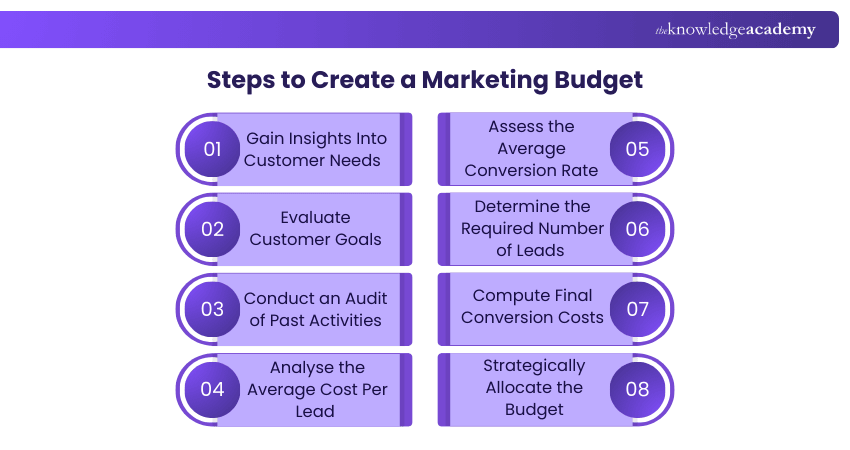
Creating a Marketing Budget for your startup may seem daunting, but it doesn’t have to be. Here is the list of eight steps that you can follow to create a Marketing Budget that works for you.
1) Gain Insights Into Customer Needs
The initial step to creating a Marketing Budget is to understand your customers and their needs. You need to know who your target audience is, what problems they have, what solutions they are looking for, and how they make purchasing decisions. You can use various methods to gain customer insights, such as:
a) Conducting market research and surveys
b) Creating buyer personas and customer journey maps
c) Analysing customer feedback and reviews
d) Using web analytics and Social Media tools
e) Talking to your existing and potential customers
By gaining insights into customer needs, you can tailor your marketing strategy and budget to meet their expectations and preferences. You can also segment your customers into various groups based on their characteristics and behaviours and allocate your budget accordingly.
2) Evaluate Customer Goals
The following step in formulating a Marketing Budget involves assessing the objectives of your customers. Understanding the results that they aim to attain through your product or service and how you can facilitate their success is crucial. Utilise the SMART criteria to establish these customer goals, ensuring they are:
a) Specific: Clearly state what your customers want to accomplish
b) Measurable: Quantify your customers’ progress and success
c) Achievable: Make sure your customers can realistically attain their goals
d) Relevant: Align your customers’ goals with your value proposition and competitive advantage
e) Time-bound: Set a deadline for your customers to reach their goals
By evaluating your customer goals, you can align your marketing goals and budget with your customer value and satisfaction. You can also prioritise your marketing activities and resources based on the impact and urgency of your customer goals.
3) Conduct an Audit of Past Activities
The third step in creating a Marketing Budget is to conduct an audit of your past marketing activities. You need to review what marketing channels, campaigns, and tactics you have used in the past and how they have performed. You can use various metrics to measure your marketing performance, such as:
a) Reach: How many people have seen your marketing messages
b) Engagement: How many people have interacted with your marketing messages
c) Conversion: How many people have taken the desired action after seeing your marketing messages
d) Retention: How many people have stayed loyal to your brand after becoming customers
e) Revenue: How much money have you generated from your marketing efforts
By conducting an audit of your past marketing activities, you can pinpoint your strengths and weaknesses and learn from your successes and failures. You can also determine what marketing channels, campaigns, and tactics have the highest Return on Investment (ROI) and allocate your budget accordingly.
4) Analyse the Average Cost Per Lead
The fourth step to creating a Marketing Budget is to analyse the average cost per lead. It is the amount of money you spend on marketing to generate one lead or a potential customer who has shown interest in your product or service. You can determine the mean cost per lead by dividing your total marketing spend by the number of leads you have generated. For example, if you have spent £10,000 on marketing and generated 500 leads, your average cost per lead is £20.
By analysing the average cost per lead, you can benchmark your marketing efficiency and effectiveness and compare it with your industry standards and competitors. You can also optimise your Marketing Budget by reducing your cost per lead and increasing your lead quality.
Learn essential marketing principles for business growth effectively with our Introduction to Marketing Training – Register today!
5) Assess the Average Conversion Rate
The fifth step in creating a Marketing Budget is to assess the average conversion rate. It is the percentage of leads that become customers or who make a purchase or sign up for your product or service. You can determine the mean conversion rate by dividing the number of customers you have acquired by the number of leads you have generated. For example, if you have generated 500 leads and acquired 100 customers, your average conversion rate is 20%.
By assessing the average conversion rate, you can evaluate your marketing effectiveness and customer satisfaction and compare it with your industry standards and competitors. You can also optimise your Marketing Budget by increasing your conversion rate and customer value.
6) Determine the Required Number of Leads
The sixth step to creating a Marketing Budget is to determine the required number of leads. It is the number of leads you need to generate to achieve your revenue goal or the amount of money you want to make from your marketing efforts. You can calculate the required number of leads by dividing your revenue goal by your average customer value and your average conversion rate. For example, if your revenue goal is £100,000, your average customer value is £500, and your average conversion rate is 20%, your required number of leads is 1,000.
By determining the required number of leads, you can set a realistic and measurable marketing goal and align it with your financial objective. You can also plan your Marketing Budget by estimating how much money you need to spend to generate the required number of leads.
7) Compute Final Conversion Costs
The seventh step to creating a Marketing Budget is to compute your final conversion costs. It is the total amount of money you spend on marketing to acquire one customer or, make one sale or sign up. You can calculate your final conversion costs by multiplying your average cost per lead by your average conversion rate. For example, if your average cost per lead is £20 and your average conversion rate is 20%, your final conversion costs are £100.
By computing your final conversion costs, you can measure your marketing ROI or the ratio of your revenue to your marketing spend. You can also optimise your Marketing Budget by lowering your final conversion costs and increasing your revenue.
8) Strategically Allocate the Budget
The final step to creating a Marketing Budget is to strategically allocate your budget. It involves determining the amount of funds to allocate to each marketing channel, campaign, and tactic, guided by your marketing objectives, performance metrics, and return on investment. You can use various methods to allocate your budget, such as:
a) Percentage of Revenue: Allocate your budget based on a fixed percentage of your projected or actual revenue
b) Objective and Task: Allocate your budget based on the specific objectives and tasks you want to accomplish with your marketing
c) Competitive Parity: allocate your budget based on what your competitors are spending on marketing
d) Experimental: Allocate your budget based on testing different marketing options and seeing what works best
Craft winning marketing strategies with our Business Marketing Strategies Training– Join to drive growth and success!
How to Calculate a Budget for a Marketing Plan?
There are several ways to calculate a Marketing Budget, depending on your goals, finances, and industry. Below are the most common methods businesses use to set their marketing spend:
1) Allocate a Fixed Percentage of Revenue
This approach sets marketing spend as a percentage of total revenue or overall business budget. The exact percentage varies based on factors such as company size, growth stage, and industry expectations. For instance, if a business allocates around 9% of its annual revenue to marketing, a £1 million turnover would result in a budget of roughly £91,000.
2) Follow Industry Benchmarks
With this method, you base your budget on what similar businesses in your industry typically spend. This involves researching overall marketing expenditure, preferred channels, spending distribution across those channels, and their effectiveness. Using industry benchmarks helps ensure your budget is competitive and aligned with market practices.
3) Base the Budget on Business Goals
This method begins with the results you want to achieve and works backwards to estimate the required spend. For example, calculate the cost of acquiring one lead, multiply it by your target, and add fixed costs like salaries, tools, or outsourcing. This keeps your budget closely aligned with business goals.
Best Practices for Startup Marketing Budgets
Startup Marketing Budgets should maximise limited resources while delivering strong results. The following best practices help startups spend wisely and grow effectively:
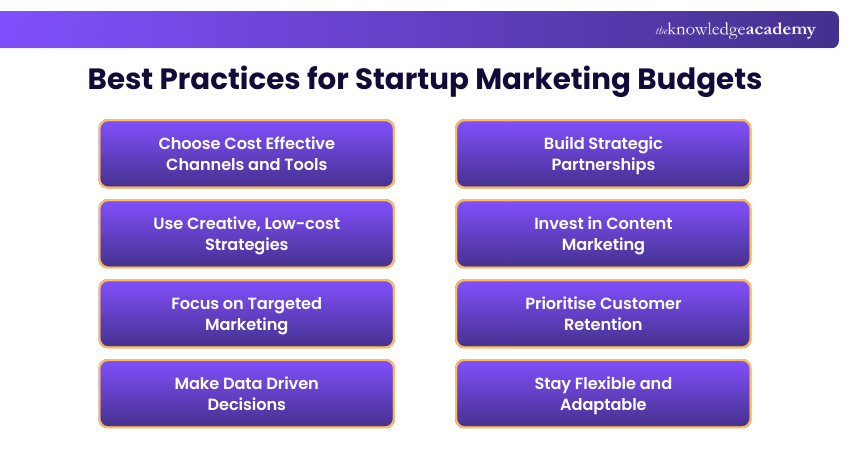
1) Choose Cost Effective Channels and Tools:
Use marketing platforms that deliver high value at low cost, such as Social Media, email marketing, and analytics tools. Many offer free or affordable options ideal for startups.
2) Use Creative, Low-cost Strategies:
Stand out with approaches like guerrilla marketing, viral campaigns, and user generated content. These rely more on creativity and engagement than large financial investment.
3) Focus on Targeted Marketing:
Direct your budget toward channels where your target audience is most active. Tailored messaging improves relevance, engagement, and return on investment.
4) Make Data Driven Decisions:
Monitor campaign performance and analyse results regularly. Use insights to refine strategies and invest more in what works best.
5) Build Strategic Partnerships:
Collaborate with other businesses, brands, or influencers to expand reach, share costs, and strengthen credibility.
6) Invest in Content Marketing:
Create valuable content such as blogs, videos, and infographics to attract and engage your audience. This builds brand authority and supports long-term organic growth.
7) Prioritise Customer Retention:
Retaining existing customers is often more cost-effective than acquiring new ones. Loyalty programmes, strong service, and regular engagement encourage repeat purchases and referrals.
8) Stay Flexible and Adaptable:
Markets and customers need to change quickly. Regularly review performance and adjust your marketing strategy to stay effective and competitive.
Understand how to align brand messaging across multiple channels successfully with our Integrated Marketing Training – Join today!
Common Marketing Budget Mistakes
The following are the common Marketing Budget mistakes:
1) Lack of Clear Objectives:
Without defined marketing goals, organisations waste their resources inefficiently. The evaluation of achievements becomes impractical, along with money allocation decisions, when there are no established precise objectives.
2) Ignoring Data and Metrics:
Without proper tracking of past metrics and ROI measurement, organisations give more money to shows that yield suboptimal results while avoiding essential effective marketing approaches.
3) Underestimating Costs:
When marketers underestimate the costs involved with their campaigns together with tools or advertising positions, they open themselves to budgetary overspending and incomplete projects.
4) Focusing Solely on Short-term Gains:
When organisations dedicate most of their marketing spending toward instant gains while neglecting to establish brand value and keep current users, they may stifle their business's growth capacity.
5) Not Allocating for Contingencies:
Marketing plans frequently confront unexpected developments together with unanticipated opportunities, during their implementation. Companies should maintain an emergency fund to adapt successfully to surprising events.
6) Overlooking Digital Channels:
Businesses that do not allocate proper funds for their Social Media strategy and Search Engine Optimisation (SEO) campaign and email marketing will fall short of digital market opportunities.
Marketing Budget Example
Here’s an example of how a Marketing Budget might be structured for a small-to-medium-sized business in the UK:
Total Budget: £50,000 per year
1) Digital Advertising: (40%)
a) Social Media Ads: £10,000
b) Google Ads: £10,000
2) Content Marketing: (25%)
a) Blog Creation: £5,000
b) Video Marketing: £7,500
3) Email Marketing: (10%)
a) Email Tools/Automation: £5,000
4) Events and Sponsorships: (15%)
a) Trade Shows/Local Events: £7,500
5) Market Research and Analytics: (5%)
a) Surveys and Analytics Tools: £2,500
6) Contingency Fund: (5%)
a) Reserved for unforeseen opportunities or emergencies: £2,500
The funding structure distributes marketing resources fairly between vital channels with an allowance for unknown business opportunities.
Explore advanced research methodologies and data collection techniques through the Marketing Research Training – Register today!
What are the 5 P's of a Marketing Plan?
The 5 P’s of a Marketing Plan guide how a business offers, prices, promotes, and delivers its products or services. The key elements are outlined below.
1) Product: The product or service you offer, including its features, quality, and how it meets customer needs.
2) Price: The amount customers pay, influenced by value, demand, competition, and business goals.
3) Place: Where and how customers purchase the product, such as online platforms, retail stores, or distribution channels.
4) Promotion: How to attract and communicate with customers through advertising, Social Media, and marketing campaigns.
5) People: Everyone involved in delivering the product or service, including staff and support teams, shapes the customer experience.
Are Marketing Costs Tax Deductible?
Yes, marketing costs are generally tax-deductible if they are ordinary and necessary expenses directly related to promoting your business or generating revenue, such as advertising, website costs, and campaigns. However, rules vary by location and expense type, so keeping accurate records and checking with a tax professional is recommended.
Conclusion
Creating a Marketing Budget is essential for business growth and financial efficiency. By following these steps on How to Create a Marketing Budget, you can allocate resources wisely, track ROI, and adapt strategies for success. A well-planned budget ensures sustainable marketing efforts, helping you achieve long-term business goals. Start planning today and watch your brand thrive!
Understand market trends and consumer behaviour to strengthen business strategies. Join our Marketing Courses today!
Frequently Asked Questions
How Much Should I Spend on Marketing as a Startup?

The most effective Marketing Budget for startups should amount to 10-20 percent of predicted revenue based on goals and development stage requirements. Startups at different development stages spend their marketing funds differently because early-stage companies allocate more funds to brand creation.
How Often Should I Update My Marketing Budget?
You should update your Marketing Budget regularly, at least once a quarter, or whenever there are significant changes in your business or market conditions. Updating your Marketing Budget will help you keep track of your marketing performance, adjust your spending as needed, and optimise your ROI.
What are the Other Resources and Offers Provided by The Knowledge Academy?
The Knowledge Academy takes global learning to new heights, offering over 3,000+ online courses across 490+ locations in 190+ countries. This expansive reach ensures accessibility and convenience for learners worldwide.
Alongside our diverse Online Course Catalogue, encompassing 19 major categories, we go the extra mile by providing a plethora of free educational Online Resources like Blogs, eBooks, Interview Questions and Videos. Tailoring learning experiences further, professionals can unlock greater value through a wide range of special discounts, seasonal deals, and Exclusive Offers.
What is The Knowledge Pass, and How Does it Work?
The Knowledge Academy’s Knowledge Pass, a prepaid voucher, adds another layer of flexibility, allowing course bookings over a 12-month period. Join us on a journey where education knows no bounds.
What are the Related Courses and Blogs Provided by The Knowledge Academy?
The Knowledge Academy offers various Marketing Courses, including the Marketing Budget Course, Introduction to Marketing Training, and Business Marketing Strategies Training. These courses cater to different skill levels, providing comprehensive insights into Top-Down Estimating.
Our Digital Marketing Blogs cover a range of topics related to Marketing Budget, offering valuable resources, best practices, and industry insights. Whether you are a beginner or looking to advance your Marketing skills, The Knowledge Academy's diverse courses and informative blogs have got you covered.

James Smith


Digital Marketing Manager and Trainer
James Smith is a digital marketing professional with over a decade of experience in SEO, content strategy, paid media and analytics. He has supported both SMEs and global brands in transforming their digital presence. James’s writing and training are rooted in results-driven tactics and the latest marketing trends.
View Detail
Upcoming Digital Marketing Resources Batches & Dates
Date
 Introduction to Marketing Training
Introduction to Marketing Training
Fri 10th Jul 2026
Introduction to Marketing Training
Fri 11th Sep 2026

 If you wish to make any changes to your course, please


