


 Top Rated Course

We may not have the course you’re looking for. If you enquire or give us a call on 01344 203999 and speak to our training experts, we may still be able to help with your training requirements.
How to Add ITIL Certification on Resume: A Detailed Explanation
John Davies 08 May 2026Are you aiming to land your dream job in IT Service Management? Crafting an impressive ITIL resume is your first step to success. With the right strategies, you can highlight your skills and experience effectively. Read this blog in detail and understand How to Add ITIL® Certification on Resume and stand out in the competitive job market.
Home
 Resources
IT Service Management
How to Add ITIL Certification on Resume: A Detailed Explanation
Resources
IT Service Management
How to Add ITIL Certification on Resume: A Detailed Explanation
Resources
IT Service Management
How to Add ITIL Certification on Resume: A Detailed Explanation

Training Outcomes Within Your Budget!
We ensure quality, budget-alignment, and timely delivery by our expert instructors.
Table of Contents
Related Courses
- ITIL® 4 Specialist: Create Deliver and Support Certification
- ITIL® 4 Foundation Certification Course
- Root Cause Analysis
- ITIL® 4 Specialist: Drive Stakeholder Value Course
- ITIL® 4 Strategist: Direct, Plan and Improve Training
- Certified IT Service Manager (CITSM) Certification
- ITIL® 5 Foundation Certification
Have you ever wondered if your resume truly reflects your IT potential? In the current competitive job market, having the right skills isn’t enough; you need to showcase them the right way. That’s where certifications like ITIL come in. They prove you know your stuff in IT Service Management and can make a real impact. But here’s the key - knowing How to Add ITIL Certification on Resume can make all the difference in getting noticed by recruiters. In this blog, we will show you exactly where and how to list your ITIL Certification to make your resume stand out. Let’s get started!
Table of Contents
1) Understanding ITIL and Its Certifications
2) Benefits of Earning an ITIL® Certification
3) How to Add ITIL® Certification to Your Resume?
4) How to Add ITIL® Certification to Your LinkedIn?
5) Tips for Formatting Your ITIL Resume
6) ITIL Professional Resume Template
7) Conclusion
Understanding ITIL and Its Certifications
ITIL is an organisational framework for IT employees, outlining policies and procedures to assist businesses with their IT needs. Initially developed for managing government technological systems, ITIL is now a standardised list of IT best practices for organisations of all sizes. By following ITIL guidelines, IT employees can create checklists to accomplish their duties more efficiently.
ITIL® Certifications
ITIL Certifications provide training in ITIL best practices, which many businesses prefer for standardising important business processes. These courses offer a range of lessons on the basics of ITIL, enhancing employment opportunities for certified individuals. ITIL 5 is the latest version and here are the certifications that you can complete for your professional development:
1) ITIL® 5 Foundation
This is an entry-level certification that introduces core concepts, terminology, and principles of IT service management. It is the starting point for all ITIL 5 pathways.

2) ITIL® 5 Practice Manager
This is achieved by:
1) Completing ITIL® 4 Practice modules (which still remain valid)
2) Completing the ITIL® 5 Transformation module
ITIL® 4 Practice modules are grouped into:
1) Monitor, Support and Fulfil (MSF): It covers the service desk, incident management, problem management, service request management, monitoring and event management.
2) Plan, Implement and Control (PIC): It covers change enablement, deployment management, release management, service configuration management and IT asset management.
3) Collaborate, Assure and Improve (CAI): It covers relationship management, supplier management, service level management, continual improvement and information security management.
3) ITIL® 5 Managing Professional (MP)
Designed for professionals managing digital products and services. It covers product lifecycle, service delivery, and customer experience. It focuses on applying ITIL practices to ensure effective service delivery, continuous improvement and value creation.
4) ITIL® 5 Strategic Leader (SL)
Aimed at senior professionals, this certification focuses on how IT and digital services support business strategy, governance and long-term value creation. It aligns IT and digital services with organisational goals and covers governance, investment decisions and value creation.
Build leadership and governance expertise with ITIL® 5 Strategy Certification Training – Register today!
5) ITIL® 5 Transformation
ITIL® 5 Transformation is a core, shared module used across multiple certification paths, including Practice Manager, Managing Professional and Strategic Leader. It focuses on organisational change, digital evolution and embedding modern ways of working within organisations.
6) ITIL® 5 AI Governance
ITIL® 5 AI Governance is a specialist extension module that highlights the growing importance of managing Artificial Intelligence (AI) within digital services. It focuses on ensuring the ethical, responsible and compliant use of AI systems, particularly in decision-making and service delivery.
7) ITIL® 5 Master
It is the highest certification level, achieved after completing all the above key designations. It demonstrates the ability to apply ITIL principles in real-world scenarios.
Benefits of Earning an ITIL® Certification
While not mandatory for IT positions, earning an ITIL Certification offers various advantages. Here are some key benefits:
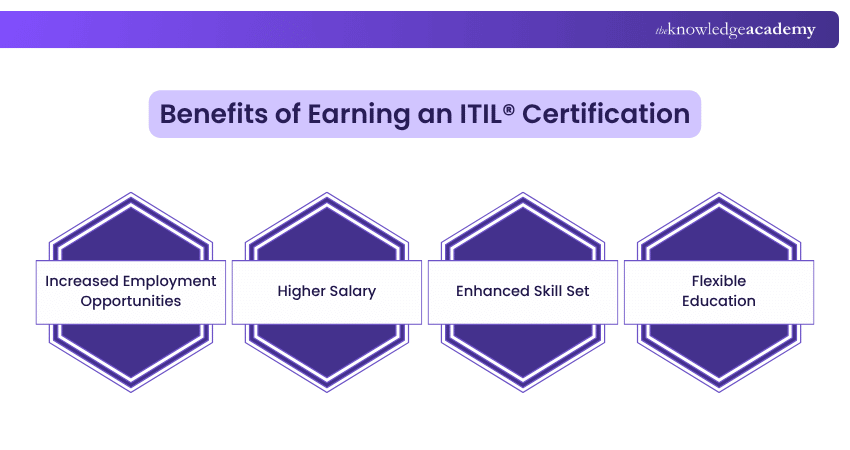
1) Increased Employment Opportunities
Many businesses prefer IT employees with ITIL Certification, enhancing your job prospects. It can also help your resume stand out from other candidates.
2) Higher Salary
Certified employees are often in higher demand, potentially leading to better salary options. The advanced skills gained from ITIL courses can make you a more attractive candidate.
3) Enhanced Skill Set
ITIL Certification improves your proficiency as an IT employee. The skills learned in these courses can boost your confidence and effectiveness in your daily tasks.
4) Flexible Education
ITIL Certification courses offer the flexibility to complete courses at home or online. This can be beneficial if you have a busy schedule, allowing you to enhance your understanding of IT responsibilities in your free time.
Understand the role of Governance, Risk and Compliance (GRC) by joining our ITIL® 4 Strategist: Direct, Plan and Improve Training today!
How to Add ITIL® Certification to Your Resume?
Every resume is unique, but there's a commonly accepted format for listing certifications. Here are the steps to efficiently include your ITIL® Certification:
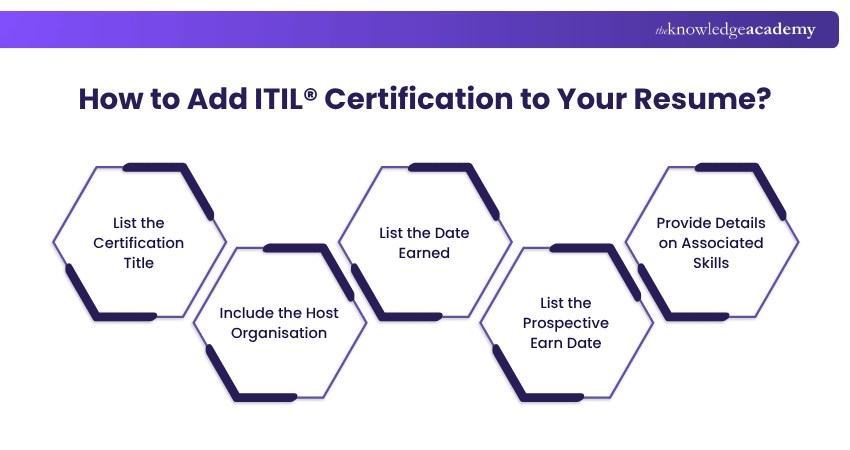
1) List the Certification Title
Use the same font and size as the rest of your resume to list the full title, "ITIL® Certification," under the heading "Certifications." Ensure the title is accurate and spell out any abbreviations for easy online searching by potential employers.
2) Include the Host Organisation
Mention the official examination body that issued your ITIL® Certification. If submitting a digital version, you can add a link to the certification and the issuing body’s website for reference.
3) List the Date Earned
Provide the date you earned your ITIL® Certification. This gives clarity on your qualifications. If renewal is required, include the most recent certification renewal date issued by PeopleCert.
4) List the Prospective Earn Date
If you are in the process of earning the ITIL® Certification, include the expected award date and an estimate of your progress in the certification process.
5) Provide Details on Associated Skills
If space permits and the skills are relevant, include a brief list of the key skills associated with the ITIL® Certification. This helps clarify its relevance and addresses any questions the reader might have.
Learn IT service strategies with our Certified IT Service Manager Certification – Sign up now!
How to Add ITIL® Certification to Your LinkedIn?
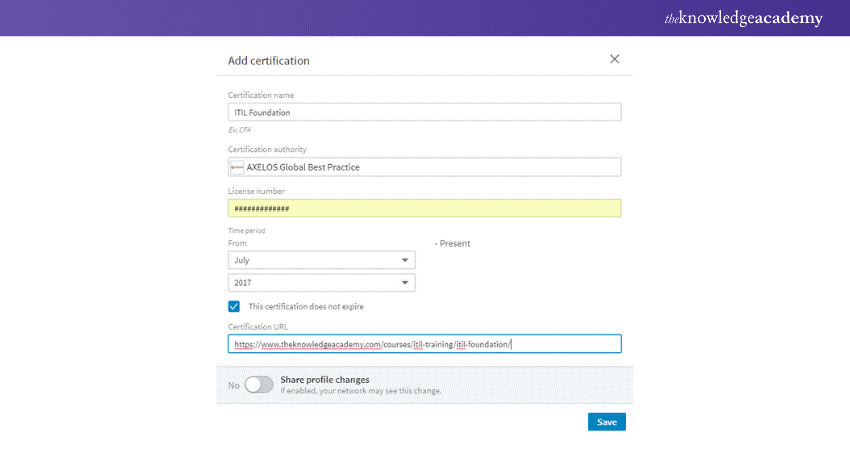
Showcasing your ITIL® Certification on LinkedIn is a great way to highlight your expertise in IT Service Management and attract potential employers. Follow these simple steps to add your ITIL® Certification to your LinkedIn profile and make your qualifications stand out.
1) Log in to your LinkedIn Account
2) On your profile, scroll down to ‘Accomplishments'
3) Click the ‘plus’ and choose ‘Certification'
4) Fill in the ‘Certification name’. For the certification authority, start to type and then select the certificate issuing body’s name 5) Fill in your license number (you can easily find this on your certificate) and select ‘This certification does not expire'
5) Fill in your license number (you can easily find this on your certificate) and select ‘This certification does not expire'
6) For the ‘Certification URL’, you can add the URL of your ITIL course.
7) That’s it! Click save
Tips for Formatting Your ITIL Resume
Creating a well-formatted ITIL resume is important to catch the recruiters’ and hiring manager's attention. Here are a few key tips to help you present your skills and experience in the best possible light.
1) Length: You should keep your resume to 2 pages or less. Recruiters and hiring managers don't have much time to read each resume, so brevity ensures they see all the important information.
2) Font and Text: Simplicity is key for a pleasant reading experience. Use a clear, professional font and break up the text with bullet points to make the information easily digestible. Avoid fancy fonts that can be hard to read.
3) Design and Structure: Choose a resume design that is both attractive and easy to read. Clearly separate sections with large headings and dividing borders. Maintain a simple colour scheme and avoid filling the page with too much text or graphics.
4) Photos and Images: Including a photo on your resume is not mandatory in the USA. However, if you're applying for positions in creative fields, adding a photo can be beneficial.
Learn how to align products with business outcomes through ITIL® 5 Product Certification Training – Join soon!
ITIL Professional Resume Template
Here is a resume template, which will help you understand an ITIL professional better. Let’s dive in!
|
[Your Name] Address: [Your Address], [City], [State], [Zip Code] Phone: [Your Phone Number] Email: [Your Email Address] LinkedIn: [Your LinkedIn Profile URL] Certification: ITIL® Certified Professional Summary Detail-oriented ITIL Specialist with [X] years of experience in IT Service Management, application configuration support, and process optimisation. Proficient in ITIL V5 processes and lifecycle management. Skilled in automated database reporting tools, project management, and team leadership. Work Experience ITIL Specialist, [Company Name] Month Year – Present a) Oversee the IT service desk to ensure timely and adequate resolution of incidents and service requests. b) Create and execute IT Service Management policies, procedures, and standards to maintain consistency and quality. c) Perform regular service reviews with stakeholders to identify improvement areas and align with business goals. d) Manage and observe Service Level Agreements (SLAs) to ensure compliance and find opportunities for enhancement. e) Lead IT projects, ensuring timely delivery and clear communication with stakeholders. f) Maintain a good relationship with vendors and service providers to ensure effective IT service delivery. g) Manage and monitor IT budgets to deliver services cost-effectively and identify potential cost savings. h) Design and enforce IT security policies and procedures to secure the confidentiality, integrity, and availability of IT systems and important data. i) Provide leadership and guidance to IT staff for effective performance management and professional development. IT Support Specialist, [Previous Company Name] Month Year – Month Year a) Provided technical support to employees, resolving IT issues promptly and efficiently. b) Assisted in developing IT policies and procedures. c) Maintained and updated IT equipment to ensure smooth operations. Education Bachelor’s Degree in Computer Science University of [University Name], Year Certifications ITIL V5 Foundation Certification a) Authority: PeopleCert b) Date Earned: [Month Year] c) Certification URL: [Link to Certification or Course] Project Management Professional (PMP) a) Authority: Project Management Institute b) Date Earned: [Month Year] Skills a) ITIL V3 Processes and Lifecycle Management b) Application Configuration Support c) Automated Database Reporting Tools d) Project Management e) Excellent Oral and Written Communication f) Strong Organisational and Presentation Abilities g) IT Security Policies and Procedures h) Vendor and Service Provider Management References Available upon request. |
Conclusion
IT Service Managers are important in managing IT services and communication between teams and customers. An effective resume should highlight skills in organising staff, managing resources, and reducing service delivery issues. It should demonstrate an understanding of IT infrastructure and compliance with industry regulations. For those wondering How to Add ITIL Certification on Resume, include it in the certifications section with relevant details like the authority and certification URL.
Equip yourself with globally recognised ITIL skills with ITIL® Certification Courses – Start now!
Frequently Asked Questions
How do You Tell if Your Resume is ATS-friendly?

An Applicant Tracking System (ATS)-friendly resume uses simple formatting, standard fonts, and clear section headings. Avoid images, tables, and special characters. Ensure your resume includes relevant keywords from the job description, which will help enhance your chances of passing the ATS scan.
How do You Say You Have IT Skills on a CV?
List your IT skills under a "Skills" section, using bullet points for clarity. Include specific technical proficiencies, such as "Proficient in Java and Python," "Experienced in network administration," and "Skilled in ITIL processes and lifecycle management." Customise your skills to align with the specific job requirements.
What are the Other Resources and Offers Provided by The Knowledge Academy?
The Knowledge Academy offers various ITIL® Certification Courses, including ITIL® 5 Foundation Certification Training, ITIL® 5 Service Certification Training and ITIL® 5 Strategy Certification Training. These courses cater to different skill levels, providing comprehensive insights into ITIL Service Management.
Our IT Service Management Blogs cover a range of topics related to How to Add ITIL Certification on Resume, offering valuable resources, best practices, and industry insights. Whether you are a beginner or looking to advance your IT Service Management skills, The Knowledge Academy's diverse courses and informative blogs have got you covered.
What is The Knowledge Pass, and How Does it Work?
The Knowledge Academy’s Knowledge Pass, a prepaid voucher, adds another layer of flexibility, allowing course bookings over a 12-month period. Join us on a journey where education knows no bounds.
What are the Related Courses and Blogs Provided by The Knowledge Academy?
The Knowledge Academy offers various ITIL® Certification Trainings, including the ITIL 4 Foundation Certification Course, ITIL 4 Specialist: Create Deliver and Support CDS, and ITIL 4 Specialist: Drive, Plan and Improve DPI. These courses cater to different skill levels, providing comprehensive insights into ITIL 4 Guiding Principles.
Our IT Service Management Blogs cover a range of topics related to ITIL 4, offering valuable resources, best practices, and industry insights. Whether you are a beginner or looking to advance your IT Service Management Skills, The Knowledge Academy's diverse courses and informative blogs have you covered.

John Davies


Cyber Security Governance & Assurance Specialist
John Davies is a cybersecurity expert specialising in governance, risk management, and compliance. With over 15 years in the field, he has led enterprise-wide security programmes across finance, healthcare and public sector organisations. His content provides practical guidance on building secure environments, managing risk and aligning with regulatory frameworks.

Upcoming IT Service Management Resources Batches & Dates
Date
 ITIL® 5 Foundation Certification
ITIL® 5 Foundation Certification
Mon 15th Jun 2026
ITIL® 5 Foundation Certification
Wed 17th Jun 2026
ITIL® 5 Foundation Certification
Mon 22nd Jun 2026
ITIL® 5 Foundation Certification
Wed 24th Jun 2026
ITIL® 5 Foundation Certification
Mon 29th Jun 2026
ITIL® 5 Foundation Certification
Wed 1st Jul 2026
ITIL® 5 Foundation Certification
Mon 6th Jul 2026
ITIL® 5 Foundation Certification
Wed 8th Jul 2026
ITIL® 5 Foundation Certification
Mon 13th Jul 2026
ITIL® 5 Foundation Certification
Wed 15th Jul 2026
ITIL® 5 Foundation Certification
Mon 20th Jul 2026
ITIL® 5 Foundation Certification
Wed 22nd Jul 2026
ITIL® 5 Foundation Certification
Mon 27th Jul 2026
ITIL® 5 Foundation Certification
Wed 29th Jul 2026
ITIL® 5 Foundation Certification
Mon 3rd Aug 2026
ITIL® 5 Foundation Certification
Wed 5th Aug 2026
ITIL® 5 Foundation Certification
Mon 10th Aug 2026
ITIL® 5 Foundation Certification
Wed 12th Aug 2026
ITIL® 5 Foundation Certification
Mon 17th Aug 2026
ITIL® 5 Foundation Certification
Wed 19th Aug 2026
ITIL® 5 Foundation Certification
Mon 24th Aug 2026
ITIL® 5 Foundation Certification
Wed 26th Aug 2026
ITIL® 5 Foundation Certification
Tue 1st Sep 2026
ITIL® 5 Foundation Certification
Mon 7th Sep 2026
ITIL® 5 Foundation Certification
Wed 9th Sep 2026
ITIL® 5 Foundation Certification
Mon 14th Sep 2026
ITIL® 5 Foundation Certification
Wed 16th Sep 2026
ITIL® 5 Foundation Certification
Mon 21st Sep 2026
ITIL® 5 Foundation Certification
Wed 23rd Sep 2026
ITIL® 5 Foundation Certification
Mon 28th Sep 2026
ITIL® 5 Foundation Certification
Wed 30th Sep 2026
ITIL® 5 Foundation Certification
Mon 5th Oct 2026
ITIL® 5 Foundation Certification
Wed 7th Oct 2026
ITIL® 5 Foundation Certification
Mon 12th Oct 2026
ITIL® 5 Foundation Certification
Wed 14th Oct 2026
ITIL® 5 Foundation Certification
Mon 19th Oct 2026
ITIL® 5 Foundation Certification
Wed 21st Oct 2026
ITIL® 5 Foundation Certification
Mon 26th Oct 2026
ITIL® 5 Foundation Certification
Wed 28th Oct 2026
ITIL® 5 Foundation Certification
Mon 2nd Nov 2026
ITIL® 5 Foundation Certification
Wed 4th Nov 2026
ITIL® 5 Foundation Certification
Mon 9th Nov 2026
ITIL® 5 Foundation Certification
Wed 11th Nov 2026
ITIL® 5 Foundation Certification
Mon 16th Nov 2026
ITIL® 5 Foundation Certification
Wed 18th Nov 2026
ITIL® 5 Foundation Certification
Mon 23rd Nov 2026
ITIL® 5 Foundation Certification
Wed 25th Nov 2026
ITIL® 5 Foundation Certification
Mon 30th Nov 2026
ITIL® 5 Foundation Certification
Wed 2nd Dec 2026
ITIL® 5 Foundation Certification
Mon 7th Dec 2026
ITIL® 5 Foundation Certification
Wed 9th Dec 2026
ITIL® 5 Foundation Certification
Sun 13th Dec 2026
ITIL® 5 Foundation Certification
Mon 14th Dec 2026
ITIL® 5 Foundation Certification
Mon 21st Dec 2026
ITIL® 5 Foundation Certification
Wed 23rd Dec 2026
ITIL® 5 Foundation Certification
Tue 29th Dec 2026

 If you wish to make any changes to your course, please


