


 Top Rated Course

We may not have the course you’re looking for. If you enquire or give us a call on 01344 203999 and speak to our training experts, we may still be able to help with your training requirements.
What is Bottom-Up Estimating and How It Improves Project Planning
Scarlett Adams 15 December 2025Bottom-up Estimating is a project planning method that calculates total cost and time by summing detailed estimates for each individual task or activity. It gives more accurate results because every small part is planned carefully. This helps in managing budgets, timelines, and team responsibilities more effectively.

Training Outcomes Within Your Budget!
We ensure quality, budget-alignment, and timely delivery by our expert instructors.
Table of Contents

Your team’s ready to launch a product. You’ve got a rough budget, ads, content, and design. Then someone asks, “Did we include video edits? Influencer fees? Landing page tests?” Suddenly, the plan feels shaky. That’s the risk of top-down guessing. Bottom-up Estimating changes the game, by mapping every task early, it keeps surprises out and success on track.
In this blog, we’ll explain what Bottom-up Estimating is, why it’s important in project planning, who uses it across industries, how to apply it step by step, its key benefits and drawbacks, and real-world examples to show it in action.
Table of Contents
1) What is Bottom-up Estimating?
2) Why is Bottom-up Estimating Important?
3) Who Uses Bottom-up Estimating?
4) Bottom-up Estimating: A Step-by-step Process
5) Key Benefits of Bottom-up Estimating
6) Drawbacks of Bottom-up Estimating
7) Examples of Bottom-up Estimating
8) Conclusion
What is Bottom-up Estimating?
Bottom-up Estimating is a way of planning a project by working out the cost, time, and resources for each small task first, then adding them all together. This method gives a more accurate overall estimate because every part of the project is considered in detail. In this method, you don’t guess the total project cost in one go. Instead, you break the project into smaller tasks and check what each one needs.
For example, if you are building a website, you don’t just say, “It will cost £5,000.” Instead, you calculate the cost for designing pages, writing content, coding, testing, and hosting. You then add these amounts to get the total. This way, nothing important is missed, and you have a clearer and more reliable plan.

Why is Bottom-up Estimating Important?
Bottom-up Estimating is important because:
1) Helps Know the Full Project Cost: Bottom-up Estimating helps teams see how much a project might really cost.
2) Looks at all Small Parts: It checks every small task or detail before adding up the total.
3) Gives Clear and Accurate Estimates: This method makes the overall estimate more correct and complete.
4) Improves Communication with Customers: Teams can explain the budget and timeline clearly to clients.
5) Helps Manage Time and Resources Better: It shows where to use people, tools, and time more effectively.
6) Supports Better Profit Planning: Knowing true costs helps teams plan prices and earn profit.
Who Uses Bottom-up Estimating?
Many people use Bottom-up Estimating, such as:
1) Project Managers: To plan the project and check progress.
2) Team Leaders: To divide tasks and set a time for each one.
3) Engineers: To figure out what tools and materials are needed.
4) Software Developers: To break coding work into smaller steps.
5) Marketing Teams: To plan costs and set timelines.
6) Construction Workers: To plan work and manage resources.
Basically, anyone working on a project that has many parts can use Bottom-up Estimating.
Learn about different estimating methods with our Project Planning and Control™ (PPC) Practitioner Course - Join now!
Bottom-up Estimating: A Step-by-step Process
Here’s how you can do Bottom-up Estimating step by step.

1) Outline Project Scope and Key Deliverables
First, decide what the project will do and what it will make.
Ask questions like:
a) What is the goal of the project?
b) What do we want to finish?
c) What can we not do?
d) How will we know it is done well?
Example: You’re building a food delivery app. The goal is to let users order food. Deliverables include the design, code, testing, and final working app.
2) Build a Detailed Work Breakdown Structure (WBS)
Break the project into small parts.
a) Start with big tasks
b) Break each big task into smaller tasks
c) Write down all the steps
d) Show them in a list or chart
Example: For the mobile app, one big task is “User Login.” The smaller tasks: design login screen, write backend code, test login feature
3) Estimate the Resources Required for Each Task
Now, look at each small task and ask:
a) How long will it take?
b) Who will do it?
c) What tools or money will we need?
Example: “Design login screen” will take 6 hours, needs a UI designer, and a design tool like Figma.
4) Aggregate the Estimates
Add all the time, cost, and work from each task to get the full amount.
Also think about:
a) What could go wrong?
b) Do we have enough people or tools?
Example: All login tasks take 15 hours in total. But one task depends on internet access, so you add two extra hours in case the connection is slow.
5) Review the Estimates
Look at all your numbers again.
a) Are they correct?
b) Did we miss anything?
Example: You estimated 3 hours for testing the app, but your last project needed 6 hours. So, you update this estimate to 6 hours to be safe.
6) Define and Assign the Resources
Give each task to the right person.
Think about:
a) Who is free to do it?
b) What tools do they need?
c) Are there any holidays or sick days?
Example: The backend login code needs 8 hours of work. You assign it to a developer who has enough free time next week. You also ask another developer to be on standby.
7) Monitor and Control the Project
While the work is going on, keep checking the progress.
Use:
a) Reports
b) Charts
c) Team talks
Example: Your team updates a shared task board every day. You notice the payment page is delayed, so you move another developer to help and stay on track.
Key Benefits of Bottom-up Estimating
Using Bottom-up Estimating brings many benefits. Here are some of the best ones:
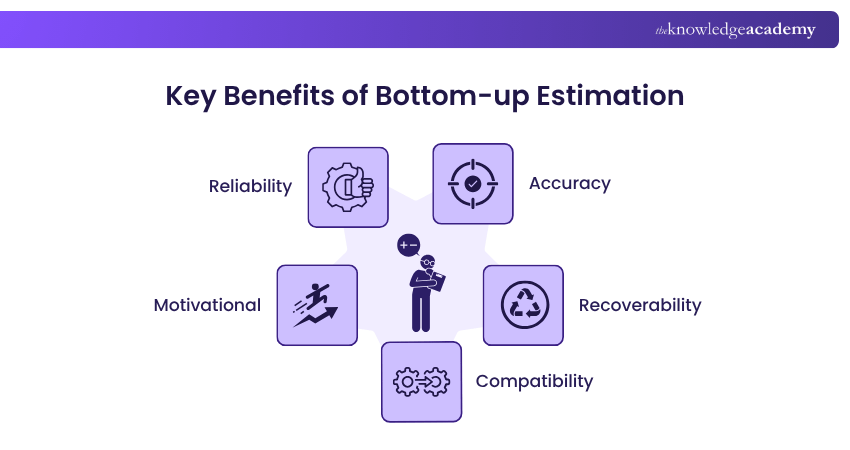
1) Accuracy
Team members who do the work help with the plan, so the estimates are more accurate. They know what each task needs and can spot problems early.
2) Recoverability
If one task is guessed wrong, others might balance it out. Small mistakes won’t hurt the whole project, and managers can find simple ways to fix them.
3) Compatibility
This method works well with other planning methods. For example, you can use bottom-up for budgets and another method for time estimates. Mixing helps make a better plan.
4) Motivational
Team members feel more involved when they help plan. This makes them more responsible, work better, and care more about the project.
5) Reliability
Since every small task is planned, the team is ready for problems. It helps manage time, money, and tools better and keeps the project on track.
Learn how to plan, control, and monitor projects effectively. Join our Project Planning and Control™ (PPC) Foundation Course now!
Drawbacks of Bottom-up Estimating
Even though it’s useful, Bottom-up Estimating has some downsides. These are the drawbacks of Bottom-up Estimating:
1) Time-consuming
Bottom-up Estimating takes a long time because every task must be looked at closely. Each small step needs time and effort to plan.
Tip: Use project tools or templates to speed it up.
2) Needs Detailed Project Information
This method needs help from many team members and experts. It can use up a lot of time, energy, and tools.
Tip: Always define the project scope first.
3) Resource Intensive
In large projects, there are many small tasks. Keeping track of all the estimates and combining them can be hard.
Tip: Use project tools to track and combine all task estimates easily.
4) Lack of Flexibility
Once you’ve planned everything in detail, it can be hard to change things quickly if the project changes.
Tip: Leave room for changes and add some buffer time.
Examples of Bottom-up Estimating
Let’s look at three real-world examples to understand how this works.
Example 1: A Software Development Project
Project Goal: Build a shopping app.
Tasks:
a) Design UI: 15 hours
b) Build Product Page: 20 hours
c) Set up Database: 25 hours
d) Payment System: 30 hours
e) Testing: 10 hours
f) Total Estimate: 100 hours
Each part is estimated, then added. This gives a clearer and more accurate plan than a guess.
Example 2: A Marketing Campaign
Project Goal: Launch a new product online.
Tasks:
a) Design Posters: 8 hours
b) Create ad Copy: 5 hours
c) Run Social Media Ads: 2 hours
d) Email Campaign: 7 hours
e) Monitor Results: 10 hours
f) Total Estimate: 42 hours
The marketing team knows exactly how long and how much each part will take.
Example 3: A Construction Project
Project Goal: Build a small office space.
Tasks:
a) Lay Foundation: 4 days
b) Build Walls: 5 days
c) Paint: 2 days
d) Electrical Work: 3 days
e) Inspection: 1 day
f) Total Estimate: 15 days
By breaking it down, builders can manage work and resources better
Conclusion
Bottom-up Estimating is a smart way to plan projects by focusing on the details first. It gives better control over time, cost, and resources by adding up every small task. Though it takes more time upfront, the accuracy and clarity it provides are worth it. If you want fewer surprises and better results, using this detailed task-based approach can be one of the most effective ways to improve your overall project planning.
Gain strategies and techniques applied to plan and close a project. Join our Project Planning and Control™ Course now!
Frequently Asked Questions
Why use Bottom-up Estimate at Completion?

A Bottom-up Estimate at Completion (EAC) helps you know the new total cost if things change mid-project. It updates your plan based on what’s been done and what’s left. This helps you stay on track and avoid running out of budget.
Why is the Bottom-up Approach Better?
Bottom-up is better when you need detailed and accurate plans. It gives clear steps, helps with team tasks, and makes tracking easier. It’s great for complex projects with many parts. Even though it takes more effort, it gives more reliable results.
What are the Other Resources and Offers Provided by The Knowledge Academy?
The Knowledge Academy takes global learning to new heights, offering over 3,000 online courses across 490+ locations in 190+ countries. This expansive reach ensures accessibility and convenience for learners worldwide.
Alongside our diverse Online Course Catalogue, encompassing 19 major categories, we go the extra mile by providing a plethora of free educational Online Resources like Blogs, eBooks, Interview Questions and Videos. Tailoring learning experiences further, professionals can unlock greater value through a wide range of special discounts, seasonal deals, and Exclusive Offers.
What is The Knowledge Pass, and How Does it Work?
The Knowledge Academy’s Knowledge Pass, a prepaid voucher, adds another layer of flexibility, allowing course bookings over a 12-month period. Join us on a journey where education knows no bounds.
What are the Related Courses and Blogs Provided by The Knowledge Academy?
The Knowledge Academy offers various Project Planning and Control™ Courses, including the Project Planning and Control™ (PPC) Foundation and Practitioner Course, Project Planning and Control™ (PPC) Foundation Course, and the Project Planning and Control™ (PPC) Practitioner Course. These courses cater to different skill levels, providing comprehensive insights into Project Planner Job Description.
Our Project Management Blogs cover a range of topics related to Bottom-up Estimating, offering valuable resources, best practices, and industry insights. Whether you are a beginner or looking to advance your Project Management skills, The Knowledge Academy's diverse courses and informative blogs have got you covered.
Upcoming Project Management Resources Batches & Dates
Date
 Project Planning and Control™ (PPC) Foundation and Practitioner
Project Planning and Control™ (PPC) Foundation and Practitioner
Mon 3rd Aug 2026
Project Planning and Control™ (PPC) Foundation and Practitioner
Mon 5th Oct 2026
Project Planning and Control™ (PPC) Foundation and Practitioner
Mon 14th Dec 2026

 If you wish to make any changes to your course, please


