


 Top Rated Course

We may not have the course you’re looking for. If you enquire or give us a call on + 1-866 272 8822 and speak to our training experts, we may still be able to help with your training requirements.
What is a Bear Market? Meaning, Phases and Investment Strategies
Charlotte Wilson 04 February 2026Bear Market is a prolonged period when stock prices fall 20%, marked by widespread pessimism, economic slowdowns, high inflation and weak investor confidence. In such a phase, businesses and investors struggle. Understanding What is a Bear Market helps investors to protect wealth and make smart decisions during uncertain financial phases.

Training Outcomes Within Your Budget!
We ensure quality, budget-alignment, and timely delivery by our expert instructors.
Table of Contents

Tumbling stock prices, fading investor confidence, and overwhelming uncertainty - This is what a Bear Market feels like. It signals a period of declining stock prices often driven by economic downturns. While it can be unsettling, smart investors hardly panic and see these downturns as opportunities.
This blog breaks down What is a Bear Market, why it happens and how to navigate it like a pro. From outlining the importance of a Bear Market to the best investment strategies, you will learn how to turn such market turbulence into long-term growth.
Table of Contents
1) What is a Bear Market?
2) Key Characteristics of a Bear Market
3) Why is a Bear Market Important?
4) Types of Bear Markets
5) Phases of a Bear Market
6) Causes of a Bear Market
7) Investment Strategies During a Bear Market
8) Bear Market vs Bull Market
9) What are Some Famous Bear Market Examples?
10) What Investments Do Well in a Bear Market?
11) Conclusion
What is a Bear Market?
A Bear Market comes into place when investment prices fall by 20% or more. It is a period where investors lose confidence, demand for stocks drop and the pressure of selling increases. Such are part of a natural market cycle, including the rise and fall phases based on economic and business conditions.
Since, financial markets move due to changes in supply and demand due to various reasons, such as inflation or interest rates. While small prices tend to decline or corrections can occur during bull market, a Bear Market lasts longer and involves higher losses. It is extremely difficult to predict when a Bear Market will start or end, making investing highly challenging.

Key Characteristics of a Bear Market
A significant decline in asset prices isn't the only thing happening during a Bear Market. The key characteristics of a Bear Market include the following
1) Extended Market Downturn
A Bear Market occurs when stock prices fall by 20% or more and stays low for a sustained period. Usually, sharp drops last only a few days but that is not the case with Bear Markets. A Bear Market ends when prices rise 20% from the lowest level. This often takes longer periods to recover followed by a recession.
2) Increased Volatility
Bear Markets don’t always follow a straight downward trajectory; they can include temporary rallies before further declines. Generally, they experience higher volatility than Bull Markets, because investors’ fear and waning confidence result in rapid price fluctuations and unpredictable movements.
3) Falling Corporate Earnings
Lower corporate profits or losses can amplify market pessimism. Bear Markets, which often accompany or precede economic downturns, typically involve declining corporate earnings. This can either be a contributing factor or a consequence of the market decline.
4) Negative Investor Sentiment
Negative investor sentiment is a true indicator of a Bear Market. Here, investors believe growth will not return soon. This makes them move money into safer assets, such as treasury bills and high-quality bonds, especially during inflation or recession. This shift from stocks increases pressure of selling and pushes down prices further.
Why is a Bear Market Important?
A Bear Market is important because it plays a big role in the economic and investment cycle, that influences financial markets, businesses, and investor behaviour. Here’s why it matters:
1) Bear Markets help correct overvalued stocks by bringing prices in line with actual company performance and fundamentals.
2) While stock prices decline, Bear Markets present chances to buy strong assets at lower prices, leading to potential gains when the market recovers.
3) A Bear Market often signals economic distress, such as slowing growth, rising unemployment, or recessions. It provides policymakers and businesses with insight into market trends and economic stability.
4) Bear Markets test investor resilience, encouraging better Risk Management and diversified portfolios.
5) Companies reassess spending, expansion, and hiring during Bear Markets to navigate economic challenges.
Types of Bear Markets
Bear Markets vary in terms of duration, severity and recovery time. These differences are based on economic events that trigger the downturn. Below we have mentioned three common types of Bear Markets:
1) Secular
A secular Bear Market is a long-term period of negative return. It often lasts for 10 years or more. Usually, it arises due to deep structural issues in the economy, such as excess debt or banking crisis. Here, short bull phases appear but, overall growth of market remains weak. For example, the 2007-09 Global Financial Crisis that spread financial damage with long recovery period.
Familiarise yourself with every crucial aspect of trading through our Forex Trading Course - Sign up now!
2) Cyclical
Cyclical Bear Market happens at the end of a business cycle. It is due to rise of inflation, increasing rates of interest and company profits falling. Such factors damage the economic confidence and hinder market growth. These markets are medium-term, lasting around 25 months on an average. For example, the 2000-02 Dot-com Crash where stock prices fell after boom in technology stocks.
3) Event-driven
Event-driven Bear Market happens due to sudden events, such as pandemics, war or natural disaster. For example, Covid-19 and 9/11 attack. These tend to be short-term and recover quicker compared to the previous two types since they arise from temporary disruptions.
Phases of a Bear Market
These are the main phases of a Bear Market:
1) Recognition: This phase is characterised by high investor sentiment and prices. The initial Bear Market signs are ignored, and some investors recognise the downturn and begin selling.
2) Panic: In this phase, prices drop sharply, investors capitulate, trading volume declines and economic indicators worsen.
3) Stabilisation: In this phase, panic selling slows while volatility remains high, and market rallies may reverse as market speculators enter.
4) Anticipation: In the final phase, prices stabilise, valuations become attractive, and investors start returning to the market.
Dive into the intricacies of financial markets and investment strategies with our comprehensive Investment Banking Training - register now!
Causes of a Bear Market
From market bubbles and high inflation to geopolitical events and economic recession, there are plenty of causes behind a Bear Market. Let’s explore them in detail
1) Market Bubbles
Bear Markets begin with market bubbles start to burst. During the time of a bubble, asset prices rise quickly due to speculation and excitement of investors. When confidence drops and investors start selling, prices fall making a way for Bear Market decline.
2) High Inflation
During high inflation, it reduces consumers power to purchase and increase cost of living. As spending starts to slow down and company profits shrink, confidence of investor weakens simultaneously. This loss of confidence and optimism leads to large scale selling in the stock market, pushing prices to get lowered.
3) Geopolitical Events
It refers to sudden global events, such as war, pandemic, geopolitical tensions or trade conflicts. This disrupts economic activity and creates a phase of uncertainty. This encourages investors to pull out risky assets, adding to steep decline of the market growth.
4) Interest Rate Hikes
Central banks raise interest rates for controlling rising inflation, but higher borrowing makes loan expensive for consumers and businesses. Since spending and investment becomes low, revenue for corporate falls. This leads to decline in stock prices and market downturns.
5) Economic Recession
During an economic recession, it involves economic output, unemployment rise and minimal business activities. This means profits of company drop and confidence of investors decline. This leads to prolonged periods of stock market decline and brings rise of a Bear Market.
Gain insights into Portfolio Management and modern Investment strategies in our Investment Management Course - Register now!
Investment Strategies During a Bear Market
Although a Bear Market may drive investors away, there are ways to weather this downturn. The best approach depends on individual circumstances, but some commonly used Bear Market investment strategies include the following
1) Think Long-term
a) Long-term focus helps investors navigate Bear Markets without any significant losses.
b) Remember to avoid panic selling, as market downturns are often temporary.
c) The losses aren't realised unless assets are sold.
d) Patience pays off, because Bear Markets are typically followed by Bull Markets.
e) Holding investments allows for recovery when market conditions improve.
2) Defensive Stocks
a) Defensive stocks include sectors like food, utilities, and healthcare, which provide essential goods and services.
b) These stocks tend to retain value, even if they don’t experience notable growth.
c) Defensive stocks perform better in Bear Markets and offer stability while other stocks decline.
d) While they may not surge in Bull Markets, they serve as a reliable hedge during economic uncertainty.
3) Value Investing
a) Bear Markets offer opportunities to buy undervalued stocks at lower prices.
b) Value stocks often have strong financial fundamentals but trade below their book value.
c) Temporarily depressed stocks may rebound when the market recovers. This allows investors to capitalise on gains.
d) Growth stocks can be riskier in Bear Markets, especially if they lack capital to sustain operations.
e) Companies with weak financials may struggle to survive economic downturns.
4) Dollar-cost Averaging
a) Dollar-cost averaging involves consistently investing a set amount at scheduled intervals rather than making a single lump-sum investment.
b) Spreading investments over time helps smooth out market volatility and price fluctuations.
c) It aligns the cost basis with market trends, reducing the impact of short-term spikes.
5) Diversify Investments
a) Diversification decreases risk by spreading investments across various companies and asset classes.
b) It protects against company-specific failures, minimising the impact of bankruptcies.
c) Different asset classes react differently, with bonds often holding up better than stocks in Bear Markets.
d) It helps limit volatility, providing more stability during market downturns.
Understand market trends and Risk Management with our Cryptocurrency Trading Training - Sign up now!
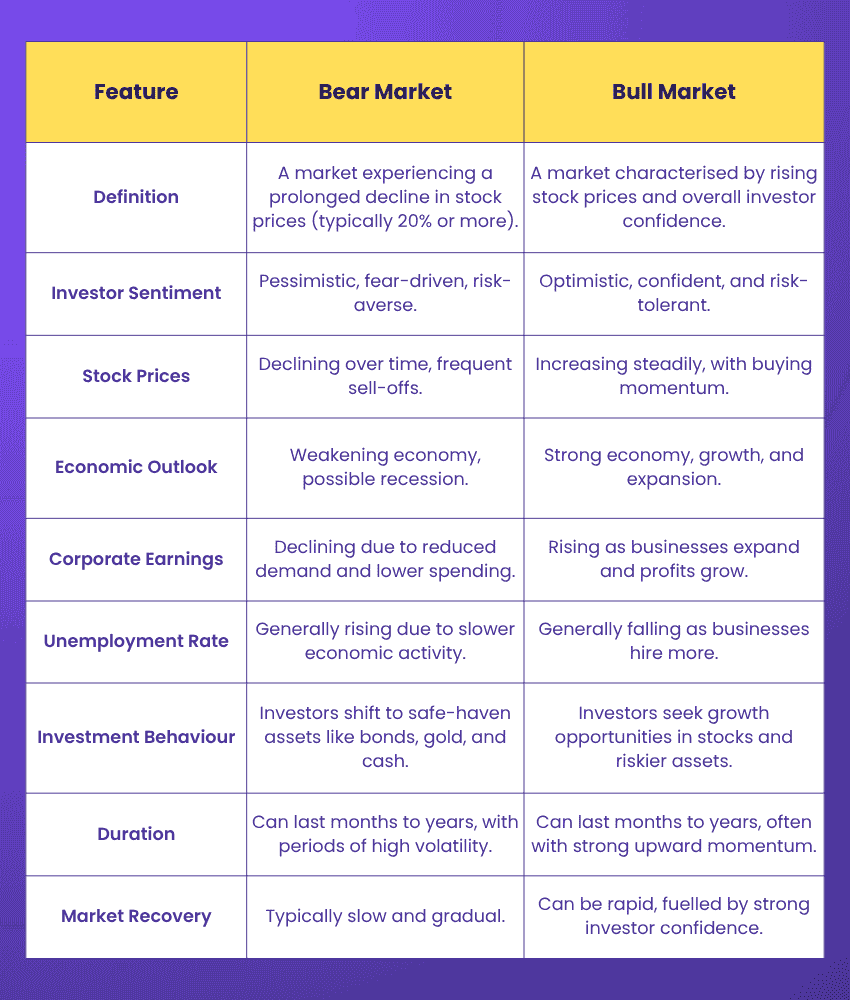
Bear Market vs Bull Market
A bear market is a period when prices fall, investor confidence drops, and economic conditions feel uncertain. In contrast, a bull market is marked by rising prices, strong investor optimism, and positive economic momentum. While bear markets create caution and reduced spending, bull markets encourage investment, growth, and higher market activity.
Let’s explore the differences between a Bear Market and a Bull Market:
What are Some Famous Bear Market Examples?
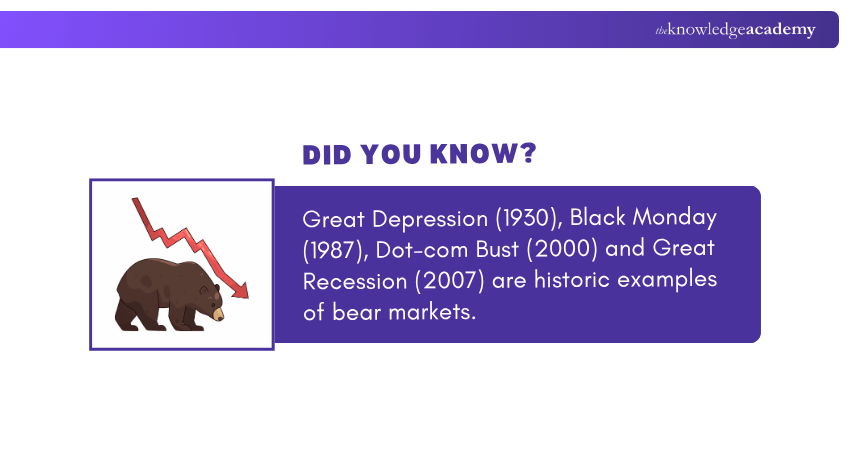
There have been various instances that shaped the financial history and the future. It provides deeply valuable lessons for investors and businesses globally. Some famous instances of Bear Markets:
1) 1929 Stock Market Crash
After this crash, the well-known Great Depression began. This led to massive decline in the economy, high unemployment and prolonged period of financial instability.
2) Japan’s Market Collapse (1989-90)
In 1989, Japan experienced a painful market downturn following the burst of huge asset price bubble. This led to collapse in stock values, making it the nation’s “lost decade.”
3) Global Financial Crisis (2007-09)
This is one of the recent examples of Bear Market. It was triggered due to excessive lending, housing market collapse and failure of the banking system. This led to global recession and years of economic recovery.
What Investments Do Well in a Bear Market?
Government bonds and defensive stocks (utilities, healthcare and consumer staples) often hold better value during uncertain time. However, the best approach for long-term investors is to build well-diversified portfolio and hold it over time for an effective strategy.
Conclusion
A Bear Market brings uncertainty but also offers an opportunity to review your strategy and identify new opportunities. By understanding What is a Bear Market, with its causes, phases and smart investment tactics, you can face downturns in the market with confidence. Also, it is essential to be patient, diversify your portfolio and focus on long-term goals to come out stronger after market recovers.
Want to master market analysis techniques for informed trading decisions? Sign up for our detailed Stock Trading Course now!
Frequently Asked Questions
Is it Good to Buy in a Bear Market?

Investing during a Bear Market can be strategic, but it comes with numerous risks and requires careful planning. Remember to buy high-quality stocks at lower prices, diversify and rebalance your portfolio, and don't panic sell.
How Long Does a Bear Market Last?
A Bear Market typically lasts around one year and nine months, though durations can vary significantly, ranging from as short as two months to over five years. For a downturn to qualify as a Bear Market, the decline must persist for at least two months.
What are the Other Resources and Offers Provided by The Knowledge Academy?
The Knowledge Academy takes global learning to new heights, offering over 3,000+ online courses across 490+ locations in 190+ countries. This expansive reach ensures accessibility and convenience for learners worldwide.
Alongside our diverse Online Course Catalogue, encompassing 19 major categories, we go the extra mile by providing a plethora of free educational Online Resources like Blogs, eBooks, Interview Questions and Videos. Tailoring learning experiences further, professionals can unlock greater value through a wide range of special discounts, seasonal deals, and Exclusive Offers.
What is The Knowledge Pass, and How Does it Work?
The Knowledge Academy’s Knowledge Pass, a prepaid voucher, adds another layer of flexibility, allowing course bookings over a 12-month period. Join us on a journey where education knows no bounds.
What are the Related Courses and Blogs Provided by The Knowledge Academy?
The Knowledge Academy offers Investment and Trading Training, including the Real Estate Financial Modelling Training, Stock Trading Course and the Investment Banking Training. These courses cater to different skill levels, providing comprehensive insights into Tangible and Intangible Assets.
Our Accounting and Finance Blogs cover a range of topics related to Financial Market, offering valuable resources, best practices, and industry insights. Whether you are a beginner or looking to advance your investment skills, The Knowledge Academy's diverse courses and informative blogs have got you covered.

Charlotte Wilson


Soft Skills and Business Training Manager
Charlotte Wilson is an expert in soft skills development, with over 14 years of experience helping individuals and teams improve communication, productivity and emotional intelligence in the workplace. Her training content is focused on enhancing interpersonal effectiveness and fostering positive, collaborative environments across all levels of an organisation.
View Detail
Upcoming Business Skills Resources Batches & Dates
Date
 Investment Management Course
Investment Management Course
Fri 17th Apr 2026
Investment Management Course
Fri 11th Sep 2026
Investment Management Course
Fri 27th Nov 2026

 If you wish to make any changes to your course, please


