


 Top Rated Course

We may not have the course you’re looking for. If you enquire or give us a call on +44 1344 203 999 and speak to our training experts, we may still be able to help with your training requirements.
NLP Engineer Job Description: A Complete Career Guide
Lily Turner 10 June 2026Do you wish to become an NLP Engineer or Developer who can provide innovative solutions by integrating information, refining processes, and using technology? Read this blog on NLP Engineer Job Description to explore the different roles of an NLP Engineer, including their duties, skills, and impact on AI and Machine learning.

Training Outcomes Within Your Budget!
We ensure quality, budget-alignment, and timely delivery by our expert instructors.
Table of Contents
Stepping into the world of NLP Engineering is like unlocking a secret language where computers and humans meet. Imagine being the bridge that connects our words to the digital minds of machines. That’s what an NLP Engineer does, and it’s a role that’s becoming more crucial by the day.
In this blog, we’ll explore the ins and outs of the NLP Engineer Job Description, uncover the skills that make these professionals so sought after, and discover how they turn our everyday conversations into something a computer can understand. Let’s dive in!
Table of Contents
1) Who is an NLP Engineer?
2) NLP Engineer Responsibilities
3) NLP Engineer Requirements and Skills
4) How to Become an NLP Engineer?
5) NLP Engineer Job Trends
6) NLP Engineer Job Description Template
7) Conclusion
Who is an NLP Engineer?
An NLP Engineer is an expert in crafting technologies that enable computers to process and produce human language. Situated at the crossroads of Computer Science, AI, and linguistics, they devise algorithms and models facilitating communication between humans and machines. Their work involves designing systems for Natural Language Processing (NLP) and enhancing speech recognition capabilities within AI frameworks.

NLP Engineer Responsibilities
Every job has certain responsibilities. Here are a few of the responsibilities of an NLP Engineer.
1) Designing Algorithms for Neural Networks:
This entails creating mathematical structures that enable machines to identify patterns in data, particularly the intricate and nuanced patterns found in human language.
2) Developing NLP Models for Various Language Tasks:
NLP models facilitate machines' interpretation of human language. Depending on the objective, an NLP Engineer may focus on tasks such as translation, sentiment analysis, or chatbot design.
3) Testing and Implementing System Effectiveness:
Prior to deployment, NLP systems must be thoroughly tested for accuracy and reliability to ensure they function correctly and minimise errors in language interpretation.
4) Continuously Optimising for Real-world Applications:
As language and user needs change, NLP systems must evolve. Engineers continuously refine and enhance models to maintain their relevance and efficiency in practical scenarios.
5) Collaborating with Data Scientists and Software Developers:
NLP is an interdisciplinary field. Engineers collaborate with Data Scientists to gain a deeper understanding of language patterns and with Software Developers to integrate models into applications.
6) Fine-tuning Based on User Feedback and Product Manager Insights:
Real-world feedback from Users and Product Managers is essential for targeted system improvements. This process involves mastering essential tools, engaging in continuous learning, and maintaining active networking.
Dive into the fascinating realm of AI with our Introduction to AI Course – Sign up today!
NLP Engineer Requirements and Skills
Now, that we know about the key responsibilities, let us learn what are the skills and requirements of NLP Engineers.
1) Proven experience as an NLP Engineer or similar role.
2) Understanding of NLP techniques for text representation, semantic extraction techniques, data structures and modelling.
3) Ability to effectively design software architecture.
4) Deep understanding of text representation techniques (such as n-grams, bag of words, sentiment analysis, etc), statistics and classification algorithms.
5) Knowledge of Python, Java and SQL.
6) Ability to write robust and testable code.
7) Experience with Machine Learning frameworks (like Keras or PyTorch) and libraries (like scikit-learn).
8) Strong communication skills.
9) An analytical mind with problem-solving abilities.
10) Degree in Computer Science, Mathematics, Computational Linguistics or similar field.
Enhance your expertise in Machine Learning through our Machine Learning Course – Sign up now!
How to Become an NLP Engineer?
To become an NLP Engineer, you need a blend of education, practical skills, and experience. Here is how to start your journey:
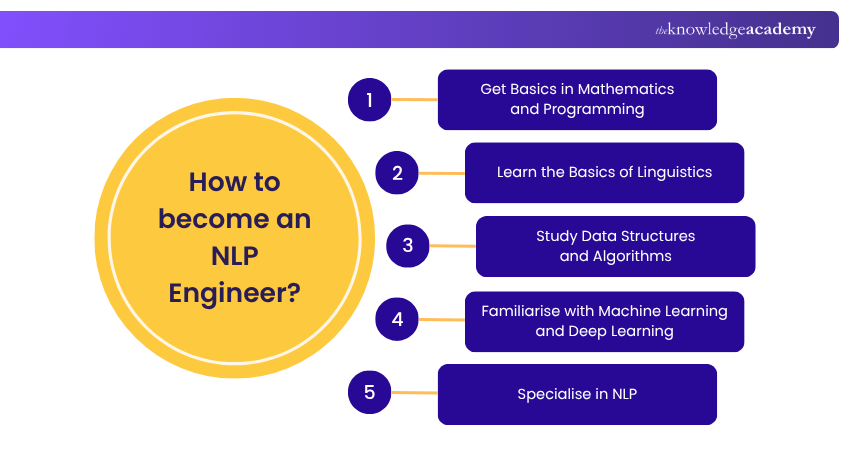
1) Get a Foundation in Mathematics and Programming:
Mathematics: Focus on linear algebra, probability, statistics, and calculus. These areas are important for understanding algorithms used in NLP.
Programming: Gain proficiency in Programming Languages like Python or Java. Python is particularly popular in NLP for its simplicity and the vast availability of libraries like NLTK, spaCy, and TensorFlow.
2) Learn the Basics of Linguistics:
Understanding the basics of linguistics is essential for NLP. Study phonetics, morphology, syntax, semantics, and pragmatics. They will help you understand how languages are structured and how meaning is constructed.
3) Study Data Structures and Algorithms:
A good grasp of data structures such as trees, graphs, and hash tables and algorithms like searching, sorting, and optimisation is essential. They are important for developing efficient NLP solutions.
4) Get Familiar with Machine Learning and Deep Learning:
Machine Learning: Learn the fundamentals of supervised and unsupervised learning, decision trees, and ensemble methods.
Deep Learning: Dive into deep learning, focusing on neural networks, which are important for NLP tasks.
5) Specialise in NLP:
Core NLP Concepts: Study key NLP concepts like tokenisation, part-of-speech tagging, named entity recognition, sentiment analysis, machine translation, and question answering.
NLP Tools and Libraries: Become proficient in using NLP libraries like NLTK, spaCy, and Gensim, as well as deep learning frameworks like TensorFlow or PyTorch for NLP tasks.

6) Work on Projects:
Apply what you have learned by working on different NLP Project Ideas. Start with simple projects like a spam classifier or sentiment analysis and gradually move to more complex problems like NLP Chatbots or machine translation systems.
7) Contribute to Open Source and Compete in Competitions:
Contributing to open-source NLP projects can help you get practical experience and improve your skills. Participating in competitions like those on Kaggle can also benefit you.
8) Stay Updated and Network:
NLP is a rapidly growing field. You can get updated in this field by following recent research and attending workshops, conferences, and webinars. Networking with professionals in the field through LinkedIn or attending some webinars can also provide valuable insights and opportunities for you.
9) Gain Experience:
Search for internships, part-time, or full-time positions as an NLP Engineer or a related role. Real-world experience is invaluable for understanding complex problems and learning how to work on large-scale systems.
10) Pursue Advanced Education:
You can also consider pursuing a master's or PhD in Computer Science, Linguistics, or a related field focusing on NLP. This is especially useful for roles in research or academia.
Equip yourself with the Artificial Intelligence (AI) for Project Managers Course! Reserve your place today!
NLP Engineer Job Trends
Let’s take a look at few NLP Engineer job trends:
1) Increased Adoption in Diverse Industries: NLP will permeate industries like healthcare, finance, and customer service, providing job opportunities beyond traditional tech companies.
2) Focus on Explainability and Trust: As NLP models become more complex, ensuring their transparency and fairness will require specialised skills.
3) Rise of Conversational AI: Building chatbots and virtual assistants with Natural Language interactions will continue to be a major area of focus.
4) Integration with Other AI Disciplines: NLP will increasingly collaborate with fields like computer vision and robotics. This can lead to the development of truly multimodal AI systems.
NLP Engineer Job Description Template
Here are two sample NLP Engineer Job Description templates tailored to different levels of experience and organisational needs:
Template 1
|
Job Title: NLP Engineer Location: [City, State] or Remote Job Description: As an NLP Engineer at [Company Name], your job will be to create and improve NLP models to enhance our AI-powered products. Your primary duties will be to come up with methods and make and test NLP models. You also need to work with teams from different departments to add these models to different apps. You will work with Product Managers, Data Scientists, and Software Developers to ensure the clients get the most up-to-date NLP solutions. Responsibilities: a) Design and develop algorithms for neural networks to recognise and interpret patterns in human language. b) Create and refine NLP models for various tasks such as translation, sentiment analysis, and chatbot development. c) Test and validate the accuracy and reliability of NLP systems before deployment to ensure error-free performance. d) Continuously optimise and update NLP models to adapt to evolving language trends and user needs. e) Collaborate with Data Scientists to analyse language patterns and with Software Developers to integrate models into applications. f) Fine-tune models based on user feedback and insights from Product Managers to improve system performance. g) Stay current with the latest advancements in NLP and AI technologies. Requirements: a) A degree in Computer Science, Computational Linguistics, Mathematics, or a related field. b) Proven experience as an NLP Engineer or in a similar role. c) Strong understanding of NLP techniques and tools, including NLTK, spaCy, TensorFlow, and PyTorch. d) Proficiency in Programming Languages such as Python and Java. e) Excellent problem-solving and analytical skills. f) Ability to write robust and testable code. g) Strong communication skills and the ability to work collaboratively in a team environment. h) A portfolio of successful NLP projects or contributions to open-source projects is a plus. |
Template 2
|
Job Title: Senior NLP Engineer Location: [City, State] or Remote Job Description: As a Senior NLP Engineer at [Company Name], you will lead the development and implementation of advanced Natural Language Processing solutions. You will be responsible for designing cutting-edge algorithms, managing large-scale NLP projects, and mentoring Junior Engineers. Your role will include close collaboration with cross-functional teams to ensure the successful integration of NLP models into our products and services. Responsibilities: a) Lead the design and development of sophisticated neural network algorithms for NLP applications. b) Develop and optimise NLP models for complex tasks such as machine translation, named entity recognition, and sentiment analysis. c) Conduct rigorous testing and validation of NLP systems to ensure high accuracy and reliability. d) Continuously improve NLP models by incorporating the latest research and adapting to changing language trends. e) Collaborate with Data Scientists, Software Developers, and Product Managers to align NLP solutions with business goals. f) Mentor and guide junior NLP Engineers, providing technical expertise and support. g) Analyse user feedback and performance metrics to fine-tune models and enhance user experience. h) Stay abreast of emerging trends and advancements in NLP and Machine Learning. Requirements: a) A degree in Computer Science, Computational Linguistics, Mathematics, or a related field; a master’s or Ph.D. is preferred. b) Extensive experience as an NLP Engineer or in a similar role, with a proven track record of successful projects. c) Deep knowledge of NLP techniques, tools, and frameworks, including NLTK, spaCy, TensorFlow, and PyTorch. d) Strong Programming skills in Python and Java. e) Demonstrated ability to design and implement complex algorithms and models. f) Excellent problem-solving, analytical, and mentoring skills. g) Ability to manage and lead large-scale projects. h) Strong communication skills and the ability to work effectively in a collaborative environment. i) A portfolio showcasing advanced NLP projects and contributions to the field. |
Master NLP Fundamentals with our Natural Language Processing (NLP) Fundamentals With Python Course – Sign up now!
Conclusion
Are you planning to become an NLP Engineer? Then, you should have a good understanding of Mathematics and Programming Languages, knowledge of linguistics, data structures and algorithms, and Machine Learning and NLP concepts. Keeping your skills updated and relevant is also important. You can refer to the NLP Engineer Job Description given above to learn more about the skills and responsibilities required for this position.
Step into the world of Artificial Intelligence by joining the Artificial Intelligence Courses today!
Frequently Asked Questions
What Makes the NLP Process Difficult?

NLP is challenging due to the complexity and ambiguity of human language. Variations in syntax, semantics, and context make it hard for machines to interpret meaning accurately. Additionally, languages are constantly evolving, which requires continuous updates to models and algorithms.
What Makes the NLP Process Difficult?
An NLP Engineer needs strong Programming skills (Python, Java), a solid foundation in Mathematics and statistics, proficiency in Machine Learning and deep learning frameworks (TensorFlow, PyTorch), knowledge of NLP techniques and tools (NLTK, spaCy), and good problem-solving and analytical abilities.
What are the Other Resources and Offers Provided by The Knowledge Academy?
The Knowledge Academy takes global learning to new heights, offering over 3,000+ online courses across 490+ locations in 190+ countries. This expansive reach ensures accessibility and convenience for learners worldwide.
Alongside our diverse Online Course Catalogue, encompassing 17 major categories, we go the extra mile by providing a plethora of free educational Online Resources like Blogs, eBooks, Interview Questions and Videos. Tailoring learning experiences further, professionals can unlock greater value through a wide range of special discounts, seasonal deals, and Exclusive Offers.
What is The Knowledge Pass, and How Does it Work?
The Knowledge Academy’s Knowledge Pass, a prepaid voucher, adds another layer of flexibility, allowing course bookings over a 12-month period. Join us on a journey where education knows no bounds.
What are the Related Courses and Blogs Provided by The Knowledge Academy?
The Knowledge Academy offers various Artificial Intelligence Courses, including the Natural Language Processing (NLP) Fundamentals With Python Training, AI Strategy & Governance Foundation and Practitioner (The Leaders) Training, and Machine Learning Course. These courses cater to different skill levels, providing comprehensive insights into AI Project Management Tools.
Our Data Analytics & AI Blogs cover a range of topics related to the NLP Engineer Job Description, offering valuable resources, best practices, and industry insights. Whether you are a beginner or looking to advance your Data Analytics and AI skills, The Knowledge Academy's diverse courses and informative blogs have got you covered.

Lily Turner


Senior AI/ML Engineer and Data Science Author
Lily Turner is a data science professional with over 10 years of experience in artificial intelligence, machine learning, and big data analytics. Her work bridges academic research and industry innovation, with a focus on solving real-world problems using data-driven approaches. Lily’s content empowers aspiring data scientists to build practical, scalable models using the latest tools and techniques.
View Detail
Upcoming Business Skills Resources Batches & Dates
Date
 Natural Language Processing (NLP) Fundamentals with Python
Natural Language Processing (NLP) Fundamentals with Python
Thu 20th Aug 2026
Natural Language Processing (NLP) Fundamentals with Python
Thu 19th Nov 2026

 If you wish to make any changes to your course, please


