


 Top Rated Course

We may not have the course you’re looking for. If you enquire or give us a call on +44 1344 203 999 and speak to our training experts, we may still be able to help with your training requirements.
Best 50+ Team Building Activities for Every Type of Workplace
William Brown 21 August 2026Team Building Activities help colleagues communicate, collaborate and build stronger workplace connections. Explore 50+ practical activities suitable for office, remote, hybrid and varied workplace teams.

Training Outcomes Within Your Budget!
We ensure quality, budget-alignment, and timely delivery by our expert instructors.
Table of Contents

Key Takeaways
1. Team Building Activities can strengthen communication, trust, collaboration and problem-solving.2. Activities should match the team's size, working environment and intended outcome.3. Even quick and simple activities can create meaningful team-building experiences.4. Remote and hybrid teams can use virtual activities to maintain interaction and connection.5. Reflection after an activity helps teams connect the experience with everyday work.
Meet. Work. Email. Repeat. Got 15 minutes and a team? You already have enough to start.
Teams spend plenty of time working together, but how often do they get the chance to connect beyond work? Team building does not always require an away day or elaborate planning. Sometimes, a simple activity is enough to get colleagues talking, thinking and laughing together.
Choose your goal:
Connect | Communicate | Collaborate | Compete | Have Fun
Whatever you pick, this blog has 50+ Team Building Activities to help you turn a little time together into something worthwhile. So, read on and make your time together count!
What are Team Building Activities?
Team Building Activities are structured games, exercises or shared tasks designed to help colleagues work and interact effectively. They may encourage communication, trust, creativity, problem-solving or stronger interpersonal relationships, depending on the team's needs.
They can range from simple conversation-based activities to more involved collaborative challenges. The aim is not simply to entertain employees, but to create opportunities for people to understand one another and practise working together.
Why are Team Building Activities Important?
Everyday workloads do not always give colleagues enough space to understand how others think or communicate. Team Building Activities create a different setting where people can interact, collaborate and learn more about one another. Their value extends across different aspects of teamwork, including:
1) Improving communication between colleagues
2) Building stronger trust and working relationships
3) Encouraging collaborative problem-solving
4) Supporting creativity and idea sharing
5) Improving morale and team connection
6) Helping new employees become familiar with colleagues
How to Choose the Right Team Building Activity?
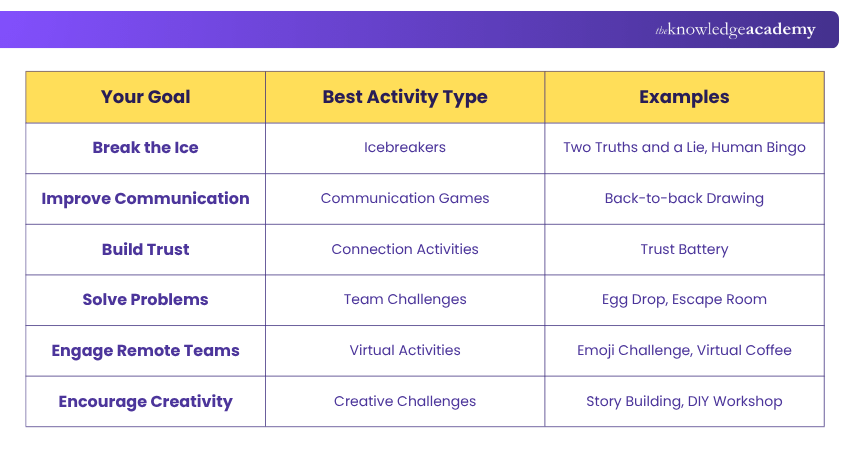
The most entertaining activity is not automatically the most useful one. The choice should begin with what you want the team to gain from the experience. Before selecting an activity, consider the following aspects:
1) Purpose: What should the activity aim to improve?
2) People: Who will participate and what are they comfortable with?
3) Team Size: Will everyone have an opportunity to contribute?
4) Location: Is the team office-based, remote or hybrid?
5) Time: Do you have five minutes, an hour or an entire day?
6) Accessibility: Can everyone participate comfortably?
7) Follow-up: How will you connect the activity with everyday teamwork?
50+ Best Team Building Activities for Work
Team Building Activities can strengthen communication, collaboration and workplace relationships. They range from quick icebreakers to creative and problem-solving challenges. Here are 50+ practical Team Building Activities to try at work:
Pick Your Team Challenge
1. Choose a number from 1–55. No scrolling. No peeking.2. Find the matching activity.3. Try it with your team.Ready? Pick a number!
1) Two Truths and a Lie
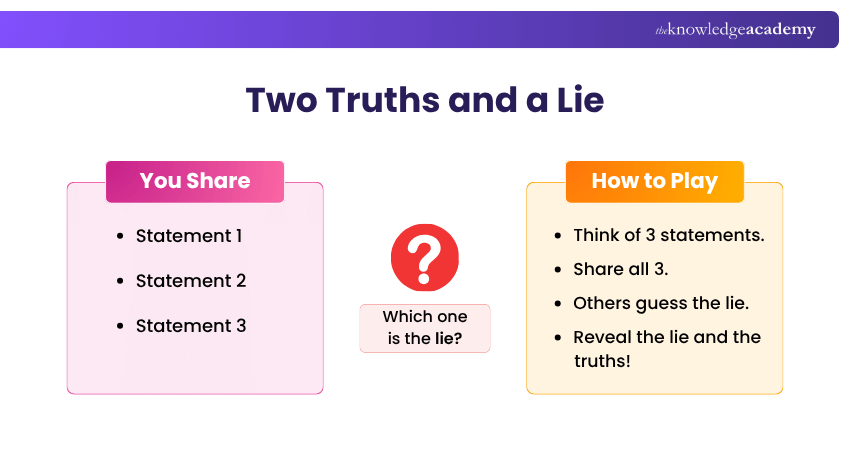
Each person shares three statements about themselves, with one being false. Colleagues guess the lie, helping team members discover interesting facts about one another in a relaxed setting.
2) Human Bingo
Create bingo cards containing interests, experiences or characteristics instead of numbers. Participants speak with colleagues to find someone who matches each square, encouraging interaction across the group.
3) Speed Networking
Not everyone gets the chance to interact beyond their usual circle at work. Pair colleagues for short conversations before rotating partners. It works particularly well for larger teams where employees may rarely have opportunities to speak with people outside their immediate group.
4) Three Question Mingle
Each person prepares three questions and discusses them with different colleagues for a limited time. The structure makes introductions more focused while encouraging meaningful conversation.
5) One-word Icebreaker
Ask each participant to describe a project, workplace topic or recent experience using one word. Discussing the reasons behind each choice can quickly reveal different perspectives.
6) What Do We Have in Common?
Divide colleagues into small groups and ask them to discover several things everyone shares. The exercise encourages questions and helps employees find connections beyond their job roles.
7) Name Juggling
Participants stand in a circle and pass a ball while saying the recipient's name. It is particularly useful for helping newly formed teams remember names while keeping introductions active.
8) Best and Worst
Give participants prompts such as "best advice you have received" or "worst travel experience". Comparing responses encourages conversation and gives colleagues a glimpse into one another's experiences.
9) Back-to-back Drawing
Pairs sit back-to-back while one person describes an image and the other attempts to draw it. Comparing the result afterwards demonstrates the importance of clear instructions and active listening.
10) Pictionary Relay
One person draws an assigned word while teammates attempt to identify it. The activity encourages quick interpretation and shows how easily messages can be understood differently.
11) Classify This
Give teams a collection of unrelated objects and ask them to organise everything into categories of their choice. Groups must explain their reasoning, highlighting how different perspectives can shape decisions.
12) Sales Pitch
Give individuals or teams an everyday office object and ask them to create a short sales pitch. The activity combines creativity, communication and quick thinking.
Tackle workplace challenges with greater confidence with the Problem Solving Course - Register today.
13) Team of Two
Pair employees and ask them to discuss how they work together, what helps their collaboration and what could improve. It can reveal simple changes that make everyday cooperation easier.
14) What I Need From You
Colleagues or departments explain what they need from one another to perform effectively. The exercise encourages people to make clear requests rather than relying on assumptions.
15) Egg Drop
Teams receive limited materials and must design something capable of protecting an egg when dropped from a specified height. The challenge encourages experimentation, planning and collective problem-solving.
16) Bridge Build
Give teams identical materials and ask them to construct a bridge capable of supporting a set weight. Participants must coordinate their ideas and manage limited resources effectively.
17) Tallest Tower
Teams compete to create the tallest freestanding tower using limited materials. The exercise encourages quick planning, creativity and adaptation when initial designs fail.
Enhance your strategic leadership skills to drive organisational success with Executive Strategy Training – Register today!
18) Scavenger Hunt
Create a list of clues, objects or tasks for teams to complete within a set time. Workplace facts and shared experiences can be incorporated to make the activity more relevant.
Did You Know?
Around 964,000 workers in Great Britain experienced work-related stress, depression or anxiety in 2024/25. This highlights the importance of healthier, more supportive workplace relationships.
19) Escape Room
Teams solve connected puzzles and clues within a time limit. Whether physical or virtual, the activity requires communication, shared reasoning and coordinated decision-making.
20) Marshmallow Challenge
Teams use spaghetti, tape, string and a marshmallow to construct the tallest freestanding structure they can. The exercise encourages rapid experimentation and collaboration.
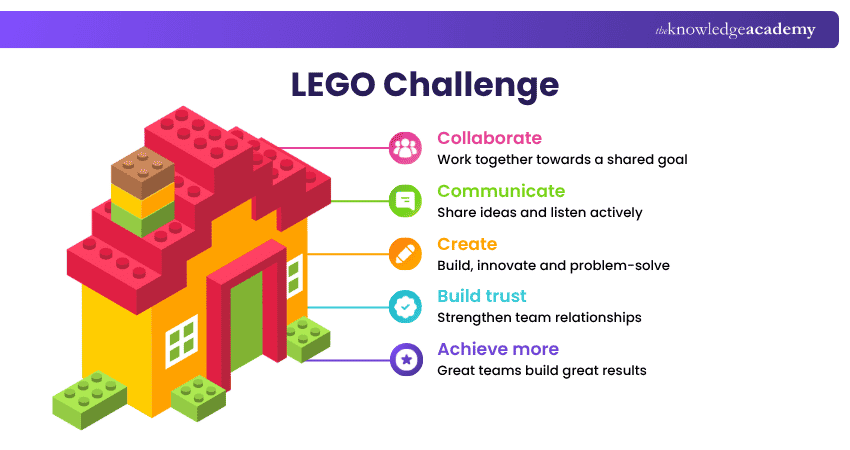
21) LEGO Challenge
Give teams LEGO pieces and ask them to create a structure or solution around a defined problem. Additional individual requirements can be introduced to test negotiation and coordination.
22) Helium Stick
Team members place their fingers beneath a lightweight pole and attempt to lower it while maintaining contact. The simple-looking challenge quickly tests patience, communication and coordination.
Pro Tip: Do not stop when the game finishes. Ask what worked, where communication failed and what the team would do differently next time. A short debrief helps turn an enjoyable exercise into useful workplace learning.
23) Trust Battery
Ask team members to reflect on the level of trust within their working relationships and discuss behaviours that increase or reduce it. The exercise encourages transparency around how trust is built.
24) Sharing Stories
Give participants prompts about meaningful experiences and invite them to share their responses in pairs or small groups. Listening to different experiences can encourage empathy and understanding.
25) Better Connections
Pairs respond to prompts such as a challenge they overcame or something they are proud of before rotating partners. It creates opportunities for more meaningful conversations between colleagues.
26) Heard, Seen, Respected
Participants share experiences in which they felt genuinely heard or respected. The group then identifies behaviours that could improve everyday workplace interactions.
27) Strength Building
One colleague shares an achievement while others identify strengths that may have contributed to it. The activity helps employees recognise abilities that colleagues see in them.
28) Strength Envelopes
Give every employee an envelope bearing their name. Colleagues add notes describing useful qualities, contributions or strengths they appreciate about that person.
29) Appreciations Exercise
Participants write something they value about each colleague and share the responses afterwards. It creates a structured opportunity for recognition and positive feedback.
30) Count up
The team attempts to count upwards without deciding who will speak next. If two people say a number simultaneously, the group starts again, requiring attention and awareness of others.
31) Snowball
Participants answer a question on paper and crumple their answers into "snowballs". After mixing them, everyone selects one and tries to identify who wrote it.
32) Non-verbal Improv
Give participants actions or situations that they must perform without speaking. Colleagues interpret what is happening, creating a light activity around non-verbal communication.
33) Team Trivia
Run a quiz based on general knowledge, company facts, past projects or team memories. It is simple to organise and can encourage friendly competition without requiring extensive preparation.
34) Team Sports
Organise an accessible sport or relay-style activity that requires teams to coordinate and communicate. Choose something suitable for the group's preferences and physical abilities.
35) Community Service
Participate together in a local clean-up, charity initiative or similar volunteering activity. The team works towards a shared objective while contributing to a wider cause.
Boost productivity through better planning and execution with Productivity and Time Management Training – Sign up soon!
36) Team Retreat
Move the team away from its normal working environment for a planned day of discussion, activities or informal interaction. Retreats can provide space for stronger connections and reflection.
37) Follow the Leader
One person performs simple movements or actions for colleagues to copy. It can work in person or through video-call gallery view as a quick energising activity.
38) Whose Office is it, Anyway?
Remote employees submit photographs of their workspaces and everyone tries to identify who each one belongs to. The activity gives colleagues a light glimpse into one another's working environments.
39) Online Multiplayer Games
Choose a cooperative online game where employees must communicate, strategise or solve problems together. The activity is particularly suitable for distributed teams.
40) Emoji Challenge
Ask team members to describe a weekend, project or mood using only emojis. Other participants interpret the symbols and try to guess the intended meaning.
41) Meme Contest
Give employees a workplace-related theme and ask them to create a suitable meme. Teams can vote for the funniest or most creative entry afterwards.
42) Virtual Coffee Break
Set aside a short optional video call without a project agenda. Remote colleagues can use the time for informal conversation similar to the interactions that happen naturally in shared offices.
43) Memory Wall
Create a physical or digital space where team members add favourite moments, project milestones, photographs or appreciation messages. It becomes a visual record of shared experiences.
44) Book Club
Select a book, article or other reading and schedule an informal discussion. Different interpretations can spark conversations that employees may not normally have during everyday work.
45) Story Building
One person begins a story with a sentence and each colleague adds another. Participants have to listen carefully because every contribution must connect with what came before.
46) Team Debate
Choose a light topic and divide participants into two groups. Teams prepare arguments together before presenting their position, encouraging communication and consideration of different perspectives.
47) Culture Exchange
Invite team members to share food, traditions, stories or experiences that are meaningful to them. It can help culturally diverse teams learn more about one another.
48) Team Brainstorming Session
Give the team a genuine or fictional challenge and ask everyone to generate potential solutions together. Focus first on creating ideas before evaluating which options are most practical.
49) Team Lunch or Dinner
Arrange a relaxed meal where colleagues can talk outside their normal project discussions. Simple social activities can give employees opportunities to build more natural working relationships.
50) Role-playing Scenarios
Give teams realistic workplace situations such as handling a difficult customer or responding to an unexpected project problem. Participants practise communication and decision-making while viewing situations from different roles.
51) Group Presentations
Give small teams a topic to research and present together. Participants must divide responsibilities, organise ideas and coordinate how the final presentation will be delivered.
52) DIY Workshop
Choose an accessible hands-on project such as crafting, painting or another simple creative task. Working alongside colleagues in an informal setting can encourage conversation and creativity.
53) Team-made Puzzle
Give participants separate pieces of an image that they must recreate individually before assembling the completed design together. It demonstrates how individual contributions affect a shared outcome.
54) Conflict Responses
Give teams a fictional workplace disagreement and ask them to identify responses that could improve or worsen the situation. The group can then develop practical principles for handling similar situations constructively.
55) Feedback Exercise
Give participants a structured opportunity to practise giving and receiving constructive feedback. The aim is to make feedback clearer, more useful and easier to discuss during everyday work.
Tips for Running Successful Team Building Activities
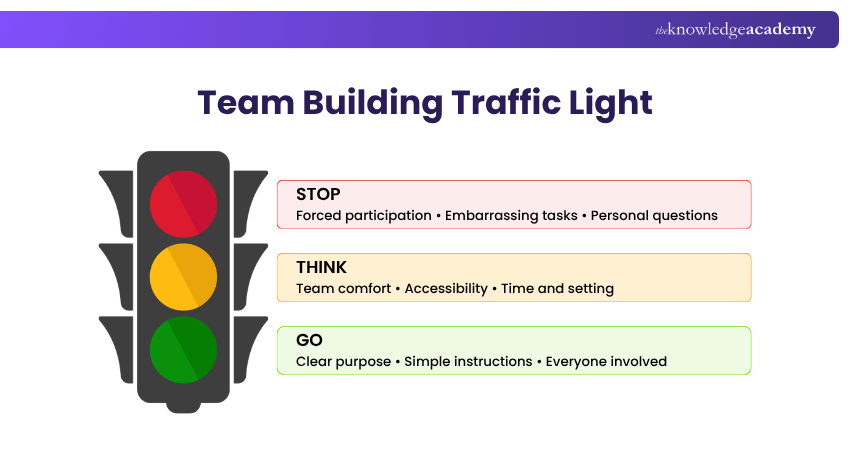
Even a good activity can fall flat if the purpose is unclear or employees feel uncomfortable participating. Planning should therefore focus as much on the people involved as on the exercise itself. Here are some practical ways to make team building more effective:
• Set a Clear Purpose: Know what you want the team to gain before selecting the activity.
• Keep Participation Inclusive: Consider physical ability, personality differences and accessibility.
• Explain the Activity Clearly: Confusing instructions can distract from the intended outcome.
• Avoid Forced Personal Disclosure: Employees should not feel pressured to reveal information they would rather keep private.
• Keep Competition Healthy: Winning should never become more important than participation.
• Give Everyone a Role: Avoid activities where several employees become passive observers.
• Debrief Afterwards: Discuss what the team noticed and how it relates to everyday work.
• Collect Feedback: Use employee responses to improve future activities.
Poorly planned activities can feel exclusionary or create forced interactions, making thoughtful facilitation essential.
Quick Team Building Activity Checklist
Before starting an activity, use this quick checklist to confirm it is purposeful, inclusive, accessible, clearly explained, and followed by reflection.
Quick Team Building Activity Checklist
Before choosing an activity, check:
☐ The activity has a clear purpose☐ Everyone can comfortably participate☐ It fits the available time☐ It works for the team size☐ Instructions are simple and clear☐ Required materials are ready☐ The activity suits the workplace setting☐ Everyone has a chance to contribute
Taking a moment to check these essentials can make the activity more engaging, accessible and worthwhile for everyone involved.
Conclusion
We hope this blog has shown that effective Team Building Activities do not need to be complicated to make a difference. The right exercise can create better conversations, stronger relationships and new ways of working together, but its real value appears when those improvements continue after the activity ends.
Build the competencies needed to thrive in a dynamic workplace with Personal and Organisational Development Training – Join now!
Frequently Asked Questions
How Often Should You Organise Team Building Activities?

There is no fixed schedule for every workplace. Short activities can be used regularly, while larger events may be organised occasionally based on team needs and working arrangements.
How Long Should a Team Building Activity Last?
An activity can last anywhere from a few minutes to several hours. The duration should reflect the purpose of the activity rather than making it longer than necessary.
Should Managers Participate in Team Building Activities?
Managers can participate when their involvement supports open interaction. However, facilitators should consider whether their presence could make employees less comfortable sharing or participating freely.

William Brown


Senior Business Analyst and Strategic Advisor
William Brown is a senior business analyst with over 15 years of experience driving process improvement and strategic transformation in complex business environments. He specialises in analysing operations, gathering requirements and delivering insights that support effective decision making. William’s practical approach helps bridge the gap between business goals and technical solutions.
View Detail

 If you wish to make any changes to your course, please


