


 Top Rated Course

We may not have the course you’re looking for. If you enquire or give us a call on +44 1344 203 999 and speak to our training experts, we may still be able to help with your training requirements.
How to Pay Corporation Tax: A Step-by-step Instructions
Scarlett Adams 15 December 2025Learn to pay Corporation Tax with this easy-to-follow process, from calculating profits to registering, meeting deadlines, and filing your tax return on time. Missing deadlines or making errors can lead to fines and extra charges, so it's important to stay organised, maintain accurate records, and seek help from an accountant if needed.

Training Outcomes Within Your Budget!
We ensure quality, budget-alignment, and timely delivery by our expert instructors.
Table of Contents
You finally made a profit, time to celebrate, right? But wait, before you start the celebration, there’s one more thing to handle: HMRC wants its share. Yep, it’s time to talk about Corporation Tax. It’s not the fun part of running a business, but it’s super important if you want to stay out of trouble. In this blog, we’ll explain what Corporation Tax is, How to Pay Corporation Tax step by step, share three ways to reduce your tax bill, what to do if you owe nothing, and how to check if His Majesty’s Revenue and Customs (HMRC) received your payment.
Table of Contents
1) What is Corporation Tax?
2) Step-by-step Instructions for How to Pay Corporation Tax
3) Top 3 Ways to Reduce Your Corporation Tax Bill
4) How to Notify HMRC If No Tax is Due?
5) How do I Know if HMRC got my Tax Payment?
6) Conclusion
What is Corporation Tax?
Corporation Tax is a type of tax that your company pays on the money it earns. If your business makes a profit, you must give a part of that money to the UK government.

You pay this tax on:
1) Money made from selling products or services
2) Interest from savings or investments
3) Profit from selling things like property or equipment
There’s no tax-free amount; you pay tax on all your profits. Most businesses pay between 19% and 25%, depending on how much they earn.
To pay Corporation Tax, you need to:
1) Work out how much profit your business made
2) Fill in a form called CT600
3) Send the form to HMRC
4) Pay the tax by the deadline
You must do this every year. If you don’t, your company could get a fine.
Step-by-step Instructions for How to Pay Corporation Tax
Paying Corporation Tax might sound difficult, but it can be easy if you keep following the steps in order. Here's a simple guide to help you through the process:
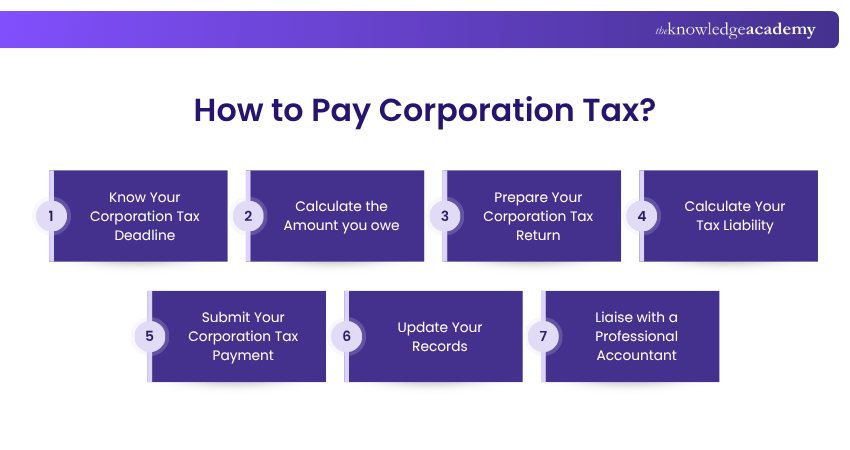
1) Know Your Corporation Tax Deadline
You must pay Corporation Tax 9 months and 1 day after your company’s accounting year ends.
If you pay late, HMRC will charge you:
1) £100 fine if up to 3 months late
2) £10 per day if 3 to 6 months late (up to £900)
3) 5% of your tax (or £300) if 6 to 12 months late
4) Another 5% if more than 12 months late
So always check your deadline and pay on time.
Become proficient in Financial planning and control for business success. Join our Management Accounting (FMA) Training now!
2) Calculate the Amount you owe
First, work out how much profit your company made during the year.
To do this:
1) Add up all the money your company earned
2) Take away all the business expenses (like rent, wages, or supplies)
The amount left is your profit, and that’s what you pay tax on.
3) Prepare Your Corporation Tax Return
You must fill in a form called CT600 to tell HMRC about your profits.
To do this, you need to:
1) Register for Corporation Tax (if you haven’t already)
2) Use HMRC’s online service or accounting software
3) Be very careful and honest when filling out the form
Mistakes can lead to fines or more taxes later.
4) Calculate Your Tax Liability
After you send your tax return, HMRC will tell you how much tax you need to pay. This is called your tax liability.
They will send you a payslip showing:
1) How much to pay
2) When to pay it
Keep this payslip safe and check it carefully.
5) Submit Your Corporation Tax Payment
Once you know how much to pay, choose how you want to pay for it. You can:
1) Set up a Direct Debit (HMRC will take it from your bank on the right day)
2) Pay using your online banking
3) Use CHAPS or BACS for big payments
4) Use a debit or credit card on HMRC’s website
Always use your 17-digit reference so HMRC knows the payment is from your company.
6) Update Your Records
After you pay, make sure to keep a copy of everything:
1) Your CT600 tax return
2) Your payment receipt or bank record
3) The HMRC payslip
4) Any documents you used to work out your profits
This helps you stay ready if HMRC asks questions and makes things easier next year.
7) Liaise with a Professional Accountant
If you’re unsure about any step, it’s best to speak to an accountant.
A good accountant can help you:
1) Fill out your tax return correctly
2) Pay the right amount
3) Claim all the tax reliefs you’re allowed
4) Avoid fines or mistakes
5) Plan better for the next year
This saves you time, money, and stress.
Acquire essential book keeping skills to maintain financial records. Join our Recording Financial Transactions (FA1) Training now!
Top Three Ways to Reduce Your Corporation Tax Bill
Running a business means looking for smart and legal ways to pay less tax. Here are three simple ways to reduce your Corporation Tax bill:
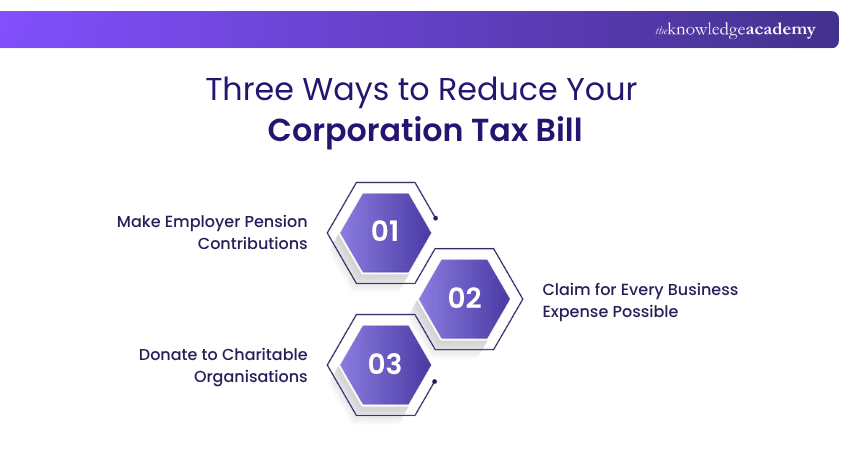
1) Make Employer Pension Contributions
Putting money into a pension for yourself or your employee counts as a business expense. It lowers your company’s profit, so you pay less Corporation Tax.
Examples of Pension Contributions:
1) Director’s pension
2) Staff workplace pensions
3) Approved company pension schemes
2) Claim for Every Business Expense Possible
Business expenses reduce your profit, which means you pay less tax. Always record your spending and keep receipts.
Examples of Business Expenses:
1) Office rent and utility bills
2) Staff wages and bonuses
3) Travel, fuel, and parking
4) Internet, phone, and software
3) Donate to Charitable Organisations
Donating to a registered charity is a business cost that reduces your taxable profit. This helps lower your Corporation Tax bill.
Examples of Donations:
1) Gift Aid donations
2) Charity sponsorships
3) One-off company donations
How to Notify HMRC If No Tax is Due?
Even if your company doesn’t owe any tax, you must still tell HMRC.
Here’s how:
1) File your CT600 tax return as normal, showing £0 tax due
2) Tick the box saying no tax is owed
3) Submit it before the deadline
If you miss this, HMRC can still fine you, even if you owe nothing.
How do I Know if HMRC got my Tax Payment?
After you send your payment:
1) HMRC usually shows your payment in your online account within a few days
2) Log in to your HMRC account to check
3) Go to the “Payments” or “Statement” section
4) If you don’t see the payment after a few days, contact HMRC for help
Tip: Use the correct reference number and save the payment proof.
Conclusion
Understanding How to Pay Corporation Tax is an important part of running a business in the UK. By understanding your deadlines, keeping clear records, and following each step carefully, you can avoid mistakes and stay on the right side of HMRC. With good planning and support, paying Corporation Tax becomes simple and stress-free, helping you focus on growing your business smoothly.
Learn core accounting skills with our ACCA Foundation Training – Join now!
Frequently Asked Questions
How do I Pay my LTD Company Tax?

To pay your LTD company tax, first work out your profit. Then fill out a CT600 form and send it to HMRC. After that, pay the tax using your business bank account or HMRC’s website. Don’t forget to use your 17-character payment reference.
How Does a Company Pay Corporation Tax?
A company pays Corporation Tax in this order:
1) Work out how much profit it made
2) Calculate the tax owed using the correct rate
3) Send the CT600 tax return
4) Pay HMRC using bank transfer, debit card or Direct Debit
5) It’s due 9 months and 1 day after your company’s year ends
What are the Other Resources and Offers Provided by The Knowledge Academy?
The Knowledge Academy takes global learning to new heights, offering over 3,000 online courses across 490+ locations in 190+ countries. This expansive reach ensures accessibility and convenience for learners worldwide.
Alongside our diverse Online Course Catalogue, encompassing 19 major categories, we go the extra mile by providing a plethora of free educational Online Resources like Blogs, eBooks, Interview Questions and Videos. Tailoring learning experiences further, professionals can unlock greater value through a wide range of special discounts, seasonal deals, and Exclusive Offers.
What is The Knowledge Pass, and How Does it Work?
The Knowledge Academy’s Knowledge Pass, a prepaid voucher, adds another layer of flexibility, allowing course bookings over a 12-month period. Join us on a journey where education knows no bounds.
What are the Related Courses and Blogs Provided by The Knowledge Academy?
The Knowledge Academy offers various ACCA Foundation Training, including the Foundations in Taxation (FTX) Training, Maintaining Financial Records (FA2) Training, and the Management Accounting (FMA) Training. These courses cater to different skill levels, providing comprehensive insights into Payroll Outsourcing.
Our Accounting and Finance Blogs cover a range of topics related to Corporation Tax, offering valuable resources, best practices, and industry insights. Whether you are a beginner or looking to advance your accounting skills, The Knowledge Academy's diverse courses and informative blogs have got you covered.
Upcoming Accounting and Finance Resources Batches & Dates
Date
 Foundations in Taxation (FTX)

 If you wish to make any changes to your course, please


