Who should attend this Six Sigma Yellow Belt Course?
Six Sigma Yellow Belt Course is designed for individuals who want to learn the basics of Six Sigma and how to apply it to their work. The following professionals can benefit from attending this Six Sigma Training Course:
- Quality Assurance Beginners
- Data Scientists
- Data Analysts
- Business Process Analysts
- Project Engineers
- Process Development Engineers
- Operating System Specialists
Prerequisites of the Six Sigma Yellow Belt Course
There are no formal prerequisites for this Six Sigma Training. However, a basic understanding of business and statistics will be beneficial before attending this Six Sigma Course.
Six Sigma Yellow Belt Course Overview
The Six Sigma Yellow Belt Course provides an essential introduction to the principles of Six Sigma Principles, offering a comprehensive overview of this widely recognised quality management methodology. As organisations increasingly prioritise efficiency and quality improvement, understanding Six Sigma Training becomes crucial for professionals across various industries.
Professionals seeking to enhance their problem-solving skills and contribute to process improvement initiatives should aim to master the Six Sigma Yellow Belt Course. This Six Sigma Course is particularly valuable for individuals involved in project teams or those who want to gain foundational knowledge in process improvement methodologies.
The Knowledge Academy's 2-day Six Sigma Course on the Six Sigma Yellow Belt Course equips delegates with practical tools and techniques, empowering them to actively participate in Six Sigma projects. This intensive Six Sigma Training covers key concepts, such as DMAIC (Define, Measure, Analyse, Improve, Control), enabling delegates to apply Six Sigma principles in their respective roles. By the end of the Six Sigma Course, delegates are prepared to contribute effectively to organisational success through the application of Six Sigma methodologies.
Course Objectives
- To comprehend the fundamental principles of Six Sigma Certification
- To master the DMAIC methodology (Define, Measure, Analyse, Improve, Control)
- To gain practical skills in process improvement and problem-solving
- To understand the role of a Six Sigma Yellow Belt in project teams
- To apply acquired knowledge to contribute effectively to organisational efficiency and quality enhancement
Upon completion of this Six Sigma Course, delegates will possess a comprehensive understanding of Six Sigma principles and practical skills in process improvement, empowering them to play an active role in enhancing organisational performance and quality standards.
Benefits of Six Sigma Yellow Belt Training
Six Sigma Yellow Belt Training builds a strong foundation in Six Sigma concepts and structured improvement thinking. It enables professionals to support improvement initiatives using recognised methods, tools, and metrics.
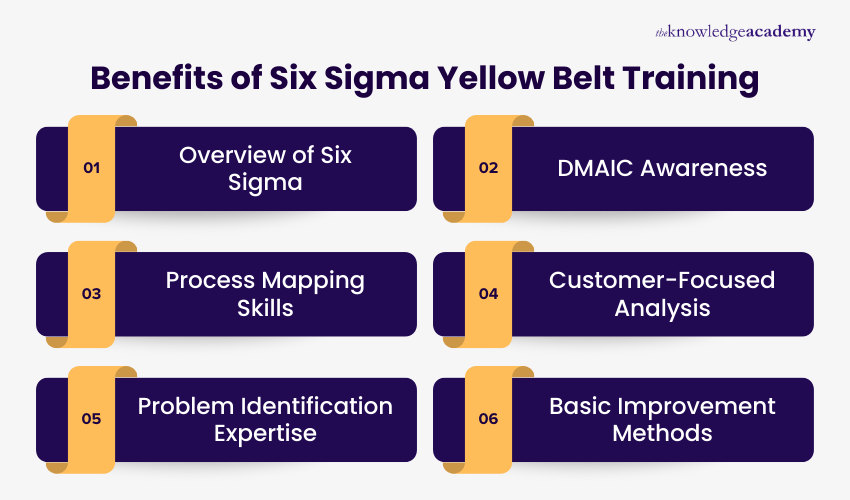
Here are the core benefits of this training:
- Overview of Six Sigma: Understand Six Sigma principles, customer value, waste (Muda), process types, demand variation, and key performance metrics.
- DMAIC Awareness: Develop working knowledge of the Define, Measure, Analyse, Improve, Control (DMAIC) cycle and commonly used phase-specific tools.
- Process Mapping Skills: Gain the ability to create Suppliers, Inputs, Process, Outputs, Customers (SIPOC) diagrams, process maps, and value stream maps to visualise workflows clearly.
- Customer-Focused Analysis: Learn to apply Voice of the Customer (VOC), Critical to Quality (CTQ) requirements, and Kano analysis effectively.
- Problem Identification Expertise: Learners will develop the capability to identify root causes using 5 Whys, prioritisation tools, and structured problem-solving frameworks.
- Basic Improvement Methods: Learners will be skilled in Lean tools, including 5s, Poka Yoke, Kaizen, Kanban, and Statistical Process Control (SPC) fundamentals.





 If you miss out, enquire to get
yourself
on the waiting list for the next day!
If you miss out, enquire to get
yourself
on the waiting list for the next day!













 If you wish to make any changes to your course, please


