Who Should Attend this Financial Accounting Course?
This course is ideal for individuals looking to develop a strong foundation in financial accounting. It is suitable for those eager to understand financial statements, reporting, compliance, and decision-making, helping them apply accounting principles effectively across various industries.
- Accountants
- Business Owners
- Investment Analysts
- Financial Consultants
- Tax Advisors
- Banking Professionals
- Finance Executives
- Auditors
Prerequisites of the Financial Accounting Course
There are no formal prerequisites for this Financial Accounting Course. However, having at least two A Levels and three GCSEs, including English and Mathematics, is recommended. A good command of English is essential, as all course materials, assessments, and discussions are conducted in English.
Financial Accounting Course Overview
Financial accounting is essential for recording, summarising, and reporting business transactions, ensuring transparency and compliance. This course provides a strong foundation in financial principles, reporting standards, and decision-making, making it relevant for individuals aiming to excel in finance-related roles across various industries.
Proficiency in financial accounting is crucial for understanding business performance, managing resources, and ensuring regulatory compliance. It is valuable for professionals involved in finance, auditing, management, and investment. Mastering financial accounting helps individuals make informed financial decisions, improving operational efficiency and contributing to business growth.
This Financial Accounting Course by The Knowledge Academy equips delegates with essential skills in financial statement preparation, analysis, and compliance. Delegatess will gain practical knowledge of accounting principles, reporting frameworks, and financial controls. By the end, delegates will be confident in interpreting financial data, improving business decision-making, and maintaining accuracy in financial reporting.
Financial Accounting Course Objectives
- To understand fundamental financial accounting principles and their applications
- To prepare and interpret financial statements accurately
- To analyse financial reports for decision-making and performance evaluation
- To ensure compliance with international accounting standards
- To apply key accounting concepts such as accruals, matching, and consistency
- To manage financial records effectively and ensure accurate bookkeeping
After completing this course, delegates will receive a Financial Accounting Certification, validating their expertise in financial reporting, compliance, and analysis. This certification enhances career prospects in finance, accounting, and management, demonstrating a strong understanding of financial principles and practical applications in professional settings.
Key Skills Gained from ACCA Financial Accounting (FA) Course
The ACCA Financial Accounting (FA) Course equips learners with essential accounting skills to record, prepare, and interpret financial information. Professionals build confidence in handling financial data and understanding how financial statements support business decision-making.
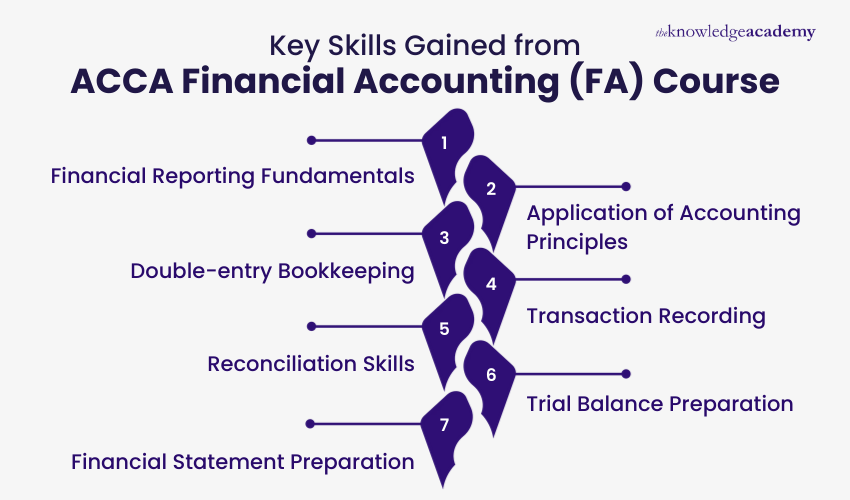
Key skills gained from this training include:
- Financial Reporting Fundamentals: Develop a clear understanding of the purpose, structure, and regulatory context of financial reporting.
- Application of Accounting Principles: Apply accounting concepts, qualitative characteristics, and frameworks to prepare reliable financial information.
- Double-entry Bookkeeping: Maintain financial transactions accurately using double-entry bookkeeping systems and maintain proper accounting records.
- Transaction Recording: Record and adjust sales, purchases, assets, depreciation, accruals, prepayments, receivables, and payables accurately.
- Reconciliation Skills: Carry out bank, receivables, and payables reconciliations to ensure accuracy and completeness of financial records.
- Trial Balance Preparation: Compile trial balances, identify errors, and use suspense accounts where necessary.
- Financial Statement Preparation: Prepare basic financial statements, including statements of profit or loss, financial position, and cash flows.





 If you miss out, enquire to get
yourself
on the waiting list for the next day!
If you miss out, enquire to get
yourself
on the waiting list for the next day!













 If you wish to make any changes to your course, please


