


 Top Rated Course

We may not have the course you’re looking for. If you enquire or give us a call on + 1-866 272 8822 and speak to our training experts, we may still be able to help with your training requirements.
What is Capital Investment: Types, Benefits, and How it Works
The Knowledge Academy 11 March 2026Capital Investment involves spending on long-term assets like property, machinery, or technology to boost efficiency, expand capacity, and generate returns. It supports long-term growth by increasing productivity and competitiveness. Although costly upfront, it delivers sustained value and stronger business performance.

Training Outcomes Within Your Budget!
We ensure quality, budget-alignment, and timely delivery by our expert instructors.
Table of Contents
Every business needs more than just good ideas; it needs smart financial planning to turn them into action. Knowing What is Capital Investment helps companies grow, upgrade resources, and build a strong base for future success through actions like buying machines, expanding offices, or training employees.
In this blog, you’ll learn about What is Capital Investment, how it works, its types, benefits, risks, and examples. You’ll also explore key factors that influence investment decisions and the difference between investment and Capital Investment for better business growth.
Table of Contents
1) What is Capital Investment?
2) How Capital Investment Works?
3) Types of Capital Investment
4) Advantages and Disadvantages of Capital Investment
5) Example of Capital Investment
6) Factors Influencing Capital Investment Decisions
7) What is the Difference Between Investment and Capital Investment?
8) How is Capital Taxed?
9) Conclusion
What is Capital Investment?
Capital Investment refers to a company’s strategic spending on long-term assets like Real Estate, machinery, technology or intellectual property to support growth and efficiency. It helps businesses expand, modernise operations or replace outdated assets for improved productivity.
Such investments are vital for sustaining innovation, strengthening market position, and ensuring long-term profitability in a competitive environment. When considering What is Capital Investment, careful planning helps companies balance risks and rewards to achieve steady and sustainable progress.
Key Points:
a) Involves acquiring or upgrading assets for long-term growth
b) Funded through cash, loans, venture capital, or stock
c) Enhances efficiency, innovation, and competitiveness
d) Recorded as non-current assets and depreciated over time
e) May create cash flow risks and higher expenses

How Capital Investment Works?
Capital Investment is a strategic undertaking that involves careful planning, analysis, and implementation to ensure the allocation of resources yields fruitful returns. The Investment process can be shattered into several key stages:
1) Identification of Investment Opportunities
The process begins with identifying opportunities that match a company’s growth goals. This involves studying markets, understanding customer needs, and tracking new technologies. Knowing the Characteristics Of Investment helps assess these opportunities. Through brainstorming and collaboration, companies can find ways to enter new markets, create innovative products, and drive lasting growth.
2) Evaluation of Potential Investments
Following opportunity identification, a comprehensive evaluation using feasibility studies, Risk Assessments, and cost-benefit analyses becomes imperative. Businesses scrutinise the viability of each investment by utilising financial metrics like Net Present Value (NPV), Internal Rate of Return (IRR), and payback period. This evaluation aids decision-makers in understanding potential returns against inherent risks, facilitating informed choices and minimising the likelihood of investing in misaligned projects.
3) Decision-making and Planning
Building on the evaluation, decision-makers must choose the most suitable investments. This involves prioritising projects, allocating budgets, and formulating implementation plans. Strategic alignment with company objectives ensures investments contribute to long-term success. Effective planning establishes the foundation for optimal resource utilisation, early addressing potential challenges, and foreseeing the project's trajectory.
4) Implementation and Monitoring
Moving into the implementation phase, investments require coordination, resource allocation, and adherence to timelines. Regular monitoring and reporting track progress against milestones, enabling timely intervention in case of deviations. This phase ensures projects stay on track, resources are used efficiently, and intended outcomes are achieved, mitigating risks of delays or budget overruns.
5) Review and Continuous Improvement
Post-execution, a review phase commences, comparing actual outcomes with initial projections. It involves introspection into successes and areas for improvement. Valuable insights from successful projects inform future decisions, fostering a culture of adaptability and innovation. Continuous improvement stems from a commitment to learning from successes and failures, contributing to an evolving and more effective Capital Investment process.
Understand branding strategies and their impact on market presence with our Real Estate Marketing Training – Register today!
Types of Capital Investment
This section explains the main types of Capital Investment that help businesses grow and stay efficient. Let’s explore each type briefly.
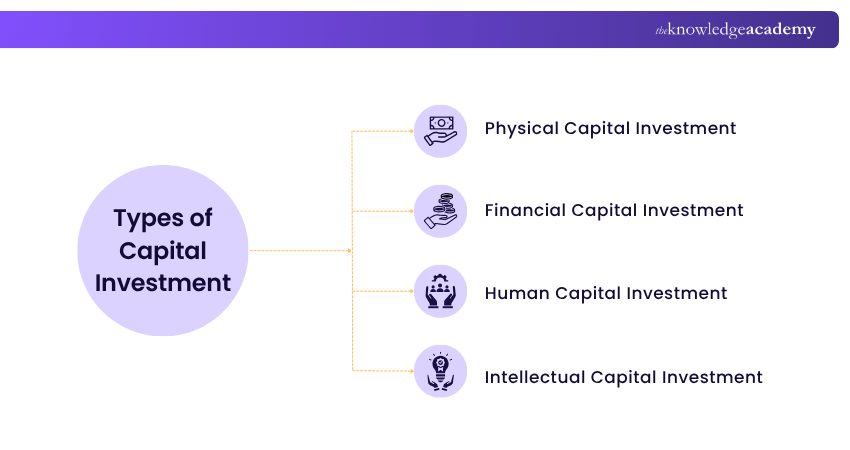
1) Physical Capital Investment
Physical Capital Investment means spending money on things a business can touch or use daily, like buildings, machines, land, tools and vehicles. These investments help increase production, improve efficiency and support business growth. For example, a factory may buy new machines to make work faster and cheaper, helping it stay strong and grow over time.
2) Financial Capital Investment
Financial Capital Investment is when a business or person puts money into financial products like shares, bonds or startups to earn money later. These investments bring profits through interest, dividends or value growth. However, they also come with risks, so careful planning and spreading money across different options help reduce losses and build a stable income.
3) Human Capital Investment
Human Capital Investment focuses on improving employees’ skills, knowledge and motivation. Companies do this through training, education and health programmes. A well-trained team works better, serves customers more efficiently and adjusts easily to changes. Investing in people helps a business stay productive, creative and successful for a long time.
4) Intellectual Capital Investment
Intellectual Capital Investment is about protecting and creating ideas that give a business an advantage. This includes patents, trademarks, copyrights and brand value. Investments help companies stand out, attract investors and earn through partnerships. In today’s world, where ideas matter most, investing in intellectual property keeps a business innovative and ahead.
Advantages and Disadvantages of Capital Investment
Capital Investment helps a business grow, but it also comes with some risks. Knowing both sides helps companies make better choices.
Advantages:
a) Business Growth: Helps expand work, enter new markets, and increase production
b) Better Efficiency: New machines or technology make work faster and cheaper
c) Higher Profits: Brings more income and saves money over time
d) Staying Competitive: Keeps the business updated with new trends and tools
e) More Company Value: Makes the business stronger and more attractive to investors
Disadvantages:
a) High Cost: Needs a lot of money to start
b) Risk of Loss: If the project fails, the company can lose money
c) Hard to Access Funds: Money is tied up for a long time and cannot be used easily
d) Delays: Projects can take longer than planned
e) Changing Markets: New competition or market changes can lower profits
Example of Capital Investment
Capital Investment means spending money on things that help a business grow in the future. For example, a factory may buy new machines to make more products faster. A tech company might upgrade its computers or servers to work better and protect data.
A retail shop could open a new branch to reach more customers, or a delivery company might buy new vehicles to serve more areas. These examples show how Capital Investments help businesses work better, earn more, and grow steadily over time.
Explore modern strategies and portfolio planning for smarter investing. Join our Investment Management Course now!
Factors Influencing Capital Investment Decisions
Making sound Capital Investment decisions is a complex process influenced by a large number of factors that shape the potential risks and rewards of each opportunity. These factors are pivotal in guiding decision-makers towards investments that match with the company's goals and contribute to its growth. Let's dive into the primary considerations that influence Capital Investment decisions:
a) Investment Objective: The intended purpose of an investment guides the allocation of funds, whether for short-term gains or long-term growth. This objective serves as the starting point in the Decision-making Process.
b) Return on Investment (ROI): Managers prioritise positive returns, aiming to invest limited funds in profitable assets or securities.
c) Return Frequency: The periodic returns offered by an investment are crucial, with investors choosing based on financial needs, whether monthly, quarterly, semi-annual, or annual returns.
d) Risk Analysis: Assessing the risk associated with an investment is essential, considering that each investor and company has a different risk appetite.
e) Maturity Period or Investment Tenure: Investor decisions are influenced by the duration funds are locked in an investment, affecting both maturity and payback periods.
f) Tax Implications: Tax liability linked to a specific asset or security is a significant determining factor, with investors avoiding heavily taxed opportunities.
g) Safety: Investments in assets adhering to regulatory frameworks and providing transparent financial disclosure are deemed safe, with government-backed assets considered the most secure.
h) Volatility: Market fluctuations can significantly impact investment returns, necessitating careful consideration.
i) Liquidity: Investors value the ability to access emergency funds, considering withdrawal restrictions and penalties when evaluating the liquidity of an asset or security.
j) Inflation Rate: Investors seek opportunities where returns outpace the nation's inflation rate in Financial Management decisions.
What is the Difference Between Investment and Capital Investment?
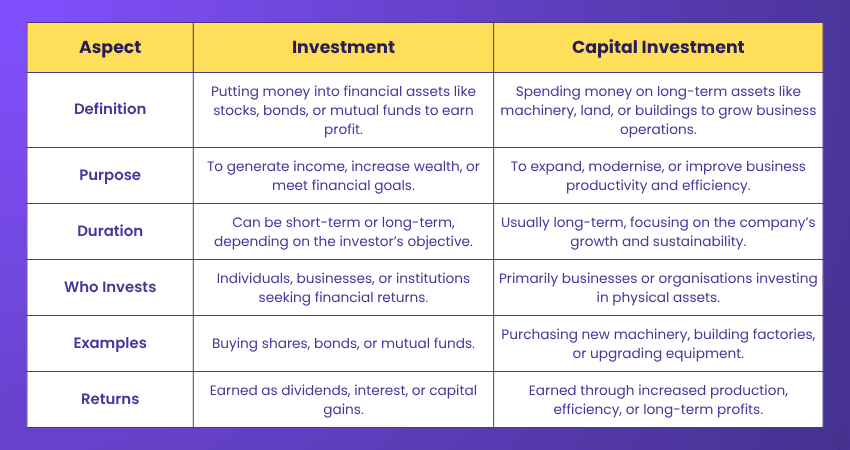
Investment means putting money into something to earn a profit, like buying shares, bonds, or mutual funds. It can be short-term or long-term, depending on your goal. People invest to grow their wealth, save for the future, or achieve specific financial targets.
Capital Investment, on the other hand, is when a business spends money on assets like machines, buildings, or equipment to grow and work more efficiently. It’s usually a long-term decision made to improve the company’s future performance.
How is Capital Taxed?
Capital is taxed mainly through Capital Gains Tax (CGT). When you sell or dispose of an asset such as property, shares, or investments, tax is charged on the profit (gain) you make, not on the total value.
The amount of tax depends on factors like the type of asset, how long it was held, and the applicable tax rates. In many cases, allowances, exemptions, or reliefs may reduce the tax payable, encouraging long-term investment.
Conclusion
In essence understanding What is Capital Investment is helps businesses make smarter financial decisions for future growth. It is key to improving efficiency, expanding operations, and staying competitive. By investing in the right assets like machines, technology, or skilled employees, companies can build a strong base for lasting success and create steady opportunities for long-term progress.
Gain practical insights through real-world case studies and hands-on simulations. Join our Investment Banking Training now!
Frequently Asked Questions
What are the Risks Associated with Capital Investment?

Capital Investment offers growth opportunities but also carries risks. Projects may underperform, causing financial loss. Since funds are tied up long-term, accessing them quickly can be hard. Rising costs, project delays, or market changes can also reduce returns. Knowing these risks helps businesses plan better and invest wisely.
Why is an Investment Decision Important?
An investment decision is important because it helps decide how to use money wisely for the best results. The right choice can increase profits, support growth, and reduce risk. It also ensures funds are used for projects that bring long-term value and help achieve business or personal goals effectively.
What are the Other Resources and Offers Provided by The Knowledge Academy?
The Knowledge Academy takes global learning to new heights, offering over 3,000+ online courses across 490+ locations in 190+ countries. This expansive reach ensures accessibility and convenience for learners worldwide.
Alongside our diverse Online Course Catalogue, encompassing 19 major categories, we go the extra mile by providing a plethora of free educational Online Resources like Blogs, eBooks, Interview Questions and Videos. Tailoring learning experiences further, professionals can unlock greater value through a wide range of special discounts, seasonal deals, and Exclusive Offers.
What is The Knowledge Pass, and How Does it Work?
The Knowledge Academy’s Knowledge Pass, a prepaid voucher, adds another layer of flexibility, allowing course bookings over a 12-month period. Join us on a journey where education knows no bounds.
What are the Related Courses and Blogs Provided by The Knowledge Academy?
The Knowledge Academy offers various Investment and Trading Training, including the Investment Banking Training, Investment Management Course, and the Investment and Portfolio Management Course. These courses cater to different skill levels, providing comprehensive insights into What are Bonds.
Our Business Skills Blogs cover a range of topics related to Capital Investment, offering valuable resources, best practices, and industry insights. Whether you are a beginner or looking to advance your Investment skills, The Knowledge Academy's diverse courses and informative blogs have got you covered.

The Knowledge Academy


Global Training Provider
The Knowledge Academy is a world-leading provider of professional training courses, offering globally recognised qualifications across a wide range of subjects. With expert trainers, up-to-date course material, and flexible learning options, we aim to empower professionals and organisations to achieve their goals through continuous learning.

Upcoming Advanced Technology Resources Batches & Dates
Date
 Cryptocurrency Trading Training
Cryptocurrency Trading Training
Fri 20th Mar 2026
Cryptocurrency Trading Training
Fri 15th May 2026
Cryptocurrency Trading Training
Fri 17th Jul 2026
Cryptocurrency Trading Training
Fri 20th Nov 2026

 If you wish to make any changes to your course, please


