


 Top Rated Course

We may not have the course you’re looking for. If you enquire or give us a call on + 1-866 272 8822 and speak to our training experts, we may still be able to help with your training requirements.
What is Marginal Cost? Formula & Examples
Olivia Taylor 09 February 2026Marginal Cost is the extra cost of producing one more unit, helping businesses decide optimal output by comparing it with marginal revenue. It plays a crucial role in deciding cost-efficient production levels and pricing strategies. Analysing fixed and variable expenses helps businesses to understand when increasing output is profitable.

Training Outcomes Within Your Budget!
We ensure quality, budget-alignment, and timely delivery by our expert instructors.
Table of Contents
What if the secret to smarter pricing and better profits came down to just one more unit? After all, in the unpredictable world of business, every extra unit produced can tip the scales between profit and loss. This is where Marginal Cost steps into the spotlight. It's a powerful metric that reveals the hidden story behind your production decisions.
This blog takes a deep dive into What is Marginal Cost. You'll learn how to calculate its value accurately, its different types, its various pros and cons, and more. Read on, embrace this game-changing concept, and discover how to turn it into your strategic superpower!
Table of Contents
1) What is Marginal Cost?
2) Marginal Cost Formula and Calculation
3) Steps to Calculate Marginal Cost
4) Marginal Cost Examples
5) What are the Different Types of Marginal Costs?
6) Pros and Cons of Using Marginal Cost
7) What Does Marginal Cost Depend on?
8) Conclusion
What is Marginal Cost?
Marginal Cost is the extra cost a business incurs to produce one additional unit of a service or product. It emerged during the Industrial Revolution, when businesses and economists raised questions about how much production leads to the highest profits. Unlike fixed costs, which stay the same regardless of output, Marginal Cost focuses on the cost of producing the next unit.
For example, a bakery may produce an extra loaf of bread cheaply when its ovens have space and staff are available. In case demand rises, and more workers shift, or equipment is required, the cost of producing additional loaves will increase. This means when production nears capacity, diminishing returns arise, and costs start increasing.

Marginal Cost Formula and Calculation
Marginal Cost helps businesses to measure how much extra money is required to produce the next unit. For calculating it, the standard formula is:
Marginal Cost = Change in Total Cost/Change in Total Quantity, where:

a) MC stands for Marginal Cost.
b) ΔTC represents the change in total cost.
c) ΔQ indicates the change in total quantity.
While total cost includes both fixed costs (FC) and variable costs (VC), fixed costs do not change with output. This is why, usually, Marginal Cost cacluation focuses on variable cost changes. Then, formula is simplified to:
Marginal Cost = (Change in Variable Cost)/ (Change in Quantity Produced)
For an accurate calculation of Marginal Cost, businesses need to include relevant variable expenses, such as:
1) Direct Materials
2) Direct Labour
3) Production Supplies
4) Energy Usage
5) Machinery Maintenance
Steps to Calculate Marginal Cost
Picture yourself managing an online store that sells artisanal jewellery. You begin making 100 bracelets daily, with a total cost of £500 including materials and labour. You opt to create an additional bracelet, making the count 101, resulting in a total cost of £505. The extra £5 represents the Marginal Cost.
Here’s the method for determining Marginal Cost:
1) Determine the Change in Quantity
Calculate the variation in the quantity of your product. This is typically a single unit, but it may differ. This helps to identify how much extra cost output is being planned to produce. A clear measure of quantity ensures the cost analysis is reliable and accurate.
2) Calculate the Change in Total Cost
Calculate how much your total cost changes with fluctuations in production. Deduct the original expenditure from the updated overall expenditure following the production boost. This difference shows the amount of additional spending required to increase production.
3) Compute the Marginal Cost
Compute the Marginal Cost by dividing the difference in total cost by the difference in quantity.
Using the example:
Difference in amount = 101 bracelets - 100 bracelets = 1 bracelet
Total cost increased by £5, from £500 to £505
The cost for each additional unit is £5, resulting in a total cost of £5
The cost of producing an additional bracelet is £5
If the cost of producing one more bracelet is lower than the selling price of that bracelet, it could be advantageous to produce more. Yet, if the Marginal Cost increases, it might be prudent to keep production levels steady or decrease them or think about raising prices to expand production.
Learn how to cut costs, not corners! Sign up for our Cost Optimisation Course now and boost your business!
What are the Different Types of Marginal Costs?
Marginal Costs are mainly about how much extra cost a business pays to make one additional unit. These costs generally come from variable expenses, but sometimes fixed and mixed costs also contribute. Here are two main types of Marginal Costs:
Fixed Marginal Costs
Normally, fixed costs like rent, salaried staff, or insurance don't change if you increase output. These usually don’t affect Marginal Cost unless a bigger change occurs, such as opening a new plant or hiring more permanent staff. Then, a fixed cost becomes part of the Marginal Cost.
Variable Marginal Costs
These change directly with production. For example:
a) Buying extra raw materials.
b) Paying more hourly wages or freelance work.
c) Spending on extra packaging or shipping.
These all increase when you make more, and they form the core of marginal cost.
Improve supplier standards with smart Quality Management! Our comprehensive Supplier Quality Management Training will show you how - Sign up now!
Marginal Cost Examples
The following Marginal Cost examples showcase how changes in production levels impact costs, helping businesses optimise pricing and output strategies.
1) Example 1
A jewellery company creates products made of beads. The cost of beads and string (variable costs) for each bracelet or necklace is £2. The factory faces fixed monthly expenses of £1,500. If the factory produces 500 items every month, each item accumulates £3 in fixed costs (£1,500 / 500 items).
The overall price for each item is £5, consisting of £3 fixed cost and £2 variable cost. When the production reaches 1,000 items, the fixed cost per item decreases to £1.50. The cost per item decreases to £3.50 (£1.50 fixed + £2 variable), reducing the Marginal Cost as production increases.
2) Example 2
Summer Mattress typically manufactures 12,000 units per year with a cost of £4 million. Rising market demand necessitates additional units, leading to increased recruitment and procurement of materials. This increases the production expenses to £8 million for a quantity of 20,000 units.
A Financial Analyst computes the incremental cost at £4 million divided by 8,000 new units, resulting in £500 per unit.

What are the Different Types of Marginal Costs?
Marginal Costs are mainly about how much extra cost a business pays to make one additional unit. These costs generally come from variable expenses, but sometimes fixed and mixed costs also contribute. Here are two main types of Marginal Costs:
1) Fixed Marginal Costs
Normally, fixed costs like rent, salaried staff, or insurance don't change if you increase output. These usually don’t affect the Marginal Cost unless a bigger change occurs, such as:
a) Opening a new plant
b) Hiring more permanent staff
c) Purchasing New Machinery
Then, a fixed cost becomes part of the Marginal Cost.
2) Variable Marginal Costs
Variable Marginal Cost changes directly with each produced unit and forms the main portion of this cost. For example:
a) Buying extra raw materials.
b) Paying more for hourly wages or freelance work.
c) Spending on extra packaging or shipping.
These all increase when you make more, and they form the core of Marginal Cost.
Learn to Price with Precision! Sign up for our Costing and Pricing Training now!
Pros and Cons of Using Marginal Cost
Here are the pros of using Marginal Cost:
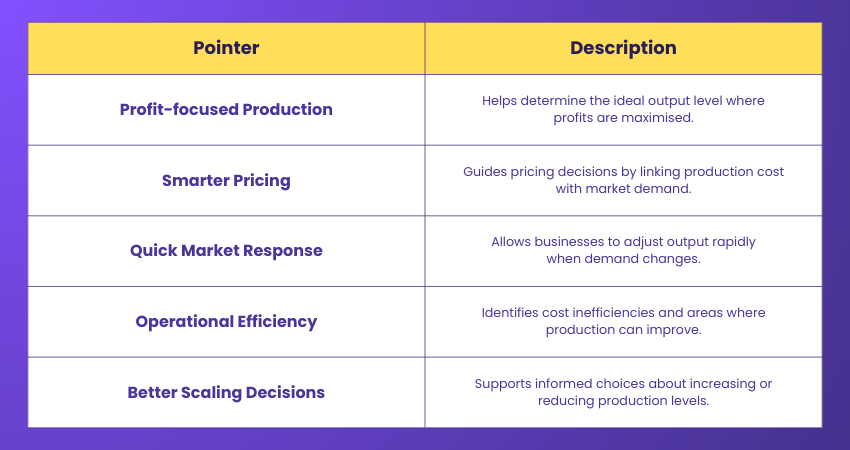
1) Marginal Cost helps optimise production by identifying the profit-maximising point (where Marginal Cost equals marginal revenue).
2) It guides effective pricing strategies based on production cost and market demand.
3) It enables businesses to respond promptly to market changes or shifts in customer demand.
4) It highlights inefficiencies in the production process, helping improve operations.
5) It supports data-driven decisions about scaling up or cutting back production.
But using Marginal Cost is not without its challenges. Here are the cons you must consider:
1) Marginal Costs can be complex to calculate, especially for businesses with many products or shared resources.
2) It assumes a smooth cost curve, which may not reflect actual stepwise cost changes.
3) It might ignore fixed costs or long-term goals if used alone for decision-making.
4) It is prone to frequent changes due to fluctuating raw material, labour, or technology costs.
5) It is not always reliable for long-term planning due to its sensitivity to cost changes.
Build sustainable business growth with the Business Sustainability Course – register today!
What Does Marginal Cost Depend on?
Here’s a summary of the factors that Marginal Cost depends on:

Conclusion
In conclusion, Marginal Cost is one of the important tools for businesses in production and pricing decisions as well as resource allocation. Once an organisation has identified production cost behaviour, it can manage its operations (and reduce prices) to improve profitability. Implementing Activity-based Costing can provide even more detailed insights into how production costs are generated, helping businesses make more strategic decisions. However, these are also real-world variables such as the demand in the market or fluctuation of cost. Marginal Cost Analysis leads businesses in aligning decisions with economic goals and market conditions, ensuring long-term operational viability.
Master the Numbers and Price with Precision! Sign up for our Costing and Pricing Training now!
Frequently Asked Questions
How Do You Find Marginal Cost?

To find out the Marginal Cost, you must utilise the standard formula, which is:
Marginal Cost = Change in Total Cost (ΔTC)/ Change in Quantity (ΔQ).
What is the Difference Between Marginal Cost and Average Cost?
Marginal Cost is the additional cost a business pays to produce one more unit, to help businesses decide if increasing output is profitable. In contrast, Average Cost refers to the total cost of production divided by the total number of units produced. It shows the overall cost efficiency of producing each unit.
What are the Other Resources and Offers Provided by The Knowledge Academy?
The Knowledge Academy takes global learning to new heights, offering over 3,000+ online courses across 490+ locations in 190+ countries. This expansive reach ensures accessibility and convenience for learners worldwide.
Alongside our diverse Online Course Catalogue, encompassing 19 major categories, we go the extra mile by providing a plethora of free educational Online Resources like Blogs, eBooks, Interview Questions and Videos. Tailoring learning experiences further, professionals can unlock greater value through a wide range of special discounts, seasonal deals, and Exclusive Offers.
What is The Knowledge Pass, and How Does it Work?
The Knowledge Academy’s Knowledge Pass, a prepaid voucher, adds another layer of flexibility, allowing course bookings over a 12-month period. Join us on a journey where education knows no bounds.
What are the Related Courses and Blogs Provided by The Knowledge Academy?
The Knowledge Academy offers various Management Courses, including the Costing and Pricing Training, Supplier Quality Management Training, and Business Sustainability Course. These courses cater to different skill levels, providing comprehensive insights into What is Price Skimming.
Our Business Skills Blogs cover a range of topics related to Marginal Cost, offering valuable resources, best practices, and industry insights. Whether you are a beginner or looking to advance your costing and pricing skills, The Knowledge Academy's diverse courses and informative blogs have got you covered.

Olivia Taylor


Chartered Accountant and Financial Training Specialist
Olivia Taylor is a qualified chartered accountant with over a decade of experience in financial management, auditing and corporate reporting. Having worked with leading firms in both the public and private sectors, Olivia brings clarity to complex financial topics. Her writing focuses on helping professionals build confidence in key areas of accounting, compliance and financial planning.
View Detail
Upcoming Accounting and Finance Resources Batches & Dates
Date
 Costing and Pricing Training
Costing and Pricing Training
Fri 15th May 2026
Costing and Pricing Training
Fri 17th Jul 2026
Costing and Pricing Training
Fri 25th Sep 2026

 If you wish to make any changes to your course, please


