


 Top Rated Course


We may not have the course you’re looking for. If you enquire or give us a call on +44 1344 203 999 and speak to our training experts, we may still be able to help with your training requirements.
What is SOX Compliance: A Guide to the Sarbanes-Oxley Act
Hailey Davis 25 February 2026SOX Compliance refers to adhering to the Sarbanes–Oxley Act, a U.S. regulation that improves corporate governance, financial transparency and internal controls. It helps prevent fraud, protect investors and ensure reliability of financial disclosures. It strengthens organisational accountability and promotes trust in financial reporting.

Training Outcomes Within Your Budget!
We ensure quality, budget-alignment, and timely delivery by our expert instructors.
Table of Contents
When major corporate scandals shook investor trust in the early 2000s, it served as a significant wake-up call in the realm of financial transparency. That's when the Sarbanes-Oxley Act (SOX) stepped in to restore order and trust in public companies. Essentially, SOX Compliance ensures that financial transparency isn't just a goal; it's a law. But exactly What is SOX Compliance, and what are its components?
This blog is here to answer these questions and more. It unpacks this financial rulebook, explores who must follow it, what it protects, and how it keeps businesses honest, accountable, and worthy of investor trust. So read on and learn What is SOX Compliance and how it shapes the way businesses operate in today’s accountability-driven landscape!
Table of Contents
1) What is SOX Compliance?
2) Why is SOX Compliance Important?
3) SOX Compliance Requirements
4) What are the Penalties for SOX Non-compliance?
5) The SOX Compliance Process
6) SOX Compliance Checklist
7) Who is Eligible for SOX Audit?
8) How Does the Sarbanes-Oxley Act Apply to Employee Protection for Filing a Claim?
9) Conclusion
What is SOX Compliance?
SOX Compliance refers to an organisation’s adherence to the Sarbanes–Oxley Act of 2002, a United States federal law to improve corporate accountability. It has been introduced to strengthen the accuracy of financial reporting, enhance information security and improve corporate governance to restore investor confidence.
SOX Compliance focuses on establishing strong internal control systems after major financial scandals involving some businesses. It requires companies to document and regularly test their internal controls and holds senior executives accountable for the accuracy of financial statements.
What is the Sarbanes-Oxley Act?
The Sarbanes–Oxley Act (SOX) is a U.S. federal law introduced in 2002 to strengthen the reliability of corporate financial reporting. It introduces strict standards for how companies document, store, and verify financial data, ensuring greater accountability throughout the organisation.
SOX also outlines specific requirements for Auditors, mandates stronger internal control frameworks, and sets penalties for any attempts to mislead shareholders or regulators. Its overall goal is to promote transparency, ethical business conduct, and improved governance within publicly traded companies.
Why is SOX Compliance Important?
Knowing What is SOX Compliance and following its rules are essential because it helps ensure the accuracy and integrity of a company’s financial reporting. Enforcing strong internal controls reduces the risk of fraud, mismanagement, and misleading financial statements. Here is a detailed look at its importance:

1) Boosts Investor Confidence
1) Increases investor willingness to support the company
2) People feel safer putting money into the business
3) The company looks more honest and transparent
4) Shows the company follows proper financial rules
5) Reduces the chances of unexpected financial problems
2) Reduces Fraud and Misconduct
1) Holds executives personally accountable for financial accuracy
2) Harder for anyone to cheat or hide information
3) Strong rules help spot fraudulent activities quickly
4) Reduces the chances of dishonest behavior
5) Makes everyone more accountable for their actions
3) Strengthens Data Security and Integrity
1) Protects financial data from being changed or misused
2) Only authorized people can access sensitive information
3) Alerts teams about unusual or risky activity
4) Helps prevent cyberattacks and data leaks
5) Keeps financial systems safe and monitored
4) Strengthens Corporate Governance
1) Improves how the company is managed and supervised
2) Encourages leaders to make responsible decisions
3) Makes roles and responsibilities clearer
4) Builds a culture of honesty and transparency
5) Enhances internal review and approval processes
5) Promotes Long-term Stability
1) Helps the company build a good reputation
2) Supports steady, sustainable growth
3) Reduces the risk of legal issues or fines
4) Keeps operations organized and consistent
5) Prepares the company for future compliance needs
Upgrade your internal controls and financial compliance with our Sarbanes-Oxley Certified Professional Training – Register today!
SOX Compliance Requirements
The Sarbanes-Oxley Act includes several sections that outline specific requirements for public companies. Let's explore those SOX Compliance requirements:
1) SOX 302
a) This section holds top executives (Chief Financial Officer (CFO), Chief Executive Officer (CEO), etc.) personally responsible for the accuracy and completeness of financial reports.
b) They must sign off on quarterly and annual reports, confirming that the statements are truthful and the company has proper internal controls in place.
c) If any false statements are found, these officers can face legal consequences.
2) SOX 401
a) SOX 401 helps make sure that financial statements give a full and fair picture of a company’s financial health.
b) Companies must prepare easy-to-understand reports that are free of misleading or hidden information.
c) This helps investors and the public make informed decisions based on transparent data.

3) SOX 404
a) This is one of the most demanding parts of SOX, Section 404.
b) It requires management as well as external Auditors to review and report on the company’s internal controls over financial reporting.
c) This involves verifying the systems used to ensure accurate reporting and identifying any potential weaknesses.
d) It helps prevent fraud and errors in financial statements.
4) SOX 409
a) In this section, companies must notify investors and regulators immediately of any big changes in their financial situation.
b) This could include anything from a drastic drop in earnings to a major lawsuit.
c) The aim here is to keep stakeholders updated with timely information.
5) SOX 802
a) SOX 802 makes it illegal to destroy, alter, or hide documents to obstruct a legal investigation.
b) This includes paper and electronic records.
c) The penalties may be severe, including fines and prison time, up to 20 years, for those found guilty of tampering with evidence.
6) SOX 806
a) This section protects employees who speak up against fraud or unethical practices.
b) It stops companies from firing, harassing, or punishing whistleblowers.
c) Additionally, employees who face retaliation can sue for damages.
d) SOX 806 encourages a culture of transparency and accountability within organizations.
7) SOX 906
a) This section requires CEOs and CFOs to certify the accuracy of financial reports.
b) The reports must comply with Securities and Exchange Commission (SEC) regulations.
c) Executives must make sure that the reports represent the company’s financial status as fairly as possible.
d) False certification can lead to legal penalties, including fines and imprisonment.
8) SOX 1107
a) SOX 1107 makes it a criminal offence to retaliate against whistleblowers.
b) It protects individuals who provide truthful information about potential federal crimes.
c) The law helps ensure informants feel safe reporting illegal activities.
d) It supports ethical reporting by discouraging threats, coercion, or unfair treatment.
Cutting corners isn’t an option in Healthcare! So, get sharp with medical compliance with our comprehensive Medical Compliance Training!
What are the Penalties for SOX Non-compliance?
Failure to comply with the Sarbanes–Oxley Act can lead to severe financial, legal, and reputational consequences for both organisations and individual executives. One of the most serious consequences is criminal liability for senior executives.
1) Executives (such as CEOs and CFOs) who knowingly submit reports that do not meet SOX requirements can face fines up to $1,000,000 and imprisonment for up to 10 years.
2) If executives willfully certify false or non-compliant financial reports, penalties can rise to fines up to $5,000,000 and imprisonment for up to 20 years.
3) Companies that fail to comply with SOX (e.g., by having inadequate internal controls or inaccurate financial reporting) may face substantial fines and sanctions.
Organisations may also face large financial fines, regulatory sanctions, and potential delisting from stock exchanges. Beyond legal penalties, organisations often suffer operational disruption, increased audit scrutiny, and higher compliance costs in the future.
The SOX Compliance Process
The SOX Compliance process is a systematic approach that companies follow to ensure adherence to the guidelines and regulations set forth by the Sarbanes-Oxley Act (SOX). Let's delve deeper into the steps involved in the SOX Compliance process and their significance:
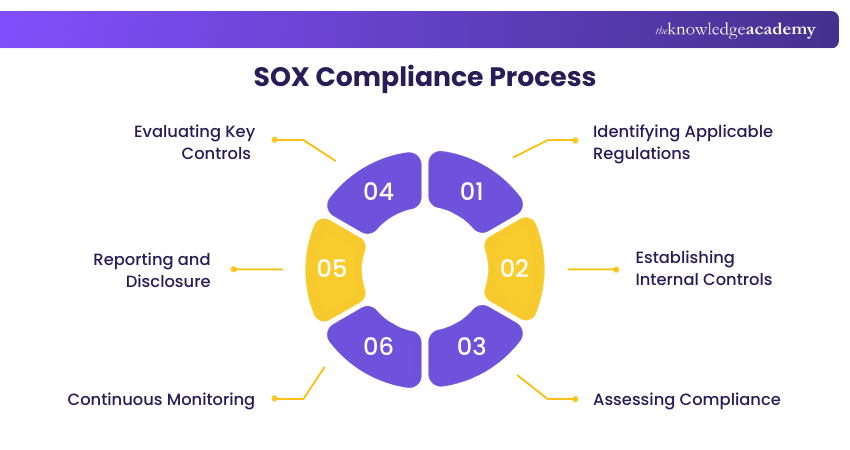
1) Identifying Applicable Regulations
The first step in the Sox Compliance process is to identify the regulations that apply to the company. This requires a comprehensive understanding of the business operations, industry-specific requirements, and any regulatory changes.
Identifying the applicable regulations helps companies determine the scope of their compliance efforts and establish a clear roadmap. It ensures that companies focus their resources and efforts on addressing the relevant regulatory requirements.
2) Establishing Internal Controls
Once the applicable regulations are identified, companies need to establish effective internal controls. Internal controls are the policies, procedures, and mechanisms put in place to oversee accurate financial reporting, prevent fraud, and safeguard company assets.
Companies must design and implement control activities such as segregation of duties, access controls, and regular reviews to mitigate the risk of errors, irregularities, and fraudulent activities. Strong internal controls provide assurance that financial information is reliable, accurate, and compliant with SOX regulations.
3) Assessing Compliance
Regular assessments are conducted to evaluate the company's compliance with SOX regulations. This involves conducting internal audits, reviewing financial statements, and performing testing to identify any areas of non-compliance or weaknesses in internal controls.
Compliance assessments provide insights into the effectiveness of internal controls, identify gaps or deficiencies, and highlight areas for improvement. By conducting thorough assessments, companies can take corrective actions to address every identified issue and improve their SOX Compliance efforts.

4) Evaluating Key Controls
This stage involves checking the most important financial and security processes within an organization to ensure they function as intended. These controls often include access permissions, data protection measures, approval workflows, and automated system checks.
By reviewing What is SOX Compliance and how these controls operate in real situations, companies can identify weaknesses, errors, or gaps that might put financial data at risk. This testing is a crucial part of SOX compliance because it verifies that financial systems remain accurate, secure, and trustworthy.
5) Reporting and Disclosure
Sox Compliance requires companies to disclose their financial information accurately and in a timely manner. This includes filing periodic reports with regulatory authorities, such as the Securities and Exchange Commission (SEC), and making public disclosures as mandated by SOX regulations.
Companies must make sure that their financial statements and disclosures are transparent, complete, and in compliance with SOX guidelines. Accurate reporting and timely disclosure of financial information promote transparency, enable stakeholders to make informed decisions, and maintain trust in the company's financial reporting practices.
6) Continuous Monitoring
Achieving SOX Compliance is not a one-time event but an ongoing process. Continuous monitoring is crucial to ensure that companies maintain compliance with SOX regulations over time. This involves regular reviews, internal audits, and assessments to monitor the effectiveness of internal controls, identify changes in regulations, and assess any evolving risks.
Continuous monitoring allows companies to promptly address any gaps or changes in the regulatory landscape, ensuring that their SOX Compliance efforts remain up to date and effective.
Set the benchmark for compliance excellence with our comprehensive ISO 37301 Compliance Management Systems Lead Auditor Training - Register now!
SOX Compliance Checklist
The following SOX Audit checklist will help tend to the main areas when designing controls:
1) Breaches:
a) Can you detect security breaches like ransomware or phishing?
b) Do you have a response team and tools in place to detect breaches in your database, website, or storage?
2) Storage:
a) Is your data stored in the cloud?
b) SOX requires data to be encrypted, searchable, and easily retrievable. Data centers must follow SOX rules, and storage times vary depending on the type of data.
3) Access:
a) Who can access your data?
b) Are users given unique logins?
c) Can the activity be traced to specific users?
d) Do you remove access when someone leaves or changes roles?
e) Are access logs tracked, like in an Enterprise Resource Planning (ERP) system?
4) Reporting:
a) Just like financial records, data security logs must be automatic, verifiable, and secure.
b) Do you use tools that log activity, protect those logs, and make them easy to search?
5) Incident Management:
a) When a security issue is logged, does your system create a support ticket to track and resolve it?
6) Segregation of Duties:
a) Make sure no one person has control over all parts of a task (e.g., ordering and receiving inventory).
b) Train staff on SOX and prevent fraud by clearly separating roles.
7) Audit Trail:
a) Do your systems keep real-time records of user actions with timestamps?
8) Backup Systems:
a) Do you regularly back up data and test those backups?
b) Are backups protected from tampering and properly documented?
Make sure compliance becomes a culture for sustainable business success! Sign up for our Effective Compliance Training now!
Who is Eligible for SOX Audit?
SOX auditing is required for all publicly traded companies, including:
1) Public companies listed on the U.S. stock exchanges.
2) Foreign companies listed in the U.S., follow the same standards.
3) Large private companies preparing for an IPO.
4) Subsidiaries of public companies if their finances impact the parent’s reports.
How Does the Sarbanes-Oxley Act Apply to Employee Protection for Filing a Claim?
The Sarbanes–Oxley Act protects employees who report fraud, financial misconduct, or violations of federal securities laws. Under SOX Compliance Section 806, employees of publicly traded companies are legally protected from any retaliation when they file a complaint, assist in an investigation, or provide information about suspected wrongdoing.
Employers are prohibited from firing, demoting, harassing, threatening, or discriminating against an employee for speaking up. If an employee experiences retaliation after filing a claim, they have the right to submit a complaint to the U.S. Department of Labor. The protections encourage transparency by ensuring employees can report unethical or illegal conduct without fear of punishment.
Conclusion
SOX Compliance is about building trust, ensuring transparency, and protecting stakeholders from any form of financial misconduct. By understanding What is SOX Compliance and its rules, you can strengthen your company's internal controls, improve accountability and renew investor confidence. Ultimately, it creates a culture of ethical responsibility and long-term financial integrity within the organisation.
Shape the future of ethical leadership by gaining a firm grasp on corporate governance! Sign up for our Corporate Governance Training now!
Frequently Asked Questions
What is the Difference Between SOX and SOC?

Enforced by the U.S. Securities and Exchange Commission (SEC), SOX is a mandatory government standard. At the same time, Service Organization Control (SOC) is a voluntary form of security self-regulation, which is enforced and overseen by non-government entities.
How to be SOX Compliant?
To be SOX compliant, public companies must implement internal controls to shield financial data from tampering and pass an annual independent audit of their financial controls and statements.
What are the Other Resources and Offers Provided by The Knowledge Academy?
The Knowledge Academy takes global learning to new heights, offering over 3,000 online courses across 490+ locations in 190+ countries. This expansive reach ensures accessibility and convenience for learners worldwide.
Alongside our diverse Online Course Catalogue, encompassing 17 major categories, we go the extra mile by providing a plethora of free educational Online Resources like Blogs, eBooks, Interview Questions and Videos. Tailoring learning experiences further, professionals can unlock greater value through a wide range of special discounts, seasonal deals, and Exclusive Offers.
What is The Knowledge Pass, and How Does it Work?
The Knowledge Academy’s Knowledge Pass, a prepaid voucher, adds another layer of flexibility, allowing course bookings over a 12-month period. Join us on a journey where education knows no bounds.
What are the Related Courses and Blogs Provided by The Knowledge Academy?
The Knowledge Academy offers various Sarbanes-Oxley Training, including the Sarbanes-Oxley Certified Professional Training. This course cater to different skill levels, providing comprehensive insights into Compliance.
Our ISO & Compliance Blogs cover a range of topics related to SOX Compliance, offering valuable resources, best practices, and industry insights. Whether you are a beginner or looking to advance your ISO and compliance expertise, The Knowledge Academy's diverse courses and informative blogs have got you covered.

Hailey Davis


Compliance Officer
Hailey Davis is an ISO compliance expert with over 10 years of experience in audit, quality management systems (QMS), and regulatory compliance. She has worked with various industries, including manufacturing, healthcare, and technology, ensuring organisations achieve and maintain ISO certifications. Hailey’s content provides practical, actionable insights on navigating compliance challenges and improving business processes.
View Detail

 If you wish to make any changes to your course, please


